Is MicroStrategy Selling Bitcoin Not a Bearish Signal? Deconstructing the 5 Financial Logics Behind Corporate Bitcoin Divestment

marsbitPublished on 2026-05-23Last updated on 2026-05-23

Abstract

The article "Is Strategy Selling Bitcoin Not a Bearish Signal? Decoding 5 Financial Logics Behind Corporate Bitcoin Divestment" analyzes why companies might sell their bitcoin holdings, arguing it's not necessarily negative. It begins by noting the market's surprise at Strategy's potential sale, contrasting its previous "never sell" stance. The core argument is that corporate decisions prioritize shareholder value, and selling bitcoin can be a rational strategic choice. The article outlines five key financial reasons for such sales: 1. **Increase Bitcoin Holdings Per Share:** Companies can use proceeds from bitcoin sales to repurchase shares when the stock price is undervalued relative to its bitcoin assets. This reduces the outstanding share count, potentially increasing the bitcoin amount backing each remaining share. 2. **Optimize Capital Structure & Reduce Financing Costs:** Building cash reserves through bitcoin sales can improve credit ratings (as favored by agencies like S&P), leading to lower future borrowing costs. Repaying debt with sale proceeds also reduces financial leverage. 3. **Legitimate Tax Planning:** In the absence of wash-sale rules for bitcoin in the US, companies can sell to realize capital losses, then repurchase, lowering the tax basis of their holdings and creating tax offsets. 4. **Counter Negative Market Narratives:** A controlled, non-disruptive sale could demonstrate market resilience and disprove fears that corporate selling would crash the...

Written by: Allard Peng

Compiled by: Saoirse, Foresight News

Recently, MicroStrategy's announcement that it may sell some Bitcoin to achieve operational goals has caused a stir in the market. The company had previously maintained a firm stance of never selling its Bitcoin holdings, with Michael Saylor even jokingly posting that he would rather sell assets than part with Bitcoin.

In reality, for companies holding Bitcoin reserves, selling is always an operational option. "Never selling" merely reflects a long-term investment philosophy, aligning with the prevalent long-term thinking in the crypto space. Even though the market generally advocates for hodling, selling Bitcoin remains a reasonable choice in numerous scenarios.

On a personal level, selling Bitcoin is often for lifestyle improvements, such as purchasing property, travel, children's education, or covering large, unexpected medical expenses. For corporations, however, the core tenet guiding all operational decisions is the enhancement of shareholder equity.

In the first quarter of 2026, Bitcoin miners sold a total of 25,376 Bitcoin, using the proceeds to pivot towards artificial intelligence (AI) businesses. Management deemed the risk-reward profile of AI projects more favorable than holding Bitcoin. This leads to a fundamental logic: when higher-return investment opportunities exist, selling Bitcoin to reallocate assets is rational. For hodling companies like MicroStrategy, selling Bitcoin can also create tangible value, specifically for five reasons.

Reason One: Increase Bitcoin Held Per Share

The amount of Bitcoin held per share is the core operational objective for companies with reserve assets. Periodic growth in this metric represents the Bitcoin yield rate. The conventional method is to purchase more Bitcoin to increase the total holdings; another approach is to buy back shares to reduce the number of shares outstanding. Both methods can push up the Bitcoin-per-share figure.

If a company's stock price is lower than its corresponding Bitcoin asset value, selling Bitcoin to repurchase shares can ultimately increase the Bitcoin held per share. The decline in total Bitcoin holdings would be smaller than the reduction in shares outstanding. When a company's operating cash flow cannot cover fixed expenditures like preferred stock dividends or bond interest, and the stock price is undervalued, selling Bitcoin to service debt and pay dividends can minimize the erosion of Bitcoin per share.

Reason Two: Optimize Capital Structure, Lower Financing Costs

Credit rating agencies significantly influence capital market flows. Adhering to their assessment criteria can help companies secure financing smoothly. Previous reports have analyzed viable ways to improve credit ratings, as a strong rating can effectively lower a company's financing costs.

Standard & Poor's (S&P) recognizes the value of cash reserves. MicroStrategy adopted this strategy accordingly. As of January 2026, the company's cash reserve reached $2.2 billion, substantially alleviating investor concerns about its ability to pay preferred stock dividends.

A company can sell Bitcoin to bolster cash reserves, meeting capital market demands and subsequently issuing bonds at a lower cost. Simultaneously, selling Bitcoin to repay debt can reduce senior liabilities, enhancing the appeal of preferred stock for financing.

In the long run, differences in financing rates widen through the effect of compound interest. Low-cost debt can reduce burdens and increase profits for business operations.

Reason Three: Legal Tax Planning

Currently, the U.S. has no wash-sale restrictions for Bitcoin. Companies can sell Bitcoin to realize a book loss, then repurchase it, lowering the asset's tax cost basis to offset tax liabilities. MicroStrategy employed this tactic during the market downturn in 2022.

This tax incentive remains effective. Companies can combine loss-harvesting for tax benefits with simultaneous share buybacks, debt repayment, or other operations to achieve multiple benefits.

Reason Four: Counter Negative Market Sentiment

The Bitcoin industry is relatively young, and various negative rumors persist. Unfounded claims suggest that if MicroStrategy sells Bitcoin, it would directly impact the entire crypto market, undermining the company's operational model of hodling.

If a company sells, for example, 50,000 Bitcoin and neither the market price nor its own stock price experiences significant volatility, it could shatter such rumors. This would help the capital market accept the business model of companies holding Bitcoin as a reserve asset.

The market possesses self-regulating capabilities. Sensationalism is often the domain of media and influencers. Professional investment institutions base decisions on actual research and are not swayed by one-sided narratives. This is the most subjective reason among the five.

Reason Five: Repurchase Preferred Stock at a Discount

This operational strategy is less discussed. When the price of a floating-rate financial instrument significantly deviates from its face value, a company can repurchase it at a price far below par, settling high-cost debt.

This operation is equivalent to closing out a short position on its own preferred stock without interest or borrowing costs. Taking the STR-C product as an example, issued with a face value of $100, if the price falls to $82, the company can use funds from selling Bitcoin to repurchase shares at this low price, earning a $18 difference per share. This gain is typically tax-free.
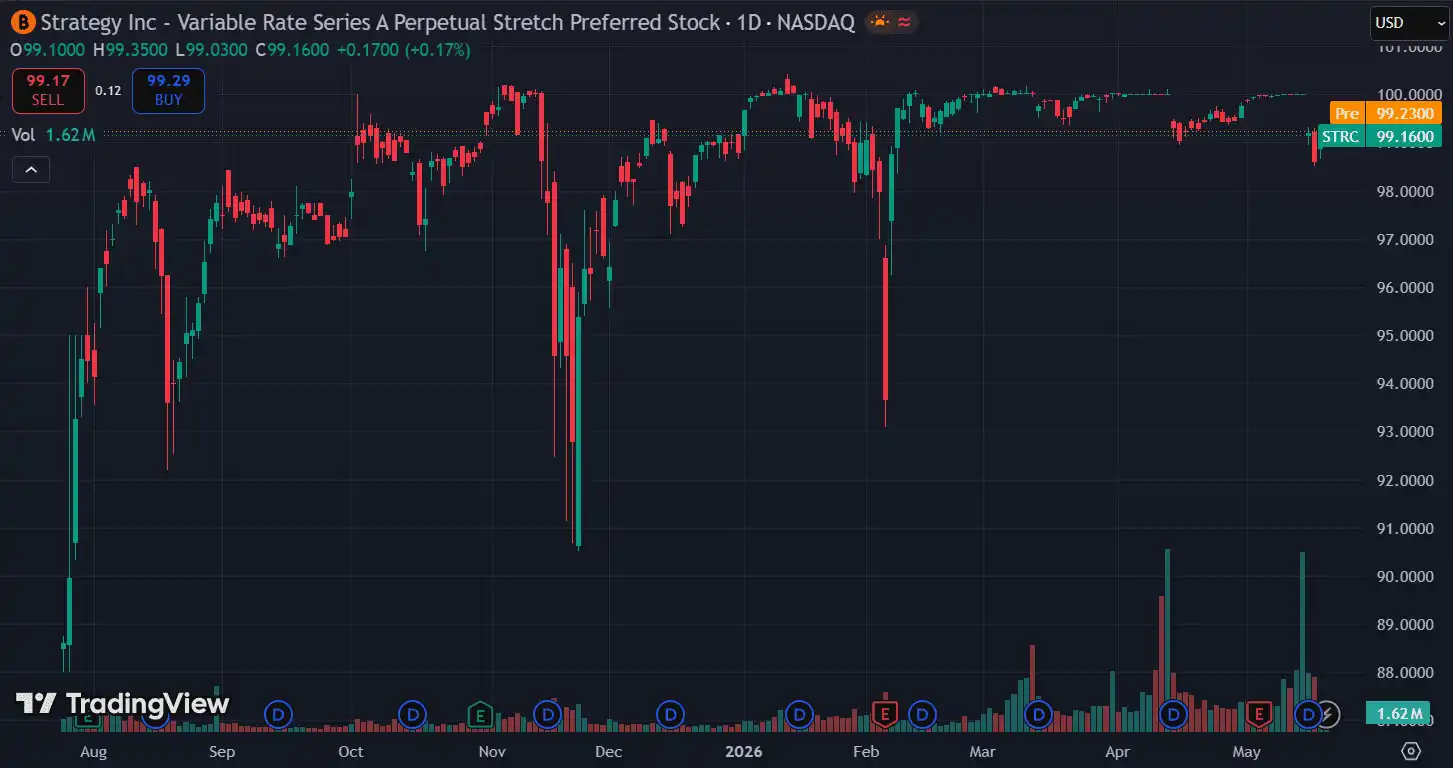
Price trend of STR-C since its initial public offering

A drop in preferred stock price does not necessarily coincide with a Bitcoin market crash. Leveraged trading can easily trigger chain reactions of selling. Companies can seize the opportunity to buy back shares at low prices, avoiding future funding drains from potential dividend rate increases.

Conclusion

A company selling Bitcoin should not automatically be viewed as a bearish signal. In many scenarios, divesting Bitcoin safeguards the interests of the company and its shareholders. Bitcoin possesses monetary attributes, providing companies with flexible capital allocation options. Utilizing assets rationally unlocks their maximum value.


Related Questions

QWhat are the five financial reasons discussed for a company like Strategy selling its bitcoin holdings?

AThe five reasons are: 1. To increase the amount of bitcoin held per share. 2. To optimize capital structure and lower financing costs. 3. For legal tax planning, such as tax-loss harvesting. 4. To dispel negative market narratives about the company's bitcoin strategy. 5. To repurchase discounted preferred stock at a profit.

QAccording to the article, why is selling bitcoin considered a reasonable business decision in certain contexts?

ASelling bitcoin is considered reasonable because the core objective of all corporate decisions is to enhance shareholder value. If alternative investments (like AI projects) offer a better risk-reward profile, or if selling can optimize financial metrics, it aligns with sound business strategy, even for long-term bitcoin holders.

QHow can selling bitcoin potentially increase a company's 'bitcoin per share' metric?

AIt can increase if the company uses the proceeds from the bitcoin sale to repurchase its own stock when the stock price is below the net asset value of its bitcoin holdings. This reduces the number of shares outstanding. The percentage decrease in total bitcoin holdings would be smaller than the percentage decrease in shares, resulting in a higher bitcoin-per-share ratio.

QWhat specific tax advantage in the US does the article mention that companies can utilize by selling bitcoin?

AThe article mentions that US companies can engage in tax-loss harvesting with bitcoin due to the absence of a wash-sale rule. A company can sell bitcoin to realize a capital loss, use that loss to offset taxes, and then repurchase bitcoin to reset the cost basis for the asset.

QWhat is the fifth reason given for selling bitcoin, and how does it create value for the company?

AThe fifth reason is to repurchase discounted preferred stock. If a company's preferred stock trades significantly below its face value, the company can sell bitcoin and use the cash to buy back these shares at the lower market price. This cancels high-cost liabilities and generates a tax-free profit equal to the difference between the face value and the repurchase price.

Related Reads

DeepSeek Announces Permanent Price Cut, But Liang Wenfeng Is Not Trying to Be a "Cyber Bodhisattva"

DeepSeek has announced a permanent 75% discount on its V4-Pro API, significantly reducing its token prices. This move stands out as a major industry-wide price cut while competitors like Anthropic, OpenAI, and Google have been quietly raising theirs. The article contrasts this strategy with the broader trend of AI becoming more expensive, citing examples of companies like Microsoft and Uber struggling with high token costs as usage soars. While CEO Liang Wenfeng is hailed by some as a "Cyber Bodhisattva" for this普惠 approach, the article argues this is a strategic business choice, not mere altruism. DeepSeek's ability to maintain low prices is attributed to several structural advantages: lower-cost AI talent in China, the impending use of domestic昇腾 hardware for further cost reductions, and, most critically, access to China's cheaper and more abundant energy infrastructure, which drastically reduces the electricity costs dominating AI operations. The analysis suggests that for many commercial applications, a "good enough" model that is radically cheaper (e.g., 1% to 11% of GPT-5.5's cost) is more valuable than the absolute top-tier model. This allows for vastly more experimentation and iteration within a budget. Therefore, as AI generally becomes more expensive, DeepSeek's cost-competitiveness—rooted in China's energy and talent advantages—becomes its core strategic value and differentiator in the global market.

marsbit5h ago

DeepSeek Announces Permanent Price Cut, But Liang Wenfeng Is Not Trying to Be a "Cyber Bodhisattva"

marsbit5h ago

The Veil of Mythos Becomes Anthropic's Lever to Move Trillions

The article discusses Anthropic's reported upcoming $30 billion funding round, which would value the company at over $900 billion. It analyzes how the company has leveraged strategic narratives around its unreleased "Mythos" model, rather than just its publicly available products, to drive this massive valuation. Key points include Google's surprising $40 billion investment in a competitor, suggesting it is buying strategic positioning. Anthropic's "Glasswing" cybersecurity project and the unreleased Mythos model are portrayed not through direct proof, but through carefully crafted narratives of being "too powerful for public release," creating an aura of exclusive, high-level capability. This is bolstered by reports of the White House and NSA seeking access to Claude/Mythos despite previous security concerns, implying indispensable technology. Furthermore, Anthropic's reported rapid revenue growth—from a $1 billion annual run-rate in late 2024 to over $30 billion by April 2026, largely driven by enterprise API and Claude Code—provides a financial story for investors. The article concludes that Anthropic's core business model is effectively converting unverifiable technical potential, government interest, and future revenue projections into a compelling narrative that secures immense capital, using the actions of wealthy investors and powerful institutions as the ultimate validation of its worth.

marsbit7h ago

The Veil of Mythos Becomes Anthropic's Lever to Move Trillions

marsbit7h ago

Trading

Spot
Futures

Hot Articles

What is $BITCOIN

DIGITAL GOLD ($BITCOIN): A Comprehensive Analysis Introduction to DIGITAL GOLD ($BITCOIN) DIGITAL GOLD ($BITCOIN) is a blockchain-based project operating on the Solana network, which aims to combine the characteristics of traditional precious metals with the innovation of decentralized technologies. While it shares a name with Bitcoin, often referred to as “digital gold” due to its perception as a store of value, DIGITAL GOLD is a separate token designed to create a unique ecosystem within the Web3 landscape. Its goal is to position itself as a viable alternative digital asset, although specifics regarding its applications and functionalities are still developing. What is DIGITAL GOLD ($BITCOIN)? DIGITAL GOLD ($BITCOIN) is a cryptocurrency token explicitly designed for use on the Solana blockchain. In contrast to Bitcoin, which provides a widely recognized value storage role, this token appears to focus on broader applications and characteristics. Notable aspects include: Blockchain Infrastructure: The token is built on the Solana blockchain, known for its capacity to handle high-speed and low-cost transactions. Supply Dynamics: DIGITAL GOLD has a maximum supply capped at 100 quadrillion tokens (100P $BITCOIN), although details regarding its circulating supply are currently undisclosed. Utility: While precise functionalities are not explicitly outlined, there are indications that the token could be utilized for various applications, potentially involving decentralized applications (dApps) or asset tokenization strategies. Who is the Creator of DIGITAL GOLD ($BITCOIN)? At present, the identity of the creators and development team behind DIGITAL GOLD ($BITCOIN) remains unknown. This situation is typical among many innovative projects within the blockchain space, particularly those aligning with decentralized finance and meme coin phenomena. While such anonymity may foster a community-driven culture, it intensifies concerns about governance and accountability. Who are the Investors of DIGITAL GOLD ($BITCOIN)? The available information indicates that DIGITAL GOLD ($BITCOIN) does not have any known institutional backers or prominent venture capital investments. The project seems to operate on a peer-to-peer model focused on community support and adoption rather than traditional funding routes. Its activity and liquidity are primarily situated on decentralized exchanges (DEXs), such as PumpSwap, rather than established centralized trading platforms, further highlighting its grassroots approach. How DIGITAL GOLD ($BITCOIN) Works The operational mechanics of DIGITAL GOLD ($BITCOIN) can be elaborated on based on its blockchain design and network attributes: Consensus Mechanism: By leveraging Solana’s unique proof-of-history (PoH) combined with a proof-of-stake (PoS) model, the project ensures efficient transaction validation contributing to the network's high performance. Tokenomics: While specific deflationary mechanisms have not been extensively detailed, the vast maximum token supply implies that it may cater to microtransactions or niche use cases that are still to be defined. Interoperability: There exists the potential for integration with Solana’s broader ecosystem, including various decentralized finance (DeFi) platforms. However, the details regarding specific integrations remain unspecified. Timeline of Key Events Here is a timeline that highlights significant milestones concerning DIGITAL GOLD ($BITCOIN): 2023: The initial deployment of the token occurs on the Solana blockchain, marked by its contract address. 2024: DIGITAL GOLD gains visibility as it becomes available for trading on decentralized exchanges like PumpSwap, allowing users to trade it against SOL. 2025: The project witnesses sporadic trading activity and potential interest in community-led engagements, although no noteworthy partnerships or technical advancements have been documented as of yet. Critical Analysis Strengths Scalability: The underlying Solana infrastructure supports high transaction volumes, which could enhance the utility of $BITCOIN in various transaction scenarios. Accessibility: The potential low trading price per token could attract retail investors, facilitating wider participation due to fractional ownership opportunities. Risks Lack of Transparency: The absence of publicly known backers, developers, or an audit process may yield skepticism regarding the project's sustainability and trustworthiness. Market Volatility: The trading activity is heavily reliant on speculative behavior, which can result in significant price volatility and uncertainty for investors. Conclusion DIGITAL GOLD ($BITCOIN) emerges as an intriguing yet ambiguous project within the rapidly evolving Solana ecosystem. While it attempts to leverage the “digital gold” narrative, its departure from Bitcoin's established role as a store of value underscores the need for a clearer differentiation of its intended utility and governance structure. Future acceptance and adoption will likely depend on addressing the current opacity and defining its operational and economic strategies more explicitly. Note: This report encompasses synthesised information available as of October 2023, and developments may have transpired beyond the research period.

363 Total ViewsPublished 2025.05.13Updated 2025.05.13

What is $BITCOIN

Discussions

Welcome to the HTX Community. Here, you can stay informed about the latest platform developments and gain access to professional market insights. Users' opinions on the price of BTC (BTC) are presented below.

活动图片














