Is Cardano Over? Charles Hoskinson Warns Of A “Wave Of Failures” — And His Own Community Is Furious

bitcoinistPublished on 2026-06-04Last updated on 2026-06-04

Abstract

Cardano co-founder Charles Hoskinson has issued a severe warning, predicting a "wave of failures," forced consolidation, and DeFi shutdowns across the Cardano ecosystem in the second half of 2026. His comments followed the sudden shutdown announcement of TapTools, a major analytics and infrastructure platform for Cardano, citing unsustainable costs. Hoskinson framed this not as an isolated incident but a sign of deeper ecosystem stress, acknowledging that a proposed treasury-funded index to support projects never materialized. He subsequently announced he was "taking a break." The crypto community reacted with strong criticism. Prominent figures accused Hoskinson of overselling Cardano's potential and failing to deliver on promises, leaving investors to suffer. The ecosystem faces significant challenges: Cardano's Total Value Locked (TVL) ranks only 28th, its 2026 summit was canceled, engineering funding was slashed, and ADA's price has fallen below $0.20 for the first time in over five years. Hoskinson's own bleak assessment raises fundamental questions about Cardano's ability to reverse its current trajectory.

Charles Hoskinson, co-founder of Cardano and Input Output Global, sparked one of the most uncomfortable public debates in the blockchain’s history this week — warning in a video posted on YouTube that the second half of 2026 will bring a wave of project failures, forced consolidation, and DeFi shutdowns across the ecosystem, as ADA fell below $0.20 for the first time in more than five years.

The catalyst was the June 2 announcement by TapTools — Cardano’s most widely used analytics and infrastructure platform, serving over one million users and powering backend data for hundreds of Cardano-native token protocols across four years — that it will wind down operations within two weeks.

The closure follows the departure of five senior team members including both co-founders, the COO, the CTO, and a backend developer who had stepped into technical leadership after the founders left, per TapTools’ official statement. Infrastructure costs, software development expenses, and support obligations had become impossible to sustain, the company said. TapTools added it remains open to acquisition discussions.
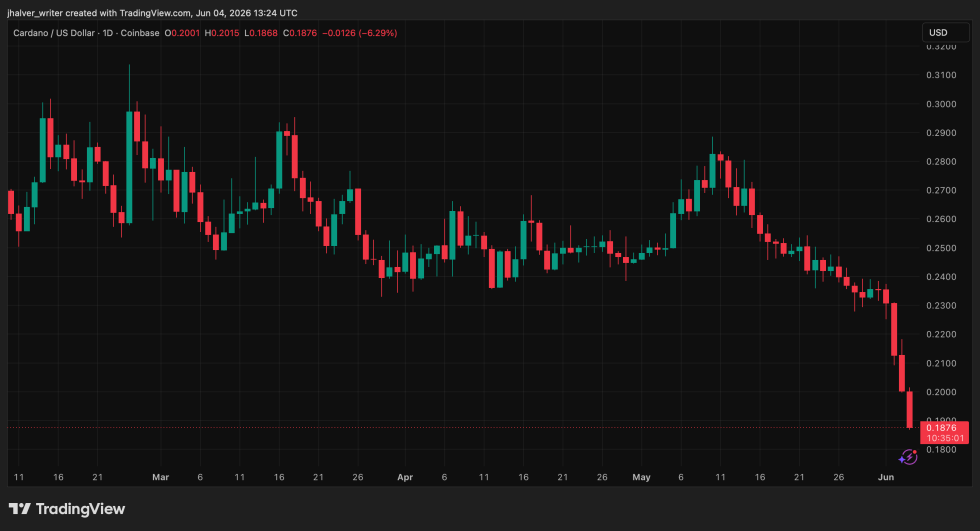
ADA's price trends to the downside on the daily chart. Source: ADAUSD on Tradingview

Hoskinson’s Warning — And The ADA Fallout

Responding in a video on the same day, Hoskinson framed TapTools’ exit not as an isolated event but as a leading indicator of deeper ecosystem stress. A substantial portion of older Cardano projects are no longer in an investable state, he said — and the H2 2026 environment will force many into the same position.

He pointed to JX Door’s earlier collapse as a warning sign that went unheeded, and acknowledged that a treasury-funded index he had proposed to backstop struggling ecosystem projects never materialized. “I came up with the plan of an index. It did not get executed,” he said in the video, per the YouTube posting, placing partial responsibility on Cardano’s governance community for failing to act when opportunities were available.

Hoskinson subsequently posted on X that he is “taking a break” — three words that landed heavily given the timing.

The Community Fires Back

The response from prominent voices in the crypto community was swift and pointed. Andreas Svanevik (@ASvanevik), CEO of Nansen, addressed Hoskinson’s implicit question about what he could do to help directly: “It’s not about what he can do NOW,” Svanevik wrote on X. “The problem is he sold Cardano as something it never was. And people believed him. Now they will all suffer the consequences together.”

The post drew significant engagement and amplified a sentiment that had been building in the community for months — that Hoskinson’s long-standing promises about Cardano’s institutional potential and developer adoption had set expectations the network could not match. @Pledditor’s post on X added further community context to the criticism, reflecting frustration that had been building across ADA holders as the ecosystem continued to lose ground.

The Structural Picture

The numbers behind the debate are difficult to argue with. Cardano’s total value locked stands at approximately $123.85 million — placing it 28th by chain TVL on DeFiLlama, behind Stellar, NEAR, Aptos, and Mantle, and roughly two orders of magnitude below Ethereum’s $39.9 billion.

The 2026 Cardano Summit was canceled after the community voted down treasury funding. Engineering proposals for 2026 were cut to $46.8 million from $97.5 million the prior year. The van Rossem hard fork was postponed to allow further testing. ADA is currently trading at approximately $0.20 — its lowest level in more than five years.

The question Hoskinson’s own comments raise — whether Cardano can reverse a trajectory that its own founder is now publicly describing in near-apocalyptic terms — is one the ecosystem has no clean answer to heading into what he himself calls the hardest half of the year.

Cover image from Grok, ADAUSD chart from Tradingview

Trending Cryptos

Related Questions

QWhat specific event did Charles Hoskinson cite as a catalyst for his warning about Cardano's ecosystem, and what was its impact?

AThe catalyst was the announcement by TapTools, Cardano's most widely used analytics and infrastructure platform, that it would wind down operations within two weeks. This event signaled deeper ecosystem stress to Hoskinson, contributing to his warning about a coming wave of project failures.

QHow did prominent voices in the crypto community, like Andreas Svanevik, respond to Hoskinson's warning and his role in Cardano's situation?

AAndreas Svanevik, CEO of Nansen, responded critically on X. He argued that the problem stemmed from Hoskinson selling Cardano as something it never was, setting unrealistic expectations about its institutional potential and developer adoption that the network failed to meet.

QWhat are some key metrics mentioned in the article that illustrate Cardano's current challenges in the broader blockchain landscape?

AKey metrics include Cardano's Total Value Locked (TVL) of approximately $123.85 million, ranking 28th among chains, and ADA's price falling below $0.20 for the first time in over five years. The article also notes the 2026 Cardano Summit was canceled and engineering proposals were significantly cut from $97.5 million to $46.8 million.

QWhat internal failure did Hoskinson acknowledge regarding a proposed plan to support struggling Cardano projects?

AHoskinson acknowledged that a treasury-funded index he had proposed to backstop struggling ecosystem projects never materialized. He stated, 'I came up with the plan of an index. It did not get executed,' placing partial responsibility on Cardano's governance community for failing to act.

QWhat major implication does Charles Hoskinson's warning raise for the future of the Cardano ecosystem according to the article's conclusion?

AHoskinson's warning raises the question of whether Cardano can reverse its current negative trajectory, which he himself describes in near-apocalyptic terms. The ecosystem faces this challenge heading into what he calls the hardest half of the year (H2 2026), with no clear answer provided.

Related Reads

The Verdict in Choi Tae-won's Divorce Case: Revealing the Inheritance Undercurrent Behind SK Hynix's Trillion-Won Empire

SK Group Chairman Chey Tae-won's high-profile divorce case, involving a record 1.38 trillion won settlement, has drawn attention to the succession plans for Korea's second-largest conglomerate, especially its crown jewel, SK hynix. Unlike traditional chaebol scripts centered on the eldest son, Chey's three children from his marriage to former President Roh Tae-woo's daughter, Roh Soh-yeong, are carving distinct, non-traditional paths. Eldest daughter Chey Yun-jung (b. 1989) is seen as the most evident successor. With a scientific and consulting background, she holds executive roles at SK bioscience and SK Inc.'s growth support department, focusing on future strategy and biopharma. Her marriage is to an AI infrastructure entrepreneur, not a traditional business alliance. Second daughter Chey Min-jung (b. 1991) took a unique route, voluntarily serving as a South Korean naval officer, including an anti-piracy deployment. She later worked on policy and strategy for SK hynix in Washington D.C. before co-founding an AI-driven healthcare startup. She married a former U.S. Marine Corps officer, connecting her to U.S. defense and policy circles—networks crucial for a global semiconductor giant. The only son, Chey In-geun (b. 1995), who studied physics like his father, worked briefly at SK E&S before joining McKinsey. Despite fitting the traditional "heir" profile as the eldest son, he remains silent and holds no public position or shares in SK, suggesting the old succession playbook is obsolete. As SK hynix's valuation soars, becoming a geopolitical asset in the AI era, the heirs' legitimacy is no longer automatic. They must prove themselves in fields like AI biotech, global policy, and strategic consulting. Their marriages also reflect new elite networks in tech and defense, not old political alliances. Their inheritance is the complex challenge of navigating a globalized, tech-driven world, not just a corporate throne.

marsbit2h ago

The Verdict in Choi Tae-won's Divorce Case: Revealing the Inheritance Undercurrent Behind SK Hynix's Trillion-Won Empire

marsbit2h ago

From OpenSea to OpenRouter: Is Alex Atallah Repeating His 'Exit at the Peak' Playbook?

From OpenSea to OpenRouter: Is Alex Atallah Repeating His "Exit at the Peak" Playbook? According to the Wall Street Journal, payments giant Stripe is in talks to acquire the AI model aggregation platform OpenRouter in a potential deal valuing the company near $100 billion. This would mark founder Alex Atallah's second creation of a company reaching a $100 billion valuation, following his co-founding of NFT marketplace OpenSea. OpenRouter, founded just over three years ago, has grown rapidly by acting as a unified gateway for developers to access over 400 AI models. It currently has about 10 million users and processes over 200 trillion tokens monthly. While the platform's annualized revenue is around $50 million, its valuation has skyrocketed from $1.3 billion in March 2026. The potential acquisition by Stripe, a company OpenRouter's founder once likened it to, represents a major expansion into AI infrastructure for the payments leader. This move echoes Atallah's previous timing with OpenSea, where he departed before the NFT market's significant downturn. For OpenRouter, selling now may be strategic. Despite its scale, its business model—charging a 5-5.5% fee on AI inference calls—faces pressure from competition, open-source models, and potential price wars among model providers, limiting its profitability narrative for an IPO. A key asset for potential acquirers like Stripe is OpenRouter's vast repository of real-world AI usage data, which offers unique insights into model performance and developer preferences that are difficult to replicate. Whether this potential deal signifies a new valuation benchmark for AI infrastructure or another market peak signal remains to be seen.

链捕手3h ago

From OpenSea to OpenRouter: Is Alex Atallah Repeating His 'Exit at the Peak' Playbook?

链捕手3h ago

Trading

Spot

Hot Articles

Discussions

Welcome to the HTX Community. Here, you can stay informed about the latest platform developments and gain access to professional market insights. Users' opinions on the price of ADA (ADA) are presented below.

活动图片