Is Cardano Over? Charles Hoskinson Warns Of A “Wave Of Failures” — And His Own Community Is Furious

bitcoinistPublished on 2026-06-04Last updated on 2026-06-04

Abstract

Cardano co-founder Charles Hoskinson has issued a severe warning, predicting a "wave of failures," forced consolidation, and DeFi shutdowns across the Cardano ecosystem in the second half of 2026. His comments followed the sudden shutdown announcement of TapTools, a major analytics and infrastructure platform for Cardano, citing unsustainable costs. Hoskinson framed this not as an isolated incident but a sign of deeper ecosystem stress, acknowledging that a proposed treasury-funded index to support projects never materialized. He subsequently announced he was "taking a break." The crypto community reacted with strong criticism. Prominent figures accused Hoskinson of overselling Cardano's potential and failing to deliver on promises, leaving investors to suffer. The ecosystem faces significant challenges: Cardano's Total Value Locked (TVL) ranks only 28th, its 2026 summit was canceled, engineering funding was slashed, and ADA's price has fallen below $0.20 for the first time in over five years. Hoskinson's own bleak assessment raises fundamental questions about Cardano's ability to reverse its current trajectory.

Charles Hoskinson, co-founder of Cardano and Input Output Global, sparked one of the most uncomfortable public debates in the blockchain’s history this week — warning in a video posted on YouTube that the second half of 2026 will bring a wave of project failures, forced consolidation, and DeFi shutdowns across the ecosystem, as ADA fell below $0.20 for the first time in more than five years.

The catalyst was the June 2 announcement by TapTools — Cardano’s most widely used analytics and infrastructure platform, serving over one million users and powering backend data for hundreds of Cardano-native token protocols across four years — that it will wind down operations within two weeks.

The closure follows the departure of five senior team members including both co-founders, the COO, the CTO, and a backend developer who had stepped into technical leadership after the founders left, per TapTools’ official statement. Infrastructure costs, software development expenses, and support obligations had become impossible to sustain, the company said. TapTools added it remains open to acquisition discussions.
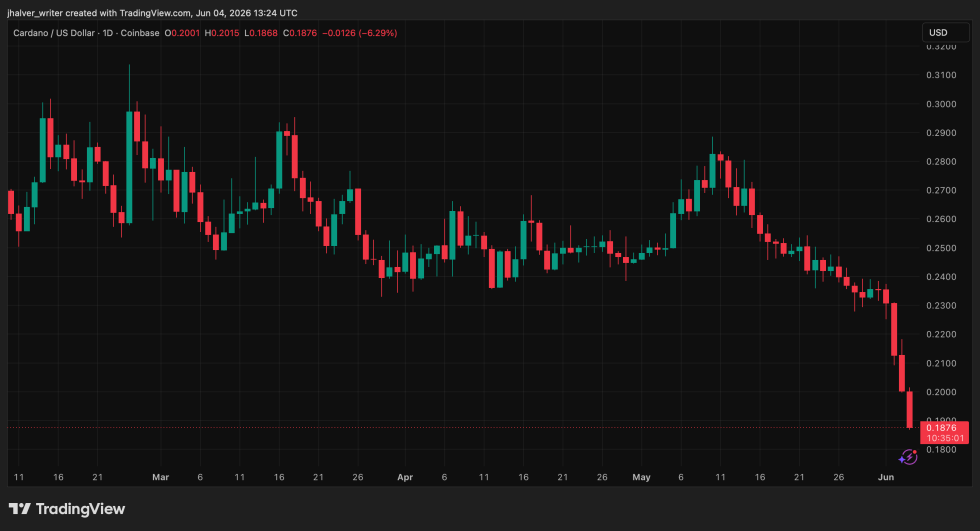
ADA's price trends to the downside on the daily chart. Source: ADAUSD on Tradingview

Hoskinson’s Warning — And The ADA Fallout

Responding in a video on the same day, Hoskinson framed TapTools’ exit not as an isolated event but as a leading indicator of deeper ecosystem stress. A substantial portion of older Cardano projects are no longer in an investable state, he said — and the H2 2026 environment will force many into the same position.

He pointed to JX Door’s earlier collapse as a warning sign that went unheeded, and acknowledged that a treasury-funded index he had proposed to backstop struggling ecosystem projects never materialized. “I came up with the plan of an index. It did not get executed,” he said in the video, per the YouTube posting, placing partial responsibility on Cardano’s governance community for failing to act when opportunities were available.

Hoskinson subsequently posted on X that he is “taking a break” — three words that landed heavily given the timing.

The Community Fires Back

The response from prominent voices in the crypto community was swift and pointed. Andreas Svanevik (@ASvanevik), CEO of Nansen, addressed Hoskinson’s implicit question about what he could do to help directly: “It’s not about what he can do NOW,” Svanevik wrote on X. “The problem is he sold Cardano as something it never was. And people believed him. Now they will all suffer the consequences together.”

The post drew significant engagement and amplified a sentiment that had been building in the community for months — that Hoskinson’s long-standing promises about Cardano’s institutional potential and developer adoption had set expectations the network could not match. @Pledditor’s post on X added further community context to the criticism, reflecting frustration that had been building across ADA holders as the ecosystem continued to lose ground.

The Structural Picture

The numbers behind the debate are difficult to argue with. Cardano’s total value locked stands at approximately $123.85 million — placing it 28th by chain TVL on DeFiLlama, behind Stellar, NEAR, Aptos, and Mantle, and roughly two orders of magnitude below Ethereum’s $39.9 billion.

The 2026 Cardano Summit was canceled after the community voted down treasury funding. Engineering proposals for 2026 were cut to $46.8 million from $97.5 million the prior year. The van Rossem hard fork was postponed to allow further testing. ADA is currently trading at approximately $0.20 — its lowest level in more than five years.

The question Hoskinson’s own comments raise — whether Cardano can reverse a trajectory that its own founder is now publicly describing in near-apocalyptic terms — is one the ecosystem has no clean answer to heading into what he himself calls the hardest half of the year.

Cover image from Grok, ADAUSD chart from Tradingview

Related Questions

QWhat specific event did Charles Hoskinson cite as a catalyst for his warning about Cardano's ecosystem, and what was its impact?

AThe catalyst was the announcement by TapTools, Cardano's most widely used analytics and infrastructure platform, that it would wind down operations within two weeks. This event signaled deeper ecosystem stress to Hoskinson, contributing to his warning about a coming wave of project failures.

QHow did prominent voices in the crypto community, like Andreas Svanevik, respond to Hoskinson's warning and his role in Cardano's situation?

AAndreas Svanevik, CEO of Nansen, responded critically on X. He argued that the problem stemmed from Hoskinson selling Cardano as something it never was, setting unrealistic expectations about its institutional potential and developer adoption that the network failed to meet.

QWhat are some key metrics mentioned in the article that illustrate Cardano's current challenges in the broader blockchain landscape?

AKey metrics include Cardano's Total Value Locked (TVL) of approximately $123.85 million, ranking 28th among chains, and ADA's price falling below $0.20 for the first time in over five years. The article also notes the 2026 Cardano Summit was canceled and engineering proposals were significantly cut from $97.5 million to $46.8 million.

QWhat internal failure did Hoskinson acknowledge regarding a proposed plan to support struggling Cardano projects?

AHoskinson acknowledged that a treasury-funded index he had proposed to backstop struggling ecosystem projects never materialized. He stated, 'I came up with the plan of an index. It did not get executed,' placing partial responsibility on Cardano's governance community for failing to act.

QWhat major implication does Charles Hoskinson's warning raise for the future of the Cardano ecosystem according to the article's conclusion?

AHoskinson's warning raises the question of whether Cardano can reverse its current negative trajectory, which he himself describes in near-apocalyptic terms. The ecosystem faces this challenge heading into what he calls the hardest half of the year (H2 2026), with no clear answer provided.

Related Reads

70% of the Public Opposes AI, Americans Hope the U.S. Loses the AI War

70% of Americans believe AI development is moving too fast, with growing public resistance evolving from online criticism to real-world protests and violence. This widespread anti-AI sentiment stems from fears of job losses, rising utility costs, environmental damage, threats to democracy, and financial instability. Key incidents illustrate the backlash: Google's former CEO Eric Schmidt was loudly booed at a graduation for promoting AI; AI company ads are vandalized; protests and even violent attacks target AI firms and data centers. Polls show deep public pessimism and strong local opposition to data center construction, often surpassing resistance to nuclear power plants. The core grievances are economic and practical: AI is seen as automating jobs, concentrating wealth, and increasing household electricity and water bills due to massive data center resource demands. Environmentalists also oppose AI's high energy use and carbon emissions. This opposition has turned AI into a major political issue in the US. While the Trump administration prioritizes AI innovation for global competition, bipartisan pushback is growing. Democrats and factions within the MAGA movement are forming temporary alliances to support stricter regulations and local bans on new data centers, pressuring the administration to choose between its tech industry backers and its voter base. The situation highlights a profound national divide over AI's future.

marsbit29m ago

70% of the Public Opposes AI, Americans Hope the U.S. Loses the AI War

marsbit29m ago

Agents Take Over Traffic Distribution Power: What Are Tencent, ByteDance, and Alibaba Competing For?

In the race to dominate the AI era's entry point, China's tech giants—Tencent, ByteDance, and Alibaba—are aggressively deploying AI Agents to control the future of traffic distribution. Alibaba is pursuing a dual-track "closed loop + openness" strategy. Its Qianwen app is evolving into a super-Agent integrated across its ecosystem (Taobao, Alipay, etc.) to handle complex tasks like travel planning. Concurrently, it is opening its platform to external brands (Luckin Coffee, KFC) and has launched a B2B Agent platform, "Wukong," targeting enterprise automation. Its other flagship, Quark, aims to be an "AI super search box" for information and tasks. ByteDance is executing an omnipresent "sprawl strategy." Its Doubao app boasts over 300 million monthly active users and is evolving into a default AI entry point for daily life, with plans for paid versions and e-commerce integration. Its core weapon is the Kouzi platform, a visual "AI assembly factory" for developers to build custom Agents. ByteDance is also pushing hardware integration, collaborating on AI phones and developing smart glasses to embed Doubao everywhere. Tencent is playing its long-held "ultimate card" by quietly embedding an AI Agent directly into WeChat. This Agent, accessible via a swipe, can understand user commands and automatically execute tasks by calling upon WeChat's millions of mini-programs (e.g., finding and ordering coffee). This leverages WeChat's unparalleled 1.4-billion-user ecosystem to position the app as an AI-powered "service operating system," a move that could dramatically reshape the competitive landscape. The core battleground is shifting from competing for "user screen time" to competing to be the "default execution layer" for user intent. The business model is evolving from an "attention economy" to an "intent economy," where the Agent that can most efficiently fulfill a user's need gains control over service access and token flow. This represents a fundamental change in how users connect with digital services, making the fight for the Agent入口 (entry point) a pivotal moment for redefining industry leadership in the AI age.

marsbit2h ago

Agents Take Over Traffic Distribution Power: What Are Tencent, ByteDance, and Alibaba Competing For?

marsbit2h ago

Trading

Spot
Futures

Hot Articles

Discussions

Welcome to the HTX Community. Here, you can stay informed about the latest platform developments and gain access to professional market insights. Users' opinions on the price of ADA (ADA) are presented below.

活动图片