Institutional Shift? Jane Street Turns Toward Ethereum After Reducing Bitcoin ETF Exposure

bitcoinistPublished on 2026-05-16Last updated on 2026-05-16

Abstract

Institutional investors are increasingly shifting focus from Bitcoin to Ethereum, with Jane Street notably reducing its Bitcoin ETF exposure while increasing its stake in ETH. This reflects a broader trend of institutions viewing Ethereum not just as an altcoin but as a distinct macro asset, driven by its growing role in DeFi and tokenization. Concurrently, Ethereum's network recorded its highest realized profits in three weeks, with $74.58 million in profits despite a recent price dip, as earlier accumulators sold into the downturn. On-chain data shows increased transaction volume and distribution activity at around $2,241, suggesting cautious investor sentiment. Analysts advise monitoring for deeper realized losses as a potential bottoming signal before considering aggressive positions.

For long, Bitcoin has remained the major target for institutional investors, but lately Ethereum is turning up strongly on their radars too. Many companies have begun to accumulate the leading altcoin at a significant rate, with some even dumping a portion of their Bitcoin holdings to buy more ETH.

Jane Street Shows Interest In Ethereum

As the crypto sector expands, the market is now experiencing a major shift in institutional investors’ interest. A number of companies are starting to increase their exposure to Ethereum while reducing their exposure to Bitcoin.

Jane Street is changing the way it is exposed to cryptocurrencies by increasing its stake in Ethereum and decreasing its holdings in Bitcoin Exchange-Traded Funds (ETFs). The move is gaining attention throughout the crypto market because it may represent shifting institutional preferences in the market for digital assets.

Deci, a market commentator, stated that Jane Street’s addition of ETH funds and reduction of exposure to BTC ETFs does not automatically make them ETH maximis. However, it does point to a growing and real rotation.

Large investors are becoming more interested in ETH, possibly due to its growing role in Decentralized Finance (DeFi), tokenization, and blockchain infrastructure, even though Bitcoin has long dominated institutional portfolios. According to the expert, institutional investors are beginning to treat ETH less like an altcoin and more like a separate macro asset next to Bitcoin and Gold.

In the expert’s view, BTC was the first digital store of value, but now ETH is becoming the financial infrastructure trade. Such a distinction, he believes, is where the market keeps underpricing the altcoin.

ETH Network Sees A Large Realized Profit Margin

After a brief price rebound, Ethereum has witnessed a surge in realized profits, indicating a shift in market dynamics. On Thursday, Santiment, a market intelligence and on-chain data analytics platform, reported that ETH registered its highest network realized profits in 3 weeks.

This may appear counterintuitive to see a spike of $74.58 million in realized profits because ETH’s price has fallen by 5.5% over the past 3 days. However, this trend is linked to investors’ behavior during the price action. ETH holders with a much lower cost basis are selling into the dip.

While ETH traded below $2,000 throughout much of February and March, savvy traders accumulated despite war fears and heightened uncertainty in crypto at the time. Furthermore, wallets that were collected during those months are still profitable despite this mid-May downturn. Meanwhile, many have chosen to sell while they believe they still have a chance to make money.
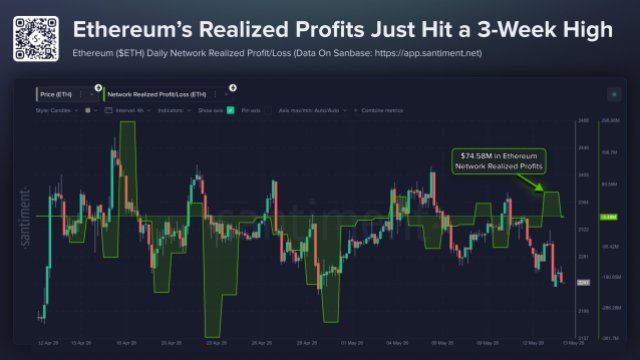
Source: Chart from Santiment on X

Santiment also highlighted an increase in the volume of on-chain movement on the Ethereum blockchain. The 4-hour candles exhibit significant price compression at $2,241, indicating increased distribution activity on the chain. Historically, more transactions have led to more realized P&L events. When volume is increased, even little individual profits add up to significant network-level totals.

Based on current ETH trader behavior, Santiment noted that investors are leaning cautious. However, this does not mean new investors should be bearish. Rather, the platform suggests watching for deeper realized losses as a potential bottoming signal and avoiding aggressive positioning until the distribution phase shows clear signs of ending.

ETH trading at $2,265 on the 1D chart | Source: ETHUSDT on Tradingview.com

Trending Cryptos

Related Questions

QWhat significant shift in institutional investment is highlighted in the article regarding Jane Street?

AThe article highlights that Jane Street is increasing its exposure to Ethereum while reducing its holdings in Bitcoin ETFs, indicating a shift in institutional interest towards Ethereum.

QAccording to market commentator Deci, what does Jane Street's move signify about institutional preferences?

AAccording to Deci, while Jane Street's move does not automatically make them 'ETH maximalists,' it points to a growing and real rotation in institutional investment, with Ethereum being treated more as a separate macro asset alongside Bitcoin and Gold.

QWhat on-chain data did Santiment report regarding Ethereum, and why was it considered counterintuitive?

ASantiment reported that Ethereum registered its highest network realized profits in 3 weeks, with a spike of $74.58 million. This was considered counterintuitive because ETH's price had fallen by 5.5% over the preceding 3 days.

QWhat behavior among ETH holders explains the surge in realized profits despite a price drop?

AThe surge in realized profits is explained by ETH holders with a much lower cost basis selling into the price dip. These savvy traders had accumulated ETH when it traded below $2,000 in February and March, so they were still profitable and chose to sell during the mid-May downturn.

QWhat current trader behavior does Santiment note, and what advice does it give to new investors based on this?

ASantiment notes that current ETH investors are leaning cautious. It advises new investors to watch for deeper realized losses as a potential bottoming signal and to avoid aggressive positioning until the distribution phase shows clear signs of ending.

Related Reads

The Verdict in Choi Tae-won's Divorce Case: Revealing the Inheritance Undercurrent Behind SK Hynix's Trillion-Won Empire

SK Group Chairman Chey Tae-won's high-profile divorce case, involving a record 1.38 trillion won settlement, has drawn attention to the succession plans for Korea's second-largest conglomerate, especially its crown jewel, SK hynix. Unlike traditional chaebol scripts centered on the eldest son, Chey's three children from his marriage to former President Roh Tae-woo's daughter, Roh Soh-yeong, are carving distinct, non-traditional paths. Eldest daughter Chey Yun-jung (b. 1989) is seen as the most evident successor. With a scientific and consulting background, she holds executive roles at SK bioscience and SK Inc.'s growth support department, focusing on future strategy and biopharma. Her marriage is to an AI infrastructure entrepreneur, not a traditional business alliance. Second daughter Chey Min-jung (b. 1991) took a unique route, voluntarily serving as a South Korean naval officer, including an anti-piracy deployment. She later worked on policy and strategy for SK hynix in Washington D.C. before co-founding an AI-driven healthcare startup. She married a former U.S. Marine Corps officer, connecting her to U.S. defense and policy circles—networks crucial for a global semiconductor giant. The only son, Chey In-geun (b. 1995), who studied physics like his father, worked briefly at SK E&S before joining McKinsey. Despite fitting the traditional "heir" profile as the eldest son, he remains silent and holds no public position or shares in SK, suggesting the old succession playbook is obsolete. As SK hynix's valuation soars, becoming a geopolitical asset in the AI era, the heirs' legitimacy is no longer automatic. They must prove themselves in fields like AI biotech, global policy, and strategic consulting. Their marriages also reflect new elite networks in tech and defense, not old political alliances. Their inheritance is the complex challenge of navigating a globalized, tech-driven world, not just a corporate throne.

marsbitYesterday 09:06

The Verdict in Choi Tae-won's Divorce Case: Revealing the Inheritance Undercurrent Behind SK Hynix's Trillion-Won Empire

marsbitYesterday 09:06

From OpenSea to OpenRouter: Is Alex Atallah Repeating His 'Exit at the Peak' Playbook?

From OpenSea to OpenRouter: Is Alex Atallah Repeating His "Exit at the Peak" Playbook? According to the Wall Street Journal, payments giant Stripe is in talks to acquire the AI model aggregation platform OpenRouter in a potential deal valuing the company near $100 billion. This would mark founder Alex Atallah's second creation of a company reaching a $100 billion valuation, following his co-founding of NFT marketplace OpenSea. OpenRouter, founded just over three years ago, has grown rapidly by acting as a unified gateway for developers to access over 400 AI models. It currently has about 10 million users and processes over 200 trillion tokens monthly. While the platform's annualized revenue is around $50 million, its valuation has skyrocketed from $1.3 billion in March 2026. The potential acquisition by Stripe, a company OpenRouter's founder once likened it to, represents a major expansion into AI infrastructure for the payments leader. This move echoes Atallah's previous timing with OpenSea, where he departed before the NFT market's significant downturn. For OpenRouter, selling now may be strategic. Despite its scale, its business model—charging a 5-5.5% fee on AI inference calls—faces pressure from competition, open-source models, and potential price wars among model providers, limiting its profitability narrative for an IPO. A key asset for potential acquirers like Stripe is OpenRouter's vast repository of real-world AI usage data, which offers unique insights into model performance and developer preferences that are difficult to replicate. Whether this potential deal signifies a new valuation benchmark for AI infrastructure or another market peak signal remains to be seen.

链捕手Yesterday 08:42

From OpenSea to OpenRouter: Is Alex Atallah Repeating His 'Exit at the Peak' Playbook?

链捕手Yesterday 08:42

Trading

Spot

Hot Articles

Discussions

Welcome to the HTX Community. Here, you can stay informed about the latest platform developments and gain access to professional market insights. Users' opinions on the price of ETH (ETH) are presented below.

活动图片