Institutional Buying Spreads Across Bitcoin, Ethereum, Solana, and XRP – Is The Bull Market Returning?

bitcoinistPublished on 2026-01-19Last updated on 2026-01-19

Abstract

Institutional buying activity is increasing across major cryptocurrencies like Bitcoin, Ethereum, Solana, and XRP, signaling a potential return of the bull market. Analysts note that institutional investors are discreetly accumulating these assets during periods of muted volatility, taking advantage of liquidity from cautious retail traders. Crypto ETF flows for these coins are at their highest since October 2025, indicating a shift toward a more diversified institutional strategy. Notably, XRP spot ETFs are experiencing strong demand, with over 803 million XRP locked in these funds. This accumulation phase, driven by smart money rather than retail, often precedes a major market repricing.

Buying activity among investors and traders has improved in the cryptocurrency market, with Bitcoin (BTC), Ethereum (ETH), Solana (SOL), and XRP leading the charge. Investors’ growing adoption and interest in these leading coins underscores their potential to produce significant gains in the long term.

Discreet Buying of Bitcoin, Ethereum, Solana, and XRP

With the market regaining bullish traction, several major cryptocurrency assets are starting to showcase upward movements. Following this rebound, institutional investors are stealthily reentering the cryptocurrency market and establishing holdings in Bitcoin, Ethereum, Solana, and XRP, without the customary fanfare.

According to the On-Chain Mind, a Bitcoin and crypto data analyst, this renewed demand among institutional investors is observed in the Exchange-Traded Funds (ETFs) field. Specifically, the behavior, which is significant for the market, is outlined on the Total ETF Flow metric.
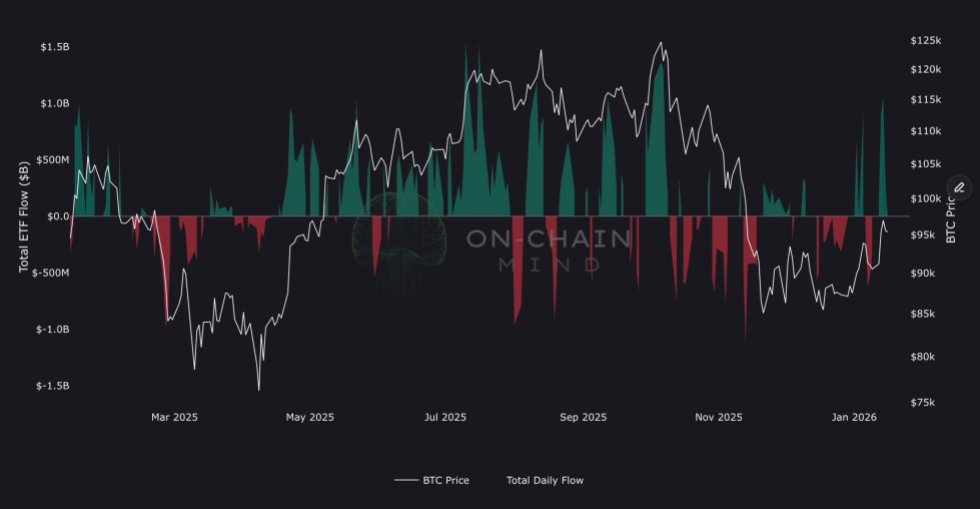
Source: Chart from On-Chain Mind on X

This suggests that large funds and professional desks seem to be accumulating during times of muted volatility and mixed moods, taking advantage of liquidity supplied by cautious retail traders rather than pursuing short-term price movements. A widespread purchasing pressure across several significant networks suggests a shift from selective exposure to a more diversified institutional strategy.

After observing the key metric, On-Chain Mind revealed that the daily total crypto ETF flows for Bitcoin, Ethereum, Solana, and XRP are showing their highest net inflows since October 2025. The expert stated that institutional capital stepping back in quietly, absorbing supply while sentiment is still unstable, is exactly what investors have been anticipating. With capital from smart money flowing underneath the surface, these key investors may be preparing the market for its next sustained phase.

XRP Spot ETFs Are Still Maintaining Strong Inflows

Lately, the XRP Spot ETFs are seeing one of the most significant demands and interest from institutional investors. Arthur, a market expert and BingX partner, shared on X that smart money traders are heavily positioning themselves into the XRP spot ETFs.

While retail investors step back, institutional flows are showing a completely different narrative and action. Such a divergence frequently signals a change in market structure, when conviction-driven capital absorbs supply from weaker hands without immediately causing price excitement.

In the past week alone, more than 22.63 million XRP were recorded flowing into the newly launched funds, as seen in the chart posted by the expert. After weeks of additional positions from every major issuer, over 803.78 million XRP is currently being locked within the spot ETFs.

When millions of tokens are being moved into ETFs per day, it often means that a major repricing is only a matter of time before it occurs. Meanwhile, XRP’s current structure reflects a more careful and calm positioning process, which historically tends to develop in price right after the accumulation phase is essentially finished.

BTC trading at $92,812 on the 1D chart | Source: BTCUSDT on Tradingview.com

Trending Cryptos

Related Questions

QWhich cryptocurrencies are mentioned as experiencing increased institutional buying activity?

AThe cryptocurrencies mentioned are Bitcoin (BTC), Ethereum (ETH), Solana (SOL), and XRP.

QAccording to the analyst 'On-Chain Mind', what metric shows the renewed demand from institutional investors?

AThe renewed demand is observed in the Total ETF Flow metric.

QWhat is the current state of daily total crypto ETF flows for these assets compared to October 2025?

AThe daily total crypto ETF flows for Bitcoin, Ethereum, Solana, and XRP are showing their highest net inflows since October 2025.

QHow much XRP is currently locked within the spot ETFs according to the article?

AOver 803.78 million XRP is currently locked within the spot ETFs.

QWhat does the divergence between institutional flows and retail investor activity often signal, according to the article?

ASuch a divergence frequently signals a change in market structure, where conviction-driven capital absorbs supply from weaker hands without immediately causing price excitement.

Related Reads

Agent Race Ends, Super Workbench Takes Over

The era of fragmented AI agents is ending. Over the past month, China's tech giants—Tencent, Alibaba, and ByteDance—have simultaneously shifted strategy: instead of launching new, standalone AI agents, they are consolidating their various agent projects into unified "super workbenches." Tencent integrated its QClaw teams into WorkBuddy, a strategic product hailed as a potential third flagship after QQ and WeChat. Alibaba is merging its QoderWork, Wukong, and MuleRun agents into a new "Qianwen Office" platform under DingTalk's leadership. ByteDance rebranded its TRAE SOLO coding agent to TRAE Work, signaling a broader focus on workflow collaboration. This convergence marks a pivotal industry consensus. The initial exploration phase, where companies rapidly built numerous overlapping agents for different scenarios, proved costly and inefficient. With open-source tools eroding technical barriers, competition has shifted from agent creation to resource consolidation and cost control. Historically, platform wars are won not by creating more products, but by simplifying them—as seen with browsers unifying web access and super-apps consolidating services. Now, the "super workbench" aims to become the unified AI entry point for work. This reflects a deeper market realization: the primary audience for AI is no longer just programmers (a market in the tens of millions) but all knowledge workers (a market of billions). The real opportunity lies in augmenting everyday tasks—managing emails, documents, data, and meetings—across the entire workday. The core battleground is becoming control over the primary AI entry point that employees use daily. Tencent's WorkBuddy leverages WeChat and Tencent Docs; Alibaba's Qianwen Office taps into DingTalk's organizational data; ByteDance's TRAE Work integrates with Feishu's workflows. Whoever owns this "super workbench" gains strategic control over orchestrating enterprise data and APIs. This shift is redefining enterprise software. Traditional SaaS applications, valued for their user interfaces, will recede into the background. Their core functionalities will be exposed as standardized "Skills" or APIs for the super workbench's agents to invoke. Software value will shift from selling user seats to charging based on API calls and outcomes delivered. The evolution of agents is moving through clear stages: first as novel standalone products, then as consolidated primary work entry points, and finally as pervasive, invisible capabilities embedded into the digital fabric. The recent moves by major tech firms signal the transition from the first stage into the second, accelerating toward the third. In the end, the most successful agent technology may become invisible—like electricity or the HTTP protocol—a fundamental, unnamed infrastructure powering work itself.

marsbit18m ago

Agent Race Ends, Super Workbench Takes Over

marsbit18m ago

Michael Saylor: 110 Reasons to Oppose BIP-110

Michael Saylor presents 110 arguments against Bitcoin Improvement Proposal (BIP) 110, a soft fork aimed at restricting certain non-monetary data storage uses (like inscriptions) on the Bitcoin blockchain. He acknowledges the proponents' valid concerns—such as node costs, fee pressure, and preserving Bitcoin's monetary focus—but fundamentally disagrees with the proposed solution. Saylor argues that BIP 110 represents a dangerous precedent of using consensus rules to enforce value judgments on transaction validity, moving away from Bitcoin's core principles of neutrality and permissionless innovation. His key objections are organized into eleven categories: 1) It violates neutrality and hard consensus by banning currently valid transactions. 2) It fails to meet the high burden of proof required for a consensus change, lacking concrete data on the alleged crisis. 3) Its seven bundled technical restrictions are overly broad, targeting generic script functionalities and blocking future upgrade paths. 4) It sacrifices compatibility and future optionality by closing off designed upgrade hooks. 5) Its temporary rules add significant complexity (grandfathering, expiry states) without sufficient justification. 6) The economic and security impacts, particularly on miner revenue and fee markets, are uncertain and unmodeled. 7) Superior, market-based tools (fee markets, relay/mining policies) already exist to manage blockchain load. 8) It stifles innovation by creating a chilling effect for developers. 9) Its modified activation mechanism (55% threshold, forced signaling) is aggressive and risks network splits. 10) The precedent it sets—using consensus to suppress disliked but legal uses—is more dangerous than the problem it aims to solve. 11) A better path exists: improving measurements, refining resource-based policies, and allowing market forces to work. Saylor concludes that Bitcoin's strength lies in its neutral rules, open markets, and hard consensus. Changing these foundational elements to target specific use cases is an unnecessary and risky "iatrogenic" intervention. He advocates for guarding Bitcoin's neutrality rather than acting as its redeemer.

marsbit33m ago

Michael Saylor: 110 Reasons to Oppose BIP-110

marsbit33m ago

Trading

Spot

Hot Articles

What is $BITCOIN

DIGITAL GOLD ($BITCOIN): A Comprehensive Analysis Introduction to DIGITAL GOLD ($BITCOIN) DIGITAL GOLD ($BITCOIN) is a blockchain-based project operating on the Solana network, which aims to combine the characteristics of traditional precious metals with the innovation of decentralized technologies. While it shares a name with Bitcoin, often referred to as “digital gold” due to its perception as a store of value, DIGITAL GOLD is a separate token designed to create a unique ecosystem within the Web3 landscape. Its goal is to position itself as a viable alternative digital asset, although specifics regarding its applications and functionalities are still developing. What is DIGITAL GOLD ($BITCOIN)? DIGITAL GOLD ($BITCOIN) is a cryptocurrency token explicitly designed for use on the Solana blockchain. In contrast to Bitcoin, which provides a widely recognized value storage role, this token appears to focus on broader applications and characteristics. Notable aspects include: Blockchain Infrastructure: The token is built on the Solana blockchain, known for its capacity to handle high-speed and low-cost transactions. Supply Dynamics: DIGITAL GOLD has a maximum supply capped at 100 quadrillion tokens (100P $BITCOIN), although details regarding its circulating supply are currently undisclosed. Utility: While precise functionalities are not explicitly outlined, there are indications that the token could be utilized for various applications, potentially involving decentralized applications (dApps) or asset tokenization strategies. Who is the Creator of DIGITAL GOLD ($BITCOIN)? At present, the identity of the creators and development team behind DIGITAL GOLD ($BITCOIN) remains unknown. This situation is typical among many innovative projects within the blockchain space, particularly those aligning with decentralized finance and meme coin phenomena. While such anonymity may foster a community-driven culture, it intensifies concerns about governance and accountability. Who are the Investors of DIGITAL GOLD ($BITCOIN)? The available information indicates that DIGITAL GOLD ($BITCOIN) does not have any known institutional backers or prominent venture capital investments. The project seems to operate on a peer-to-peer model focused on community support and adoption rather than traditional funding routes. Its activity and liquidity are primarily situated on decentralized exchanges (DEXs), such as PumpSwap, rather than established centralized trading platforms, further highlighting its grassroots approach. How DIGITAL GOLD ($BITCOIN) Works The operational mechanics of DIGITAL GOLD ($BITCOIN) can be elaborated on based on its blockchain design and network attributes: Consensus Mechanism: By leveraging Solana’s unique proof-of-history (PoH) combined with a proof-of-stake (PoS) model, the project ensures efficient transaction validation contributing to the network's high performance. Tokenomics: While specific deflationary mechanisms have not been extensively detailed, the vast maximum token supply implies that it may cater to microtransactions or niche use cases that are still to be defined. Interoperability: There exists the potential for integration with Solana’s broader ecosystem, including various decentralized finance (DeFi) platforms. However, the details regarding specific integrations remain unspecified. Timeline of Key Events Here is a timeline that highlights significant milestones concerning DIGITAL GOLD ($BITCOIN): 2023: The initial deployment of the token occurs on the Solana blockchain, marked by its contract address. 2024: DIGITAL GOLD gains visibility as it becomes available for trading on decentralized exchanges like PumpSwap, allowing users to trade it against SOL. 2025: The project witnesses sporadic trading activity and potential interest in community-led engagements, although no noteworthy partnerships or technical advancements have been documented as of yet. Critical Analysis Strengths Scalability: The underlying Solana infrastructure supports high transaction volumes, which could enhance the utility of $BITCOIN in various transaction scenarios. Accessibility: The potential low trading price per token could attract retail investors, facilitating wider participation due to fractional ownership opportunities. Risks Lack of Transparency: The absence of publicly known backers, developers, or an audit process may yield skepticism regarding the project's sustainability and trustworthiness. Market Volatility: The trading activity is heavily reliant on speculative behavior, which can result in significant price volatility and uncertainty for investors. Conclusion DIGITAL GOLD ($BITCOIN) emerges as an intriguing yet ambiguous project within the rapidly evolving Solana ecosystem. While it attempts to leverage the “digital gold” narrative, its departure from Bitcoin's established role as a store of value underscores the need for a clearer differentiation of its intended utility and governance structure. Future acceptance and adoption will likely depend on addressing the current opacity and defining its operational and economic strategies more explicitly. Note: This report encompasses synthesised information available as of October 2023, and developments may have transpired beyond the research period.

969 Total ViewsPublished 2025.05.13Updated 2025.05.13

What is $BITCOIN

Discussions

Welcome to the HTX Community. Here, you can stay informed about the latest platform developments and gain access to professional market insights. Users' opinions on the price of BTC (BTC) are presented below.

活动图片












