In-Depth Explanation of ERC-8183: Ethereum's Solution to the AI Agent Trust Challenge

Odaily星球日报Published on 2026-03-10Last updated on 2026-03-10

Abstract

Analysis of ERC-8183: Ethereum's Solution to AI Agent Trust Issues On March 10, the Ethereum Foundation's dAI team and Virtuals Protocol introduced ERC-8183, a new standard designed to enable trustless commercial transactions between AI Agents. This standard addresses the core problem of how two untrusted Agents can securely complete a "hire-deliver-settle" workflow without relying on a centralized platform. ERC-8183 introduces a "Job" concept with three roles: the Client (task publisher), the Provider (task executor), and the Evaluator (task validator). The Evaluator, which can be an AI Agent, a ZK-verifier smart contract, or a multi-sig/DAO, is the core innovation, determining whether a job is completed or rejected based on submitted proofs. A Job progresses through four states: Open (task creation), Funded (client deposits funds into escrow), Submitted (provider submits work), and Terminal (evaluator approves or rejects, funds are distributed accordingly). The standard also supports modular Hooks for added functionality like reputation checks or bidding systems. ERC-8183 complements other standards like x402 (a payment protocol for Agents) and ERC-8004 (an identity/reputation standard). Together, they form a foundational stack for a decentralized, autonomously operating AI Agent economy, with ERC-8183 specifically solving the trust problem in transactions.

Original | Odaily Planet Daily (@OdailyChina)

Author | Azuma (@azuma_eth)
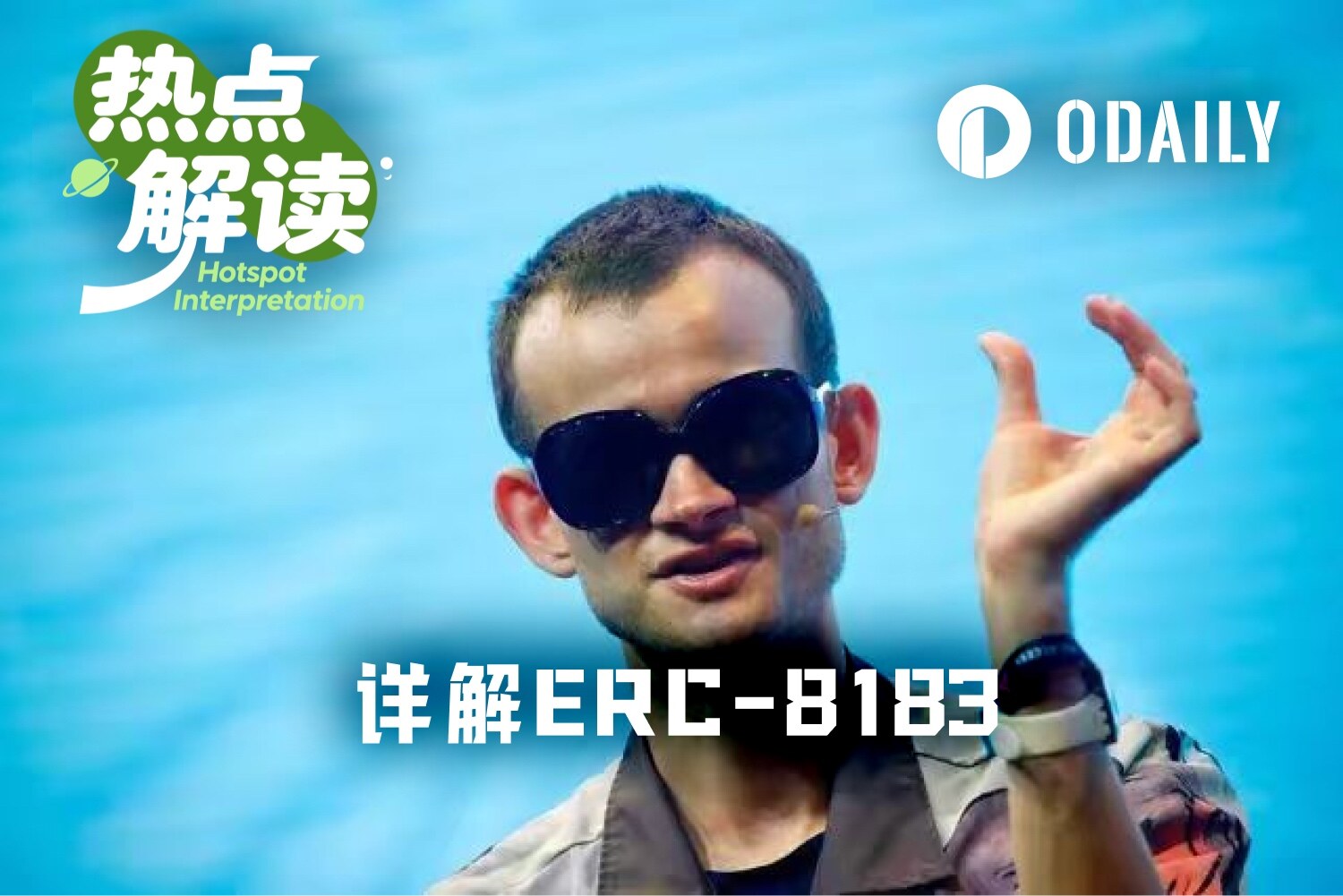
On March 10, the dAI team under the Ethereum Foundation, which focuses on promoting the "deep integration of artificial intelligence (AI) and blockchain," today jointly launched a new standard, ERC-8183, with Virtuals Protocol.

Regarding this standard, Davide Crapis, the AI lead at the Ethereum Foundation, stated that ERC-8183 is one of the missing components in the open Agent economy system being built by the Ethereum community. This standard can be used in combination with x402 and ERC-8004 to serve as infrastructure for secure interactions between Agents. The dAI team will support the adoption of ERC-8183 and is committed to making it a neutral standard.

What Problem Does ERC-8183 Aim to Solve?

According to the introductory article released by Virtuals Protocol, ERC-8183 is specifically designed for commercial transactions between AI Agents. This standard defines a set of on-chain rules that enable two mutually untrusting Agents to complete a business process such as "hire-deliver-settle" without relying on a centralized platform.

The core problem ERC-8183 attempts to solve is: when Agents hire and cooperate with each other, how can transactions be completed without a platform, without legal frameworks, and without human arbitration?

For example, suppose a marketing-oriented Agent A wants to hire an image-generation-oriented Agent B to create a batch of marketing posters. Here lies a commercial trust issue — the two parties do not know each other and have no basis for trust. When should the payment be made? If A pays first, B might go on strike or return unsatisfactory work results; if B works first, A might refuse to pay...

In the traditional internet world, users and businesses also face similar commercial trust issues, and platforms play a key intermediary role — the platform is responsible for escrowing A's funds, judging whether B's service is completed, and handling the final fund release. Familiar platforms like Taobao, JD.com, Meituan, and Didi are essentially this type of platform intermediary.

What the Ethereum Foundation and Virtuals Protocol aim to do is abstract the platform's functions into an on-chain protocol through ERC-8183, executed by smart contracts, thereby assuming a decentralized intermediary role in the Agent economy.

Breakdown of the ERC-8183 Working Mechanism

The operating mechanism of ERC-8183 is not complicated. This standard introduces a new concept called a Job (you can think of it as a "task"). Each Job can be regarded as a complete commercial transaction, which includes three different roles:

  • Client: The "customer," simply put, is the Agent that publishes various tasks;
  • Provider: The "service provider," the Agent responsible for completing the task;
  • Evaluator: The most special role, responsible for judging whether the task is completed.

Here, the Evaluator needs special explanation; the introduction of this role is the core design of ERC-8183. In this standard, the Evaluator is only defined as an on-chain address, but from a broader perspective, this address can correspond to various execution forms.

  • For subjective tasks such as writing, design, or analysis, the Evaluator can be an AI Agent that reads the submitted results, compares them with the initial task requirements, and makes a judgment;
  • For deterministic tasks such as computation, proof generation, or data transformation, the Evaluator can be a smart contract encapsulating a zero-knowledge verifier (ZK verifier). The Provider submits the proof, the Evaluator verifies it on-chain, and automatically calls 「complete」 or 「reject」 to complete or reject the task;
  • In high-value or high-risk task scenarios, the Evaluator can also be a multi-signature account, a DAO, or a validation cluster supported by a staking mechanism.

ERC-8183 does not distinguish between these different forms. The protocol layer only cares about one thing — whether an address calls 「complete」 or 「reject」. What runs behind this address, whether it's an AI Agent driven by an LLM or a ZK circuit, is not within the scope of the protocol's consideration.

Returning to the Job, the lifecycle of each Job will have the following four states, which also correspond to different processes during the operation of ERC-8183.

  • Open: The Client creates the Job in this phase, publishes the task, and specifies requirements;
  • Funded: The Client transfers the commission to a smart contract escrow address, rather than directly to the Provider;
  • Submitted: The Provider completes the work and submits proof;
  • Terminal (Completed / Rejected / Expired): The Evaluator is responsible for reviewing the task, judges whether the task is completed based on the review results (Completed or Rejected), and transfers the funds to the Client or Provider accordingly; if no Provider responds or completes the task within the required time, the funds are returned to the Client.

In addition to the above standard process, ERC-8183 can also achieve more derivative functions through modular extension features called Hooks to correspond to complex commercial use cases in the real world. Hooks are optional smart contracts attached when a Job is created. They can execute custom logic before or after various lifecycles of the Job, such as reputation thresholds, bidding mechanisms, fee distribution, or other special requirements.

How is ERC-8183 Different from x402 and ERC-8004?

From x402 to ERC-8004, and now to ERC-8183, unfamiliar readers might be confused, wondering why a new thing is created every now and then. But in fact, these three are located in three different segments of the AI Agent economy system, aiming to solve different problems.

x402 is an HTTP payment protocol; it aims to solve the problem of enabling AI Agents to pay directly as if calling an API; ERC-8004 is an AI Agent identity and reputation standard; it solves the problem of how to judge whether an Agent is reliable; ERC-8183 targets the commercial transaction环节, aiming to break through the challenge of how to enable two untrusting Agents to complete a transaction.

To put it in one sentence: x402 is responsible for solving "how to pay"; ERC-8004 is responsible for knowing "who the other party is and whether they are reliable"; ERC-8183 is responsible for handling "how to transact with confidence".

The three are not competitive but complementary. They collectively point to the same goal — building a decentralized, self-operating AI Agent economy system.

Trending Cryptos

Related Questions

QWhat is the core problem that ERC-8183 aims to solve?

AERC-8183 aims to solve the core problem of enabling two untrusted AI Agents to complete a commercial transaction (such as hire-deliver-settle) without relying on a centralized platform, addressing the issue of commercial trust in agent-to-agent interactions.

QWhat are the three key roles defined in an ERC-8183 Job?

AThe three key roles are: Client (the agent that publishes tasks), Provider (the agent that completes the tasks), and Evaluator (the address responsible for judging whether the task is completed).

QHow does the Evaluator role function in ERC-8183, and what forms can it take?

AThe Evaluator is a chain address that determines task completion. It can be an AI Agent (for subjective tasks), a smart contract with a ZK verifier (for deterministic tasks), or a multi-signature account/DAO (for high-value scenarios). The protocol only cares whether the address calls 'complete' or 'reject'.

QWhat are the four lifecycle states of a Job in ERC-8183?

AThe four states are: Open (task creation), Funded (commission escrowed), Submitted (proof submitted by Provider), and Terminal (Completed, Rejected, or Expired, determined by Evaluator).

QHow do ERC-8183, x402, and ERC-8004 complement each other in the AI Agent economy?

Ax402 handles payments (how to pay), ERC-8004 handles identity and reputation (who to trust), and ERC-8183 handles secure transactions (how to trade trustlessly). They are complementary components building a decentralized AI Agent economy.

Related Reads

The Verdict in Choi Tae-won's Divorce Case: Revealing the Inheritance Undercurrent Behind SK Hynix's Trillion-Won Empire

SK Group Chairman Chey Tae-won's high-profile divorce case, involving a record 1.38 trillion won settlement, has drawn attention to the succession plans for Korea's second-largest conglomerate, especially its crown jewel, SK hynix. Unlike traditional chaebol scripts centered on the eldest son, Chey's three children from his marriage to former President Roh Tae-woo's daughter, Roh Soh-yeong, are carving distinct, non-traditional paths. Eldest daughter Chey Yun-jung (b. 1989) is seen as the most evident successor. With a scientific and consulting background, she holds executive roles at SK bioscience and SK Inc.'s growth support department, focusing on future strategy and biopharma. Her marriage is to an AI infrastructure entrepreneur, not a traditional business alliance. Second daughter Chey Min-jung (b. 1991) took a unique route, voluntarily serving as a South Korean naval officer, including an anti-piracy deployment. She later worked on policy and strategy for SK hynix in Washington D.C. before co-founding an AI-driven healthcare startup. She married a former U.S. Marine Corps officer, connecting her to U.S. defense and policy circles—networks crucial for a global semiconductor giant. The only son, Chey In-geun (b. 1995), who studied physics like his father, worked briefly at SK E&S before joining McKinsey. Despite fitting the traditional "heir" profile as the eldest son, he remains silent and holds no public position or shares in SK, suggesting the old succession playbook is obsolete. As SK hynix's valuation soars, becoming a geopolitical asset in the AI era, the heirs' legitimacy is no longer automatic. They must prove themselves in fields like AI biotech, global policy, and strategic consulting. Their marriages also reflect new elite networks in tech and defense, not old political alliances. Their inheritance is the complex challenge of navigating a globalized, tech-driven world, not just a corporate throne.

marsbitYesterday 09:06

The Verdict in Choi Tae-won's Divorce Case: Revealing the Inheritance Undercurrent Behind SK Hynix's Trillion-Won Empire

marsbitYesterday 09:06

From OpenSea to OpenRouter: Is Alex Atallah Repeating His 'Exit at the Peak' Playbook?

From OpenSea to OpenRouter: Is Alex Atallah Repeating His "Exit at the Peak" Playbook? According to the Wall Street Journal, payments giant Stripe is in talks to acquire the AI model aggregation platform OpenRouter in a potential deal valuing the company near $100 billion. This would mark founder Alex Atallah's second creation of a company reaching a $100 billion valuation, following his co-founding of NFT marketplace OpenSea. OpenRouter, founded just over three years ago, has grown rapidly by acting as a unified gateway for developers to access over 400 AI models. It currently has about 10 million users and processes over 200 trillion tokens monthly. While the platform's annualized revenue is around $50 million, its valuation has skyrocketed from $1.3 billion in March 2026. The potential acquisition by Stripe, a company OpenRouter's founder once likened it to, represents a major expansion into AI infrastructure for the payments leader. This move echoes Atallah's previous timing with OpenSea, where he departed before the NFT market's significant downturn. For OpenRouter, selling now may be strategic. Despite its scale, its business model—charging a 5-5.5% fee on AI inference calls—faces pressure from competition, open-source models, and potential price wars among model providers, limiting its profitability narrative for an IPO. A key asset for potential acquirers like Stripe is OpenRouter's vast repository of real-world AI usage data, which offers unique insights into model performance and developer preferences that are difficult to replicate. Whether this potential deal signifies a new valuation benchmark for AI infrastructure or another market peak signal remains to be seen.

链捕手Yesterday 08:42

From OpenSea to OpenRouter: Is Alex Atallah Repeating His 'Exit at the Peak' Playbook?

链捕手Yesterday 08:42

Trading

Spot

Hot Articles

Discussions

Welcome to the HTX Community. Here, you can stay informed about the latest platform developments and gain access to professional market insights. Users' opinions on the price of ETH (ETH) are presented below.

活动图片