Hyperbeat: Launching a 'Bank' on Hyperliquid

marsbitPublished on 2026-04-09Last updated on 2026-04-09

Abstract

Hyperbeat, a protocol built on Hyperliquid, has launched "Liquid Banking," a self-custodial banking solution deployed on HyperEVM. It integrates stablecoin deposits, VISA card spending, perpetual trading, and multi-currency fiat on/off ramps into a single on-chain smart wallet. The core feature is "Credit Mode," powered by Morpho's lending engine. Users deposit assets like BTC or ETH as collateral. When spending with the VISA card, the system instantly borrows stablecoins via Morpho to complete payments, while the collateral remains on-chain earning yield. There is no grace period—interest accrues immediately upon spending. Hyperbeat uses its native stablecoin, beatUSD, issued in partnership with Paxos. Deposit yields come from real borrowing interest generated by consumer spending. Fiat services are provided by Noah, supporting multiple currencies, and the VISA card is issued by Third National via infrastructure from Rain. As a self-custodial system, user assets stay in their smart wallet. To prevent fraud, withdrawals require a cooling period and operator approval for collateral removal. The system emphasizes transparency and on-chain security but places responsibility on users to manage their account health, with no customer support to reverse errors.

On April 8, Hyperliquid's native protocol Hyperbeat launched Liquid Banking, a self-custodied 'bank' deployed on HyperEVM, integrating stablecoin deposits, VISA card spending, perpetual contract trading, and multi-currency fiat on/off ramps into a single on-chain smart wallet.

The Hyperbeat team transitioned from being among the first validators on the Hyperliquid testnet. Initially just 5 people, they self-funded a start with approximately $200,000. The two co-founders, Kilian Boshoff(@Fundi_Crypto) and 800.HL(@degennQuant), maintain a low profile; the former has a background from Stellenbosch University in South Africa. The company is registered in the Cayman Islands.

In August 2025, it completed a $5.2 million seed round co-led by ether.fi Ventures and Electric Capital, with participation from Coinbase Ventures, Maelstrom, Anchorage Digital, and others, valuing the company at approximately $40 million.

Morpho Provides the Engine, Building a 'Bank' in Ten Months

The core selling point of Liquid Banking is Credit Mode.
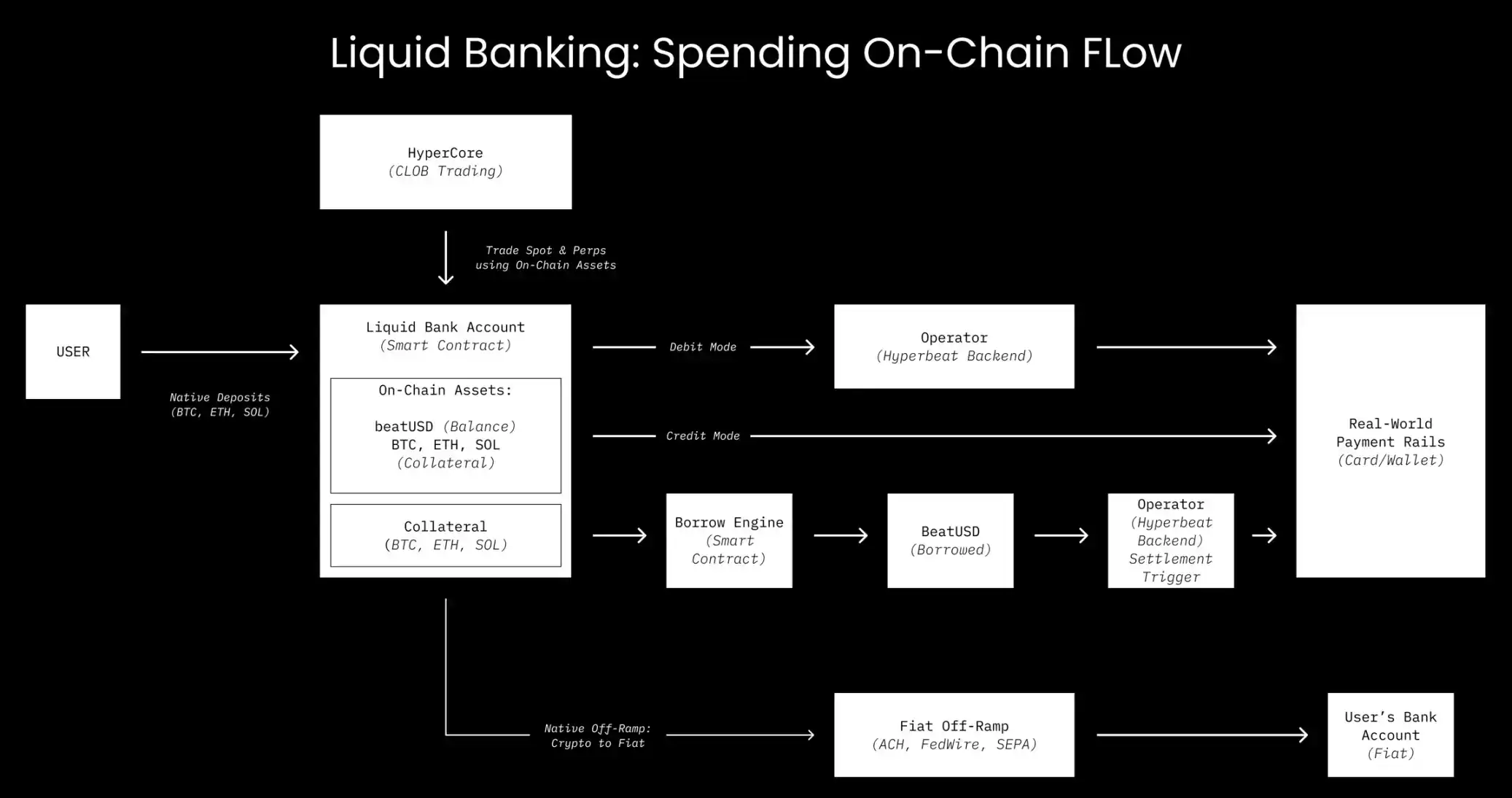
Users deposit assets like BTC, ETH, HYPE, etc., as collateral. When swiping the VISA card, the system instantly borrows stablecoins through the Morpho Blue market to complete the payment, while the collateral remains on-chain, continuing to generate yield. The user never interacts with a borrowing interface; the act of swiping the card is itself an on-chain loan.

The underlying lending engine comes from Morpho. Hyperbeat integrates Morpho into the user's smart wallet through an on-chain whitelist mechanism. Currently, Credit Mode operates on six isolated markets, with collateral covering HYPE, UBTC, UETH, USOL, and even the gold token XAUT.

Hyperbeat does not touch the core lending logic; Morpho does not touch the user interface. The former builds the 'bank frontend,' the latter supplies the 'credit engine.'

Stablecoin deposits for Liquid Banking center around beatUSD, a native stablecoin issued in partnership with Paxos Labs. Paxos provides the stablecoin infrastructure (underpinned by USDG0). The yield from the reserves flows directly back into Hyperbeat's rewards program and is ultimately distributed to users, rather than remaining with the issuer.

The deposit-side USD+ vault automatically allocates user funds to protocols like Morpho, Hypuur, Hyperlend, Felix, etc., offering 3%-8% APY.

The yield comes from the real borrowing interest paid by Credit Mode consumers. The more spending, the higher the deposit yield. But the sustainability of this cycle depends on the volume of real consumption.

Spend Without Selling Crypto, But Interest Accrues Immediately on Swipe

Fiat on/off ramps for Liquid Banking are provided by Noah, supporting USD (ACH, FedWire) and EUR (SEPA) deposits, with a unique IBAN bound to each account.
In March 2026, direct top-ups and withdrawals for Vietnamese Dong and Malaysian Ringgit were added. Withdrawals also cover over ten currencies including British Pounds, Dirhams, and Thai Baht.

The VISA card is issued by Third National, with underlying infrastructure from Rain, a Visa Principal Member. By early January 2026, Rain's financing round valued it at $1.95 billion, with an annualized processing volume exceeding $3 billion, covering over a hundred countries.

The card tier is Visa Signature,附带机场贵宾厅等权益 (includes benefits like airport lounge access). Foreign currency transactions incur a 1% FX fee (based on Visa's official exchange rate), with no annual fee and no transaction fees; ATM withdrawals cost $1 + 0.65%; the default monthly spending limit is $100,000.

The borrowing利率 (interest rate) for Credit Mode fluctuates with the utilization rate of the Morpho market, but there is no grace period. Every instance of 'spending without selling crypto' starts accruing interest the second the card is swiped.

Hyperbeat's official 'no hidden fees' refers to the transparency of the yield strategy, not the card's fee pricing. The Credit Mode borrowing rate is dynamically determined by the Morpho market. The lack of a grace period means the real-time cost of the convenience of 'spending without selling crypto' exists and is not low.

The Cost of Self-Custody is a One-Day Cooling Period

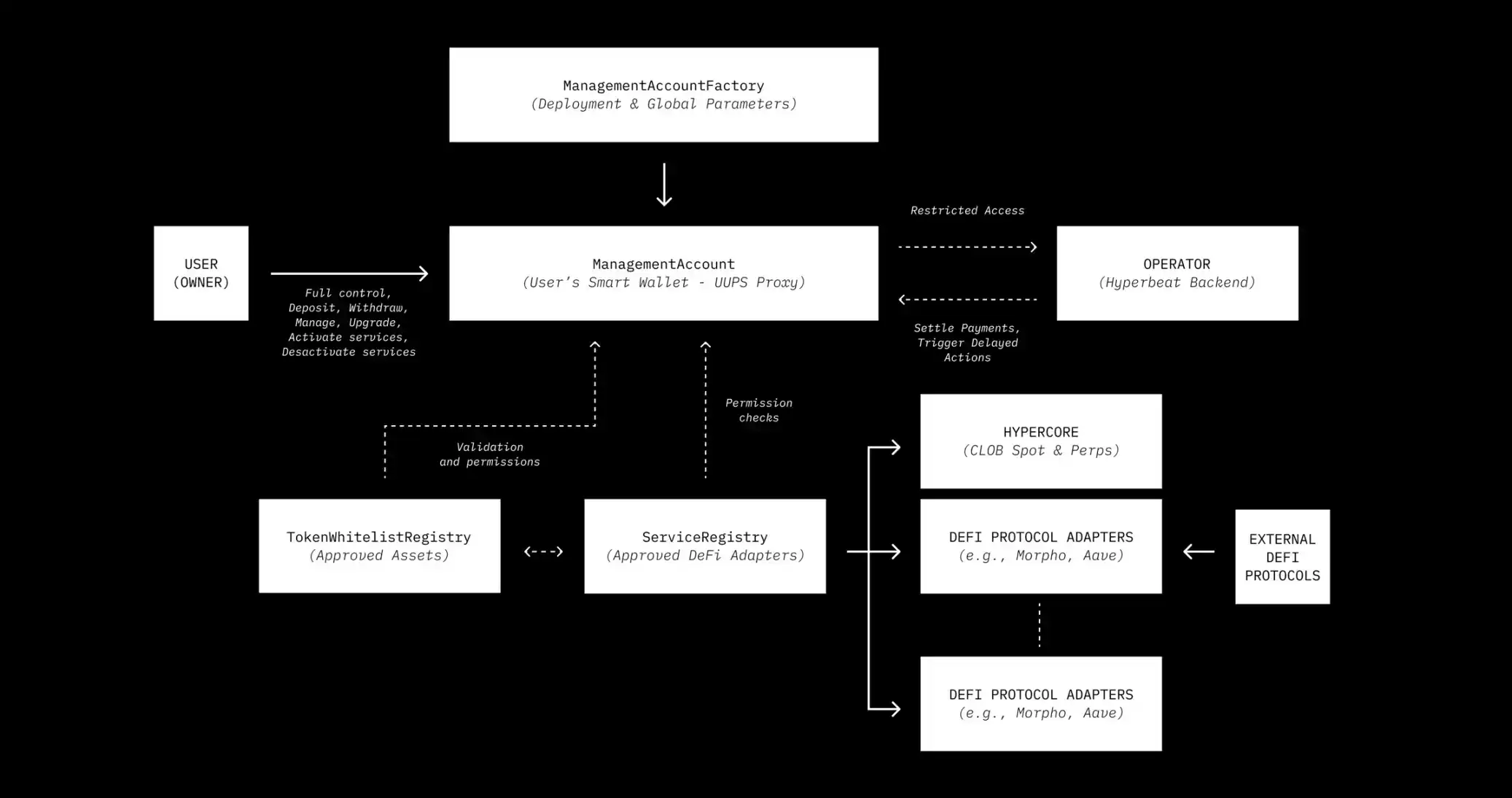
Unlike all centralized crypto cards, user assets always remain in their self-controlled ManagementAccount smart wallet. The Hyperbeat backend only has a restricted Operator role, able to execute settlements only within user-set limits and unable to transfer assets to unauthorized addresses.

But self-custody must solve one problem: what if a user withdraws funds right after swiping the card? Hyperbeat introduces an on-chain timelock mechanism.

Withdrawing settlement tokens requires a cooling period and a confirmation process. Withdrawing collateral requires Operator approval to prevent bad debt. Switching modes also has a delay. The contracts were audited by Zellic and Nethermind, with key management provided by Turnkey.

These frictions are not a bug; they are a feature. They acknowledge the speed difference between on-chain settlement and offline consumption, filling the gap with contract rules rather than 'please believe us.' But users must monitor their health factor themselves; there is no customer service to undo operational mistakes.


Trending Cryptos

Related Questions

QWhat is the core feature of Hyperbeat's Liquid Banking product launched on Hyperliquid?

AThe core feature is Credit Mode, which allows users to spend stablecoins borrowed instantly via Morpho Blue markets using their crypto assets as collateral, all within a single on-chain smart wallet without manually interacting with a lending interface.

QWhich companies were the lead investors in Hyperbeat's $5.2 million seed round and what was the valuation?

AThe seed round was co-led by ether.fi Ventures and Electric Capital, with participation from CoinBase Ventures, Maelstrom, and Anchorage Digital, valuing the company at approximately $40 million.

QHow does Hyperbeat's Credit Mode generate yield for stablecoin depositors?

AYield is generated from the real borrowing interest paid by consumers using Credit Mode. User deposits are automatically allocated to protocols like Morpho, Hypuur, Hyperlend, and Felix, with the interest from spending/borrowing flowing back to the reward program and ultimately to depositors.

QWhat is a key operational difference and potential cost for users of the Hyperbeat VISA card compared to traditional credit cards?

AA key difference is that there is no interest-free grace period. Borrowing interest starts accruing from the very second a transaction is made, and the rate is dynamically determined by the Morpho market's utilization.

QWhat is a key security feature and its associated user trade-off in Hyperbeat's self-custody model?

AA key security feature is the on-chain timelock and cooldown period for withdrawing settled tokens or collateral, which prevents bad debt but introduces a delay (e.g., a one-day cooldown) and requires users to actively manage their health factor without the ability for customer support to reverse mistakes.

Related Reads

Amidst Capital's Encirclement, Decentralization is the Sole Defense for Public Blockchains

In a landscape dominated by power and profit motives, the author argues that decentralization is not merely one desirable feature among many in blockchain design—it is the singular, non-negotiable defense against corporate and capital capture. The article adopts a Machiavellian, realist perspective on human institutions, positing that businesses will inevitably attempt to co-opt any valuable network to protect their profits and dominance. While external attacks like 51% forks are often discussed, the greater existential risk is internal capture—the gradual erosion of a protocol’s neutrality by vested interests, as seen historically with platforms like Visa and Google. The piece critiques permissioned chains, highly centralized “permissionless” layer-1s, and layer-2s without sufficient decentralization (e.g., single sequencers) as inherently vulnerable. These compromised systems, promoted by established financial players, are framed as delaying tactics to stifle truly open networks that threaten existing high-fee, inefficient business models. Real-world examples, such as closed enterprise consortiums that exclude competitors, illustrate how such systems cement oligopolies rather than foster innovation. The author concludes that while decentralized protocols like Ethereum are imperfect and costly to operate, they represent the only viable long-term equilibrium. In a market where value naturally flows to the most secure and neutral settlement layer, only maximally decentralized public blockchains can resist being subsumed by capital and powerful incumbents.

Foresight News11m ago

Amidst Capital's Encirclement, Decentralization is the Sole Defense for Public Blockchains

Foresight News11m ago

Who Decides the Rules of Bitcoin? BIP-110 Ignites Governance Debate

Bitcoin's governance is once again at the center of a heated debate, this time ignited by BIP-110, the "Reduced Data Temporary Softfork." This proposal aims to curb non-monetary data (like inscriptions and Runes) by introducing seven new consensus-layer restrictions over a year, such as limiting new output scripts to 34 bytes and restoring the OP_RETURN cap to 83 bytes. The controversy stems from BIP-110's fundamental shift: it moves the battle against "spam" from node relay and miner policies to the consensus layer, rendering currently valid transactions invalid. Supporters, arguing that default policy governance has failed (highlighted by Bitcoin Core v30's relaxation of OP_RETURN limits), see this as necessary to protect node resources and Bitcoin's monetary focus. Opponents, led by figures like Michael Saylor and Adam Back, warn it dangerously centralizes governance. Saylor listed 110 reasons against it, criticizing its low 55% miner activation threshold and potential for chain splits. Back emphasized Bitcoin's "permissionless" ethos, arguing no single group should impose value judgments via consensus rules. Further complicating matters, technical critiques suggest BIP-110 may be technically circumventable, and a "BlockSlop" vulnerability in its upgrade path poses a consensus risk. The debate has drawn in diverse stakeholders: miners (with pools like Ocean signaling support and Foundry polling clients), node operators (like Bitcoin Knots), and new players like corporate treasury holder MicroStrategy (Saylor), whose market influence adds a novel dimension. Ultimately, BIP-110 acts as a governance stress test, exposing the unresolved question: who decides Bitcoin's rules? It pits the authority of miners, node operators, developers, and capital holders against each other, with each side claiming to defend Bitcoin's core principles of neutrality and security.

marsbit28m ago

Who Decides the Rules of Bitcoin? BIP-110 Ignites Governance Debate

marsbit28m ago

Who Decides Bitcoin's Rules? BIP-110 Ignites Governance Debate

Title: Who Decides Bitcoin's Rules? BIP-110 Ignites Governance Debate A new technical proposal, BIP-110 (Reduced Data Temporary Softfork), has sparked a fundamental governance debate within the Bitcoin community. It aims to impose new consensus rules for one year to limit non-financial data (like inscriptions and Runes) on-chain, moving beyond simple node and miner policy filters to invalidate currently valid transactions. Supporters argue that default policies have failed due to workarounds, necessitating consensus-layer changes to protect Bitcoin's core monetary function from data spam. Critics, including Michael Saylor and Adam Back, contend this dangerously centralizes judgment, undermines permissionlessness, and sets a risky governance precedent. They advocate for market-based solutions like fees or Layer 2s instead. The debate exposes deeper tensions: miners are divided on activation; node operators assert their sovereignty; Bitcoin Core developers influence defaults without direct accountability; and large corporate holders like MicroStrategy now wield narrative influence. Technically, BIP-110 may not fully block data and carries a disclosed consensus bug risk. Ultimately, BIP-110 acts as a stress test, forcing the community to confront the unresolved question: who legitimately decides what Bitcoin is and how it evolves, amidst competing claims from miners, nodes, developers, and capital holders.

链捕手40m ago

Who Decides Bitcoin's Rules? BIP-110 Ignites Governance Debate

链捕手40m ago

Zcash's New Node Zakura Goes Live: Privacy Payments Can Reach 50,000 TPS, Aiming to Rival Visa and Mastercard

Zcash, a privacy-focused cryptocurrency, has launched a new full node software called Zakura version 1.0.0. Developed by Zcash co-founder Sean Bowe and Dev Ojha, with private ZEC donations, its goal is to enable Zcash to process over 50,000 transactions per second (TPS)—matching the scale of Visa and Mastercard—while maintaining full transaction privacy and verifiability. This addresses a key bottleneck, as Zcash currently handles only about 1 private transaction per second. Zakura is a fork of the Zcash Foundation's Zebra node. It features chain pruning and snapshots, reducing disk usage and allowing new nodes to sync in under two minutes. It also offers compatibility with the legacy `zcashd` client interface. The scalability challenge stems from the large data size of privacy proofs. Bowe's Tachyon project aims to use recursive proofs to reduce consensus-layer data needs from ~500 MB/s to ~100 MB/s. For wallet scalability, Valar Group is researching Private Information Retrieval (PIR) tech to allow wallets to fetch their data privately. Zakura supports fast block propagation and the upcoming "Ironwood" network upgrade (NU6.3), scheduled for activation around July 28th. Ironwood was created to contain a critical inflation bug discovered in the Orchard shielded pool in May 2024. The fix uses "turnstiles" to trap any counterfeit ZEC created during the vulnerability period within the shielded pool, preventing it from entering circulation and restoring supply integrity.

marsbit54m ago

Zcash's New Node Zakura Goes Live: Privacy Payments Can Reach 50,000 TPS, Aiming to Rival Visa and Mastercard

marsbit54m ago

Trading

Spot

Hot Articles

What is $BANK

Bank AI: A Revolutionary Step in the Future of Banking Introduction In an era marked by rapid advancements in technology, Bank AI stands at the intersection of artificial intelligence (AI) and banking services. This innovative project seeks to redefine the financial landscape, enhancing operational efficiency, security measures, and customer experiences through the power of AI. As we embark on this exploration of Bank AI, we will delve into what the project entails, its operational dynamics, its historical context, and significant milestones. What is Bank AI? At its core, Bank AI represents a transformative initiative aimed at integrating artificial intelligence into various banking operations. This project harnesses the capabilities of AI to automate processes, improve risk management protocols, and enhance customer interaction through personalised services. The primary objectives of Bank AI include: Automation of Banking Functions: By leveraging AI technologies, Bank AI aims to automate routine tasks, reducing the burden on human resources and enhancing efficiency. Enhanced Risk Management: The project utilises AI algorithms to predict and identify risks, thereby fortifying security measures against fraud and other threats. Personalisation of Banking Services: Bank AI focuses on offering tailored financial products and services by analysing customer data and behaviours. Improving Customer Experience: The implementation of AI-driven solutions, such as chatbots and virtual assistants, aims to provide users with more human-like interactions, revolutionising the way customers engage with banks. With these goals, Bank AI positions itself as a crucial player in rendering banking more efficient, secure, and user-centric. Who is the Creator of Bank AI? Details regarding the creator of Bank AI remain unknown. As such, no specific individual or organisation has been identified in the available information. The anonymity surrounding the project's inception raises questions but does not detract from its ambitious vision and objectives. Who are the Investors of Bank AI? Similar to the project's creator, specific information regarding the investors or supporting organisations of Bank AI has not been disclosed. Without this information, it is challenging to outline the financial backing and institutional support that might be propelling the project forward. Nevertheless, the importance of having a robust investment foundation is pivotal for sustaining development in such an innovative field. How Does Bank AI Work? Bank AI operates on several innovative fronts, focusing on unique factors that differentiate it from traditional banking frameworks. Below are key operational features: Automation: By applying machine learning algorithms, Bank AI automates various manual processes within banks. This results in reduced operational costs and allows human workers to redirect their efforts towards more strategic activities. Advanced Risk Management: The integration of AI into risk management practices equips banks with tools to accurately predict potential threats such as fraud, ensuring that customer information and assets remain secure. Tailored Financial Recommendations: Through continuous learning from customer interactions, the AI systems develop a nuanced understanding of user needs, enabling them to offer tailored advice on financial decisions. Enhanced Customer Interactions: Utilizing chatbots and virtual assistants powered by AI, Bank AI enables a more engaging customer experience, allowing users to have their queries resolved quickly, thus reducing wait times and improving satisfaction levels. Together, these operational features position Bank AI as a pioneer in the banking sector, establishing new benchmarks for service delivery and operational excellence. Timeline of Bank AI Understanding the trajectory of Bank AI requires a look at its historical context. Below is a timeline highlighting important milestones and developments: Early 2010s: The conceptualisation of AI integration into banking services began to gain attention as banking institutions recognised the potential benefits. 2018: A marked increase in the implementation of AI technologies occurred when banks started using AI tools like chatbots for basic customer service and risk management systems for improved security handling. 2023: The sophistication of AI continued to advance, with generative AI being introduced for more complex tasks such as document processing and real-time investment analysis. This year marked a significant leap in the capabilities afforded to banks by AI technology. 2024-Current Status: As of this year, Bank AI is on an upward trajectory, with ongoing research and developments poised to further enhance capabilities in banking operations. Continued exploration of AI applications hints at exciting developments yet to come. Key Points About Bank AI Integration of AI in Banking: Bank AI focuses on adopting artificial intelligence to streamline banking processes and improve user experiences. Automation and Risk Management Focus: The project strongly emphasises these areas, aiming to shift the burden of routine tasks while enhancing security frameworks through predictive analytics. Personalised Banking Solutions: By harnessing customer data, Bank AI enables tailored banking services that cater to individual user needs. Commitment to Development: Bank AI remains committed to ongoing research and development efforts, ensuring its adaptability and ongoing relevance as technology continues to evolve. Conclusion In summary, Bank AI exemplifies a crucial step forward in the banking industry, leveraging artificial intelligence to reshape operational paradigms, enhance security, and promote customer satisfaction. Despite gaps in information surrounding the creator and investors, the clear objectives and functional mechanisms of Bank AI provide a strong foundation for its ongoing evolution. As AI technology continues to advance and merge with the banking sector, Bank AI is well-positioned to significantly impact the future of financial services, enhancing the way we understand and interact with banking.

203 Total ViewsPublished 2024.04.06Updated 2024.12.03

What is $BANK

Discussions

Welcome to the HTX Community. Here, you can stay informed about the latest platform developments and gain access to professional market insights. Users' opinions on the price of BANK (BANK) are presented below.

活动图片