HSBC Bank and Anchorpoint Financial win Hong Kong’s first stablecoin licenses – Details

ambcryptoPublished on 2026-04-10Last updated on 2026-04-10

Abstract

Hong Kong has issued its first stablecoin licenses to institutional, bank-backed entities HSBC Bank and Anchorpoint Financial (backed by Standard Chartered, Animoca Brands, and HKT). This marks the formal launch of the city's strict stablecoin regulatory framework, which prioritizes established players with strong compliance, capital reserves, and regulatory respect. The cautious, limited approval process may slow broader market participation and innovation in the near term but is designed to ensure user protection, risk management, and overall trust. The regime, which came into effect in August 2025, includes stringent rules on reserves, governance, and anti-money laundering controls.

Hong Kong has granted its first stablecoin issuer licenses. The initial batch is small and institutional, which sets a cautious tone.

Here’s what you need to know.

Bank-backed issuers dominate first approvals

The first stablecoin licenses went to Anchorpoint Financial and HSBC’s Hong Kong banking arm, both well-known TradFi players. Anchorpoint itself is backed by Standard Chartered, Animoca Brands, and HKT.

The initiative is happening under a new framework, led by the Hong Kong Monetary Authority (HKMA). Both entities are set to begin operations in the coming months.

These approvals are the formal launchpad for the city’s stablecoin regime, which took effect in August 2025.
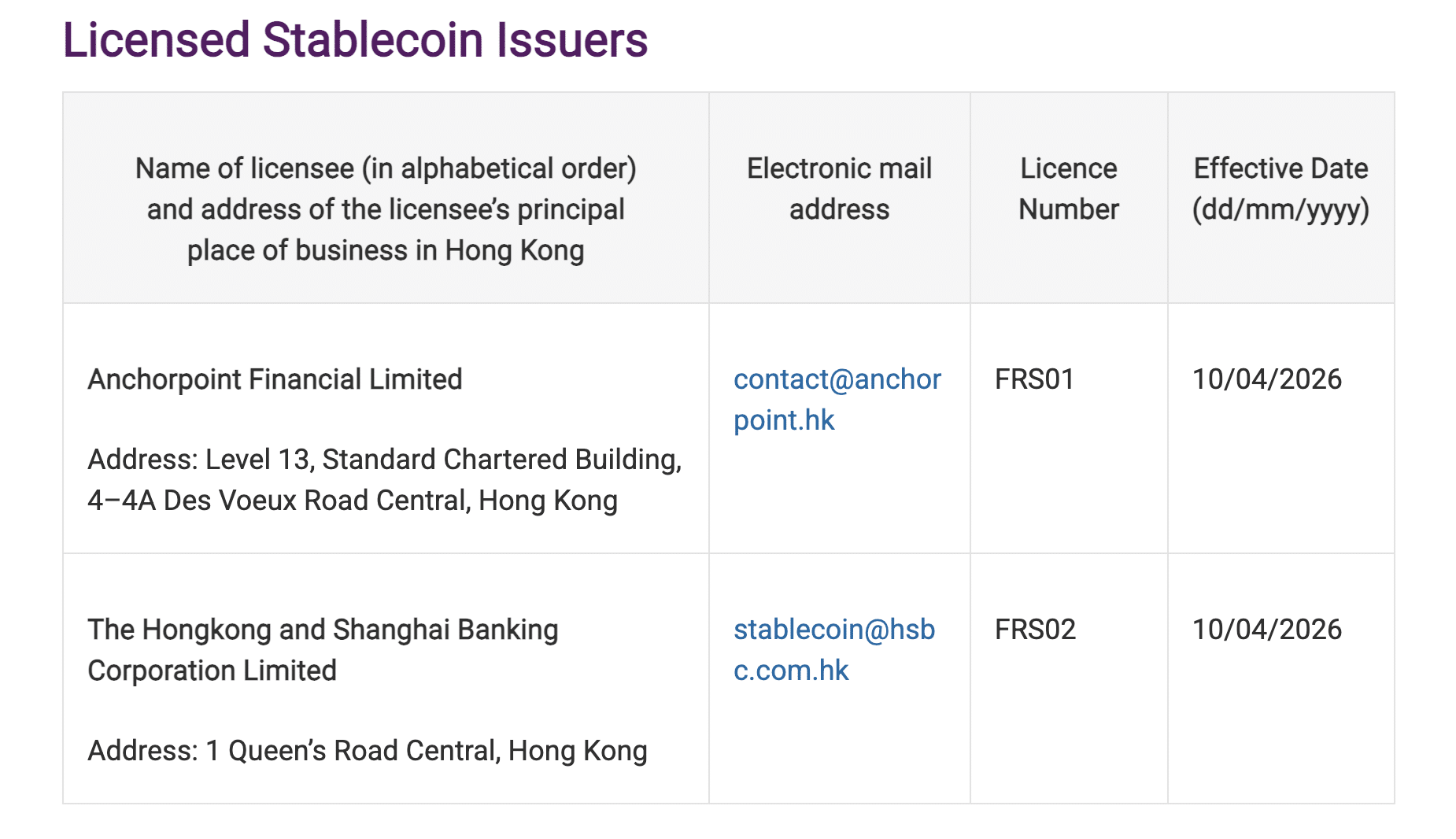
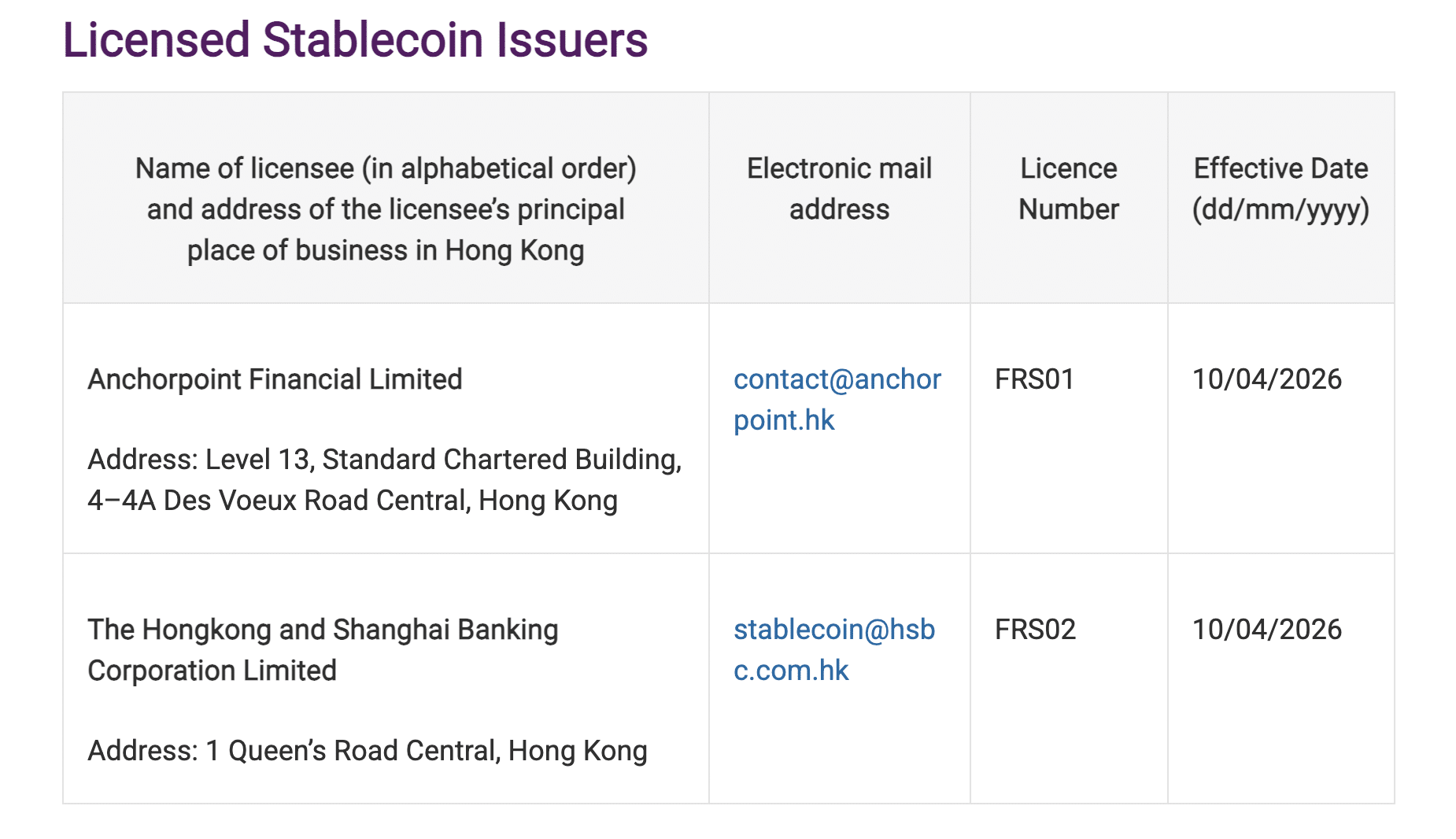
Source: HKMA

They’re prioritizing entities with established compliance systems, capital backing, and regulatory respect.

HKMA Chief Executive Eddie Yue stated that the regime would provide –

An orderly operating environment... while ensuring robust user protection and effective risk management.

AMBCrypto previously reported that Hong Kong expanded its licensing regime to cover crypto dealers and custodians. This brought trading and asset storage under the same regulatory perimeter.

The announcement came after a delayed timeline

The HKMA had earlier stated that initial licenses could be issued as early as March. However, approvals only materialized in April.

This is in line with the regime itself, with its strict requirements on reserve backing, redemption mechanisms, governance, and AML controls. The framework also lays out enforcement powers, including fines and license revocations.

Institutions first, broader access later?

In the near term, Hong Kong’s stablecoin market is likely to remain held by institutional players. Limited licenses and stringent compliance thresholds will slow participation from crypto-native firms.

It will certainly increase trust and stability among the masses, but early innovation impediment is a concern. The key question in time, will be whether the HKMA expands access or maintains a bank-led model.


Final Summary

  • Hong Kong’s first stablecoin licenses go to bank-backed players.
  • Strict rules and limited approvals could slow innovation but increase trust.

Related Questions

QWhich two companies received Hong Kong's first stablecoin licenses?

AHSBC's Hong Kong banking arm and Anchorpoint Financial received the first stablecoin licenses.

QWhich regulatory authority is leading the new stablecoin framework in Hong Kong?

AThe Hong Kong Monetary Authority (HKMA) is leading the new stablecoin framework.

QWhat are some of the key requirements of Hong Kong's stablecoin regime?

AThe regime has strict requirements on reserve backing, redemption mechanisms, governance, and Anti-Money Laundering (AML) controls.

QWhat is a potential concern regarding the new licensing approach according to the article?

AA potential concern is that limited licenses and stringent compliance could slow participation from crypto-native firms and create an early innovation impediment.

QWhen did Hong Kong's stablecoin regulatory regime officially take effect?

AThe stablecoin regulatory regime took effect in August 2025.

Related Reads

NVIDIA Begins Adding Soap to the Bubble

NVIDIA is taking on a dual role: not just as a leading chip supplier, but as a massive capital allocator across the entire AI supply chain. In 2026, the company has committed over $40 billion in investments within five months, targeting everything from optical fiber manufacturing and data center operations to foundational AI model development. This investment spree, described as a systematic "sprinkler" approach, primarily funds companies that are major buyers of NVIDIA's own GPUs. Critics, including analysts from Goldman Sachs, label this a "circular revenue" loop—comparable to a supplier financing a customer to buy more of its products. A prominent example is NVIDIA's investment in OpenAI, which is expected to generate around $13 billion in revenue for NVIDIA, much of which may be reinvested back into OpenAI. While CEO Jensen Huang dismisses the "circular financing" critique as "absurd," arguing the investments are confidence votes in long-term generational shifts, some analysts express discomfort. They note that while investments in critical supply chain components like optics are strategically sound, funding new cloud providers like CoreWeave feels like "pre-paying for your own GPUs." The strategy carries significant risks. If the AI investment cycle turns, the market may question how much demand is genuine versus artificially sustained by NVIDIA's own balance sheet. Despite posting record-breaking earnings—$215.9 billion in annual revenue and $120 billion in net profit for FY2026—NVIDIA's stock fell after its report, signaling that "beating expectations" may no longer be enough to assure investors about the duration of the AI spending boom. The article concludes that while a bubble isn't necessarily a fraud, NVIDIA's actions resemble adding soap to a bubble—making it appear more robust and durable. This creates a complex scenario requiring extreme冷静 from investors to distinguish between real structural growth and financial engineering.

marsbit11m ago

NVIDIA Begins Adding Soap to the Bubble

marsbit11m ago

Short Positions Have Been Squeezed Out: Will the Next Leg of the U.S. Stock AI Rally Continue in Seoul?

"Short Squeeze Exhausted: Will the Next Leg of the AI Rally Continue in Seoul?" A Nomura report suggests the US AI stock rally, which saw the S&P 500 rise ~16.6% in 28 days largely driven by 10 key stocks, may be pausing. The fuel from short covering, CTA fund positioning, and volatility-control strategies is nearing its limit. For the rally to continue, new momentum from retail and sentiment-driven FOMO (Fear Of Missing Out) is needed. South Korea's market provided a potential answer on the very day the report was published. The KOSPI index surged 4.32%, triggering a buy-side circuit breaker, led by massive gains in chip giants SK Hynix (+11.98%) and Samsung. This surge is characterized by retail "hynix FOMO" and overseas funds precisely buying into AI themes via chip-focused ETFs, shifting from broad Korean market ETFs. The Korean rally is a high-beta extension of the US AI capital expenditure story, as major cloud providers plan massive infrastructure spending, directly benefiting memory chip leaders. However, this linkage also implies vulnerability. The sustainability of this next leg depends on whether US tech stocks correct, the trajectory of US inflation (with upcoming CPI data key), and geopolitical tensions around the Strait of Hormuz. Seoul has emerged as the new epicenter of the AI trade, but its fate remains tied to these broader macro and market dynamics.

marsbit16m ago

Short Positions Have Been Squeezed Out: Will the Next Leg of the U.S. Stock AI Rally Continue in Seoul?

marsbit16m ago

Borrowing Money from a Hundred Years Later, Building Incomprehensible AI

Tech giants like Alphabet, Amazon, Meta, and Microsoft are undergoing a radical financial transformation due to AI. Their traditional "light-asset, high-free-cash-flow" model is being dismantled by staggering capital expenditures on AI infrastructure—data centers, GPUs, and power. Combined 2026 guidance exceeds $700 billion, a 4.5x increase from 2022, causing free cash flow to plummet (e.g., Amazon's fell 95%). To fund this, they are borrowing unprecedented sums through long-dated, multi-currency bonds (e.g., Alphabet's 100-year bond). The world's most conservative capital—pensions, insurers—is now funding Silicon Valley's most speculative bet. This shift makes these companies resemble heavy-asset industrials (railroads, utilities) rather than software firms, threatening their premium valuations. Historically, such infrastructure booms (railroads, fiber optics) followed a pattern: genuine technology, overbuilding fueled by competitive frenzy, aggressive debt financing, and a crash triggered by financial conditions—not technology failure. The infrastructure remained, but many original builders and financiers did not survive. The core gamble is a "time arbitrage": using cheap debt today to build scale and lock in customers before AI capabilities commoditize. They are betting that AI revenue will materialize before debt comes due. Their positions vary: Amazon is under immediate cash pressure; Meta's path to monetization is unclear; Alphabet has a robust core business buffer; Microsoft has the shortest path from infrastructure to revenue. The contract is set: the most risk-averse global capital has lent its time to Silicon Valley, awaiting a future that is promised but uncertain.

marsbit1h ago

Borrowing Money from a Hundred Years Later, Building Incomprehensible AI

marsbit1h ago

Trading

Spot
Futures

Hot Articles

How to Buy WIN

Welcome to HTX.com! We've made purchasing WINkLink (WIN) simple and convenient. Follow our step-by-step guide to embark on your crypto journey.Step 1: Create Your HTX AccountUse your email or phone number to sign up for a free account on HTX. Experience a hassle-free registration journey and unlock all features.Get My AccountStep 2: Go to Buy Crypto and Choose Your Payment MethodCredit/Debit Card: Use your Visa or Mastercard to buy WINkLink (WIN) instantly.Balance: Use funds from your HTX account balance to trade seamlessly.Third Parties: We've added popular payment methods such as Google Pay and Apple Pay to enhance convenience.P2P: Trade directly with other users on HTX.Over-the-Counter (OTC): We offer tailor-made services and competitive exchange rates for traders.Step 3: Store Your WINkLink (WIN)After purchasing your WINkLink (WIN), store it in your HTX account. Alternatively, you can send it elsewhere via blockchain transfer or use it to trade other cryptocurrencies.Step 4: Trade WINkLink (WIN)Easily trade WINkLink (WIN) on HTX's spot market. Simply access your account, select your trading pair, execute your trades, and monitor in real-time. We offer a user-friendly experience for both beginners and seasoned traders.

4.8k Total ViewsPublished 2024.03.29Updated 2025.03.21

How to Buy WIN

Discussions

Welcome to the HTX Community. Here, you can stay informed about the latest platform developments and gain access to professional market insights. Users' opinions on the price of WIN (WIN) are presented below.

活动图片













