How Can War News Turn into Millions in Profits a Step Ahead?

比推Published on 2026-03-02Last updated on 2026-03-02

Abstract

The article "How War News Turns into Millions in Profits" explores the rise of prediction markets like Polymarket and Kalshi as digital arenas for wagering on geopolitical events, using the hypothetical U.S.-Israel airstrike on Iran on February 28, resulting in the death of Iran’s Supreme Leader Ali Khamenei, as a case study. These platforms saw surging trading volumes, with Polymarket’s market on "Will Khamenei be ousted by February 28?" reaching $95.93 million in daily volume. While Polymarket operates with anonymity and a profit-based fee model, Kalshi faced controversy for refusing to fully pay out on contracts tied to deaths, citing ethical concerns. The piece also highlights suspicions of insider trading, with some wallets making highly timed, profitable bets ahead of the strike. The trend raises questions about morality, market manipulation, and the need for stricter regulation as prediction markets blur the lines between real-world conflict and digital profit-seeking.

Author: Ma He, Foresight News

Original Title: Prediction Platforms Are Becoming the Digital Battlefield of Postmodern Warfare


On February 28, the United States and Israel jointly launched an airstrike against Iran, resulting in the death of Iran's Supreme Leader Ali Khamenei. This attack shook Middle Eastern geopolitics. In the 21st century, the flames of war continue to spread everywhere, and its impact has also stirred up huge waves in the prediction markets of the crypto world.

Polymarket and Kalshi became another "battlefield" outside the actual war zone. Traders placed bets on the timing of the attack, regime change, and ceasefire dates, with trading volumes soaring to astronomical figures.

In war, some are always quietly making a fortune.

Polymarket became a "barometer" of the conflict. Since last December, they had set up a market for "When will the US strike Iran?" covering various date options.

The prediction market "Will Khamenei step down by February 28?" saw a daily trading volume of $95.93 million on February 28, becoming one of the platform's largest geopolitical markets ever. Its trading volume reached $54.15 million on March 31.
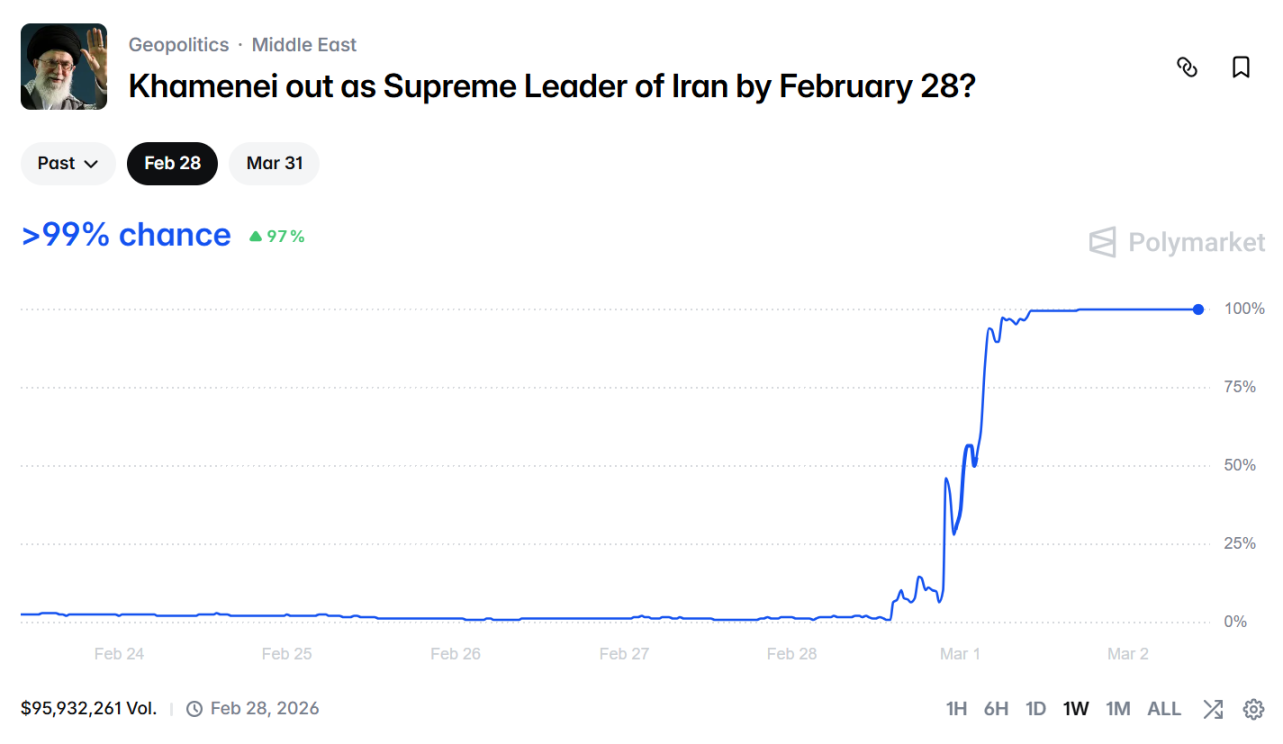
After the attack was confirmed, this market quickly settled to "Yes" (it is still in the final dispute period), as Khamenei's death directly led to him "stepping down."

Although Polymarket currently does not charge any transaction fees for the vast majority of its regular markets (including all political, geopolitical, pop culture, and long-term macro events), in early 2026, Polymarket introduced fees for specific high-frequency trading markets. The expansion of its brand influence has a significantly positive impact on its revenue growth.

Furthermore, the global version of Polymarket uses a profit-based fee model. Its core logic is: users do not need to pay fees when placing buy or sell orders daily, but when users close a position for profit, the platform charges a 2% fee on the net profit. This model only taxes the "winners."

Taking the example in the image, if the total net profit of the winners is $10 million, the income from this single prediction market alone would reach $200,000.

Traders flocked there not only for the thrill but also because these markets reflect news in real time—much faster than traditional media. As soon as news of the attack broke, contract prices instantly jumped, demonstrating the market's "efficiency."

There are always winners in war. In the past, those who profited from conflicts were often arms dealers, oil giants, or intelligence peddlers—think of Lockheed during World War II or the oil tycoons during the Cold War, who made fortunes through contracts and resource monopolies. Ordinary people? At best, they were bystanders; war meant loss and uncertainty for them. But now, crypto prediction markets have颠覆ed this landscape. Platforms like Polymarket allow retail investors to also bet on geopolitical events, from the date of US-Iran airstrikes to the probability of regime change, sharing a piece of the pie with just a few clicks.

However, participating in this game also blurs ethical boundaries. This shift is striking: the "dividends" of war have spread from the physical supply chain to the digital gambling table. Arms dealers are still making money, but prediction markets have turned ordinary users into new players. They don't produce missiles, but they can "predict" explosions on the blockchain and profit handsomely.

When conflicts escalate, platform trading volumes explode; the war economy has gone digital.

But this also raises many questions—does the thrill of making money dilute compassion for real suffering?

Kalshi, as another player, also got a share of the pie. Their "Will Khamenei step down?" market had a trading volume of tens of millions of dollars (slightly varying by source). On the day of the attack, trading volume in this market surged, reaching tens of millions of dollars in a single day.

But Kalshi's handling of the situation sparked controversy. A clause in the platform's rules states "no settlement on death," meaning that if stepping down is due to death, the "Yes" contract will not be paid in full.

After the attack, Kalshi suspended the market. CEO Tarek Mansour posted on X to explain: they oppose profiting from an individual's death, so they would settle at the last traded price before the death and refund all fees in full. Mansour emphasized that this was to uphold "moral bottom lines" and avoid the platform becoming a "death betting pool." Some users complained that this was like changing the rules mid-game, but Kalshi insisted this was a pre-set term, with details clarified just the day before the attack.
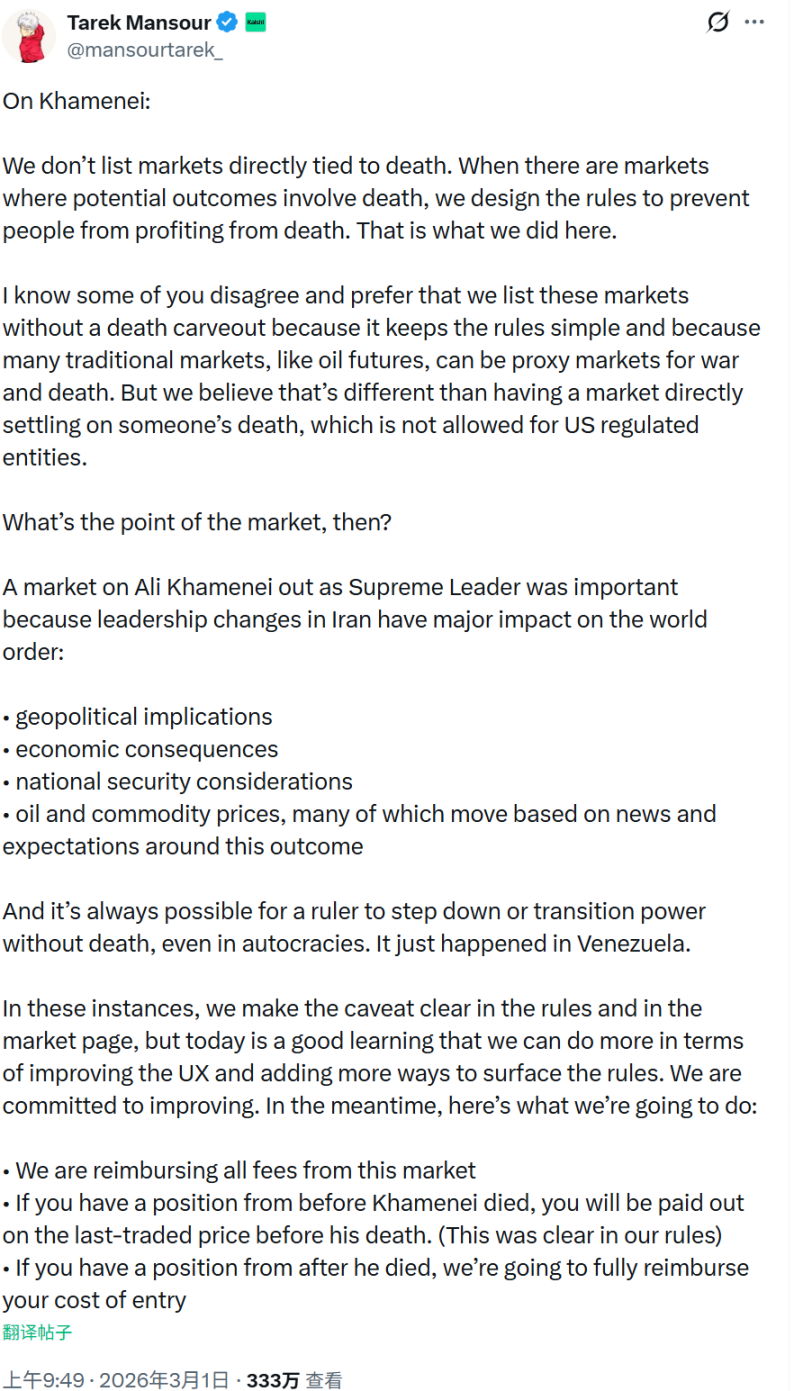
As a result, the platform lost money but gained a reputation for "not making money from the dead."

Polymarket has high user anonymity, attracting global funds; Kalshi is more compliant but restricts markets related to war and assassination.

However, while most players bet based on gut feeling, some insiders are also quietly making a fortune.

On Polymarket, the timing of some accounts' bets was so precise that it raised suspicions of insider trading. Blockchain analysis company Bubblemaps discovered that six newly created wallets placed bets on a US strike against Iran on February 28 just hours before the attack, collectively profiting about $1 million.
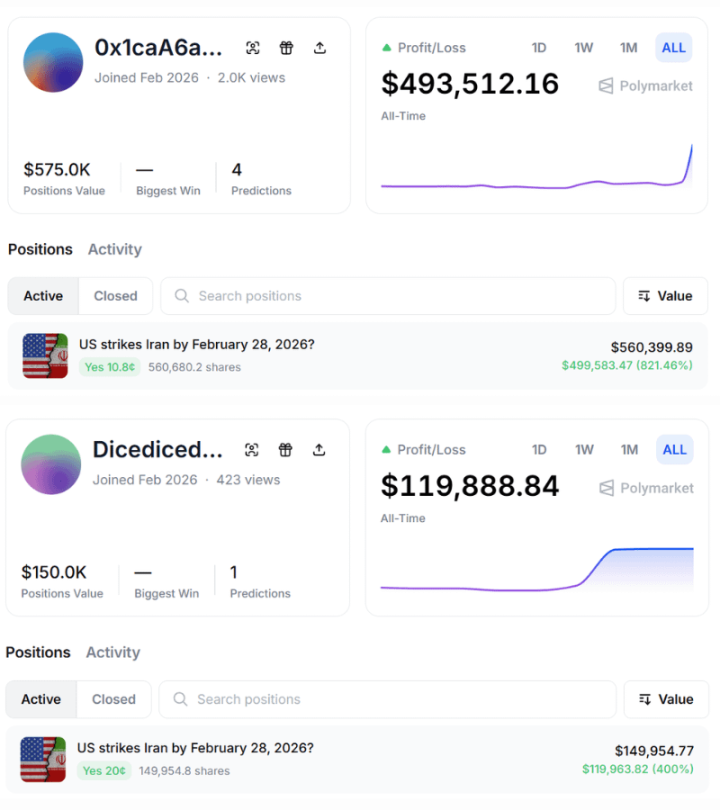
These 6 wallets were all created in February of this year. Almost all their trading was concentrated on contracts predicting the timing of the US military strike. Some positions were established hours before the first news of explosions emerged from Tehran, with contract purchase prices as low as around $0.10. Analysts stated that such concentrated betting behavior before major geopolitical events is characteristic of "suspected insider trading" previously seen in prediction markets.

However, the report also pointed out that the related accounts had incurred losses in other predictions before, and the US government had publicly warned weeks earlier that military action was possible. Therefore, the timing of the trades alone is not sufficient to directly prove illegal activity.

These are not isolated cases. Polymarket has faced similar质疑 in the past, such as during the 2024 Super Bowl or the Venezuela incident. But this time the scale is larger, involving national security. The CFTC has warned about insider trading in the past, and Kalshi recently penalized famous YouTube creator MrBeast's team editor, Artem Kaptur, for insider trading. Polymarket operates overseas with loose regulation, becoming a gray area.

US Representative Ritchie Torres is promoting legislation called the "2026 Public Integrity in Financial Prediction Markets Act," which aims to restrict government officials with access to non-public information from trading on related prediction markets. Meanwhile, Polymarket has faced regulatory restrictions or bans in multiple countries in recent years, including the Netherlands, France, Italy, and Singapore.

Of course, not everyone won. Many bet on the wrong date and suffered heavy losses. Currently, Polymarket has updated its website's top display, pinning all prediction markets related to the Iran situation to the top.
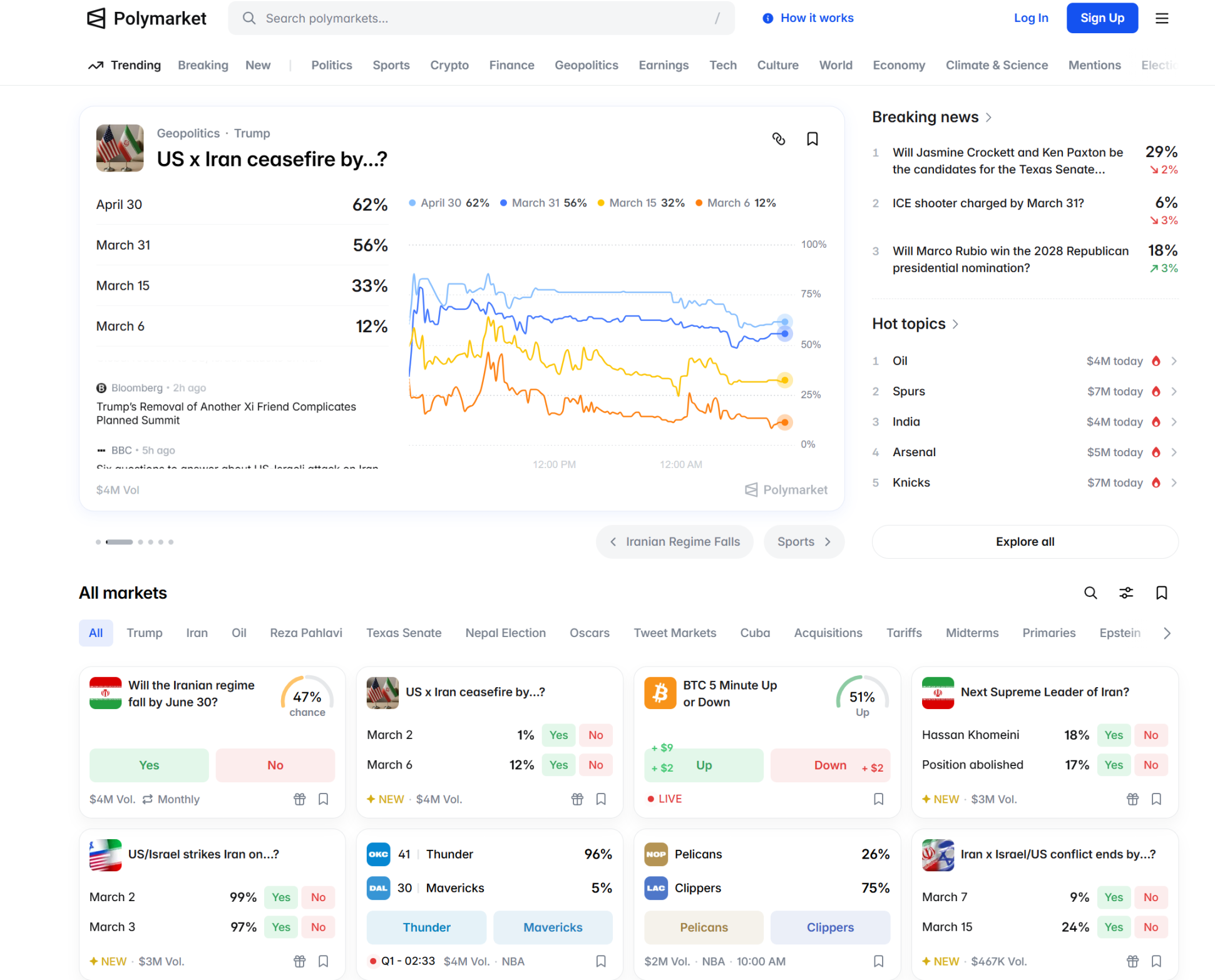
Overall, this "war profit" exposed the double-edged sword of prediction markets: on one hand, they provide real-time data intelligence and insights; on the other hand, they are easily manipulated or exploited with insider information.

Under the trend of "everything can be bet on," future betting in prediction markets may require stricter regulation and clearer rules. After all, the stakes are real money, but behind them are real lives.


Twitter:https://twitter.com/BitpushNewsCN

Bitpush TG Discussion Group:https://t.me/BitPushCommunity

Bitpush TG Subscription: https://t.me/bitpush

Original link:https://www.bitpush.news/articles/7615813

Related Questions

QWhat are the two main prediction markets discussed in the article that saw massive trading volumes related to the US-Israel airstrike on Iran?

AThe two main prediction markets discussed are Polymarket and Kalshi.

QHow does Polymarket's global version generate revenue from its users?

APolymarket's global version uses a profit-based fee model, charging users a 2% fee on their net profits only when they close a winning position, effectively taxing only the 'winners'.

QWhat controversial action did Kalshi take regarding its market on 'Whether Khamenei would step down' after the airstrike, and why?

AKalshi paused its market and settled it based on the last trading price before the event, citing a pre-existing 'no settlement on death' clause. The CEO stated this was to uphold moral standards and avoid profiting from an individual's death.

QWhat evidence suggests potential insider trading on Polymarket related to the airstrike?

ABlockchain analysis firm Bubblemaps found six newly created wallets that placed bets on the US striking Iran on February 28th just hours before the attack, collectively profiting approximately $1 million.

QWhat legislative action is mentioned in the article as a response to concerns about prediction markets?

AUS Representative Ritchie Torres is promoting legislation called the '2026 Financial Prediction Market Public Integrity Act,' which aims to restrict government officials with non-public information from trading on such prediction markets.

Related Reads

380,000 Apps Exposed, 2,000+ Apps Leaked Secrets: AI Programming Turns 'Intranet' into Public Internet

Israeli cybersecurity firm RedAccess uncovered a severe data exposure trend linked to "vibe coding" or AI-powered software development tools. Their research found approximately 38,000 publicly accessible web applications built with platforms like Lovable, Base44, Netlify, and Replit. Of these, an estimated 2,000 apps exposed sensitive corporate and personal data, including medical records, financial information, internal strategic documents, and customer chat logs. In some cases, access even granted administrative privileges. The core issue stems from default privacy settings that make applications public by default, combined with a lack of built-in security controls (like authentication) in the AI-generated code. This allows employees without security expertise—"citizen developers"—to easily create and deploy applications that bypass standard corporate security reviews. The exposed apps, often indexed by search engines, are trivially discoverable. While some platform providers (Replit, Lovable, Wix/Base44) argue that security configuration is the user's responsibility and question the validity of some findings, security researchers confirm the widespread reality of such exposures. This pattern, also noted in prior studies, highlights a critical security gap as AI democratizes app creation, potentially leading to massive, unintentional data leaks.

marsbit34m ago

380,000 Apps Exposed, 2,000+ Apps Leaked Secrets: AI Programming Turns 'Intranet' into Public Internet

marsbit34m ago

Attracting Global Capital, Asia's New 'Super Cycle' Is Unfolding

Investors are turning to Asia as the next frontier for global equity growth, with a new "super cycle" unfolding across the region. Driven by the AI revolution, Asian markets, particularly South Korea, have seen significant rallies. According to Morgan Stanley analysis, the underlying drivers of Asia's industrial cycle are shifting from traditional sectors like real estate and manufacturing to massive investments in AI infrastructure, energy security and transition, and supply chain resilience. Fixed asset investment in Asia is projected to grow from around $11 trillion in 2025 to $16 trillion by 2030, with a 7% annual growth rate from 2026-2030. The AI wave is a primary catalyst, driving immense capital expenditure for chips, servers, data centers, and power systems. Asia is central to this hardware supply chain. In China, AI investment is focused on building a full-system domestic capability, with the local AI chip market potentially reaching $86 billion by 2030. Beyond AI, China's export story is expanding from EVs and batteries to robotics. The country already captures about half of new global industrial robot demand and over 90% of humanoid robot shipments. This growth phase mirrors the early stages of China's EV export boom. Simultaneously, energy security investments, spurred by AI's massive power needs, are rising, with China benefiting from its leadership in solar, batteries, and EVs. Regional defense spending is also increasing structurally, supporting demand for advanced manufacturing. The main beneficiaries are China, South Korea, and Japan, positioned in core supply chain areas. However, risks remain, including potential overcapacity, profit margin pressures from competition, persistent technological restrictions, geopolitical friction, and workforce displacement due to AI-driven automation. Market volatility is also expected to increase as investor expectations diverge on the realization of these capital investment and export themes.

marsbit35m ago

Attracting Global Capital, Asia's New 'Super Cycle' Is Unfolding

marsbit35m ago

Funding Weekly Report | 14 Public Funding Events, Kalshi Completes $10B New Funding Round at $220B Valuation Led by Coatue Management

Weekly Funding Roundup: 14 Deals and $10.49B+ in Total Funding, Led by Kalshi's $1B Round Last week (5.4-5.10) saw 14 notable funding events in the global blockchain ecosystem, raising over $10.49 billion in total. Key highlights include Kalshi, a prediction market platform, securing a $1 billion round led by Coatue Management, reaching a $22 billion valuation. The platform now boasts ~2 million MAUs and $178B in annualized trading volume. In DeFi, regulated on-chain reinsurer OnRe raised $5 million in Series A funding, and Bitcoin-backed credit protocol Saturn Credit completed a $2 million seed round. For Infrastructure & Tools, OpenTrade raised $17 million to expand its stablecoin yield infrastructure, and RWA platform Balcony secured $12.7 million to deploy its property settlement service in the US. Centralized Finance saw one deal: AI-driven trading platform Stockcoin.ai completed a seed round led by Amber Group. In the prediction market sector alongside Kalshi, AI-powered platform Elastics raised $2 million. Other notable deals include SC Ventures' strategic investment in crypto market maker GSR and Centrifuge securing a "seven-figure" investment from Coinbase to become a core RWA partner for Base. On the investor side, Haun Ventures raised a new $1 billion fund targeting crypto and AI, and Multi Investment raised ~$616 million to focus on blockchain and Web3 investments.

marsbit1h ago

Funding Weekly Report | 14 Public Funding Events, Kalshi Completes $10B New Funding Round at $220B Valuation Led by Coatue Management

marsbit1h ago

Trading

Spot
Futures
活动图片





