Hoskinson Denies Cardano Exit Rumors: ‘I’m Not Leaving’

bitcoinistPublished on 2026-06-05Last updated on 2026-06-05

Abstract

Cardano founder Charles Hoskinson dismissed rumors of his departure, clarifying in a June 4 livestream that he is only stepping back from public communication, not resigning from the project. This followed community concern after his "taking a break" post on X. Hoskinson cited an unsustainable level of online toxicity, with nearly one-third of replies to his posts being hostile or abusive, making meaningful engagement nearly impossible. While acknowledging X's role in crypto information flow, he stated the psychological cost is too high. He emphasized his focus remains on technological development like RealFi, Midnight, and research, not on ADA's price. Hoskinson described a "tale of two Cardanos": significant protocol advancements versus poor market performance leading critics to label it a failure. He called for the community to resolve this dissonance by moving discussions away from X, rethinking incentives, and developing a new shared roadmap. He was critical of the Cardano Foundation's lack of accountability. Hoskinson announced he will take time away from public videos and social media to reflect, but will continue working on Midnight. He stated he will only engage in channels where he is treated with respect and dignity.

Cardano founder Charles Hoskinson rejected speculation that he is leaving the ecosystem, saying in a June 4 livestream that he is stepping back from public-facing communication but not resigning from Cardano. The comments came after his brief “taking a break” post on X triggered concern across the community and inquiries from journalists

Hoskinson opened the livestream by directly addressing the rumors. “I wanted to make a quick video to remind everybody that I am okay,” he said. “I’m not suicidal. I’m not leaving the ecosystem or resigning from Cardano and running around.”

The clarification followed a wave of speculation after Hoskinson signaled he would take time away from social media. He said the reaction reflected a broader problem with the communication environment around Cardano, especially on X, where he argued productive engagement has become nearly impossible.

Hoskinson Says Online Toxicity Has Become Unsustainable

Much of Hoskinson’s livestream focused on what he described as a hostile social media environment. He cited an analysis of roughly 130 replies to his recent comments, saying nearly one-third were hostile, abusive, or profanity-laden and that some showed signs of coordinated targeting.

“Every tweet, about 30% of all replies is hostile, negative, and it’s categorized this way,” Hoskinson said. “It’s really impossible to meaningfully engage and want to be there in those types of platforms with people. So I wanted to leave last year and I thought for sure I’d be out.”

Hoskinson said X remains difficult to abandon because it is still one of the few platforms where crypto-native information moves quickly and directly. Still, he argued that the psychological cost of staying in that environment had become too high, adding that he does not want to be in a communication medium where personal attacks dominate a significant share of engagement.

He also drew a sharp distinction between his continued work on Cardano-related technology and the public expectation that he should be responsible for ADA’s market performance.

“What I’m not passionate about is making the price of ADA go up so that speculators can dump it and go on to the next thing,” Hoskinson said. “I’m just not. It’s never been my passion. I’ve never accepted that role. I’ve never once told you that that is my job.”

Hoskinson said he remains focused on work including RealFi, making Bitcoin programmable, proofs, privacy, Midnight, and broader research. But he said the community has to decide whether Cardano is primarily about science, philosophy, and real-world impact, or whether it is increasingly defined by price frustration.

Cardano Founder Calls For New Roadmap

Hoskinson described what he called “the tale of two Cardanos”: one in which the protocol, engineering base, decentralization, and research stack have advanced significantly since 2021, and another in which market performance has led critics to label the project a failure.

“We’re massively ahead of where we were in 2021,” he said. “Massively. We’ve done things that we could only have dreamed of when I started the project. Leios testnet is starting June 23rd. I think when you look at it from a price appreciation, we’re in the toilet. We’re at 18 cents. It’s a dead and failed project.”

That gap, he argued, has produced a “cognitive dissonance” that Cardano’s community must resolve. Hoskinson said the ecosystem needs to leave X as its primary venue for discussion, rethink incentives for builders, change parts of its management culture, and develop a new roadmap that gives participants a shared destination.

He was particularly critical of the Cardano Foundation, arguing that ADA holders lack meaningful accountability mechanisms over its board, priorities, and staffing. He called the structure “the worst mistake” of his career, contrasting it with Input Output, where he said the community can vote against proposals.

Hoskinson said he will take time away from public videos, interviews, X, and other social channels while continuing to work on Midnight. He said he intends to reflect, recover, and later propose ideas for Cardano’s future, ranging from incremental reforms to more radical changes.

“I could certainly be part of it, but you know what my red lines are,” he said. “I have to be treated with respect and dignity and I am only going to live in channels that enforce that.”

At press time, ADA traded at $0.1589.
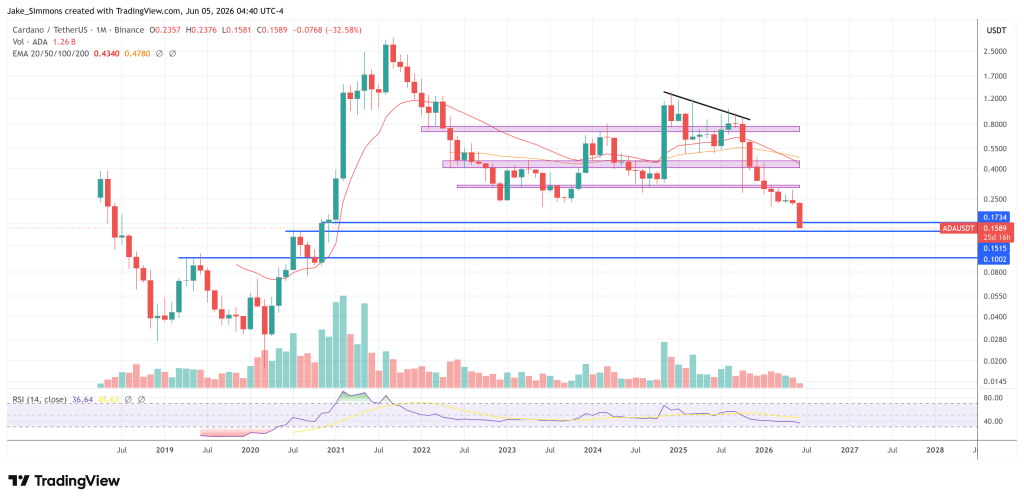
ADA keeps going lower, 1-month chart | Source: ADAUSDT on TradingView.com

Trending Cryptos

Related Questions

QWhat was the main reason Charles Hoskinson gave for stepping back from public communication?

AHe stated that the hostile and toxic social media environment, particularly on X, has become unsustainable, with a high volume of abusive replies making meaningful engagement nearly impossible.

QHow did Hoskinson clarify the purpose of his role regarding the price of ADA?

AHe clarified that he is not passionate about making the price of ADA go up for speculators, has never accepted that role, and his job is focused on technology, research, and real-world impact, not market performance.

QWhat did Hoskinson mean by 'the tale of two Cardanos'?

AHe described a gap between Cardano's significant technical and research progress since 2021 and its poor market price performance, which leads some to label it a failure, creating a 'cognitive dissonance' the community must resolve.

QWhat future changes did Hoskinson propose for the Cardano ecosystem?

AHe proposed that the ecosystem needs to leave X as its primary discussion venue, rethink incentives for builders, change management culture, develop a new shared roadmap, and address the lack of community accountability over the Cardano Foundation.

QWhat are Hoskinson's 'red lines' for his continued involvement with Cardano?

AHis red lines are that he must be treated with respect and dignity and will only participate in communication channels that enforce that standard.

Related Reads

Unlocking $100 Million in Liquidity? Pump.fun's New Policy Tests the 5-Minute Pump Technique

Pump.fun, a popular meme coin launchpad, has introduced a new standard mechanism called BOOST. It aims to address a significant capital efficiency issue: when a newly launched token graduates from its initial bonding curve to a liquidity pool (LP), roughly 20% of its liquidity becomes permanently locked as "dead liquidity," estimated to waste over $100 million annually. Instead of locking these funds permanently, BOOST repurposes them. Upon a token's migration, approximately 20% of the settlement funds (e.g., 17.6 SOL or ~$2516 USDC) are used to buy back the token on the open market over a 5-minute period via a Time-Weighted Average Price (TWAP) mechanism. All purchased tokens are immediately burned. This creates a brief, systematic buy pressure immediately after migration, potentially generating a short-term price surge ("pump") while permanently reducing the token's circulating supply. The goal is to enhance the immediate post-launch trading experience, potentially increasing trader retention and sustainable protocol revenue, which funds ongoing token buybacks. However, concerns exist that this artificial 5-minute boost could lower the barrier for launching low-quality tokens and lead to steeper price crashes once the buy pressure stops, if followed by large sell-offs. The feature automatically applies to tokens migrating after July 21, 2024, but not to previously migrated tokens or those launched via the Mayhem AI Agent lab.

marsbit10m ago

Unlocking $100 Million in Liquidity? Pump.fun's New Policy Tests the 5-Minute Pump Technique

marsbit10m ago

Podcast Notes | Conversation with GSR Asset Management Head: To Determine if This Crypto Rally is Real, Just Watch the Lending Rates on Aave

Podcast Summary: Dialogue with GSR's Head of Asset Management: To Determine if This Crypto Rally is Real, Just Check Lending Rates on Aave Andy Baehr, Managing Director of Asset Management at GSR, discusses the current crypto market, characterizing it as stuck in a state of "ambivalence" with short-lived, unsustainable rallies. He outlines a simple framework: the market moves between "ambivalence" and "conviction" (sustained upward momentum). Currently, every rally resembles a single-stage rocket booster that quickly fizzles out. Baehr identifies three key signals to watch: 1) DeFi lending rates, 2) the potential passage of the CLARITY Act, and 3) the market forming a consensus on the "Fed hawkish peak." He emphasizes that the most immediate indicator for the sustainability of the recent CPI-triggered rally is the USDC borrowing rate on Aave, currently around 3.75%—close to U.S. Treasury yields. The absence of a credit spread indicates low leverage demand and a lack of market energy. He explains that a healthy, sustained rally requires layered buying pressure. Last year's rally progressed from an ETH short squeeze to crypto-native trader influx and finally to ETF inflows. Currently, this structure is missing. Other potential structural buyers like Digital Asset Treasury (DAT) companies are absent, and ETF flows have proven transient. Baehr notes that while small-cap crypto tokens outperformed large caps in Q2—a potential sign of capitation in major assets—capital is also flowing to more exciting opportunities like AI stocks and tech IPOs, leaving crypto sidelined. Regarding DeFi, he highlights that platforms like Aave provide a clear, real-time signal of leverage demand through their supply/demand-driven interest rates. A significant, sustained rate increase would signal genuine market conviction. He also observes the quiet emergence of fixed-income-like products and vaults in DeFi. On regulation, the probability of the CLARITY Act passing before the August 7th deadline has dropped linearly from 75% to below 40% on Polymarket. Baehr suggests its passage would be treated as a bullish surprise, a potent driver for price movement. However, political hurdles, including ethical clause debates and disclosures about the First Family's crypto profits, remain significant obstacles. Ultimately, the market awaits clarity on the Fed's terminal rate under Chair Warsh. Until the "Fed Solstice"—the point where the market collectively understands the peak of hawkish policy—sustained conviction will be difficult to achieve.

marsbit41m ago

Podcast Notes | Conversation with GSR Asset Management Head: To Determine if This Crypto Rally is Real, Just Watch the Lending Rates on Aave

marsbit41m ago

Trading

Spot

Hot Articles

Discussions

Welcome to the HTX Community. Here, you can stay informed about the latest platform developments and gain access to professional market insights. Users' opinions on the price of ADA (ADA) are presented below.

活动图片