Hope For Altcoin Season: The Bitcoin Move That Could Kickstart Everything

bitcoinistPublished on 2026-05-23Last updated on 2026-05-23

Abstract

"Hope For Altcoin Season: The Bitcoin Move That Could Kickstart Everything" analyzes the potential for a new altcoin season. Despite prolonged underperformance against Bitcoin and a low Altcoin Season Index, analysis from Cryptollica suggests altcoin dominance is currently at a long-term floor within a rising channel dating to 2017—a level from which past major altcoin rotations in 2017 and 2021 began. However, a confirmed breakout requires specific signals currently absent: ETH/BTC needs to bottom, and stablecoin liquidity must grow as Bitcoin dominance declines. While not yet showing strength, the current setup is described as a "waiting room" rather than a dead market. If altcoin dominance breaks out to the channel's upper trendline, the total market cap of altcoins outside the top 10 could surge significantly relative to Bitcoin's.

Altcoins have spent years losing ground against Bitcoin, and that has made the phrase “altseason is dead” one of the easiest claims in crypto. However, a market structure shared by Cryptollica on X suggests the story may not be that simple.

The chart does not show strength yet, but it does show a familiar location where the alt dominance is currently positioned at a long-term bottom where previous rotations began.

Altcoin Dominance Returns To The Floor

Crypto analyst Cryptollica recently published a long-term look at altcoin dominance, specifically, the ratio of total market cap excluding the top 10 assets to Bitcoin. The chart stretches back to 2016 and points to two major alt rotation phases: the 2017 altseason and the 2021 altseason.

The important thing from the analysis is that altcoin dominance has not simply been collapsing in a straight line. It has been moving inside a rising channel since 2017. The upper side of that channel touched the 2018 cycle top and the 2021 cycle top, while the lower side has acted as a long-term floor during periods of alt underperformance in comparison to Bitcoin.
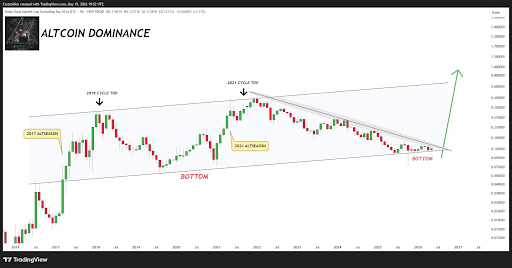
Source: Chart from Cryptollica on X

That compression is precisely where the market sits today. The current setup shows the ratio back near that lower boundary again. As shown in the chart below, the 2026 zone is another possible bottom, similar to the bottom that formed before the 2021 alt rotation. This is why the analysis challenges the idea that altcoins are dead.

The Confirmation Layer Alt Bulls Still Need

Bitcoin’s share of the total crypto market is currently at 59.9%, according to CoinMarketCap, and the Altcoin Season Index is at 38, which is well below the 75 threshold that would formally confirm an altseason. The numbers look discouraging.

The move of an altseason will come from Bitcoin dominance rolling over. However, history shows that a stronger altcoin season argument needs more than a long-term floor on altcoin dominance. Two major confirmation signals came before the 2017 and 2021 rotations. The first confirmation signal was ETH/BTC bottoming before broader alt dominance. That first signal is not fully present yet.

The second signal was stablecoin liquidity growing as Bitcoin dominance began to fall. However, liquidity alone does not create altseason, as it needs direction to flow into. Hence, the current setup of the altseason is not that of a dead one but more of a waiting room than a confirmed breakout.

At the time of writing, the dominance index of altcoins excluding the top 10 altcoins is around 0.10 of Bitcoin’s market cap. The projection from crypto analyst Cryptollica sees the index breaking out and returning to the upper trendline. Such a move would put the total value of the altcoin market outside the top 10 anywhere between 0.6 and 0.8 of Bitcoin’s market cap.

Overall market cap excluding BTC at $1.01 trillion | Source: TOTAL2 on Tradingview.com

Related Questions

QWhat does the market structure shared by Cryptollica on X suggest about altcoin dominance?

AIt suggests that altcoin dominance may not be dead, as it is currently positioned at a long-term bottom similar to where previous major altcoin rotations began in 2017 and 2021.

QAccording to Cryptollica's chart, what has been the pattern for altcoin dominance since 2017?

AAltcoin dominance has been moving inside a rising channel since 2017. The upper side of the channel touched the cycle tops in 2018 and 2021, while the lower side has acted as a long-term floor during periods when altcoins underperformed Bitcoin.

QWhat two major confirmation signals preceded the 2017 and 2021 altcoin rotations?

AThe two major signals were: 1) ETH/BTC bottoming before broader altcoin dominance increased, and 2) stablecoin liquidity growing as Bitcoin dominance began to fall.

QWhat is the current state of the market regarding a potential altseason, according to the article?

AThe current setup is described as more of a 'waiting room' than a confirmed breakout. While altcoin dominance is at a historical floor, key confirmation signals like ETH/BTC bottoming are not fully present, and the Altcoin Season Index is well below the threshold for a formal altseason.

QWhat potential move does crypto analyst Cryptollica project for the altcoin dominance index?

AThe projection sees the altcoin dominance index (excluding the top 10 altcoins) breaking out and returning to the upper trendline of its long-term channel. Such a move would increase the total value of the altcoin market (outside the top 10) to between 0.6 and 0.8 of Bitcoin's market cap.

Related Reads

After Marvell's 32% Surge, the Chinese Chip Family Behind It Emerges

The stock price of Marvell Technology surged 32.5% on June 2nd, driven by NVIDIA CEO Jensen Huang highlighting its custom ASICs and optical interconnects as core to AI data center architecture. This event brought attention to the Chinese semiconductor family behind Marvell: the Dai siblings. The story centers on three siblings, all UC Berkeley graduates, whose three-decade entrepreneurial journey aligns with major semiconductor industry shifts. In 1995, youngest sister Dai Wei Li co-founded Marvell with her husband Sehat Sutardja and his brother, focusing on storage controllers. Eldest brother Dai Wei Min founded EDA company Ultima, later sold to Cadence, and later founded VeriSilicon (芯原) in China, becoming a leading semiconductor IP provider. Second brother Dai Wei Jin co-founded EDA firm Silicon Perspective (sold to Cadence) and GPU IP company Vivante, later acquired by VeriSilicon. The combined "Dai-Sutardja" family network extends beyond Marvell. Their ventures and investments form a comprehensive ecosystem for the post-Moore's Law, chiplet era. Key holdings include: Dream Big Semiconductor (AI SuperNICs, acquired by Arm), Alphawave (high-speed SerDes IP, acquired by Qualcomm), and Silicon Box (a chiplet advanced packaging foundry). VeriSilicon itself thrives on the AI ASIC and IP boom in China. Collectively, the family's AI infrastructure-related portfolio is estimated at over $22 billion. Their strategy represents a distinct path: building critical components for open standards and key manufacturing capacity in the chiplet era, rather than pursuing standalone AI chip dominance. While this path may not create the next NVIDIA, it has enabled repeated successful exits and sustained influence within the global semiconductor industry.

marsbit52m ago

After Marvell's 32% Surge, the Chinese Chip Family Behind It Emerges

marsbit52m ago

Microsoft is Afraid of Being Marginalized by AI Giants

Microsoft, once the defining force of the PC era, now faces a familiar challenge in the AI age: the risk of being relegated to a profitable but invisible infrastructure provider. This anxiety was laid bare at Build 2026, where CEO Satya Nadella unveiled a major strategic pivot. The catalyst was a quiet April agreement that dissolved Microsoft's exclusive licensing and cloud-hosting deal with OpenAI, its once-vital partner. This erased Microsoft's key AI moat. With OpenAI and Anthropic defining AI applications and gaining enterprise traction—even within Microsoft's own ranks—Nadella had to answer: without exclusivity, what is Microsoft's role? The answer was a suite of seven in-house AI models, a developer-focused AI workstation (Surface RTX Spark Dev Box), and, most crucially, the Agent 365 platform for enterprise AI governance. The models, notably targeting Anthropic's strengths in coding and enterprise, signal a defensive move. However, the broader strategy is to make the models themselves less decisive. Financially, Microsoft's AI revenue is strong, driven largely by Azure running others' models. Yet its user-facing products like Copilot show weak penetration and engagement. Microsoft earns infrastructure money but lacks direct user mindshare. Nadella's core fear is being "hollowed out." As OpenAI and Anthropic prepare for IPOs and gain financial independence, they may build their own infrastructure, threatening Azure's lucrative AI revenue stream. Microsoft's window is to entrench itself deeper: not as the model creator, but as the indispensable platform for securely deploying, managing, and governing all AI models within the enterprise through Agent 365. Build 2026 revealed Microsoft's bet: in the AI era, the ultimate power lies not in any single model, but in the enterprise "operating system" that controls them. Nadella is determined to ensure Microsoft is the driver of this new era, not just a passenger.

marsbit1h ago

Microsoft is Afraid of Being Marginalized by AI Giants

marsbit1h ago

CPU, Quietly Returning to the Center of the AI Computing Power Stage

Over the past three years, AI computing power narratives have been dominated by GPUs. However, starting in 2026, this story began to shift. While training large models remains GPU-intensive, the rapid growth of inference and AI agent workloads, which require high levels of task orchestration, concurrency, and data flow management, has highlighted a renewed critical role for CPUs. These are tasks GPUs are not designed to handle. Intel's recent launch of the Xeon 6+ processor, built on its Intel 18A process and featuring up to 288 efficiency cores (E-cores), exemplifies this strategic pivot. It is positioned not as a mere companion to GPUs but as the essential "control plane" for AI infrastructure, optimized for high-density, energy-efficient, and high-throughput workloads characteristic of AI agents and inference. This "CPU resurgence" is not about CPUs outperforming GPUs in raw computation. It reflects a systemic bottleneck: as AI scales from training single models to deploying countless intelligent agents, the demand for coordination and data handling surges. Major cloud providers are also developing their own high-density ARM-based server CPUs for similar workloads. However, Intel's success with this strategy faces significant challenges. Competition includes NVIDIA's integrated CPU-GPU solutions, the expanding adoption of cloud vendors' in-house ARM CPUs, and the crucial market test of Intel's 18A manufacturing process against rivals like TSMC's N2. In conclusion, CPUs are indeed reclaiming a central, though redefined, role in AI compute—managing the complex orchestration that enables massive-scale AI deployment. While the trend is clear, which company will ultimately lead this CPU resurgence remains an open question to be decided in the data centers of 2027 and beyond.

marsbit1h ago

CPU, Quietly Returning to the Center of the AI Computing Power Stage

marsbit1h ago

Trading

Spot
Futures

Hot Articles

What is $BITCOIN

DIGITAL GOLD ($BITCOIN): A Comprehensive Analysis Introduction to DIGITAL GOLD ($BITCOIN) DIGITAL GOLD ($BITCOIN) is a blockchain-based project operating on the Solana network, which aims to combine the characteristics of traditional precious metals with the innovation of decentralized technologies. While it shares a name with Bitcoin, often referred to as “digital gold” due to its perception as a store of value, DIGITAL GOLD is a separate token designed to create a unique ecosystem within the Web3 landscape. Its goal is to position itself as a viable alternative digital asset, although specifics regarding its applications and functionalities are still developing. What is DIGITAL GOLD ($BITCOIN)? DIGITAL GOLD ($BITCOIN) is a cryptocurrency token explicitly designed for use on the Solana blockchain. In contrast to Bitcoin, which provides a widely recognized value storage role, this token appears to focus on broader applications and characteristics. Notable aspects include: Blockchain Infrastructure: The token is built on the Solana blockchain, known for its capacity to handle high-speed and low-cost transactions. Supply Dynamics: DIGITAL GOLD has a maximum supply capped at 100 quadrillion tokens (100P $BITCOIN), although details regarding its circulating supply are currently undisclosed. Utility: While precise functionalities are not explicitly outlined, there are indications that the token could be utilized for various applications, potentially involving decentralized applications (dApps) or asset tokenization strategies. Who is the Creator of DIGITAL GOLD ($BITCOIN)? At present, the identity of the creators and development team behind DIGITAL GOLD ($BITCOIN) remains unknown. This situation is typical among many innovative projects within the blockchain space, particularly those aligning with decentralized finance and meme coin phenomena. While such anonymity may foster a community-driven culture, it intensifies concerns about governance and accountability. Who are the Investors of DIGITAL GOLD ($BITCOIN)? The available information indicates that DIGITAL GOLD ($BITCOIN) does not have any known institutional backers or prominent venture capital investments. The project seems to operate on a peer-to-peer model focused on community support and adoption rather than traditional funding routes. Its activity and liquidity are primarily situated on decentralized exchanges (DEXs), such as PumpSwap, rather than established centralized trading platforms, further highlighting its grassroots approach. How DIGITAL GOLD ($BITCOIN) Works The operational mechanics of DIGITAL GOLD ($BITCOIN) can be elaborated on based on its blockchain design and network attributes: Consensus Mechanism: By leveraging Solana’s unique proof-of-history (PoH) combined with a proof-of-stake (PoS) model, the project ensures efficient transaction validation contributing to the network's high performance. Tokenomics: While specific deflationary mechanisms have not been extensively detailed, the vast maximum token supply implies that it may cater to microtransactions or niche use cases that are still to be defined. Interoperability: There exists the potential for integration with Solana’s broader ecosystem, including various decentralized finance (DeFi) platforms. However, the details regarding specific integrations remain unspecified. Timeline of Key Events Here is a timeline that highlights significant milestones concerning DIGITAL GOLD ($BITCOIN): 2023: The initial deployment of the token occurs on the Solana blockchain, marked by its contract address. 2024: DIGITAL GOLD gains visibility as it becomes available for trading on decentralized exchanges like PumpSwap, allowing users to trade it against SOL. 2025: The project witnesses sporadic trading activity and potential interest in community-led engagements, although no noteworthy partnerships or technical advancements have been documented as of yet. Critical Analysis Strengths Scalability: The underlying Solana infrastructure supports high transaction volumes, which could enhance the utility of $BITCOIN in various transaction scenarios. Accessibility: The potential low trading price per token could attract retail investors, facilitating wider participation due to fractional ownership opportunities. Risks Lack of Transparency: The absence of publicly known backers, developers, or an audit process may yield skepticism regarding the project's sustainability and trustworthiness. Market Volatility: The trading activity is heavily reliant on speculative behavior, which can result in significant price volatility and uncertainty for investors. Conclusion DIGITAL GOLD ($BITCOIN) emerges as an intriguing yet ambiguous project within the rapidly evolving Solana ecosystem. While it attempts to leverage the “digital gold” narrative, its departure from Bitcoin's established role as a store of value underscores the need for a clearer differentiation of its intended utility and governance structure. Future acceptance and adoption will likely depend on addressing the current opacity and defining its operational and economic strategies more explicitly. Note: This report encompasses synthesised information available as of October 2023, and developments may have transpired beyond the research period.

363 Total ViewsPublished 2025.05.13Updated 2025.05.13

What is $BITCOIN

Discussions

Welcome to the HTX Community. Here, you can stay informed about the latest platform developments and gain access to professional market insights. Users' opinions on the price of BTC (BTC) are presented below.

活动图片















