Hope For Altcoin Season: The Bitcoin Move That Could Kickstart Everything

bitcoinistPublished on 2026-05-23Last updated on 2026-05-23

Abstract

"Hope For Altcoin Season: The Bitcoin Move That Could Kickstart Everything" analyzes the potential for a new altcoin season. Despite prolonged underperformance against Bitcoin and a low Altcoin Season Index, analysis from Cryptollica suggests altcoin dominance is currently at a long-term floor within a rising channel dating to 2017—a level from which past major altcoin rotations in 2017 and 2021 began. However, a confirmed breakout requires specific signals currently absent: ETH/BTC needs to bottom, and stablecoin liquidity must grow as Bitcoin dominance declines. While not yet showing strength, the current setup is described as a "waiting room" rather than a dead market. If altcoin dominance breaks out to the channel's upper trendline, the total market cap of altcoins outside the top 10 could surge significantly relative to Bitcoin's.

Altcoins have spent years losing ground against Bitcoin, and that has made the phrase “altseason is dead” one of the easiest claims in crypto. However, a market structure shared by Cryptollica on X suggests the story may not be that simple.

The chart does not show strength yet, but it does show a familiar location where the alt dominance is currently positioned at a long-term bottom where previous rotations began.

Altcoin Dominance Returns To The Floor

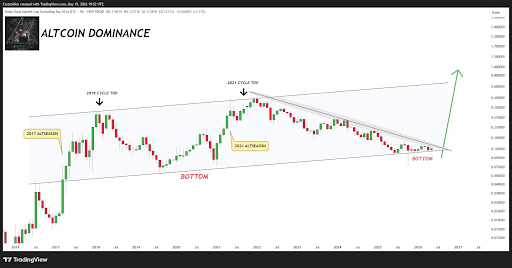
Crypto analyst Cryptollica recently published a long-term look at altcoin dominance, specifically, the ratio of total market cap excluding the top 10 assets to Bitcoin. The chart stretches back to 2016 and points to two major alt rotation phases: the 2017 altseason and the 2021 altseason.

The important thing from the analysis is that altcoin dominance has not simply been collapsing in a straight line. It has been moving inside a rising channel since 2017. The upper side of that channel touched the 2018 cycle top and the 2021 cycle top, while the lower side has acted as a long-term floor during periods of alt underperformance in comparison to Bitcoin.
Source: Chart from Cryptollica on X

That compression is precisely where the market sits today. The current setup shows the ratio back near that lower boundary again. As shown in the chart below, the 2026 zone is another possible bottom, similar to the bottom that formed before the 2021 alt rotation. This is why the analysis challenges the idea that altcoins are dead.

The Confirmation Layer Alt Bulls Still Need

Bitcoin’s share of the total crypto market is currently at 59.9%, according to CoinMarketCap, and the Altcoin Season Index is at 38, which is well below the 75 threshold that would formally confirm an altseason. The numbers look discouraging.

The move of an altseason will come from Bitcoin dominance rolling over. However, history shows that a stronger altcoin season argument needs more than a long-term floor on altcoin dominance. Two major confirmation signals came before the 2017 and 2021 rotations. The first confirmation signal was ETH/BTC bottoming before broader alt dominance. That first signal is not fully present yet.

The second signal was stablecoin liquidity growing as Bitcoin dominance began to fall. However, liquidity alone does not create altseason, as it needs direction to flow into. Hence, the current setup of the altseason is not that of a dead one but more of a waiting room than a confirmed breakout.

At the time of writing, the dominance index of altcoins excluding the top 10 altcoins is around 0.10 of Bitcoin’s market cap. The projection from crypto analyst Cryptollica sees the index breaking out and returning to the upper trendline. Such a move would put the total value of the altcoin market outside the top 10 anywhere between 0.6 and 0.8 of Bitcoin’s market cap.

Overall market cap excluding BTC at $1.01 trillion | Source: TOTAL2 on Tradingview.com

Related Questions

QWhat does the market structure shared by Cryptollica on X suggest about altcoin dominance?

AIt suggests that altcoin dominance may not be dead, as it is currently positioned at a long-term bottom similar to where previous major altcoin rotations began in 2017 and 2021.

QAccording to Cryptollica's chart, what has been the pattern for altcoin dominance since 2017?

AAltcoin dominance has been moving inside a rising channel since 2017. The upper side of the channel touched the cycle tops in 2018 and 2021, while the lower side has acted as a long-term floor during periods when altcoins underperformed Bitcoin.

QWhat two major confirmation signals preceded the 2017 and 2021 altcoin rotations?

AThe two major signals were: 1) ETH/BTC bottoming before broader altcoin dominance increased, and 2) stablecoin liquidity growing as Bitcoin dominance began to fall.

QWhat is the current state of the market regarding a potential altseason, according to the article?

AThe current setup is described as more of a 'waiting room' than a confirmed breakout. While altcoin dominance is at a historical floor, key confirmation signals like ETH/BTC bottoming are not fully present, and the Altcoin Season Index is well below the threshold for a formal altseason.

QWhat potential move does crypto analyst Cryptollica project for the altcoin dominance index?

AThe projection sees the altcoin dominance index (excluding the top 10 altcoins) breaking out and returning to the upper trendline of its long-term channel. Such a move would increase the total value of the altcoin market (outside the top 10) to between 0.6 and 0.8 of Bitcoin's market cap.

Related Reads

ETH Bull and Bear Views Compilation: Can Ethereum's Value Flow Back to ETH?

Titled "ETH Bull and Bear Views: Can Ethereum's Value Flow Back to ETH?", this article synthesizes the current heated debate around Ethereum's native token, ETH, following Bankless co-founder David Hoffman's decision to sell his entire ETH holdings. The **bullish case**, represented by figures like Tom Lee (BitMine CEO) and Raoul Pal, argues that ETH's core thesis remains intact. They contend Ethereum is the essential, secure, and neutral foundational layer for future finance—encompassing stablecoins, RWA, DeFi, L2s, and Agentic AI. Bulls bet on ETH's long-term revaluation as institutional adoption of on-chain finance grows, with significant buying activity from entities like BitMine and Consensys cited as evidence. Conversely, the **bearish perspective**, led by Hoffman and analysts like Markus Thielen, questions ETH's value capture mechanism. They acknowledge Ethereum's network success but argue that the value created by L2s, DeFi, and applications does not sufficiently accrue to the ETH token itself. Bears point to ETH's prolonged underperformance versus the broader crypto market, lack of traditional cash flows, weakening "ultrasound money" narrative, and apparent institutional retreat (e.g., Harvard Management Company exiting its ETH ETF position) as key concerns. The debate highlights a pivotal shift: ETH is no longer just a community belief asset. The central question is whether ETH can transition from being a "**used infrastructure**" to a "**continuously bought and held core asset**" as more value enters the Ethereum ecosystem. The market is now critically examining the direct link between network growth and ETH's value.

marsbit43m ago

ETH Bull and Bear Views Compilation: Can Ethereum's Value Flow Back to ETH?

marsbit43m ago

Crypto is dead, Perps are forever

The crypto industry is shifting from a focus on creating native assets (like altcoins and protocol tokens) to becoming a "global asset pipeline." Native cryptocurrencies, except for Bitcoin, are seen as failing in their value storage and utility promises, with demand driven largely by speculation. Attention and liquidity are now moving toward real-world assets (RWAs) like U.S. stocks, bonds, gold, and oil traded on-chain via perpetual contracts (Perps). Stablecoins like USDT and USDC set the precedent, proving blockchain's core strength is efficient global settlement and transfer, not inventing new monetary systems. Meanwhile, assets like Ethereum and many DeFi tokens struggle as their narratives weaken against tangible traditional assets and the rapid real-world progress of AI. Perpetual contracts have emerged as a pivotal innovation. They simplify trading by offering pure price exposure to any asset, bypassing complexities of ownership, custody, and traditional market hours. Projects like Hyperliquid gained traction by combining CEX-like efficiency with on-chain transparency, capitalizing on post-FTX distrust, macroeconomic volatility, and the surge in demand for 24/7 stock trading. In conclusion, while the era of speculative native "crypto assets" may be over, perpetual contracts persist as the industry's most potent financial instrument—transforming all assets into globally accessible, constantly tradable instruments centered on price speculation.

marsbit48m ago

Crypto is dead, Perps are forever

marsbit48m ago

Tencent, Alibaba, ByteDance in a Battle for the Skill Store

Skill is becoming a key concept in the AI field, essentially serving as a structured "instruction manual" for AI Agents that specifies tool calls, decision logic, and output standards. This allows Agents to execute predefined tasks. As the number of Skills grows, distribution platforms have emerged. Major tech companies are swiftly entering this space. In March, Tencent, Alibaba, and ByteDance launched Skill stores within their respective Agent platforms. Subsequently, players like Zhipu AI, Meituan, and Xiaohongshu joined the fray. This competition for the "Skill store" is fundamentally a battle for the AI-era user entry point; whoever controls distribution controls the users. While ByteDance's Coze has experimented with paid Skills, most platforms offer them for free. The real value lies not in the stores themselves but in using them to attract and retain users within an ecosystem, driving revenue from services like cloud computing, model calls, or advertising. The landscape features three main player types: 1) **Internet giants** (e.g., Alibaba, ByteDance, Tencent, Meituan), leveraging Skills to drive traffic and monetize through their broader ecosystems (cloud services, transactions, ads). 2) **Large model companies** (e.g., Zhipu AI, Moonshot AI), using Skill stores to increase user engagement and monetize model API calls. 3) **Content platforms** (e.g., Xiaohongshu), treating Skills as a new content format to generate traffic and ad revenue. However, transforming Skill stores into a sustainable business faces significant hurdles. Key challenges include: the **difficulty in pricing Skills** due to inconsistent outputs across different models and contexts; **lack of cost transparency** (varying token consumption); **security risks** like Skill poisoning; and the **absence of standardized protocols** for development and evaluation. Unlike standardized mobile apps, Skills are often personalized workflows resistant to uniformity, which hinders the establishment of a reliable review and monetization system akin to the App Store. While there is genuine user demand for paid Skills—particularly in enterprise (e.g., contract review) and certain personal productivity scenarios—current platforms offer developers limited and unpredictable distribution. The future of Skill stores depends on overcoming these standardization, evaluation, and safety challenges to make acquiring a Skill as straightforward as downloading an app. For now, the stores function more as display shelves than robust marketplaces.

marsbit48m ago

Tencent, Alibaba, ByteDance in a Battle for the Skill Store

marsbit48m ago

The Crypto Scene Is Dead, Perpetual Swaps Are Eternal

The crypto industry is undergoing a fundamental shift. The era defined by minting novel, native digital assets (altcoins) is fading. These assets, lacking real-world cash flows or clear value, are losing relevance as attention and capital flow elsewhere. Two powerful external forces are reshaping the space. First, traditional assets like U.S. stocks, bonds, gold, and oil are being tokenized and traded on-chain. Second, the explosive growth of AI, with its tangible products, has overshadowed crypto's once-dominant "future narrative." This marks a critical pivot: crypto is transitioning from being a "factory for new assets" to becoming a "global conduit for existing assets." Its validated utility is not complex financial reinvention but efficient global settlement, transfer, and trading—the original promise of blockchain. Stablecoins like USDT and USDC exemplify this, offering faster dollar movement rather than replacing it. Consequently, native ecosystems like Ethereum face profound challenges. While still crucial infrastructure, ETH struggles to capture value as users interact with Layer 2s or trade traditional assets without needing to hold it. DeFi's grand narrative of rebuilding finance has narrowed to core needs like cheap transfers and deep liquidity. The true breakout innovation is the perpetual contract (Perp). It brilliantly bypasses the complexities of direct asset ownership (custody, compliance, dividends) by creating pure price exposure. Users can speculate on the price movement of *any* asset—NVIDIA, gold, oil—24/7, globally, and with leverage. This "price casino" model, while risky and ethically fraught, delivers unmatched liquidity and accessibility. Projects like Hyperliquid succeeded not by inventing new mechanics but by perfecting the timing and execution of this model. Key drivers included making on-chain Perps feel like centralized exchanges, post-FTX trust migration towards transparency, and rising demand to trade macro assets and equities round-the-clock. In conclusion, the crypto world's most enduring successes are the dollar (via stablecoins), Bitcoin, and trading. Its new frontier is not creating alternative assets but providing a seamless, perpetual trading layer—a new API—for the world's existing financial system. The age of native altcoins is over; the age of perpetual synthetic exposure has begun.

Odaily星球日报57m ago

The Crypto Scene Is Dead, Perpetual Swaps Are Eternal

Odaily星球日报57m ago

Trading

Spot
Futures

Hot Articles

What is $BITCOIN

DIGITAL GOLD ($BITCOIN): A Comprehensive Analysis Introduction to DIGITAL GOLD ($BITCOIN) DIGITAL GOLD ($BITCOIN) is a blockchain-based project operating on the Solana network, which aims to combine the characteristics of traditional precious metals with the innovation of decentralized technologies. While it shares a name with Bitcoin, often referred to as “digital gold” due to its perception as a store of value, DIGITAL GOLD is a separate token designed to create a unique ecosystem within the Web3 landscape. Its goal is to position itself as a viable alternative digital asset, although specifics regarding its applications and functionalities are still developing. What is DIGITAL GOLD ($BITCOIN)? DIGITAL GOLD ($BITCOIN) is a cryptocurrency token explicitly designed for use on the Solana blockchain. In contrast to Bitcoin, which provides a widely recognized value storage role, this token appears to focus on broader applications and characteristics. Notable aspects include: Blockchain Infrastructure: The token is built on the Solana blockchain, known for its capacity to handle high-speed and low-cost transactions. Supply Dynamics: DIGITAL GOLD has a maximum supply capped at 100 quadrillion tokens (100P $BITCOIN), although details regarding its circulating supply are currently undisclosed. Utility: While precise functionalities are not explicitly outlined, there are indications that the token could be utilized for various applications, potentially involving decentralized applications (dApps) or asset tokenization strategies. Who is the Creator of DIGITAL GOLD ($BITCOIN)? At present, the identity of the creators and development team behind DIGITAL GOLD ($BITCOIN) remains unknown. This situation is typical among many innovative projects within the blockchain space, particularly those aligning with decentralized finance and meme coin phenomena. While such anonymity may foster a community-driven culture, it intensifies concerns about governance and accountability. Who are the Investors of DIGITAL GOLD ($BITCOIN)? The available information indicates that DIGITAL GOLD ($BITCOIN) does not have any known institutional backers or prominent venture capital investments. The project seems to operate on a peer-to-peer model focused on community support and adoption rather than traditional funding routes. Its activity and liquidity are primarily situated on decentralized exchanges (DEXs), such as PumpSwap, rather than established centralized trading platforms, further highlighting its grassroots approach. How DIGITAL GOLD ($BITCOIN) Works The operational mechanics of DIGITAL GOLD ($BITCOIN) can be elaborated on based on its blockchain design and network attributes: Consensus Mechanism: By leveraging Solana’s unique proof-of-history (PoH) combined with a proof-of-stake (PoS) model, the project ensures efficient transaction validation contributing to the network's high performance. Tokenomics: While specific deflationary mechanisms have not been extensively detailed, the vast maximum token supply implies that it may cater to microtransactions or niche use cases that are still to be defined. Interoperability: There exists the potential for integration with Solana’s broader ecosystem, including various decentralized finance (DeFi) platforms. However, the details regarding specific integrations remain unspecified. Timeline of Key Events Here is a timeline that highlights significant milestones concerning DIGITAL GOLD ($BITCOIN): 2023: The initial deployment of the token occurs on the Solana blockchain, marked by its contract address. 2024: DIGITAL GOLD gains visibility as it becomes available for trading on decentralized exchanges like PumpSwap, allowing users to trade it against SOL. 2025: The project witnesses sporadic trading activity and potential interest in community-led engagements, although no noteworthy partnerships or technical advancements have been documented as of yet. Critical Analysis Strengths Scalability: The underlying Solana infrastructure supports high transaction volumes, which could enhance the utility of $BITCOIN in various transaction scenarios. Accessibility: The potential low trading price per token could attract retail investors, facilitating wider participation due to fractional ownership opportunities. Risks Lack of Transparency: The absence of publicly known backers, developers, or an audit process may yield skepticism regarding the project's sustainability and trustworthiness. Market Volatility: The trading activity is heavily reliant on speculative behavior, which can result in significant price volatility and uncertainty for investors. Conclusion DIGITAL GOLD ($BITCOIN) emerges as an intriguing yet ambiguous project within the rapidly evolving Solana ecosystem. While it attempts to leverage the “digital gold” narrative, its departure from Bitcoin's established role as a store of value underscores the need for a clearer differentiation of its intended utility and governance structure. Future acceptance and adoption will likely depend on addressing the current opacity and defining its operational and economic strategies more explicitly. Note: This report encompasses synthesised information available as of October 2023, and developments may have transpired beyond the research period.

363 Total ViewsPublished 2025.05.13Updated 2025.05.13

What is $BITCOIN

Discussions

Welcome to the HTX Community. Here, you can stay informed about the latest platform developments and gain access to professional market insights. Users' opinions on the price of BTC (BTC) are presented below.

活动图片















