Hong Kong Issues First Stablecoin Licenses To HSBC, Standard Chartered JV

bitcoinistPublished on 2026-04-11Last updated on 2026-04-11

Abstract

The Hong Kong Monetary Authority (HKMA) has issued its first stablecoin licenses to The Hongkong and Shanghai Banking Corporation Limited (HSBC) and Anchorpoint Financial Limited, a joint venture between Standard Chartered, Animoca Brands, and Hong Kong Telecom. This follows the implementation of Hong Kong’s Stablecoins Ordinance in August 2025, which established a licensing framework for fiat-backed cryptocurrency issuers. The HKMA received 36 applications but approved only two in this initial phase, as anticipated by Chief Executive Eddie Yue. Amid a broader downturn in digital assets, the stablecoin market has remained resilient, with its combined market cap holding near all-time highs since Q4 2025. Meanwhile, Bitcoin has declined over 42% in the same period. At the time of writing, Bitcoin was trading around $72,200, up more than 8% over the past week.

The Hong Kong Monetary Authority (HKMA) has handed out its first stablecoin licenses, and the winners are Standard Chartered’s JV and HSBC.

HKMA Has Released First Stablecoin Licenses After A Delay

According to HKMA’s website, two entities have now become registered stablecoin issuers in Hong Kong: Anchorpoint Financial Limited and The Hongkong and Shanghai Banking Corporation Limited.

Hong Kong launched its stablecoin bill called the Stablecoins Ordinance back in August 2025, establishing a licensing regime for stablecoin issuers. Under this law, parties interested in issuing fiat-tied cryptocurrencies in the Chinese city have to first obtain a license from the HKMA.

Major names quickly lined up to apply for a license. This included HSBC and Anchorpoint Financial Limited. The latter is a joint venture (JV) created by Standard Chartered, Animoca Brands, and Hong Kong Telecom. In total, the HKMA ended up receiving applications from 36 entities. Despite the high interest, though, Eddie Yue, the financial regulator’s chief executive, said in February that a “very small number” of licenses would be granted in the first wave.

Yue also said that these licenses would arrive in March, but in the end, no licenses were issued during that month, suggesting a delay from the HKMA. However, today, on April 10th, the first batch has finally gone out.

With just two licenses being handed out, Yue indeed set up the correct expectations. As mentioned earlier, Standard Chartered’s JV and HSBC are the applicants who have received the first approval. Thus, these banks have a head start over the rest when it comes to stablecoins in the region.

Hong Kong’s stablecoins advance is just one example of positive regulation that these fiat-tied tokens have seen the world over in the past year. One of the most important wins for the sector has been the GENIUS Act signed into law by United States President Donald Trump last year.

Because of all the regulatory momentum and adoption, the stablecoins sector has performed relatively well amid the wider downturn in the digital assets market. As data from DefiLlama shows, stablecoins have seen their combined market cap move sideways at all-time highs (ATHs) since Q4 2025. In the same period as this flat phase in these fiat-tied tokens, Bitcoin has gone down by more than 42%.
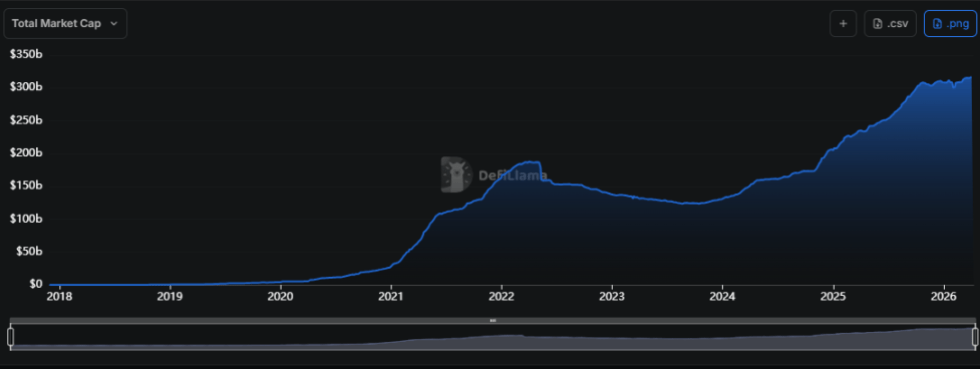
The trend in the market cap of the stablecoins over the years | Source: DefiLlama

While the stablecoin market cap is significant in size, the vast majority of it is covered by just two assets pegged to the US Dollar: USDT and USDC. Moves like the euro-pegged token from a consortium of major European banks could shake up this dominance, but it only remains to be seen how the landscape will evolve.

Bitcoin Price

At the time of writing, Bitcoin is floating around $72,200, up more than 8% in the last seven days.

Looks like the price of the coin has surged recently | Source: BTCUSDT on TradingView


Related Questions

QWhich two entities received the first stablecoin licenses from the Hong Kong Monetary Authority?

AAnchorpoint Financial Limited and The Hongkong and Shanghai Banking Corporation Limited (HSBC).

QWhat is the name of the stablecoin bill that established the licensing regime in Hong Kong and when was it launched?

AThe Stablecoins Ordinance, launched in August 2025.

QHow many entities applied for a stablecoin license from the HKMA, and how many were granted in this first wave?

A36 entities applied, and 2 licenses were granted in the first wave.

QAccording to the data from DefiLlama, how has the stablecoin market cap performed compared to Bitcoin since Q4 2025?

AThe stablecoin market cap has moved sideways at all-time highs, while Bitcoin has declined by more than 42% in the same period.

QWhat is the current price of Bitcoin mentioned in the article and its 7-day performance?

ABitcoin is floating around $72,200, up more than 8% in the last seven days.

Related Reads

Arbitrum Pretends to Be the Hacker, 'Steals' Back the Money Lost by KelpDAO

Title: Arbitrum Poses as Hacker to Recover Stolen Funds from KelpDAO Last week, KelpDAO suffered a hack resulting in nearly $300 million in losses, marking the largest DeFi security incident this year. Approximately 30,765 ETH (worth over $70 million) remained on an Arbitrum address controlled by the attacker. In an unprecedented move, Arbitrum’s Security Council utilized its emergency authority to upgrade the Inbox bridge contract, adding a function that allowed them to impersonate the hacker’s address and initiate a transfer without access to its private key. The council’s action, approved by 9 of its 12 members, moved the stolen ETH to a frozen address in a single transaction before reverting the contract to its original state. The operation was coordinated with law enforcement, which attributed the attack to North Korea’s Lazarus Group. Community reactions are divided: some praise the recovery of funds, while others question the centralization of power, as the council can upgrade core contracts without governance votes. However, such emergency mechanisms are common among major L2s. Despite the partial recovery, over $292 million was stolen in total, with more than $100 million in bad debt on Aave and remaining funds scattered across other chains. The incident highlights escalating security challenges in DeFi, with state-sponsored hackers employing advanced tactics and L2s responding with elevated countermeasures.

marsbit5m ago

Arbitrum Pretends to Be the Hacker, 'Steals' Back the Money Lost by KelpDAO

marsbit5m ago

iQiyi Is Too Impatient

The article "iQiyi Is Too Impatient" discusses the controversy surrounding the Chinese streaming platform IQiyi's recent announcement of an "AI Actor Library" during its 2026 World Conference. IQiyi claimed over 100 actors, including well-known names like Zhang Ruoyun and Yu Hewei, had joined the initiative. CEO Gong Yu suggested AI could enable actors to "star in 14 dramas a year instead of 4" and that "live-action filming might become a world cultural heritage." The announcement quickly sparked backlash. Multiple actors named in the list issued urgent statements denying they had signed any AI-related authorization agreements. This forced IQiyi to clarify that inclusion in the library only indicated a willingness to *consider* AI projects, with separate negotiations required for any specific role. The incident, which trended on social media with hashtags like "IQiyi is crazy," is presented as a sign of the company's growing desperation. Facing intense competition from short-video platforms like Douyin and Kuaishou, as well as Bilibili and Xiaohongshu, IQiyi's financial performance has weakened, with revenues declining for two consecutive years. The author argues that IQiyi is "too impatient" to tell a compelling AI story to reassure the market, especially as it pursues a listing on the Hong Kong stock exchange. The piece concludes by outlining three key "AI questions" IQiyi must answer: defining its role as a tool provider versus a content creator, balancing the "coldness" of AI with the human element audiences desire, and properly managing the interests of platforms, actors, and viewers. The core dilemma is that while AI can reduce costs and increase efficiency, it risks creating homogenized, formulaic content and devaluing human performers.

marsbit59m ago

iQiyi Is Too Impatient

marsbit59m ago

Trading

Spot
Futures
活动图片