Arbitrum Pretends to Be the Hacker, 'Steals' Back the Money Lost by KelpDAO

marsbitPublished on 2026-04-21Last updated on 2026-04-21

Abstract

Title: Arbitrum Poses as Hacker to Recover Stolen Funds from KelpDAO Last week, KelpDAO suffered a hack resulting in nearly $300 million in losses, marking the largest DeFi security incident this year. Approximately 30,765 ETH (worth over $70 million) remained on an Arbitrum address controlled by the attacker. In an unprecedented move, Arbitrum’s Security Council utilized its emergency authority to upgrade the Inbox bridge contract, adding a function that allowed them to impersonate the hacker’s address and initiate a transfer without access to its private key. The council’s action, approved by 9 of its 12 members, moved the stolen ETH to a frozen address in a single transaction before reverting the contract to its original state. The operation was coordinated with law enforcement, which attributed the attack to North Korea’s Lazarus Group. Community reactions are divided: some praise the recovery of funds, while others question the centralization of power, as the council can upgrade core contracts without governance votes. However, such emergency mechanisms are common among major L2s. Despite the partial recovery, over $292 million was stolen in total, with more than $100 million in bad debt on Aave and remaining funds scattered across other chains. The incident highlights escalating security challenges in DeFi, with state-sponsored hackers employing advanced tactics and L2s responding with elevated countermeasures.

Author: Deep Tide TechFlow

Last week, KelpDAO was hacked for nearly $300 million, making it the largest negative security incident in DeFi so far this year.

The stolen ETH is now scattered across multiple chains, with approximately 30,765 ETH remaining in an address on the Arbitrum chain, worth over $70 million.

Just when everyone thought the story was over, a sequel emerged today.

According to on-chain security firm PeckShield, the funds in the hacker's address on the Arbitrum chain were transferred out a few hours ago. Strangely, the funds were moved to a bizarre address that appears to be almost all zeros: 0x00000...
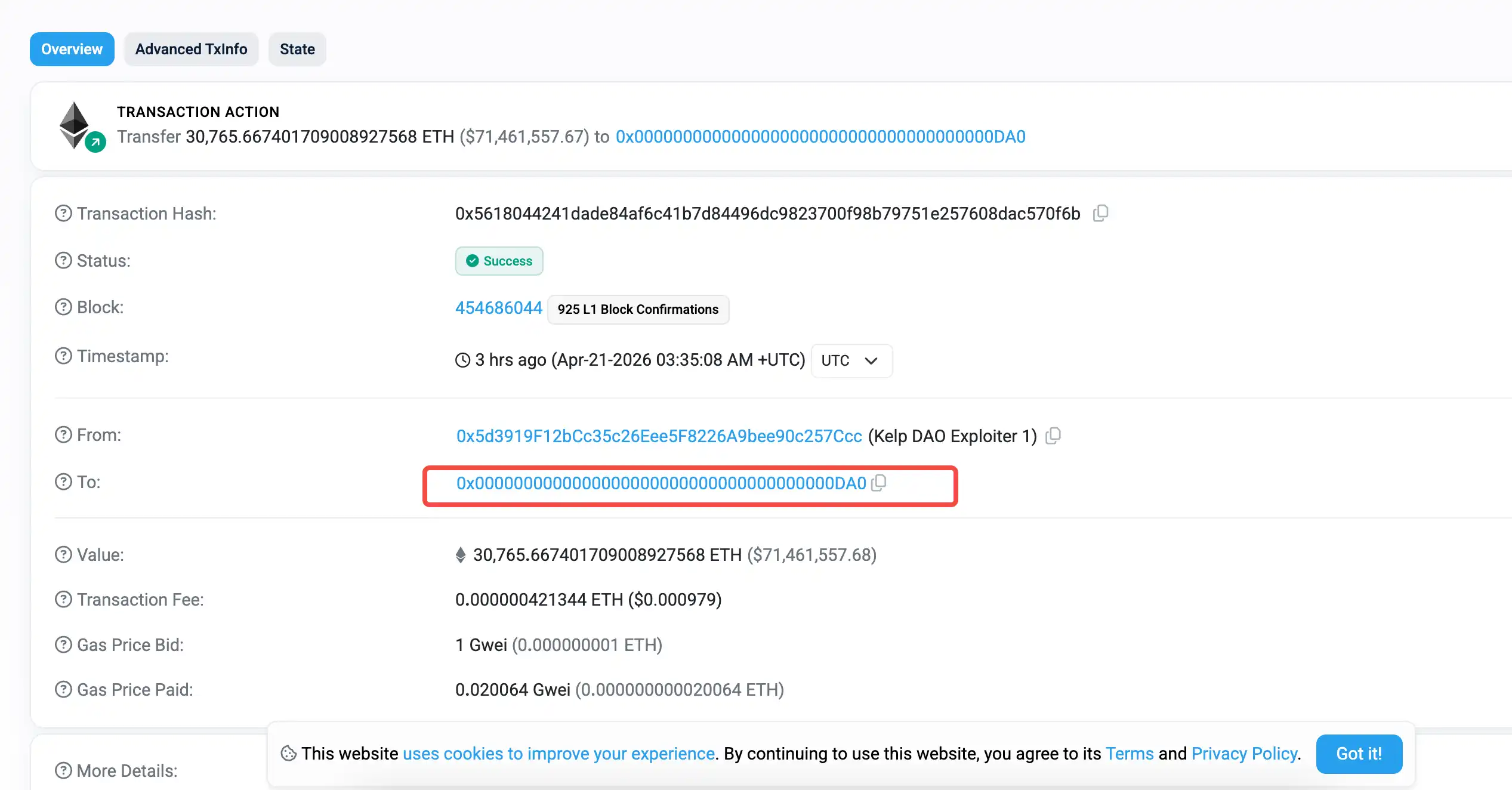
Everyone was speculating: Did the hacker burn the funds by sending them to a black hole address? Or did they have a change of heart or get recruited?

Neither.

A few hours ago, the Arbitrum official forum posted an emergency action announcement explaining the situation. The hacker's funds were transferred by the Arbitrum Security Council.

However, the remarkable part is that without knowing the private key of the hacker's address, the Arbitrum Council neither froze the funds nor had the authority to transfer them. Instead, they directly issued a transfer instruction "in the name of the hacker."

The hacker was unaware, the private key was not leaked, and the on-chain records made it look like the hacker had performed the operation themselves.
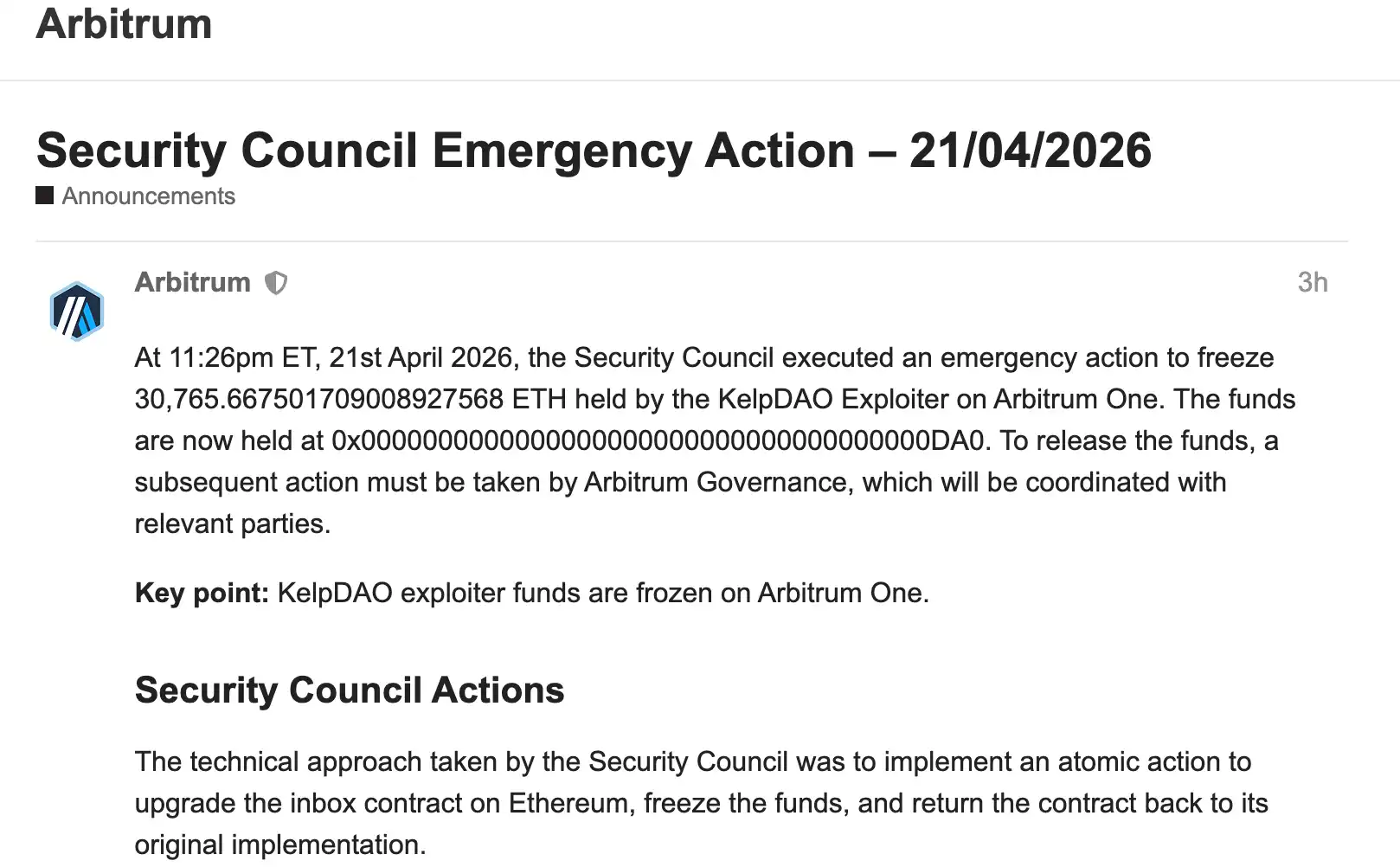
The principle behind this operation is that all cross-chain messages between Arbitrum and Ethereum must pass through a bridge contract called Inbox. The Security Council used its emergency authority to temporarily upgrade this contract, adding a new function:

It allows sending cross-chain transactions in the name of any wallet address, without needing that wallet's private key.

They then used this function to forge a message, with the sender field filled as the hacker's wallet, and the content being "Transfer all my ETH to the frozen address." The Arbitrum chain received it and executed it as usual, resulting in the bizarre scene captured in the on-chain transfer screenshot above.

After transferring the hacker's funds, the contract was immediately downgraded back to its original version. The upgrade, forgery, transfer, and restoration were all completed within a single Ethereum transaction. Other users and applications were completely unaffected.

This operation is unprecedented in Arbitrum's history.

According to the forum announcement, the Security Council first confirmed the hacker's identity with law enforcement, pointing to North Korea's Lazarus Group, the most active state-level hacker organization in the DeFi space this year. The council conducted a technical assessment to ensure it would not affect other users before taking action.

Since the hacker was in the wrong first, this move carries a bit of a "don't blame us for not playing by the rules" sentiment. As for the subsequent handling of the frozen ETH, it will go through Arbitrum's DAO governance vote and be coordinated with law enforcement.

Recovering over $70 million in stolen funds is undoubtedly a good thing. But it's worth noting the prerequisite for achieving this: 9 out of the 12 members of the Security Council can sign to bypass all governance votes and upgrade any core on-chain contract with zero delay.

Praising the Outcome, Worrying about the Capability?

Currently, the community's reaction is divided.

Some think Arbitrum did a great job, protecting assets at a critical moment, which actually adds a bit of confidence in L2. Others ask a very direct question: If 9 people can sign to move any asset in anyone's name, can this still be called decentralization?

In my opinion, the two sides are actually talking about different things.

The former is talking about the result, the latter is talking about the capability. The result of this incident is certainly good—over $70 million in stolen funds was recovered. But the capability demonstrated by Arbitrum this time—to modify contract functions via multi-sig—is neutral in itself; what it is used for in the future, whether it can be used, and how it is used, all actually depend on the council's governance.

However, for most people using Arbitrum, this discussion might be less relevant than another fact. Arbitrum is not special; currently, almost all mainstream L2s retain similar emergency upgrade permissions.

The chain you are using most likely also has a similar Security Council with similar capabilities. This is not a unique choice by Arbitrum; it's almost a universal design for L2s at this stage.

Looking at it from another angle, this offensive and defensive battle actually reveals a bigger picture.

The attacker is North Korea's Lazarus Group, attributed to at least 18 DeFi attacks since the beginning of this year. Just three weeks ago, they stole $285 million from Drift Protocol using a completely different method.

On one side, state-level hackers are constantly upgrading their attack methods; on the other, L2s are starting to use underlying permissions to fight back. The security war in DeFi is entering a new stage, moving beyond "post-incident freezes, on-chain shouting, and praying for white hats to intervene."

In extraordinary times, they created a master key to open the hacker's address, and melted the key after use. Just judging by this incident alone, having the capability to respond to hacker attacks is not a bad thing.

And if we must elevate this to a philosophical discussion about "this is not decentralized at all," then there are many more things to talk about. The crypto industry has no shortage of centralized operations. This time, at least, it was handling a negative incident and solving a problem, not creating one.

Looking back more pragmatically, KelpDAO was robbed of $292 million, and only over $70 million was recovered—less than a quarter of the total. The remaining ETH is still scattered on other chains. Over $100 million in bad debt on Aave remains unresolved, and it's still unknown how much rsETH holders will get back.

Even though Arbitrum invoked god-like permissions, this battle is clearly far from over.

Related Questions

QWhat was the approximate value of the ETH stolen from KelpDAO that remained on the Arbitrum chain?

AOver $70 million worth of ETH, specifically 30,765 ETH, remained on the Arbitrum chain.

QHow did the Arbitrum Security Council manage to move the hacker's funds without the private key?

AThe Security Council used its emergency powers to temporarily upgrade the Inbox bridge contract, adding a new function that allowed them to forge a cross-chain message that appeared to be from the hacker's address, instructing the transfer of all ETH to a frozen address.

QWhich hacker organization was identified as being responsible for the attack on KelpDAO?

AThe attack was attributed to the North Korean state-backed hacker group, Lazarus Group.

QWhat is a major concern raised by the community regarding the Arbitrum Security Council's action?

AA major concern is that the action demonstrates a lack of decentralization, as 9 out of 12 council members can sign to upgrade any core contract and move any assets without a governance vote.

QWhat percentage of the total stolen funds from KelpDAO was recovered through this action on Arbitrum?

ALess than a quarter of the total stolen funds were recovered. The action recovered roughly $70 million of the total $292 million stolen.

Related Reads

In Conversation with Ray Dalio: We Are Currently in an AI Bubble, with 1% of My Portfolio in Bitcoin

Ray Dalio, founder of Bridgewater Associates, warns in an interview that the current AI boom shows classic bubble characteristics, which could lead to significant economic downturns as seen in past cycles like 1929 or 2000. He explains that speculative enthusiasm, fueled by debt and overvaluation, often precedes a crash when rising rates or taxation force asset sales, causing widespread losses and recession. Dalio also outlines his "Big Cycle" theory, describing an approximate 80-year pattern where widening wealth gaps, massive government deficits, and shifting geopolitical power (like China's rise) create internal conflict and global instability. He emphasizes that we are in a late-cycle, transitional phase where traditional powers like the US and UK face decline. For personal wealth protection, Dalio advises diversification beyond cash into assets like stocks, bonds, real estate, and particularly gold, which he prefers over Bitcoin. While he holds about 1% of his portfolio in Bitcoin as a non-printable hard asset, he views gold as more secure from technological or governmental threats. Regarding AI's impact, Dalio believes it will disproportionately benefit capital owners, worsening inequality by replacing both physical and cognitive labor. He suggests that human intuition and emotional intelligence, combined with AI, will be key for future workers. On taxation, Dalio argues that wealth taxes are impractical and risk triggering asset sell-offs, reducing productive investment. He points to the UK as a cautionary example of debt, low productivity, and political strife. Geopolitically, Dalio foresees a more regionalized world, with the US showing weakness in prolonged conflicts like with Iran, akin to past imperial declines. The ideal outcome, he suggests, is coexisting powerful blocs (e.g., Americas, China-Asia Pacific) without major war.

marsbit1h ago

In Conversation with Ray Dalio: We Are Currently in an AI Bubble, with 1% of My Portfolio in Bitcoin

marsbit1h ago

Daily 7.2 Trillion KRW: Foreign Capital's Record Net Buying on Friday! Wall Street Says Headwinds for Korean Stock Fund Flows Have Subsided

South Korean stock market sees a dramatic shift in fund flows. On July 31, foreign investors made a record net purchase of approximately KRW 7.2 trillion in KOSPI stocks, marking a fundamental reversal from the persistent large-scale net outflows seen in previous months. This contributed to a significant narrowing of foreign net selling in July to KRW 9.8 trillion, down sharply from KRW 48.4 trillion in June and KRW 44.5 trillion in May. Simultaneously, domestic institutional pressure eased. South Korean pension funds and asset managers turned to a net buying position in July, purchasing KRW 1.0 trillion worth of KOSPI shares, contrasting with net sales in May and June. Market volatility is expected to be dampened by new financial regulations. Effective July 31, the Financial Services Commission tightened access for retail investors to single-stock leveraged ETFs by raising the minimum cash deposit requirement. Trading volumes for these products subsequently dropped to about 50% of their monthly average. Citigroup Research maintains its year-end KOSPI target of 10,000 points. The firm cites several supportive factors: the substantial easing of headwinds from capital outflows, a robust fundamental outlook for the semiconductor sector, historically low market valuations, strong economic fundamentals, and the potential for policy support from financial authorities if needed.

marsbit1h ago

Daily 7.2 Trillion KRW: Foreign Capital's Record Net Buying on Friday! Wall Street Says Headwinds for Korean Stock Fund Flows Have Subsided

marsbit1h ago

Thanks to Dice Rolls, Bitcoin Keys Are Stored Offline, But Not Everyone Will Do It

The article discusses using dice rolls to generate secure Bitcoin wallet seeds, providing entropy independent of potentially flawed hardware random number generators. It explains that each fair dice roll offers about 2.585 bits of entropy, with around 50 rolls needed for a standard 12-word seed phrase and 99+ recommended for higher security. This method gained attention after a vulnerability was revealed in some Coldcard hardware wallets, where a faulty firmware RNG (dating back to 2021) compromised generated keys. The analysis notes that while a dice-generated main seed was safe from this specific flaw, other Coldcard functions (like creating paper wallets, backup keys, or passwords) could still be vulnerable if they used the defective RNG. The piece argues that while dice-based entropy is technically robust, the manual process is error-prone, tedious, and unrealistic for most new users, who might make mistakes in recording or inputting rolls. It concludes that while manual entropy generation should remain an option for advanced users, the long-term goal is to develop reliable, user-friendly hardware and software that securely generates randomness without requiring specialized knowledge. Coldcard users are advised to check their firmware version and replace any secondary secrets (like paper wallet keys) created with vulnerable devices, while also considering multi-signature setups with devices from different manufacturers for added security.

cryptonews.ru6h ago

Thanks to Dice Rolls, Bitcoin Keys Are Stored Offline, But Not Everyone Will Do It

cryptonews.ru6h ago

Trading

Spot
活动图片





