High-Tier Ethereum Wallet Addresses Distribute While Retail Investors Step In to Accumulate

bitcoinistPublished on 2026-02-13Last updated on 2026-02-13

Abstract

Heightened market volatility has kept Ethereum's price below $2,000, leading to a divergence in investor behavior. According to Santiment, high-tier holders (with at least 1,000 ETH) are selling, reducing their collective holdings to below 75% of the total supply after distributing about 1.5% since Christmas. Meanwhile, retail and low-tier investors (holding less than 1 ETH) are accumulating, pushing their collective stash to a record 2.3% of the supply. Mid-tier investors (1–1,000 ETH) are also buying, reaching over 23% ownership for the first time since July 2025. Additionally, Ethereum staking demand is at an all-time high, with a queue of 4.1 million ETH and a 71-day waiting period, indicating strong long-term conviction rather than short-term speculation.

Heightened volatility in the market continues to keep the price of Ethereum below the $2,000 mark, capping every attempt towards the upside. During the persistent downward price action, a divergence has emerged among ETH investors, with large holders selling while smaller holders are buying.

Ethereum Whale Selling Meets Retail Accumulation In Market Split

Ethereum’s ongoing waning price action is taking its toll on investors, as evidenced by their current activity and sentiment. Following the downward trend, a notable divergence in investors’ behavior is developing, causing large and small holders to move in separate directions.

Looking at the report from Santiment, a leading market intelligence and on-chain data analytics platform, large investors are pushing toward the sell side, while small investors are leaning towards the buy side. Even as retail and grassroots investors enter the market to purchase, this divergence raises the possibility that major holders often regarded as whales or institutional-grade participants may be locking in profits or repositioning.

The current selling activity is observed among wallet addresses holding at least 1,000 ETH, which in this case are considered high-tier holders. Meanwhile, buying activity is taking place among wallet addresses holding less than 1 ETH, flagged as low-tier investors.

Before now, these high-tier holders were collectively holding more than 75% of Ethereum’s total supply. However, after the dumping of about 1.5% of the supply since Christmas, their holdings are now below the level. Such redistribution phases have the potential to alter the market structure by shifting supply from concentrated hands to a wider base.
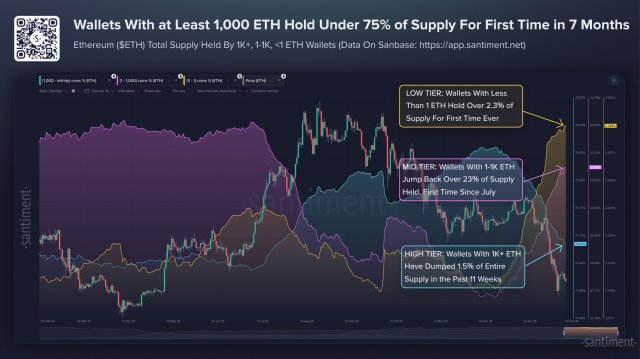
ETH high-tier investors in selling mode since December 2025 | Source: Chart from Santiment on X

According to data from Santiment, mid-tier investors (those holding between 1 and 1,000 ETH) have also been steadily buying the altcoin. This persistent buying has pushed their collective holdings back to over 23% of the total supply for the first time since July 2025.

For smaller holders and low-tier investors, ETH accumulation has been rising, bringing their collective stash to 2.3% of the overall supply, marking the highest level ever. Santiment highlighted that these wallet addresses are likely growing due to ETH staking.

Staking ETH Now Takes More Time

As Ethereum staking grows, the process is now taking more time than ever. Milk Road shared on X that investors are expected to wait for 71 days and 11 hours to stake ETH. Recently, Ethereum staking reached 30% of the total supply, locking up 36.8 million ETH valued at a whopping $72 billion.

The 4.1 million ETH queue suggests that demand to stake is at an all-time high while the altcoin’s price sits below $2,000. Meanwhile, the exit queue is essentially nonexistent by comparison, with just 75,872 ETH leaving. Such a trend is an indication of conviction, not yield farming behavior. When people lock up $74B during a price dip, it means they are settling in, instead of speculating. “Watch that queue, it’s a sentiment indicator,” Milk Road added.

ETH trading at $1,968 on the 1D chart | Source: ETHUSDT on Tradingview.com

Trending Cryptos

Related Questions

QWhat divergence in investor behavior is currently observed in the Ethereum market according to the Santiment report?

AThe divergence shows that large investors (high-tier holders with at least 1,000 ETH) are selling, while small investors (low-tier holders with less than 1 ETH) and mid-tier investors (1-1,000 ETH) are buying and accumulating.

QHow much of Ethereum's total supply did high-tier holders collectively own before their recent selling activity?

AHigh-tier holders collectively owned more than 75% of Ethereum's total supply before their recent selling activity.

QWhat is the current staking queue time for Ethereum, and what does the long queue indicate about investor sentiment?

AThe current staking queue time is 71 days and 11 hours. The long queue with 4.1 million ETH waiting to be staked, coupled with a minimal exit queue, indicates strong conviction and long-term holding sentiment among investors rather than speculative yield farming.

QWhat percentage of Ethereum's total supply is now being staked, and what is its approximate value?

A30% of Ethereum's total supply is now being staked, which amounts to 36.8 million ETH valued at approximately $72 billion.

QTo what level has the collective holdings of low-tier Ethereum investors (less than 1 ETH) risen?

AThe collective holdings of low-tier investors have risen to 2.3% of the overall supply, marking the highest level ever recorded.

Related Reads

Bitcoin Withdrawals Continue: 8 Years of Storage in a Coldcard Cold Wallet Ended in Zero

Coldcard Hardware Wallet Hacked: Losses Mount Due to Vulnerable Seed Generation A critical vulnerability in Coldcard hardware wallets has led to a continued wave of fund thefts. According to Galaxy Research, the total stolen has reached 1,367.05 BTC (approx. $88.6 million) from 4,585 addresses, a significant increase from the initial 594.5 BTC reported on July 30, 2026. Most of the stolen funds remain on the attackers' addresses. The issue is not with the current firmware, which Coinkite has updated, but with seed phrases generated on vulnerable devices between March 2021 and the release of fixed firmware versions. Due to a programmer error, devices switched from using a hardware random number generator to the software-based Yasmarang generator, which was initialized with publicly accessible data like the chip's serial number. This made the seed phrases predictable through offline brute-force attacks, meaning wallets remain at risk until funds are moved to a new wallet generated with the patched firmware. Affected devices include Mk2/Mk3 with firmware 4.0.1–4.1.9 (and up to 5.0.3), Mk4/Mk5 up to version 5.6.0, and Q models up to 1.5.0Q. The only exceptions are seeds created with a high-entropy method like at least 50 independent dice rolls or a strong unique BIP-39 passphrase. All other owners must generate a new seed on the fixed firmware and transfer their assets. A case highlighting the human impact involves a 39-year-old long-term investor who lost 2 BTC (approx. $130,000) in minutes. He had accumulated the Bitcoin over eight years through physical labor, viewing it as a financial lifeline and a retirement plan in a country suffering from hyperinflation. His story underscores that even conservative "buy and hold in cold storage" strategies can be compromised by such underlying technical flaws. From a technical perspective, this incident echoes historical failures where weak random number generators undermined cryptographic security, challenging the assumption that offline storage is automatically foolproof.

cryptonews.ru6m ago

Bitcoin Withdrawals Continue: 8 Years of Storage in a Coldcard Cold Wallet Ended in Zero

cryptonews.ru6m ago

Trading

Spot

Hot Articles

Discussions

Welcome to the HTX Community. Here, you can stay informed about the latest platform developments and gain access to professional market insights. Users' opinions on the price of ETH (ETH) are presented below.

活动图片















