Here Are The Major Bitcoin Levels To Watch After Breaking $80,000

bitcoinistPublished on 2026-05-11Last updated on 2026-05-11

Abstract

Bitcoin has closed a week above $80,000 for the first time since late January, strengthening the bullish case after breaking through the $78,000 to $80,000 bearish order block. The key to future price action now depends on whether bulls can hold two critical levels. The first is the $78,000 floor, which must be defended to confirm the former resistance zone has turned into support. The second is the $82,000 lower-high area; a clean break above it could open the path toward the next major resistance at $90,000. However, a truly bullish trend shift would only be confirmed with a high-timeframe close above the $97,900 "Change of Character" level, which would break the pattern of lower highs formed since late 2025. While currently trading around $81,000, analysis suggests there remains a significant chance Bitcoin retests the $60,000 zone before any sustained upward move.

Bitcoin has done something it had not managed since late January: close a week above $80,000. Bitcoin bulls now have a stronger argument after BTC pushed through the $78,000 to $80,000 bearish order block, but the next phase is not yet easy to predict.

What comes next, however, depends entirely on whether Bitcoin bulls can defend the price ground the cryptocurrency has just claimed and two important price levels.

The $78,000 Floor That Must Hold

TradingView data shows that Bitcoin registered a weekly close of $82,210 against Tether on Sunday, May 10, confirming that the break above $80,000 was not just an intraday reclaim of the psychological level.

However, the zone between $78,000 and $80,000 was not simply a range that Bitcoin traded through. Technical analysis of the daily candlestick price chart shows that it was a bearish order block, a supply area where sellers had previously overwhelmed buyers repeatedly.

This makes $78,000 the level bulls may need to defend if the breakout is going to stay valid. A clean hold above this area would suggest that the former bearish order block has flipped into support, giving BTC a stronger base for another attempt at higher levels.

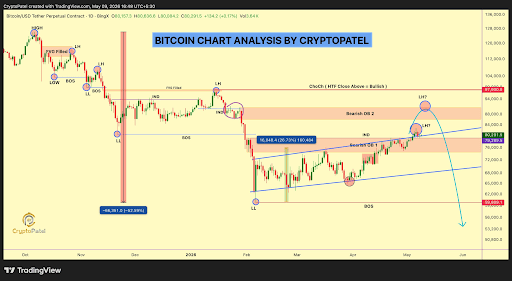
The next level is the current lower-high area around $82,000. CryptoPatel’s chart shows Bitcoin trading around this zone after reclaiming the $78,000 to $80,000 order block, and this is where the market could either confirm continuation or form another short-term rejection.
Source: Chart from Crypto Patel on X

A clean break above $82,000 would open the door for Bitcoin to move higher. In that case, the next likely target becomes the $90,000 bearish order block.

Bigger Levels That Decide The Trend

The most important upside level on the chart is $90,000, marked as Bearish OB 2. If Bitcoin breaks cleanly above the $82,000 lower-high zone, this is the next area where sellers may try to regain control. BTC has already broken above $78,000 to $80,000 Bearish OB 1, so the chances of hitting $90K Bearish OB 2 are now high.

A move into $90,000 would keep the market in recovery mode, but it would still leave Bitcoin inside a broader bearish structure unless buyers push much higher. It wouldn’t be until Bitcoin breaks above $97,000 that it would finally be bullish. CryptoPatel’s chart marks $97,900 as the Change of Character level, with a high-time-frame close above it needed for a bullish change.

As shown in the chart above, a rally into $90,000 followed by rejection would still fit the lower-high structure that BTC has been forming since its October 2025 all-time high. A high-timeframe close above $97,900 would be more meaningful because it would break the structure of lower highs.

At the time of writing, Bitcoin is trading at $80,870. However, according to Crypto Patel, there is still a high probability BTC revisits the $60,000 zone before any real continuation.

BTC trading at $81,030 on the 1D chart | Source: BTCUSDT on Tradingview.com

Trending Cryptos

Related Questions

QWhat was significant about Bitcoin's weekly close on May 10, 2026?

ABitcoin registered a weekly close of $82,210, confirming that the break above $80,000 was not just an intraday event but a meaningful weekly closure above that psychological level.

QWhy is the $78,000 level considered crucial for Bitcoin bulls to defend?

AThe $78,000-$80,000 zone was a bearish order block where sellers previously dominated. Holding above $78,000 would flip this former supply area into support, validating the breakout and providing a strong base for further price increases.

QAccording to the article, what is the significance of Bitcoin breaking above the $82,000 level?

AA clean break above $82,000 would open the door for Bitcoin to move higher towards the next major target, which is the $90,000 bearish order block.

QWhat price level does the article identify as the 'Change of Character' level, and why is it important?

AThe article identifies $97,900 as the Change of Character level. A high-time-frame close above this level would be significant because it would break the structure of lower highs that Bitcoin has been forming since its all-time high in October 2025, signaling a true bullish change.

QDespite the recent breakout, what potential downside scenario is mentioned by analyst CryptoPatel?

AAccording to CryptoPatel, there is still a high probability that Bitcoin could revisit the $60,000 zone before any real continuation of the upward trend occurs.

Related Reads

Can Generative Models Finally Be Trained End-to-End? The Core Is a For Loop

This article introduces a novel training paradigm for generative models called Explorative Modeling (XM), which enables true end-to-end training. Traditionally, powerful generative models like autoregressive and diffusion models are not trained end-to-end. They are trained to predict a single small step but require iterative multi-step sampling for inference. This "exposure bias" leads to error accumulation and limits performance. The core challenge XM addresses is "mode blurring." In generative tasks, a single input (e.g., "generate a dog") corresponds to many valid outputs (multiple modes). Standard training objectives like reconstruction loss force the model to average these modes, producing unrealistic, blurry outputs. To avoid this, existing models break generation into many small, almost deterministic steps, sacrificing end-to-end training. XM tackles this by restructuring the training loop itself. Its key insight is to amplify "generative expressivity." For each training input, instead of generating one sample, the model generates K candidate outputs. Only the candidate closest to the real data is used for computing the loss and updating the model via backpropagation. This simple "best-of-K" mechanism is implemented as a short for-loop. By exploring multiple possibilities, the model learns to distribute its guesses across different modes rather than collapsing to their uninformative average. The paper demonstrates that "exploration" acts as a new, powerful scaling axis. Gains from XM increase with model size, data scale, and compute. Experiments show improvements in FID scores for image generation and significant efficiency gains, sometimes outperforming larger models without exploration. When pushed to the limit, XM enables fully single-step, end-to-end generative models. In robotics tasks, an "Explorative Policy" matched the performance of a 100-step Diffusion Policy with a single forward pass, drastically improving inference speed. While the best-of-K concept is not entirely new, the authors' contribution lies in formally understanding it as a direct method to boost generative expressivity without fragmenting the generation process. This work suggests that as models scale, enhancing exploration during training may become crucial for overcoming fundamental performance bottlenecks.

marsbit49m ago

Can Generative Models Finally Be Trained End-to-End? The Core Is a For Loop

marsbit49m ago

Annual Salary of Millions Competing for Electricians, Meta Rushes to Open Its Own Technical School

The AI boom is facing an unexpected bottleneck: a severe shortage of skilled construction workers and electricians. As tech giants like Meta, OpenAI, and Alphabet race to build massive data centers—such as OpenAI's $16 billion "Stargate" project—they are hitting a critical labor wall. The U.S. needs an estimated 130,000 more electricians, 240,000 construction workers, and 150,000 supervisors by 2030 for AI infrastructure alone, but tens of thousands of electrician jobs go unfilled each year. While AI companies offer high premiums, with electricians earning up to $280,000 annually, worker scarcity still causes massive losses—delays on a single project can cost $14.2 million per month. The complexity of building AI data centers, which require immense power (equivalent to powering hundreds of thousands of homes), sophisticated electrical systems, and advanced liquid cooling solutions, demands highly skilled technicians who are in short supply. To combat this, companies are investing heavily in training. Meta has committed $115 million to a free training school offering tuition, housing, and stipends, targeting 5,000 new workers. OpenAI is partnering with unions to secure skilled labor. These efforts are paying off, with a significant rise in Gen Z interest in trade schools over college. However, the power demands are staggering. AI data centers are driving a rapid surge in electricity consumption, projected to account for up to 12% of U.S. power use by 2028 and raising costs for consumers. Furthermore, the construction boom is project-based, leading to a potential future glut of trained workers once building peaks, which could depress wages industry-wide. The race for AI supremacy now depends as much on skilled hands as on advanced chips.

marsbit2h ago

Annual Salary of Millions Competing for Electricians, Meta Rushes to Open Its Own Technical School

marsbit2h ago

Trading

Spot

Hot Articles

What is $BITCOIN

DIGITAL GOLD ($BITCOIN): A Comprehensive Analysis Introduction to DIGITAL GOLD ($BITCOIN) DIGITAL GOLD ($BITCOIN) is a blockchain-based project operating on the Solana network, which aims to combine the characteristics of traditional precious metals with the innovation of decentralized technologies. While it shares a name with Bitcoin, often referred to as “digital gold” due to its perception as a store of value, DIGITAL GOLD is a separate token designed to create a unique ecosystem within the Web3 landscape. Its goal is to position itself as a viable alternative digital asset, although specifics regarding its applications and functionalities are still developing. What is DIGITAL GOLD ($BITCOIN)? DIGITAL GOLD ($BITCOIN) is a cryptocurrency token explicitly designed for use on the Solana blockchain. In contrast to Bitcoin, which provides a widely recognized value storage role, this token appears to focus on broader applications and characteristics. Notable aspects include: Blockchain Infrastructure: The token is built on the Solana blockchain, known for its capacity to handle high-speed and low-cost transactions. Supply Dynamics: DIGITAL GOLD has a maximum supply capped at 100 quadrillion tokens (100P $BITCOIN), although details regarding its circulating supply are currently undisclosed. Utility: While precise functionalities are not explicitly outlined, there are indications that the token could be utilized for various applications, potentially involving decentralized applications (dApps) or asset tokenization strategies. Who is the Creator of DIGITAL GOLD ($BITCOIN)? At present, the identity of the creators and development team behind DIGITAL GOLD ($BITCOIN) remains unknown. This situation is typical among many innovative projects within the blockchain space, particularly those aligning with decentralized finance and meme coin phenomena. While such anonymity may foster a community-driven culture, it intensifies concerns about governance and accountability. Who are the Investors of DIGITAL GOLD ($BITCOIN)? The available information indicates that DIGITAL GOLD ($BITCOIN) does not have any known institutional backers or prominent venture capital investments. The project seems to operate on a peer-to-peer model focused on community support and adoption rather than traditional funding routes. Its activity and liquidity are primarily situated on decentralized exchanges (DEXs), such as PumpSwap, rather than established centralized trading platforms, further highlighting its grassroots approach. How DIGITAL GOLD ($BITCOIN) Works The operational mechanics of DIGITAL GOLD ($BITCOIN) can be elaborated on based on its blockchain design and network attributes: Consensus Mechanism: By leveraging Solana’s unique proof-of-history (PoH) combined with a proof-of-stake (PoS) model, the project ensures efficient transaction validation contributing to the network's high performance. Tokenomics: While specific deflationary mechanisms have not been extensively detailed, the vast maximum token supply implies that it may cater to microtransactions or niche use cases that are still to be defined. Interoperability: There exists the potential for integration with Solana’s broader ecosystem, including various decentralized finance (DeFi) platforms. However, the details regarding specific integrations remain unspecified. Timeline of Key Events Here is a timeline that highlights significant milestones concerning DIGITAL GOLD ($BITCOIN): 2023: The initial deployment of the token occurs on the Solana blockchain, marked by its contract address. 2024: DIGITAL GOLD gains visibility as it becomes available for trading on decentralized exchanges like PumpSwap, allowing users to trade it against SOL. 2025: The project witnesses sporadic trading activity and potential interest in community-led engagements, although no noteworthy partnerships or technical advancements have been documented as of yet. Critical Analysis Strengths Scalability: The underlying Solana infrastructure supports high transaction volumes, which could enhance the utility of $BITCOIN in various transaction scenarios. Accessibility: The potential low trading price per token could attract retail investors, facilitating wider participation due to fractional ownership opportunities. Risks Lack of Transparency: The absence of publicly known backers, developers, or an audit process may yield skepticism regarding the project's sustainability and trustworthiness. Market Volatility: The trading activity is heavily reliant on speculative behavior, which can result in significant price volatility and uncertainty for investors. Conclusion DIGITAL GOLD ($BITCOIN) emerges as an intriguing yet ambiguous project within the rapidly evolving Solana ecosystem. While it attempts to leverage the “digital gold” narrative, its departure from Bitcoin's established role as a store of value underscores the need for a clearer differentiation of its intended utility and governance structure. Future acceptance and adoption will likely depend on addressing the current opacity and defining its operational and economic strategies more explicitly. Note: This report encompasses synthesised information available as of October 2023, and developments may have transpired beyond the research period.

1.4k Total ViewsPublished 2025.05.13Updated 2025.05.13

What is $BITCOIN

Discussions

Welcome to the HTX Community. Here, you can stay informed about the latest platform developments and gain access to professional market insights. Users' opinions on the price of BTC (BTC) are presented below.

活动图片