Harvard University May Have Lost $150 Million in Cryptocurrency Trading! Has Liquidated Ethereum and Significantly Reduced Bitcoin ETF Positions

marsbitPublished on 2026-05-18Last updated on 2026-05-18

Abstract

Harvard University's endowment fund, managed by Harvard Management Company (HMC), recently disclosed significant reductions in its cryptocurrency holdings. According to its latest 13F filing, HMC sold its entire position in the BlackRock Ethereum Spot ETF (ETHA) and reduced its stake in the BlackRock Bitcoin Spot ETF (IBIT) by 43% in Q1 2026. This marks a sharp reversal from its peak holdings of $443 million in crypto assets just two quarters prior, bringing the current value to approximately $117 million. Analysis suggests these sales likely resulted in substantial losses. Estimates indicate HMC's Bitcoin ETF trades incurred a roughly 28% loss (over $100 million), while its brief Ethereum position fell about 35% (over $30 million), totaling potential losses exceeding $150 million. The timing of HMC's trades—aggressively adding to Bitcoin near its all-time high in late 2025 and buying Ethereum just before a market downturn—has drawn criticism as potential "buying high and selling low." However, the context points to broader pressures. Harvard faced a $113 million operating deficit in FY2025 due to cuts in federal research funding and a significant tax increase on endowment income. With much of its portfolio locked in illiquid private equity and hedge funds, the highly liquid crypto ETFs presented the most straightforward assets to sell for liquidity and risk management. Furthermore, HMC's Bitcoin ETF holding had grown to 20% of its public portfolio by Q3 2025, prompting nec...

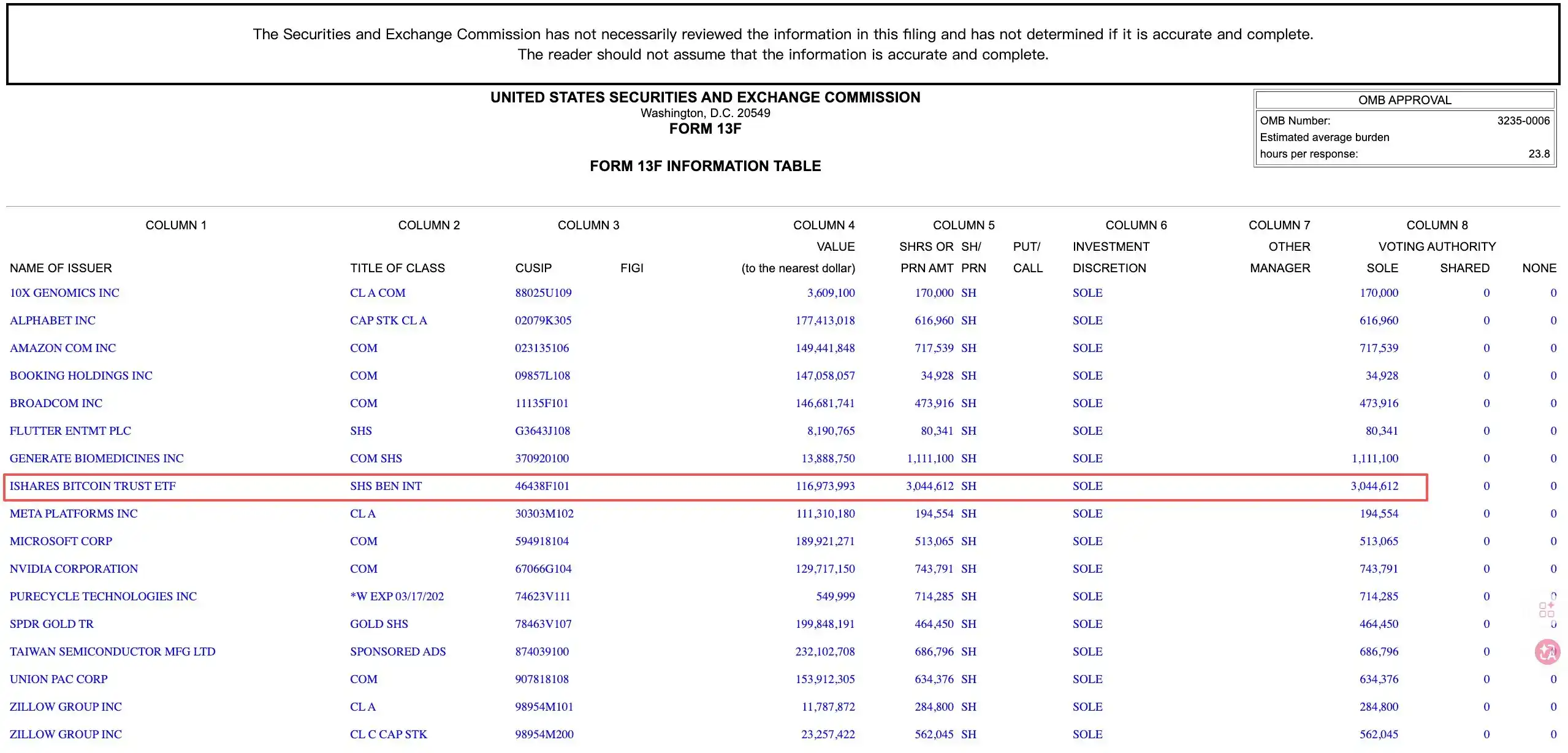
Last weekend, Harvard Management Company (HMC) filed its latest 13F holdings report with the U.S. Securities and Exchange Commission. Its holdings in the BlackRock Bitcoin Spot ETF (IBIT) shrank by 43% compared to the previous quarter, while the Ethereum ETF (ETHA) purchased during the same period was completely liquidated.

In just two quarters, Harvard's public holdings in crypto assets fell from a peak of $443 million to about $117 million. As one of the top-tier institutions managing the world's largest university endowment fund, this move has sparked market questioning: Can even top talent escape the trap of buying high and selling low?

In fact, Harvard's connection with cryptocurrency goes far beyond this. As early as 2018, several Ivy League endowment funds showed keen interest in blockchain technology through venture capital funds focused on cryptocurrencies. It was reported that Harvard, Yale, Brown, and the University of Michigan began quietly purchasing Bitcoin through exchanges like Coinbase around 2019.

Among them, HMC first publicly disclosed its holdings in Q2 2025. According to the 13F filing submitted in August of that year, HMC held approximately 1.9 million shares of IBIT, valued at about $117 million, and simultaneously established a position in the Gold ETF (GLD) worth about $102 million.

Matt Hougan, CIO of Bitwise, interpreted this set of operations as a "depreciation hedge trade," simultaneously betting on Bitcoin and gold to hedge against the risk of global currency oversupply. IBIT thus became Harvard's fifth-largest public holding, surpassing its holdings in Alphabet, Google's parent company.

Entering the third quarter, HMC made a significant increase in its position. As of September 30, 2025, its IBIT holdings expanded to approximately 6.81 million shares, valued at about $443 million, a quarter-over-quarter increase of over 257%. IBIT surpassed Microsoft, Amazon, and Nvidia to become the single largest holding in HMC's publicly disclosed portfolio, accounting for about 20% of its public U.S. stock portfolio.

At that time, facing persistently low expected returns from traditional assets, many university endowment funds were quietly adjusting their investment strategies.

Kim Lew, CEO of Columbia Investment Management Company, stated that expected returns and alpha from traditional asset classes would both be compressed, forcing institutions to move further out on the risk curve. Carlos Rangel of the W.K. Kellogg Foundation bluntly said that the traditional foundation model would be difficult to sustain if an 8% return rate couldn't be achieved.

Simultaneously, even Harvard's own economics professors couldn't sit still. In August 2025, Kenneth Rogoff, former IMF Chief Economist and Harvard economics professor, publicly reflected on his mistaken 2018 prediction—he had predicted that Bitcoin was more likely to fall to $100 than rise to $100,000 within a decade, yet at that time, the Bitcoin price had already exceeded $113,000, representing over a 10-fold increase since his prediction.

Rogoff admitted he had been "overly optimistic about the prospects for sensible crypto regulation in the United States" and had underestimated the demand support for Bitcoin in the global underground economy. The public admission of error by such an academic figurehead provided an additional layer of emotional endorsement for this wave of institutional buying. And Bitcoin subsequently approached its historical peak of $126,000 in October 2025.

In Q4 2025, after the market peaked and began to retreat, HMC adjusted its positions accordingly. IBIT holdings decreased by about 21%, falling to approximately 5.35 million shares valued at about $266 million. Simultaneously, the BlackRock Ethereum Spot ETF (ETHA) appeared for the first time in the report, with a holding of about 3.87 million shares valued at approximately $86.8 million.

As disclosed by Bloomberg ETF analyst James Seyffart, hedge funds were net sellers of Ethereum ETFs this quarter due to the collapse of basis trade returns, becoming the largest net sellers. Harvard precisely entered the market against the trend during this time window, becoming the largest new buyer of Ethereum ETFs for the quarter.

The latest disclosed holdings for Q1 2026 show that ETHA, which had just been established less than a quarter ago, has been completely liquidated. Meanwhile, HMC significantly reduced its IBIT holdings again, cutting its position by about 43%, leaving about 3.04 million shares valued at about $117 million. IBIT has also fallen out of Harvard's top five holdings, surpassed in turn by TSMC, Alphabet, Microsoft, and SPDR Gold Trust.

According to estimates by well-known crypto KOL Chen Jian, HMC's average purchase price for IBIT was around $110,000, with an average selling price of about $80,000, resulting in a loss of approximately 28%, with a paper loss on the Bitcoin portion exceeding $100 million. Regarding Ethereum, the average purchase price for ETHA was about $4,000, and it was liquidated at around $2,600, estimated to incur a single-quarter loss of over $30 million (-35%). Combined, these crypto operations are suspected to have resulted in losses exceeding $150 million.
Is this chasing rallies and selling on dips, or routine institutional rebalancing?

One perspective argues that HMC made its largest-scale increase in position when Bitcoin was near its historical high, then sold more as it fell lower, drawing a classic curve of buying high and selling low. The Ethereum position was even completely liquidated less than a quarter after purchase, almost capturing the entire decline. This is typical behavior of chasing rallies and selling on dips.

Another perspective points out that by the end of Q3, IBIT already accounted for 20% of HMC's public portfolio, a clearly excessive concentration. Subsequent reductions were necessary actions from a risk control standpoint. Moreover, HMC still maintains a base position of about $117 million in IBIT, indicating it hasn't completely exited the market.

However, this round of position reduction must also consider the current real-world pressures Harvard is facing.

Last October, Harvard's financial report for fiscal year 2025 showed that due to the Trump administration halting almost all federal research funding in the spring, Harvard incurred an annual operating loss of $113 million on total revenue of $6.7 billion, marking the first budget deficit since the pandemic.This deficit represents 1.7% of total revenue, with the operating shortfall standing in stark contrast to the $45 million surplus in 2024.
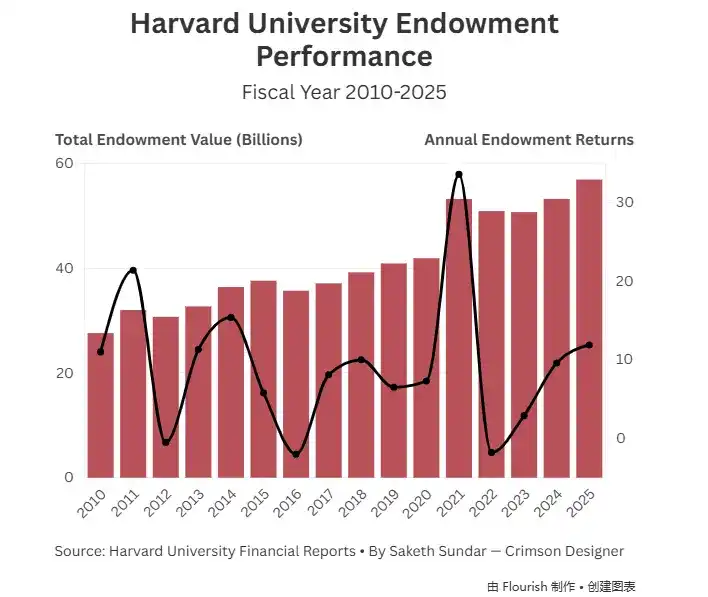
The endowment fund contributes about 37% of Harvard's operating income. In fiscal 2025, it provided approximately $2.5 billion in spending support, but 80% of these funds are restricted by donor purposes and cannot be reallocated at will.

Simultaneously, the Republican tax bill formally signed into effect in July 2025 significantly raised the maximum tax rate on endowment income from 1.4% to 8%. Harvard estimates this will result in an additional annual tax burden of approximately $300 million.

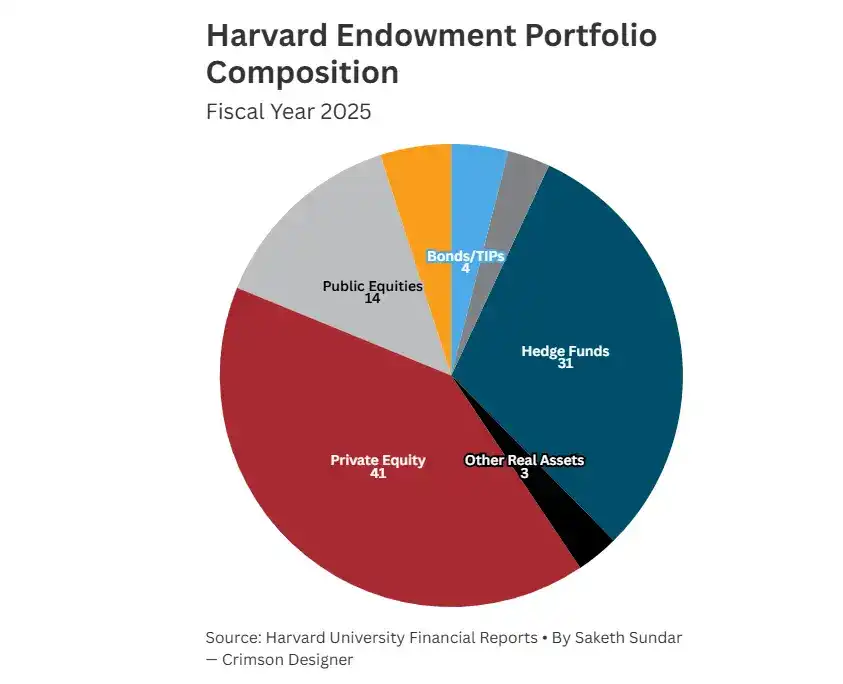
Under such pressure, the asset structure itself determines where cuts are easiest to make.

Private equity accounts for about 41% of Harvard's endowment fund, and hedge funds about 31%. These assets have long lock-up periods and extremely high costs for discounted sales. IBIT and ETHA, as intraday-tradable public market ETFs, offer the strongest liquidity and lowest liquidation costs, naturally making them the first targets for adjustment.
Furthermore, N.P. Narvekar, the current CEO of HMC, has revealed plans to retire around 2027 and is currently discussing succession arrangements with the board. In an environment where fiscal pressure, political uncertainty, and leadership transition overlap, holding a large-scale, highly volatile crypto position becomes an additional reputational risk.

In contrast to Harvard's retreat are the distinctly different choices of other institutions. Among them, the Abu Dhabi sovereign fund Mubadala continued to increase its IBIT holdings by about 16% in Q1 2026, raising its position to about $566 million, marking its fifth consecutive quarter of increasing its Bitcoin ETF stake.

As another university endowment fund, Dartmouth maintained its IBIT position unchanged, swapped its Ethereum ETF for a staking version, and added approximately $3.67 million in the Bitwise Solana Staking ETF, becoming one of the first U.S. university endowment funds to extend its crypto allocation beyond Bitcoin and Ethereum.

Brown University kept its 212,500 IBIT shares unchanged, while Emory University exited its small IBIT position, instead increasing its holdings in the Grayscale Bitcoin Mini Trust.

Overall, Harvard's round of operations is the result of the combined effects of fiscal pressure, liquidity needs, and triggered risk budgets, making it difficult to simply attribute it to chasing rallies and selling on dips.

When the world's top university endowment fund enters the crypto market, it does not do so with a crypto-native belief-based approach, but rather with Wall Street's risk-ledger logic. Crypto ETF products certainly provide an institutional entry point, but they also bring institutional-style selling pressure during risk-off periods.


Related Questions

QAccording to the article, what was the total estimated loss from Harvard Management Company's cryptocurrency trades?

AThe estimated total loss from HMC's crypto trades was over $150 million. This comprises a loss of over $100 million on Bitcoin (IBIT) and a loss of over $30 million on Ethereum (ETHA).

QWhat were the two main opposing interpretations of HMC's trading activity in the article?

AThe two main interpretations are: 1) That it was classic 'buying high and selling low' behavior, as HMC increased its Bitcoin position near the market peak and then sold as prices fell. 2) That it was a necessary risk control and portfolio rebalancing action, especially after Bitcoin ETF holdings reached 20% of HMC's public portfolio, and that the sales were motivated by liquidity needs.

QWhat specific financial and political pressures did Harvard face that may have influenced its decision to sell its cryptocurrency holdings?

AHarvard faced several pressures: 1) A $113 million operating deficit in fiscal year 2025 due to halted federal research funding. 2) A significant increase in the endowment tax rate from 1.4% to 8%, adding an estimated $300 million in annual tax liability. 3) The liquidity of the cryptocurrency ETFs made them the easiest assets to sell to raise cash, compared to illiquid private equity and hedge fund holdings.

QHow did the trading strategy of other institutions, like Mubadala and Dartmouth, contrast with Harvard's in Q1 2026?

AIn contrast to Harvard's sell-off, Mubadala (Abu Dhabi's sovereign fund) increased its IBIT holdings by about 16% in Q1 2026. Dartmouth College's endowment maintained its IBIT position unchanged, swapped its Ethereum ETF for a staking version, and added a Bitwise Solana Staking ETF, expanding its crypto exposure.

QWhat does the article suggest about how traditional institutions like Harvard approach the cryptocurrency market?

AThe article suggests that traditional institutions like Harvard do not enter the crypto market based on 'crypto-native' belief. Instead, they use a 'Wall Street risk ledger' logic. While crypto ETFs provide an entry point for institutions, they also become a source of institutional selling pressure when these entities need to de-risk or rebalance their portfolios.

Related Reads

Fei-Fei Li's Team Clarifies the Concept of 'World Models', Sora Merely a Renderer

"World Models" has become a widely used yet confusing term in AI. To address this, a team led by Fei-Fei Li and World Labs proposed a functional taxonomy based on the Partially Observable Markov Decision Process framework. This taxonomy categorizes systems called "world models" into three distinct projections: Renderers, Simulators, and Planners. Renderers, like OpenAI's Sora and other video generation models, focus on producing photorealistic visual outputs for human perception. They prioritize visual fidelity over physical accuracy. Simulators, such as NVIDIA Omniverse, aim to compute precise future environmental states for computational tasks like engineering analysis or digital twins. Planners, like Vision-Language-Action models, take in observations and goals to output executable actions for robots or agents. The article clarifies that most current "world models," including Sora, are primarily Renderers. They generate convincing visuals but lack the core ability to simulate state transitions based on actions, a key requirement for a true world model in classic reinforcement learning definitions. This conceptual confusion has practical implications, leading to potential misalignment in technology selection, investment, and public understanding of AI capabilities. Clear categorization is crucial. It helps enterprises avoid costly mistakes (e.g., using a renderer for robot training), allows investors to accurately assess markets, and enables researchers to build comparable benchmarks. While future systems may integrate these functions, recognizing current boundaries is essential for honest assessment and progress.

marsbit7m ago

Fei-Fei Li's Team Clarifies the Concept of 'World Models', Sora Merely a Renderer

marsbit7m ago

Bloomberg Uncovered: How Do China's Wealthy Circumvent the Annual $50,000 Limit to Transfer Assets?

**Summary: How Wealthy Chinese Circumvent $50,000 Annual Foreign Exchange Limits** Despite China's strict capital controls, including an annual $50,000 per person foreign exchange quota, an estimated $150 billion in funds still leaves the country annually via various gray and underground channels. This report outlines the evolution of China's "capital wall" and the methods used to bypass it. **The Evolving Capital Controls:** * **Foundation (1994):** The system of "current account convertibility with strict capital account controls" was established. * **Quota Set (2007):** The $50,000 individual annual forex purchase limit was formalized. * **Crackdown Begins (2015-2017):** Following market volatility, enforcement tightened. Banks were required to scrutinize transactions, and channels like using UnionPay cards for Hong Kong insurance premiums or buying overseas property were blocked. * **Digital & Legal Upgrades (2024-2026):** Enhanced algorithms now flag suspicious patterns (e.g., "smurfing"). The Common Reporting Standard (CRS) provides Chinese tax authorities with data on citizens' offshore accounts. Unlicensed cross-border brokers have been targeted. **Five Primary Methods for Moving Capital:** 1. **Underground Banking / "Hawala" (Duiqiao):** The largest-scale method. No money crosses borders. Clients pay RMB to a domestic account; an overseas associate deposits equivalent foreign currency into the client's offshore account. Risks include high fees, account freezes, and legal penalties. 2. **"Smurfing" or "Ant Moving":** Using multiple individuals' $50,000 quotas to pool funds for one offshore recipient. Increasingly detected by anti-money laundering algorithms. 3. **Trade Invoice Manipulation:** Businesses over-invoice imports or under-invoice exports via offshore shell companies, creating a pretext to transfer excess funds abroad under the guise of trade. 4. **Channel Migration:** After a crackdown on internet brokers, funds flow toward more compliant but costly channels like major banks' cross-border wealth management services or Qualified Domestic Institutional Investor (QDII) quotas. 5. **Structural Arrangements:** High-net-worth individuals use complex, high-cost legal structures involving offshore trusts, insurance, and investment migration programs to transfer asset ownership. **Regulatory Response: Focusing on People, Not Just Money** The current strategy extends oversight from enterprises to **individual residents**. Tools like CRS allow retroactive visibility into offshore assets. Cryptocurrencies, once seen as a potential loophole, are now actively monitored and prosecuted as an illegal channel. The underlying driver remains: with significant wealth concentrated among millions of affluent households seeking diversification amid domestic economic shifts, the incentive to move assets offshore persists despite regulatory barriers.

marsbit27m ago

Bloomberg Uncovered: How Do China's Wealthy Circumvent the Annual $50,000 Limit to Transfer Assets?

marsbit27m ago

Ethereum's Ballmer Moment: As Everyone Is Bearish, the Circulating Supply Is Disappearing

"Ethereum's Ballmer Moment: Circulation Shrinks Amid Bearish Sentiment" Amid widespread bearish sentiment, with prominent figures like Bankless founder David Hoffman selling ETH and young developers flocking to Solana, some argue Ethereum is entering its "Ballmer era"—akin to Microsoft's perceived stagnation under Steve Ballmer. While surface-level criticisms about slow protocol development, cautious leadership, and competitive pressure are valid, underlying fundamentals tell a different story. Approximately 30% of ETH is staked, major holders like BitMine are accumulating, and spot ETFs continue to absorb supply. Regulatory clarity, including the SEC/CFTC's March ruling on staking rewards and the potential passage of the CLARITY Act, is transforming crypto from a regulatory threat into a legitimized framework. This institutionalization, alongside a shrinking circulating supply (with net issuance around 0.23% annually), creates significant buy-side pressure independent of fee-based value capture. The broader crypto total addressable market is expanding through regulated stablecoins, tokenized assets, and institutional adoption. While public chains face competition from permissioned alternatives, the winning model appears to be permissioned assets settling on public chains like Ethereum and Solana. The author advocates a non-maximalist, barbell strategy: holding ETH for its institutional role and supply squeeze, SOL for consumer/throughput trends, BTC as a macro hedge, and a basket of next-gen L1s. Key bullish drivers for ETH include rapid circulation shrinkage, potential Q2 staked ETF approvals, regulatory tailwinds solidifying its role as a default settlement layer, and the optionality of an eventual "Satya moment" leadership shift. Despite bearish consensus, the current setup—where crypto is "not hot" and regulatory groundwork is being laid—presents a compelling investment opportunity. The crypto cycle's focus may have shifted to AI, but blockchain infrastructure is gaining a legal and institutional foothold precisely while attention is elsewhere.

marsbit27m ago

Ethereum's Ballmer Moment: As Everyone Is Bearish, the Circulating Supply Is Disappearing

marsbit27m ago

Trading

Spot
Futures

Hot Articles

Discussions

Welcome to the HTX Community. Here, you can stay informed about the latest platform developments and gain access to professional market insights. Users' opinions on the price of ETH (ETH) are presented below.

活动图片














