Hacker Attack Cuts Flow in Half, Rollback Plan Sparks Civil War Within Ecosystem

Odaily星球日报Published on 2025-12-29Last updated on 2025-12-29

Abstract

A severe hack targeting the Flow blockchain, developed by Dapper Labs, led to the theft of approximately $3.9 million due to an execution layer vulnerability. The incident caused the token FLOW to plummet by over 50%, dropping from $0.173 to $0.079, though it later partially recovered to around $0.107. Initially, the Flow Foundation proposed rolling back the network to a checkpoint before the attack to remove all transactions within a six-hour window, aiming to eliminate fraudulent activity. However, this plan faced strong opposition from cross-chain bridge partners and community members. Key partners, including deBridge and LayerZero, warned that a rollback could cause severe issues like double-spending and inconsistent asset states across chains, potentially harming legitimate users and bridge operators. Under significant criticism, Flow abandoned the rollback plan and instead adopted an "Isolation and Recovery" strategy. This new approach involves no chain reorganization, preserves all legitimate user transactions, and temporarily restricts accounts that received illicitly minted assets. The recovery is being executed in phases, with Cadence environment repairs prioritized first, followed by gradual reactivation of EVM functionality and cross-chain services. The incident sparked a broader debate about decentralization and chain integrity, with critics arguing that the initial rollback proposal revealed excessive centralization. The revised recovery plan has eased some t...

Original | Odaily Planet Daily (@OdailyChina)

Author | Asher (@Asher_ 0210)
Last Saturday afternoon, a sudden hacker attack threw the Flow network into chaos. This Layer 1 network, built by the Dapper Labs team and tailored for the next generation of applications, games, and digital assets, watched helplessly as assets worth $3.9 million were transferred off-chain due to an exploited execution layer vulnerability. Following the attack, its token FLOW was temporarily cut in half, plummeting from $0.173 to $0.079, and has since rebounded slightly to around $0.107.
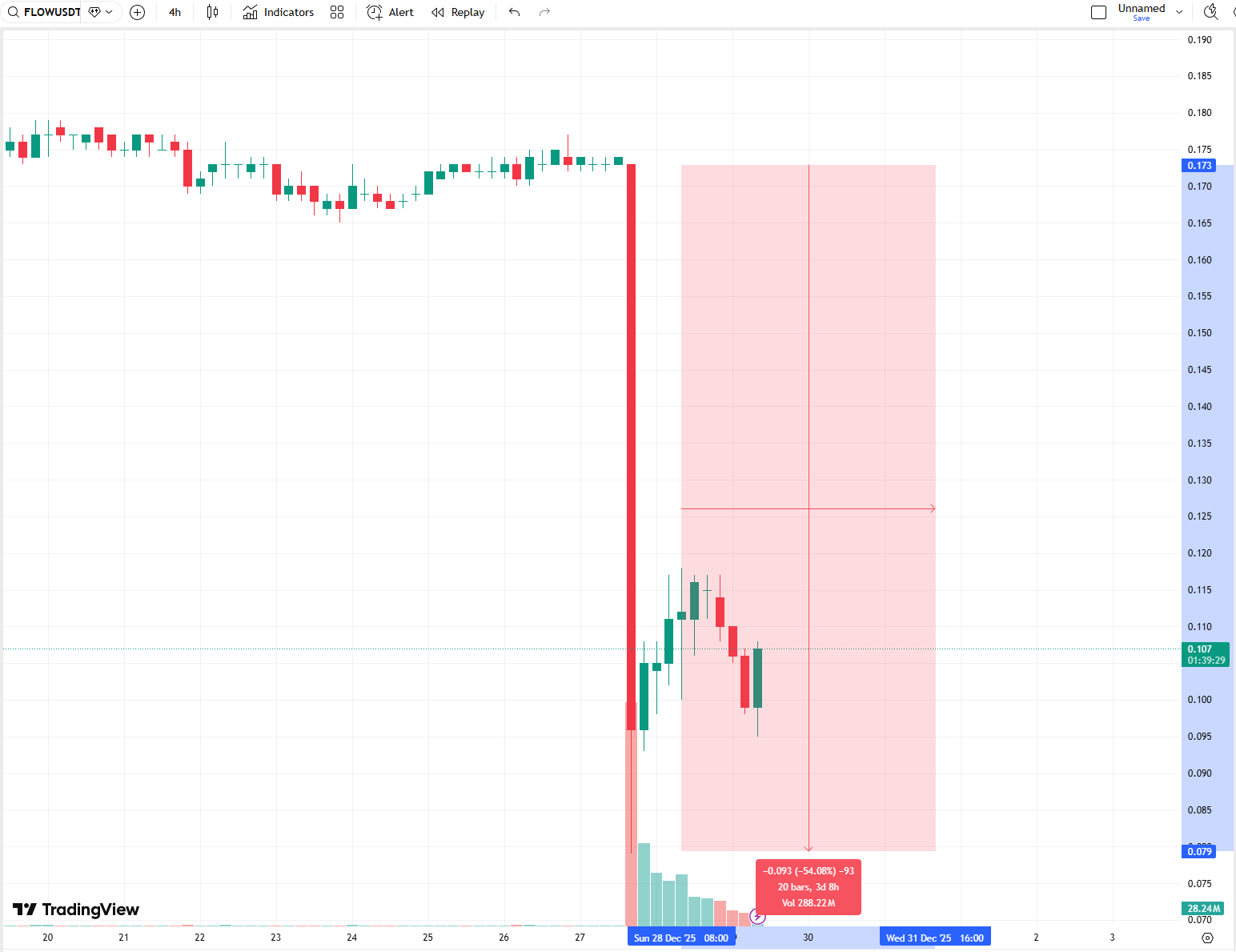
FLOW K-Line Chart

Below, Odaily Planet Daily breaks down this Flow theft incident, the official response, and why it has sparked strong质疑 (questioning/doubts) from Flow's partners and community.

Flow Official Emergency Response: Isolate Network, and Announce Rollback Plan

After the attack, the Flow Foundation quickly responded and confirmed the details of the incident. The attacker exploited an execution layer vulnerability to transfer approximately $3.9 million in assets; the incident did not affect users' existing balances, and user deposits remain safe. The relevant attack addresses have been marked, money laundering paths are being continuously tracked, and the Foundation has submitted asset freeze requests to Circle, Tether, and several major exchanges.

To clean up illegal on-chain transactions and repair the vulnerability, the Flow Foundation isolated the network and simultaneously published Mainnet 28, a patched version for the mainnet vulnerability. The Foundation's initial proposed solution was to roll back the network state to a checkpoint before the attack, specifically to Cadence block height 137363395, thereby deleting all transaction records generated within approximately a 6-hour window. Regardless of whether the transactions were legitimate, they would all be erased, and users would need to resubmit transactions after node restart. The Foundation believed this plan was the safest path to restore network integrity, repeatedly emphasized that user funds would not be affected throughout the process, and promised to provide external updates on progress every two hours.

This rollback decision, seemingly decisive, quickly ignited an ecosystem firestorm—because the hacker's funds had already been bridged off-chain, the rollback would not affect the attacker but would only impact honest users and partners.

Cross-Chain Bridge Partners, Community Users Strongly Oppose, Rollback Plan Heavily Criticized

After the rollback plan was announced, cross-chain bridge partners within the Flow ecosystem and community users quickly faced collective质疑 (questioning/doubts). Alex Smirnov, co-founder of deBridge, a major cross-chain bridge partner for Flow, publicly criticized the decision on platform X as too hasty and stated that no prior communication had been made with key bridge partners beforehand. As a crucial asset channel for the Flow ecosystem, deBridge did not receive any advance notice regarding the rollback.

Smirnov pointed out that the potential damage from a rollback could far exceed that of the initial hack itself. Since cross-chain assets had already circulated across multiple systems, a forced rollback would cause serious issues like asset duplication and inconsistent custodial states, ultimately harming the bridges, users, and counterparties who operated normally during the window. He disclosed that approximately $200,000 and $50,000 in deposits on deBridge fell within the rollback time window; once the rollback was executed, it could lead to funds disappearing on one side or the extreme case of assets being double-minted.

Based on these risks, Smirnov called on Flow validators to suspend block production and validation until compensation plans, partner coordination mechanisms, and plans for independent security team involvement were all clarified. Similar issues were not isolated cases. As the main cross-chain custodian for USDC on the Flow network, LayerZero also faced risks with approximately $220,000 and $180,000 in cross-chain transactions falling within the rollback window.

Beyond cross-chain bridge partners within the Flow ecosystem, users on platform X began集中 (concentratedly) expressing concerns about fund safety, developers questioned the network's reliability and governance mechanisms under extreme circumstances, investor sentiment turned cautious accordingly, and selling pressure intensified. A significant number of voices directly pointed out that the rollback itself exposed the reality of centralized control on the chain, rapidly turning a technical incident into a crisis of trust.

Some community views further targeted the core principles of blockchain. Some argued that the rollback directly shook transaction finality and immutability, making Flow resemble an alliance chain subject to administrative intervention at a critical moment. Others compared it to historical security incidents on other public chains, pointing out that similar situations are usually handled by isolating attacker addresses and freezing fund flows, rather than performing a global rollback of the entire network state.

Crypto KOL Wazz (@WazzCrypto) stated bluntly on platform X that Flow's rollback decision was one of the worst handling methods he had ever seen. In his view, the attacker had already transferred nearly $4 million in assets off-chain and would hardly be substantively affected by the rollback; the real cost would instead be borne by innocent users who used the network normally via cross-chain bridges.

Flow Official Changes Stance: Abandons Rollback, Adopts New Isolation Recovery Plan

Facing strong opposition from partners and the community, the Flow official team ultimately decided to abandon the network rollback and shift to an "Isolation Recovery Plan". This plan was developed through direct consultation with cross-chain bridges, exchanges, and infrastructure partners. Key points include:

  • No rollback/reorganization, preserving all legitimate user activity;
  • No need for partners to replay transactions;
  • Over 99.9% of accounts unaffected, normal operation upon restart;
  • Temporary restriction of accounts that received illegally minted tokens upon restart;

Furthermore, the network will be restored in phases:

  • Phase 1: Cadence environment goes online, EVM temporarily restricted;
  • Phase 2: Cadence repair (approx. 24 to 48 hours);
  • Phase 3: EVM repair and restart;
  • Phase 4: Cross-chain bridges/exchanges resume operation, specific recovery time determined by operators based on actual conditions after confirming stability.

Additionally, Dapper Labs, the team behind Flow, expressed support for this plan on platform X, stating it "preserves legitimate activity and provides a clear path to recovery".

This "abandon rollback" stance alleviated ecosystem tensions in the short term and avoided the systemic risk扩散 (spread/proliferation) a rollback might have caused. As of now, the network is still in a phased coordination and recovery process, with officials stating user funds remain safe.

In the highly uncertain environment of the crypto market, this crisis may become a significant watershed in Flow's development path. Its long-term impact remains to be tested by time.


Trending Cryptos

Related Questions

QWhat was the immediate impact of the hack on the Flow network's native token, FLOW?

AThe FLOW token experienced a sharp price drop, falling from $0.173 to $0.079, effectively halving its value in a short period. It later saw a small rebound to around $0.107.

QWhat was the initial recovery plan proposed by the Flow Foundation after the hack, and why was it controversial?

AThe initial plan was to roll back the network state to a checkpoint before the attack, which would have erased all transactions from a 6-hour window. This was controversial because it would have affected legitimate user transactions and cross-chain bridge operations, potentially causing more damage than the hack itself, while the hacker's funds were already off-chain and unaffected.

QWhich key cross-chain bridge partner publicly criticized the rollback plan, and what was their main concern?

AAlex Smirnov, the co-founder of deBridge, publicly criticized the plan. The main concern was that the rollback was decided without prior communication with key bridge partners and would create severe problems like double-spending and inconsistent custodial states for assets that had already been bridged to other chains during that window.

QWhat was the final recovery solution that Flow adopted instead of a network rollback?

AFlow abandoned the rollback and adopted an 'Isolation Recovery Plan.' This plan involved no rollback, preserved all legitimate user activity, did not require partners to replay transactions, and temporarily restricted accounts that received illegally minted tokens. The network was to be restored in phases.

QWhat broader principle of blockchain technology did the proposed rollback crisis call into question according to the community?

AThe community argued that the proposed rollback shook the core blockchain principles of transaction finality and immutability, making Flow appear more like a centrally controlled consortium chain that could be administratively interfered with, rather than a decentralized ledger.

Related Reads

9.42 Million Retail Investors Compete for Changxin Technology, Who Got Allotted?

Evergreen Technology's IPO subscription results are now available. On July 20, the domestic memory chip giant announced the offline preliminary allotment results and online lottery results for its IPO. A total of approximately 9.43 million retail investors participated in the online subscription, generating 770,000 winning lots with a final winning rate of about 0.4714%, setting a record for new shares on the STAR Market. After triggering a clawback mechanism from institutional to retail investors, the online retail allocation was significantly increased to 3.851 billion shares. Simultaneously, 285 institutional investors participated in the offline subscription, ultimately receiving 2.173 billion shares at an allotment rate of approximately 0.1756%. Leading insurers and public funds were among the major recipients. Notably, Liang Wenfeng, founder of the major AI model company DeepSeek, through his quantitative investment firms Ningbo Huanfang Quantitative and Zhejiang Jiuzhang Asset, secured the largest share among private funds, with a total allotment worth approximately 175 million yuan. Estimates suggest potential profits could reach 730 million yuan if Evergreen Technology's market capitalization reaches 3 trillion yuan post-listing. The company is expected to list on July 27 and could become the highest-valued tech stock on the A-share market, with various brokerages providing valuations ranging from 1 trillion to over 4 trillion yuan. However, recent significant corrections in global tech stocks may impact its post-listing performance. (Character count: 1,196)

marsbit44m ago

9.42 Million Retail Investors Compete for Changxin Technology, Who Got Allotted?

marsbit44m ago

L2 'Recalibration': When L1 Becomes Its Own Rollup, What Is Ethereum's Endgame?

The article discusses the evolving relationship between Ethereum's Layer 1 (L1) and Layer 2 (L2) solutions, moving beyond the initial "L2 for scaling" model. As Ethereum L1 itself scales (increasing Gas Limit, statelessness, zkEVM), the unique value proposition of L2s shifts from merely providing cheap execution to offering differentiated features like application-specific optimization, privacy, and flexible governance. The piece explores three key themes: 1. **L2's New Role:** L2s are transitioning from a pure scaling technology to a spectrum of execution environments with varying degrees of security inheritance from Ethereum L1. 2. **Interoperability as State Trust:** Solving L2 fragmentation is less about cross-chain bridges and more about enabling faster, trust-minimized state verification between environments. This involves initiatives like faster L1 finality, intent-based architectures (Open Intents Framework), and native account abstraction. 3. **Blurring Layers:** With the potential integration of zk-proofs into L1 validation (making L1 akin to its own "Rollup") and the concept of "Native Rollups," the rigid boundary between L1 and L2 may fade. The future could be a unified system with multiple execution domains (for DeFi, gaming, privacy, etc.) sharing a common security, settlement, and state framework. In conclusion, Ethereum's goal is not to abandon L2s or re-centralize everything on L1, but to re-integrate the fragmented user experience—liquidity, accounts, applications—while preserving the scaling benefits of a multi-environment ecosystem. The endgame is a cohesive "one chain" feeling for users, powered by diverse but securely interconnected execution layers.

marsbit1h ago

L2 'Recalibration': When L1 Becomes Its Own Rollup, What Is Ethereum's Endgame?

marsbit1h ago

Trading

Spot

Hot Articles

How to Buy FLOW

Welcome to HTX.com! We've made purchasing Flow (FLOW) simple and convenient. Follow our step-by-step guide to embark on your crypto journey.Step 1: Create Your HTX AccountUse your email or phone number to sign up for a free account on HTX. Experience a hassle-free registration journey and unlock all features.Get My AccountStep 2: Go to Buy Crypto and Choose Your Payment MethodCredit/Debit Card: Use your Visa or Mastercard to buy Flow (FLOW) instantly.Balance: Use funds from your HTX account balance to trade seamlessly.Third Parties: We've added popular payment methods such as Google Pay and Apple Pay to enhance convenience.P2P: Trade directly with other users on HTX.Over-the-Counter (OTC): We offer tailor-made services and competitive exchange rates for traders.Step 3: Store Your Flow (FLOW)After purchasing your Flow (FLOW), store it in your HTX account. Alternatively, you can send it elsewhere via blockchain transfer or use it to trade other cryptocurrencies.Step 4: Trade Flow (FLOW)Easily trade Flow (FLOW) on HTX's spot market. Simply access your account, select your trading pair, execute your trades, and monitor in real-time. We offer a user-friendly experience for both beginners and seasoned traders.

3.8k Total ViewsPublished 2024.03.29Updated 2026.06.02

How to Buy FLOW

Discussions

Welcome to the HTX Community. Here, you can stay informed about the latest platform developments and gain access to professional market insights. Users' opinions on the price of FLOW (FLOW) are presented below.

活动图片












