Got Ripped Off by Polymarket, This Time the Bug is a "Time Warp"

Odaily星球日报Published on 2026-03-09Last updated on 2026-03-09

Abstract

Title: Polymarket's "Time Warp" Bug During Daylight Saving Transition Causes User Losses On March 8, 2024, Polymarket, a prediction market platform, encountered a significant timing error due to the transition from Eastern Standard Time (EST) to Eastern Daylight Time (EDT) in the US. This annual clock adjustment, which skips the hour from 2:00 AM to 3:00 AM, disrupted the platform's automated event creation and settlement system. The issue affected Polymarket's "Crypto Up or Down" hourly prediction markets for assets like BTC, ETH, SOL, and XRP. Events scheduled to run from 1:00 AM to 2:00 AM ET were impacted. Due to the time change, the platform's front-end and API incorrectly displayed the event duration as "March 8, 1-1 AM ET"—a logically impossible interval—instead of the correct "1:00 AM to 3:00 AM ET" (which still represents one actual hour). This bug caused substantial problems for automated trading systems that rely on precise timing data from the API. One user, "@richrichardoz," reported losses exceeding $100,000 because their trading bot malfunctioned upon receiving identical start and end times. The user and others have called for Polymarket to switch its time standard to UTC (Coordinated Universal Time) to avoid such issues and to compensate affected users. The incident highlights a critical design flaw in using local time (which is subject to bi-annual changes) instead of UTC, the global standard for financial systems. This ensures time remains consistent, mo...

Original | Odaily Planet Daily (@OdailyChina)

Author | Azuma (@azuma_eth)

In conventional understanding, time is linear, but the crypto world has its "exceptions".

Yesterday, Eastern Time (ET) completed the switch from standard time to daylight saving time as per convention (generally on the second Sunday of March at 2:00 AM), moving the clock forward by one hour, jumping directly from 2:00 AM on March 8 to 3:00 AM. The time didn't vanish into thin air; it's just that the Eastern Time zone switches between Eastern Standard Time (EST) and Eastern Daylight Time (EDT) based on custom, aiming to artificially adjust the time scale to make fuller use of daylight hours (and save electricity in the process).

For daily life, this switch doesn't cause much impact, but on the prediction market Polymarket, yesterday's time zone change directly sparked an unexpected controversy.

Polymarket Runs Into Timing Controversy

The controversy occurred in the "Crypto Up or Down" prediction events on Polymarket.

Polymarket offers cryptocurrency up/down prediction events with timeframes of year, month, week, day, 4 hours, 1 hour, 15 minutes, and 5 minutes, covering mainstream tokens like BTC, ETH, SOL, and XRP. These events are automatically created and settled based on Eastern Time and have become a significant source of trading volume on Polymarket.

At 1:00 AM on March 8 (still under Eastern Standard Time at that moment), Polymarket launched a new batch of 1-hour up/down prediction events for BTC, ETH, SOL, and XRP. The relevant links are as follows.

  • BTC (Final Result: Up): https://polymarket.com/event/bitcoin-up-or-down-march-8-1am-et
  • ETH (Final Result: Down): https://polymarket.com/event/ethereum-up-or-down-march-8-1am-et
  • SOL (Final Result: Down): https://polymarket.com/event/solana-up-or-down-march-8-1am-et
  • XRP (Final Result: Down): https://polymarket.com/event/xrp-up-or-down-march-8-1am-et

According to the event's resolution rules — comparing the opening price and closing price of the 1-hour candlestick on Binance USDT trading pairs, starting from the event's start time — the above four events have all been settled.

However, because the end time of this batch of events coincided with the daylight saving time switch, the moment Eastern Time reached 2:00 AM, it directly jumped to 3:00 AM (meaning the period from 2:00 AM to 3:00 AM was skipped), causing some timing confusion for this batch of events on the Polymarket platform itself.


As shown on Polymarket's frontend interface, perhaps because 2:00 AM did not exist in yesterday's Eastern Time reckoning, the time period currently displayed for this batch of events is "March 8, 1-1 AM ET" (i.e., March 8, 1:00 AM - 1:00 AM). Under normal timing conditions, such events should display a 1-hour time period (for example, the previous day's similar event was "March 7, 1-2 AM ET", i.e., 1:00 AM - 2:00 AM). If accounting for the daylight saving time switch, a more reasonable time period for this batch should be "March 8, 1-3 AM ET" (i.e., 1:00 AM - 3:00 AM, still essentially 1 hour).

So no matter how you look at it, the currently displayed "March 8, 1-1 AM ET" is very strange.

Chinese user "Xiao Z" (@richrichardoz) posted on X about this, stating that besides the frontend, Polymarket's API also returned the "1-1 AM ET" time period, causing automated programs relying on the API data to "all crash", estimating losses exceeding $100,000 because of this.

"Xiao Z" further explained that the start time and end time being exactly the same is a market state that is logically impossible. Many automated trading systems rely on the end time to determine the trading window; this error directly caused his program to lose a large sum of money. Therefore, he suggested that Polymarket change the time standard for related events to UTC time and compensate users affected by the data issue.
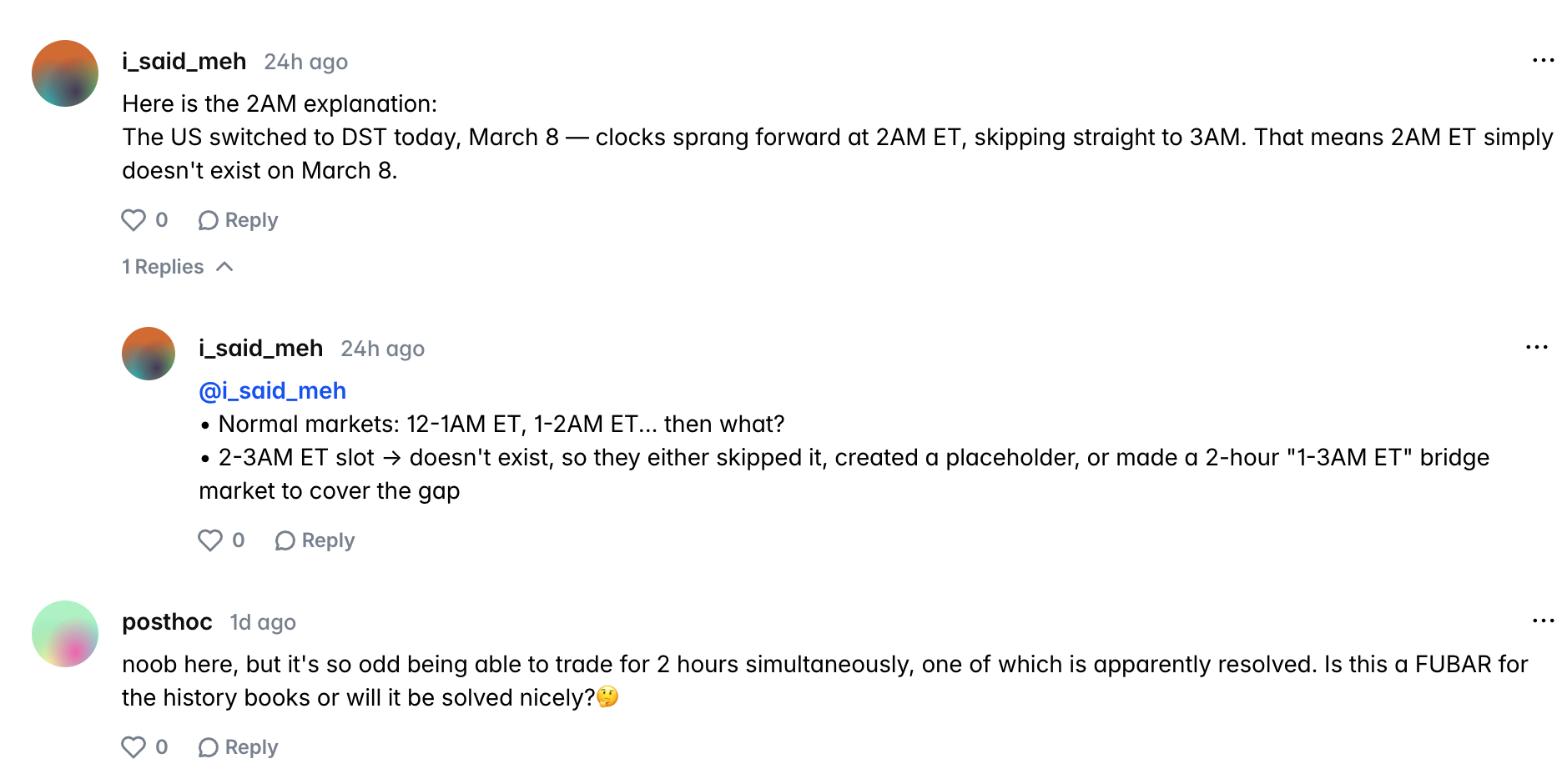
Besides this user, many external users have also left comments under the related events expressing confusion, but as of writing, Polymarket has not responded through official channels.

Time Standards in Traditional Financial Markets

Looking back at this controversy, although the scale of impact isn't huge, it exposed a fundamental design flaw in Polymarket's "Crypto Up or Down Market" events.

Influenced by historical customs, economic status, and industry practices, Eastern Time is still widely used across various industries. However, this is not very friendly to financial systems because Eastern Time switches between daylight saving time and standard time every year — artificially moving the clock forward or backward by one hour at specific times, resulting in "jumps" and "overlaps" in time respectively.

In modern financial systems, UTC time has long become the de facto universal standard. In the vast majority of financial infrastructure, internal systems typically use UTC timestamps as the sole standard time. Local times like Eastern Time are still used, but in terms of system logic, they often only exist in the presentation layer for users. This design is precisely to avoid the uncertainty of time systems, ensuring that time remains monotonic, unique, and globally consistent in financial transactions, settlements, and automated systems.

The key contradiction in Polymarket's controversy lies in the fact that the related events used Eastern Time as the timing standard but failed to fully consider the potential variable of the daylight saving time switch, ultimately causing confusion in the frontend and API data. Among the current user base of prediction markets, an increasing number of participants are trading via APIs and automated programs. Some minor issues that originally only affected frontend display can easily be amplified into real financial losses in automated systems.

Judging from the outcome, this controversy might not be considered a serious incident, and theoretically it could only happen at most twice a year, but what it reveals is a more serious design problem — as prediction markets gradually move towards becoming financial infrastructure, they must also adhere to the engineering standards used by financial infrastructure.


Related Questions

QWhat was the specific bug that occurred on Polymarket related to time?

AThe bug was a 'time warp' caused by the switch from Eastern Standard Time (EST) to Eastern Daylight Time (EDT), where the hour from 2:00 AM to 3:00 AM was skipped. This led to a batch of 1-hour prediction events being incorrectly labeled with a time range of '1-1 AM ET' instead of the proper one-hour duration.

QWhich prediction markets on Polymarket were affected by this timing issue?

AThe affected markets were the 1-hour 'up or down' prediction events for Bitcoin (BTC), Ethereum (ETH), Solana (SOL), and XRP that started at 1:00 AM ET on March 8.

QWhat was the financial impact reported by user '@richrichardoz' due to this bug?

AUser '@richrichardoz' (also referred to as '小Z') reported that their automated trading systems, which relied on the API's end time data, malfunctioned due to the incorrect time data, resulting in estimated losses of over $100,000.

QWhat is the suggested solution to prevent such timing issues on Polymarket according to the article?

AThe article suggests that Polymarket should change the time standard for its events to UTC (Coordinated Universal Time) to avoid the complexities and inconsistencies of local time changes like daylight saving time.

QWhy does the article state that UTC time is the de facto standard in modern financial systems?

AUTC time is the standard because it provides a monotonic, unique, and globally consistent time reference. Financial infrastructure uses UTC internally to avoid the uncertainties caused by local time changes, such as daylight saving time transitions, which can disrupt trading, settlement, and automated systems.

Related Reads

Within Strategy's Framework, STRC's Dividend Yield Remains at 12% as Share Price Stays Below Par Value

Michael Saylor, Executive Chairman of Strategy (MSTR), confirmed that the dividend rate for its STRC perpetual preferred shares will remain at 12.00% through August 2026. The rate has increased from 9% at its July 2025 launch to the current high via a "ratchet" mechanism, which permanently raises the rate by 0.5% whenever the share price falls below $95. This mechanism is intended to push the price back toward its $100 par value and support Strategy's "at-the-market" (ATM) program for issuing new shares to fund Bitcoin purchases. However, the mechanism has not worked as intended. STRC shares closed at $89.46 on July 31, remaining about 10-11% below par value despite the record-high dividend. Competition from rival Strive's higher-yielding SATA securities has pressured demand. The persistent discount has forced Strategy to suspend new STRC issuances via its ATM program, limiting this funding channel for Bitcoin acquisitions. STRC's struggles reflect Bitcoin's own volatility, as the preferred shares historically move in tandem. Analysts have warned the ratchet structure carries long-term, one-way risk. A law firm is investigating Strategy's ability to maintain dividend payments if Bitcoin's price stays low. Retail investors own roughly 83% of outstanding STRC shares, a group seen as prone to panic selling during downturns. In response, Strategy has established financial reserves, including a liquidity cushion covering about 26 months of dividend/interest obligations, and a $2 billion share buyback program alongside a Bitcoin monetization framework, though the company emphasized it is not obligated to sell any Bitcoin.

cryptonews.ru13m ago

Within Strategy's Framework, STRC's Dividend Yield Remains at 12% as Share Price Stays Below Par Value

cryptonews.ru13m ago

Analyst: Bitcoin's Price Will Drop to $60k in August, Then Rebound to $70k

Financial analyst Andrey Poroshin has provided a new forecast for Bitcoin's price dynamics in August. Poroshin, an analyst at the Bitbanker exchange, expects the cryptocurrency market to experience a downturn this month, with prices retesting the $60,000 level due to a lack of supportive macroeconomic catalysts. He noted that the recent US Federal Reserve decision to hold interest rates did not significantly impact the market, while inflation remains above the 2% target. Poroshin stated that Bitcoin is ending July under pressure from moderate volatility and a lack of new macroeconomic stimuli, leading to continued market caution. According to his base scenario, Bitcoin will drop to a range of $60,000 to $62,000 before recovering to $70,000. He pointed out that even $70,000 remains below the cost of mining in the US, which has prompted some miners to shift towards AI data center operations. Poroshin cited the winding down of BitMEX's operations as a potential catalyst for a price rebound, suggesting the exit of weaker players often coincides with market reversals and reduced short-term selling pressure. He believes Bitcoin is currently less susceptible to geopolitical shocks, such as the Iran-US conflict, and does not expect significant market changes in August related to the pending CLARITY Act. Looking ahead, Poroshin forecasts that September will bring more active price fluctuations driven by potential Fed rate decisions and possible discussions or approval of the CLARITY Act.

cryptonews.ru13m ago

Analyst: Bitcoin's Price Will Drop to $60k in August, Then Rebound to $70k

cryptonews.ru13m ago

Trading

Spot
活动图片






