Gold beats Bitcoin in the ‘safe-asset’ debate once again: ‘Get out while you still can!’

ambcryptoPublished on 2026-03-30Last updated on 2026-03-30

Abstract

The ongoing debate between Gold and Bitcoin as safe-haven assets continues, with recent developments favoring gold. While Bitcoin initially outperformed gold during U.S.-Iran geopolitical tensions in early March 2026—even nearing $74,000—it has since lost momentum, struggling to maintain levels above $67,000. The XAU/BTC chart shows green candles on the 4-hour timeframe, indicating gold's current outperformance, though the bounce remains minimal and lacks clear trend reversal signals, with RSI in overbought territory. The correlation between Bitcoin and Gold stands at -0.47, reflecting opposing price movements. On-chain analysis reinforces Bitcoin's perception as a riskier asset compared to gold, a view echoed by critic Peter Schiff. Market cap rankings further highlight gold’s dominance, placing first while Bitcoin ranks 12th. At press time, Bitcoin traded around $67,258 and gold at $4,536. Despite Bitcoin briefly acting as a safe haven during gold’s worst five-day drop since 1983, the market remains divided heading into Q2 2026. The key takeaway is that both assets exhibit strength under different conditions, with no consensus yet on the true safe-haven asset.

The good old debate between Gold [XAU] and Bitcoin [BTC] never seems to conclude. Earlier in March, after the U.S.-Iran escalations, Bitcoin started outperforming gold. It even climbed back to around $74,000, acting as a hedge during geopolitical tensions.

But as we move towards the end of the month and the end of the first quarter of 2026, Bitcoin is losing its charm.

Gold vs. Bitcoin: An analysis

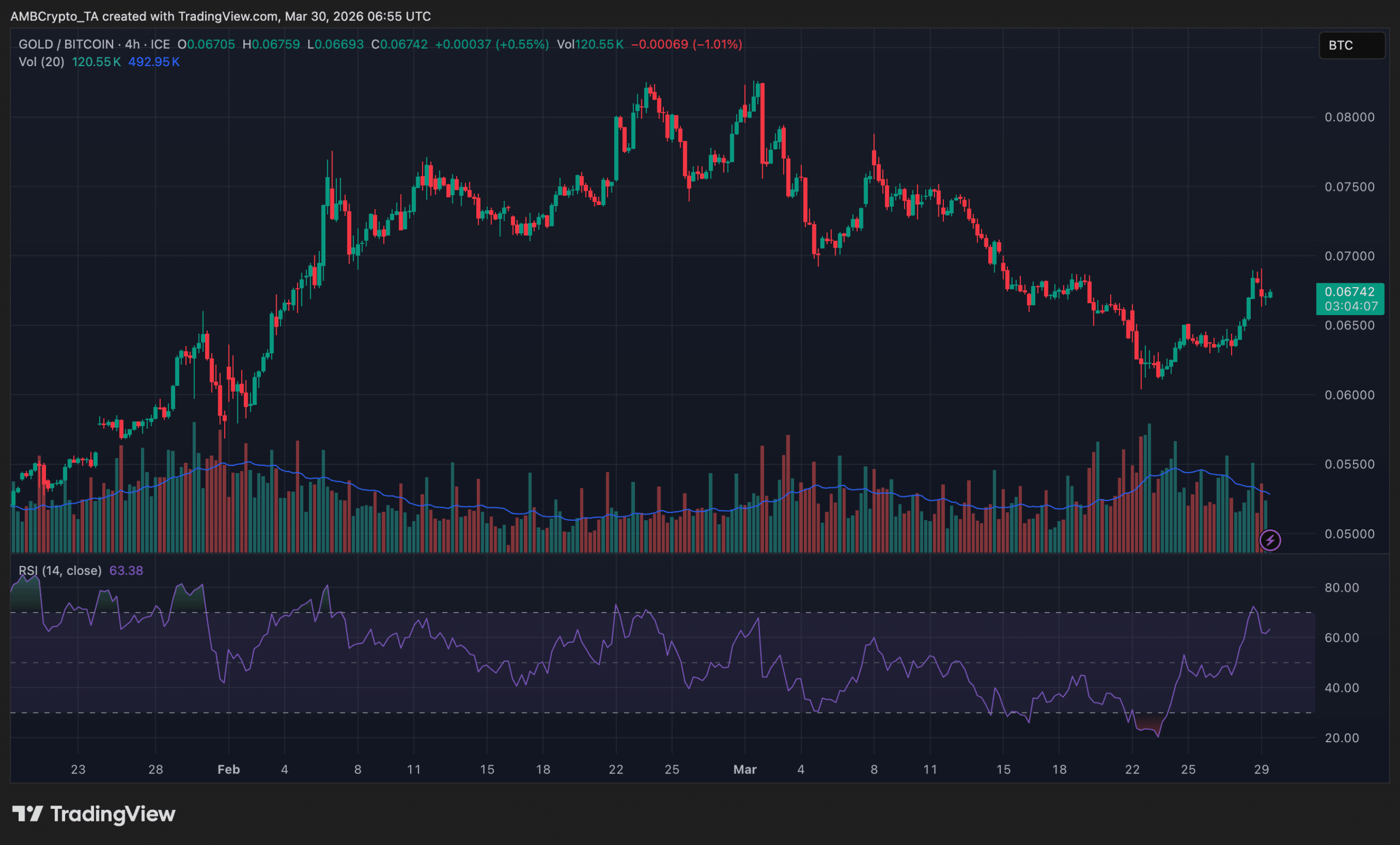
At the time of reporting, the XAU/BTC chart was showing green candles on the 4-hour time frame, indicating that gold was performing better than Bitcoin again. At the same time, Bitcoin was struggling to stay above the important $67,000 level.
Source: TradingView

Looking back, one can see that earlier this month, the chart dropped sharply. That meant Bitcoin was doing much better than Gold. Thereafter, both assets moved sideways for a while, showing a balance between them, but now things have shifted.

However, it’s also important to note that this bounce is currently minimal and does not hint at a real trend change. That said, the RSI was also around 72, in the overbought zone, which further confirmed the sentiment.

Bitcoin-Gold correlation hits rock bottom

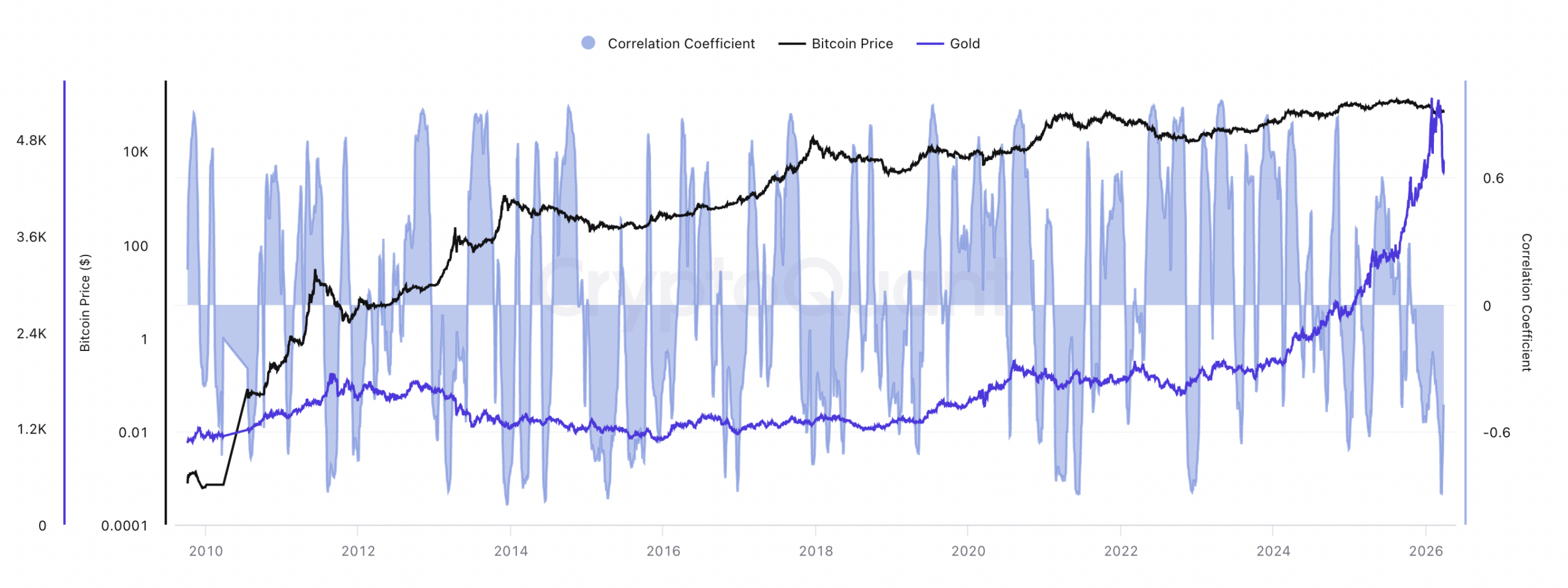
At press time, Bitcoin and Gold’s price correlation stood at -0.47, meaning that both assets were moving in opposite directions.
Source: CryptoQuant

So, according to on-chain analysis, Bitcoin is still being considered a risky asset in comparison to gold.

Bitcoin’s all-time critic, Peter Schiff, echoed this sentiment, noting,

Source: Peter Schiff/X

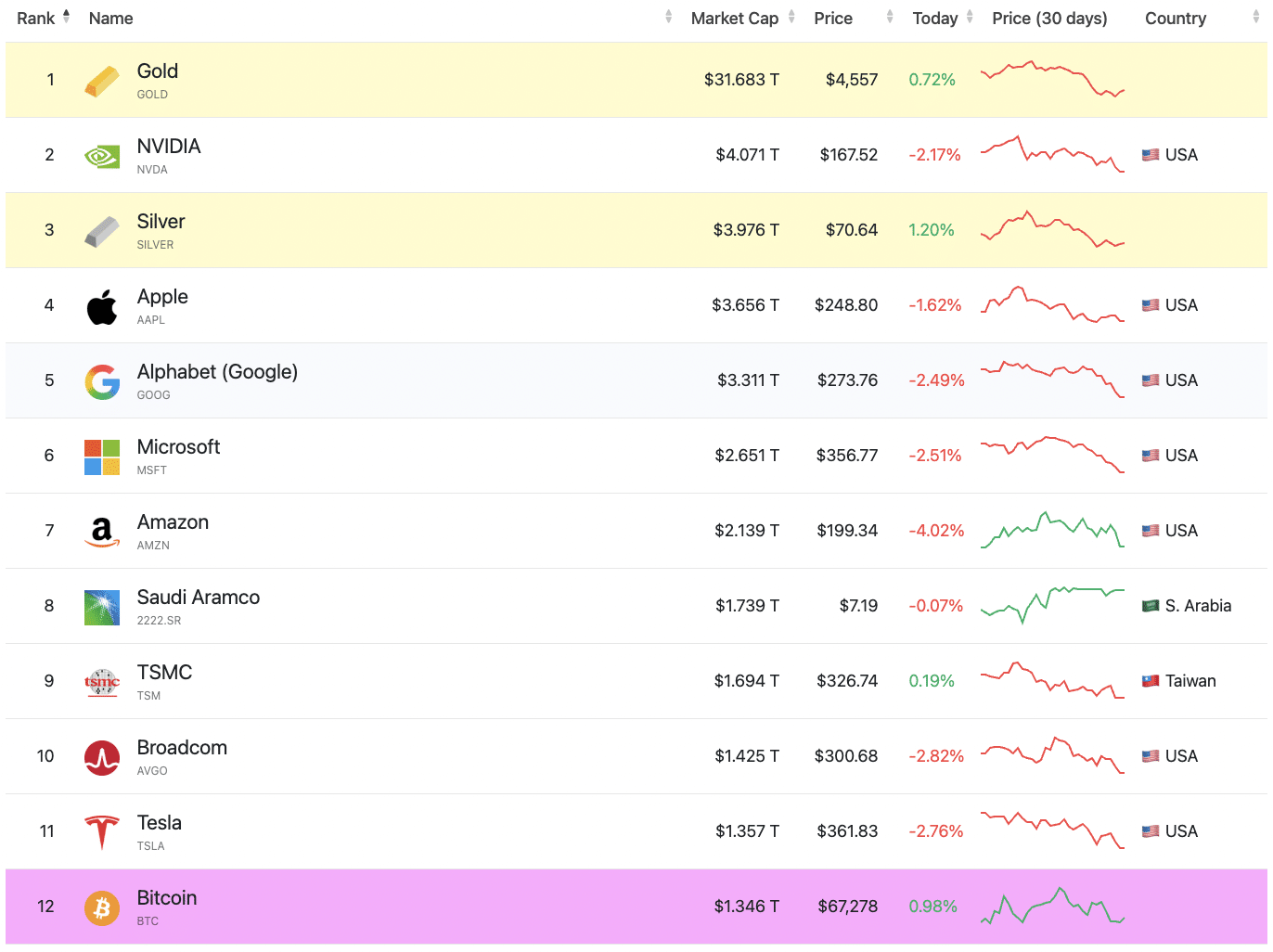
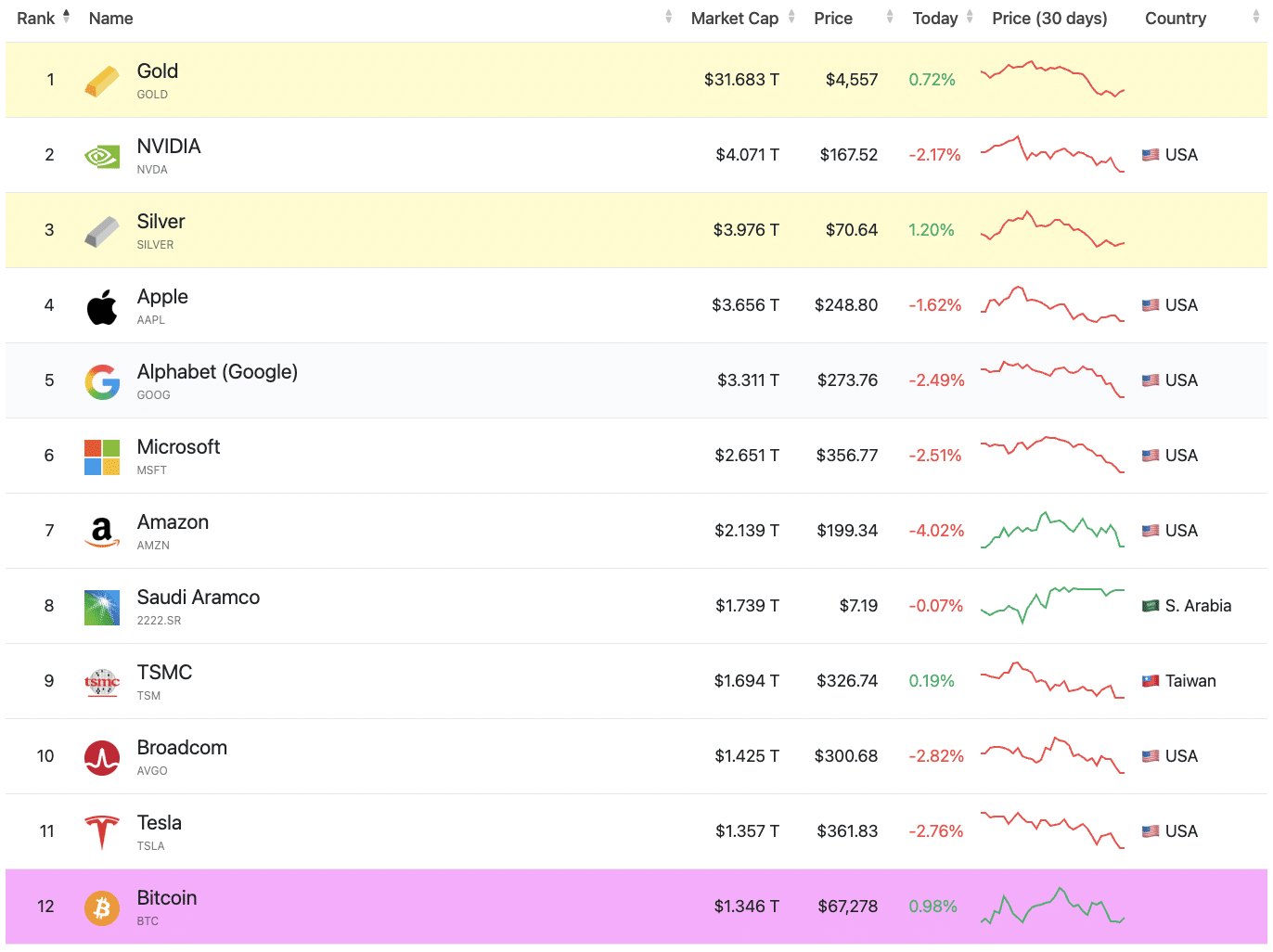
Schiff’s narrative was further supported by the asset market cap chart, which showed that Bitcoin was ranking 12th, whereas gold was at the top.
Source: CompaniesMarketCap

This comes as Bitcoin was trading around $67,258, and gold was priced at $4,536 at press time.

However, when you zoom out and look at the full month, Bitcoin was acting as a ‘safe haven’ when gold was witnessing its worst five-day drop since 1983.

Thus, as we move to Q2 of 2026, it remains to be seen whether the market is still divided or there is some agreement in terms of the actual ‘safe haven’ notion.


Final Summary

  • The Gold vs. Bitcoin debate continues to unfold, as both assets show strength at different times under different market conditions.
  • The negative correlation metric further confirms that both assets are not moving in the same direction.


Related Questions

QWhat was the price correlation between Bitcoin and Gold at the time of reporting, and what does it indicate?

AThe price correlation between Bitcoin and Gold was -0.47, indicating that the two assets were moving in opposite directions.

QAccording to the article, which asset was performing better on the XAU/BTC 4-hour chart at the time of reporting?

AGold was performing better than Bitcoin, as indicated by the green candles on the XAU/BTC 4-hour chart.

QWhat did the RSI level of 72 suggest about the market sentiment for the assets discussed?

AThe RSI level of 72 was in the overbought zone, which confirmed the sentiment that the bounce was minimal and not indicative of a real trend change.

QWho is cited in the article as a major critic of Bitcoin, and what was his stance?

APeter Schiff is cited as a major critic of Bitcoin, echoing the sentiment that Bitcoin is a risky asset compared to gold and advising people to 'get out while you still can'.

QHow did Bitcoin's role as a 'safe haven' asset compare to Gold's during the worst five-day drop for gold since 1983?

ABitcoin acted as a 'safe haven' asset during gold's worst five-day drop since 1983, outperforming gold and providing a hedge during that period of market stress.

Related Reads

Within Strategy's Framework, STRC's Dividend Yield Remains at 12% as Share Price Stays Below Par Value

Michael Saylor, Executive Chairman of Strategy (MSTR), confirmed that the dividend rate for its STRC perpetual preferred shares will remain at 12.00% through August 2026. The rate has increased from 9% at its July 2025 launch to the current high via a "ratchet" mechanism, which permanently raises the rate by 0.5% whenever the share price falls below $95. This mechanism is intended to push the price back toward its $100 par value and support Strategy's "at-the-market" (ATM) program for issuing new shares to fund Bitcoin purchases. However, the mechanism has not worked as intended. STRC shares closed at $89.46 on July 31, remaining about 10-11% below par value despite the record-high dividend. Competition from rival Strive's higher-yielding SATA securities has pressured demand. The persistent discount has forced Strategy to suspend new STRC issuances via its ATM program, limiting this funding channel for Bitcoin acquisitions. STRC's struggles reflect Bitcoin's own volatility, as the preferred shares historically move in tandem. Analysts have warned the ratchet structure carries long-term, one-way risk. A law firm is investigating Strategy's ability to maintain dividend payments if Bitcoin's price stays low. Retail investors own roughly 83% of outstanding STRC shares, a group seen as prone to panic selling during downturns. In response, Strategy has established financial reserves, including a liquidity cushion covering about 26 months of dividend/interest obligations, and a $2 billion share buyback program alongside a Bitcoin monetization framework, though the company emphasized it is not obligated to sell any Bitcoin.

cryptonews.ru21m ago

Within Strategy's Framework, STRC's Dividend Yield Remains at 12% as Share Price Stays Below Par Value

cryptonews.ru21m ago

Analyst: Bitcoin's Price Will Drop to $60k in August, Then Rebound to $70k

Financial analyst Andrey Poroshin has provided a new forecast for Bitcoin's price dynamics in August. Poroshin, an analyst at the Bitbanker exchange, expects the cryptocurrency market to experience a downturn this month, with prices retesting the $60,000 level due to a lack of supportive macroeconomic catalysts. He noted that the recent US Federal Reserve decision to hold interest rates did not significantly impact the market, while inflation remains above the 2% target. Poroshin stated that Bitcoin is ending July under pressure from moderate volatility and a lack of new macroeconomic stimuli, leading to continued market caution. According to his base scenario, Bitcoin will drop to a range of $60,000 to $62,000 before recovering to $70,000. He pointed out that even $70,000 remains below the cost of mining in the US, which has prompted some miners to shift towards AI data center operations. Poroshin cited the winding down of BitMEX's operations as a potential catalyst for a price rebound, suggesting the exit of weaker players often coincides with market reversals and reduced short-term selling pressure. He believes Bitcoin is currently less susceptible to geopolitical shocks, such as the Iran-US conflict, and does not expect significant market changes in August related to the pending CLARITY Act. Looking ahead, Poroshin forecasts that September will bring more active price fluctuations driven by potential Fed rate decisions and possible discussions or approval of the CLARITY Act.

cryptonews.ru21m ago

Analyst: Bitcoin's Price Will Drop to $60k in August, Then Rebound to $70k

cryptonews.ru21m ago

Trading

Spot
活动图片