Gemini Leaves For USA Market Dominance As MAXI Emerges As A Top Contender

bitcoinistPublished on 2026-02-05Last updated on 2026-02-05

Abstract

Gemini exchange is strategically withdrawing from secondary markets like Canada, the Netherlands, and France to focus on dominating the U.S. market and capturing institutional capital. This shift creates a divergence: regulated platforms target safety and compliance, while retail traders seek high-risk, high-reward opportunities on-chain. Maxi Doge ($MAXI) emerges as a meme token catering to this demand, offering gamified trading, leverage-like features, and staking rewards. Its presale has raised over $4.5M, reflecting strong retail interest as on-chain volumes grow. The project represents a cultural shift toward aggressive, community-driven trading amid increasing central exchange regulation.

The crypto regulatory map is changing fast. Gemini, the Winklevoss-led exchange, is accelerating its withdrawal from secondary jurisdictions to double down on the United States of America.

After leaving the Netherlands and France, they’ve just told Canadian users to close accounts by year-end. Is this a retreat? Hardly. It’s a cold calculation.

By cutting loose fragmented markets, Gemini is clearing the runway to become the primary gateway for the massive wave of U.S. institutional capital heading our way. The market is effectively splitting in two.

On one side, you have regulated giants like Gemini chasing safety and ‘slow’ institutional money. On the other? An insatiable retail hunger for high-variance plays. While institutions stick to the ‘boring’ infrastructure, retail liquidity is flowing aggressively on-chain, hunting for outsized returns.

As exchanges get ‘suit-ified,’ a vacuum for risk-on assets is opening up. New meme tokens are filling the gap, offering the volatility regulated giants can’t touch.

That explains why on-chain volumes are hitting fresh highs even as exchanges shrink their global footprints. It’s in this divergence that Maxi Doge ($MAXI) has surfaced, not just as a token, but as a vehicle for the aggressive trading culture traditional exchanges are regulating out of existence.

Institutional Safety Versus The Retail Hunger For Alpha

The narrative is defined by a tension between compliance and degeneracy. Gemini exiting Canada to focus on U.S. dominance might be great for Bitcoin’s long-term legitimacy, but frankly, it leaves a void for traders craving the raw energy of early crypto.

The ‘Leverage King’ culture of Maxi Doge targets that exact crowd, traders who see volatility as a feature, not a bug.

Maxi Doge isn’t just another static meme coin relying on a cute dog picture. It gamifies the experience, baking a 1000x leverage mentality right into the project. With planned features like Holder-Only Trading Competitions and a Maxi Fund treasury, community activity actually influences liquidity. It doesn’t avoid the mascot play altogether, though, instead leaning into a fitting, ‘gym-bro’ canine stack with muscles and chugging energy drinks.
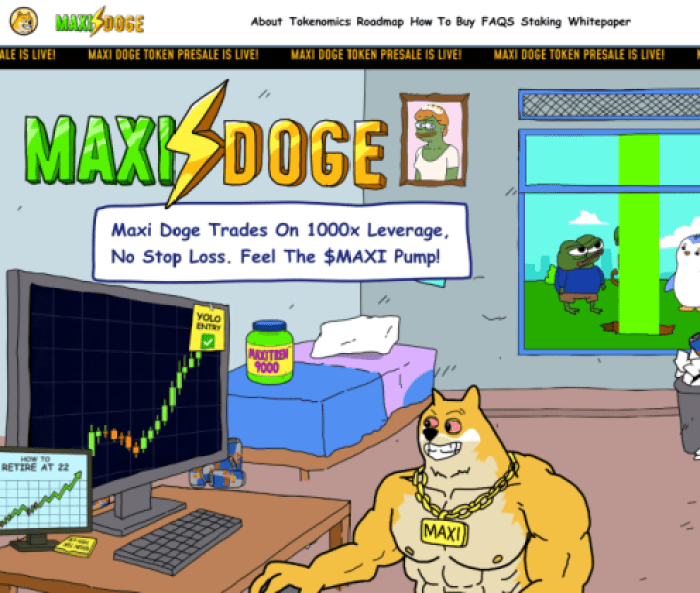
It’s a feedback loop that mirrors a broader trend: utility-adjacent memes are simply outperforming pure speculative assets right now.

Smart money seems to be watching this setup. On-chain data from Etherscan highlights whale wallets scooping up purchases as high as $314K. It suggests high-net-worth players are hedging the institutional bets with high-upside meme plays.

That barbell strategy holding Bitcoin while hunting alpha is quickly becoming the standard for sophisticated portfolios.

BUY $MAXI ON ITS OFFICIAL PRESALE PAGE

Presale Metrics Signal A Shift In Risk Appetite

While Gemini sanitizes its platform for ETF issuers and pension funds, the speculative capital driving viral cycles is moving on-chain. The Maxi Doge presale proves the point. $MAXI has already raised over $4.5M. That figure signals massive demand, arguably because retail excitement on centralized exchanges is cooling off.

At the current price of $0.0002802, the token is sitting in a spot to capture entry-level liquidity before potential listing premiums hit. But there’s more to it than just price action. The project offers a dynamic APY staking model (rewards planned to be paid daily from a 5% pool). It encourages holding, ‘never skipping leg day,’ while the treasury builds out partnerships.

The contrast couldn’t be starker. Gemini offers safety and modest yields (wealth preservation). Maxi Doge offers a high-risk, high-reward arena (wealth creation).

For the retail trader priced out of owning a whole Bitcoin, the ‘lift, trade, repeat’ ethos of $MAXI just hits harder than regulatory compliance. The data backs it up, too: as centralized friction grows, decentralized volume explodes.

EXPLORE $MAXI ON ITS OFFICIAL PRESALE PAGE

This article is for informational purposes only and does not constitute financial advice. Cryptocurrency investments, especially in presale and meme tokens, carry high risks, including the potential loss of principal. Always conduct independent research.


Related Questions

QWhy is Gemini withdrawing from secondary markets like Canada, the Netherlands, and France?

AGemini is withdrawing from these secondary jurisdictions to focus its resources and double down on the United States market, aiming to become the primary gateway for the massive wave of U.S. institutional capital entering the crypto space.

QWhat is the core difference between the strategy of regulated giants like Gemini and the on-chain retail activity described in the article?

ARegulated giants like Gemini are chasing safety and 'slow' institutional money, focusing on compliance and wealth preservation. In contrast, retail liquidity is flowing on-chain, aggressively hunting for high-variance, high-return assets that offer outsized gains, which regulated exchanges often cannot provide.

QWhat is the unique value proposition of Maxi Doge ($MAXI) according to the article?

AMaxi Doge ($MAXI) is not just a meme token; it gamifies the trading experience by baking a 1000x leverage mentality into the project. It offers features like Holder-Only Trading Competitions and a treasury fund, creating a feedback loop where community activity influences liquidity, targeting traders who see volatility as a feature.

QWhat does the article suggest about the current trend of 'smart money' or high-net-worth players in crypto?

AThe article suggests that smart money is employing a 'barbell strategy': they are hedging their institutional bets (like holding Bitcoin) with high-upside meme plays (like $MAXI), as indicated by whale wallets making large purchases to capture alpha while maintaining a base of safer assets.

QWhat does the success of the Maxi Doge presale (raising over $4.5M) indicate about the current market?

AThe successful presale indicates a massive demand and a shift in risk appetite, showing that speculative capital is moving on-chain as retail excitement on centralized exchanges cools off, and traders are seeking high-risk, high-reward opportunities in decentralized environments.

Related Reads

From South Korea to the United States: Blue-Collar Jobs Are Becoming Increasingly Popular, Thanks to AI

AI is reshaping the labor market's value proposition. The traditional four-year college degree is losing its appeal as a guaranteed career path, while skilled blue-collar trades like electricians, welders, and plumbers are experiencing historic demand and wage premiums. This shift is driven by dual pressures: AI's displacement of certain white-collar roles and a booming need for physical infrastructure and data center construction. Data confirms the trend. In the U.S., vocational school revenue surged, and a significant portion of recent layoffs are AI-related. Surveys show a majority of Gen Z adults plan to pursue blue-collar work, citing better job security against AI automation. Vocational education interest has exploded recently. Experts cite a psychological shift as younger generations seek tangible, AI-resistant careers and avoid high student debt. In many cases, salaries for skilled trades now match or exceed those requiring a bachelor's degree. In South Korea, semiconductor vocational high schools boast near-total employment, with graduates securing high-paying roles at companies like Samsung. The shortage is structural, exacerbated by a retiring baby boomer workforce and massive infrastructure projects. Companies like JPMorgan Chase, Meta, and Lowe's are investing heavily in training programs. However, overcoming historical stigma and a "perception gap" around trade careers remains a key challenge to closing the talent gap.

marsbit23m ago

From South Korea to the United States: Blue-Collar Jobs Are Becoming Increasingly Popular, Thanks to AI

marsbit23m ago

Qualcomm: AI Hype Subsides, When Will Smartphones Emerge from the Gloom?

Qualcomm reported its Q3 FY2026 results (ending June 2026), with revenue of $9.95B, down 4% YoY but above expectations. Gross margin declined to 53.1%, pressured by rising costs across manufacturing and memory. Key business segments showed mixed performance: Handset revenue fell 19.6% YoY to $5.09B, dragged by an 11% decline in non-Apple Android shipments and weaker high-end mix. Conversely, Automotive revenue surged 61% to $1.59B, and IoT grew 9% to $1.83B. Core operating profit dropped 41% YoY due to margin compression and higher expenses. Management's Q4 FY2026 guidance projects revenue of $9.7B-$10.5B, in line with consensus, but Non-GAAP EPS guidance of $2.05-$2.25 fell short of expectations. Amidst persistent weakness in its core handset market, Qualcomm is pursuing growth in AI, focusing on Edge AI (smartphones, PCs, automotive) and Data Center AI. Its data center strategy includes four pillars: AI accelerators (e.g., AI200), commercial CPUs (Dragonfly C1000), custom silicon, and connectivity solutions. While these initiatives initially boosted its stock, concerns over AI capital expenditure sustainability have since erased those gains. The company targets $5B in data center revenue for FY2027 and $15B for FY2029. The report concludes that with the traditional handset business still under pressure, the data center opportunity is currently viewed as a longer-term option, and a more conservative valuation based on core operations may be warranted until AI contributions materialize.

marsbit27m ago

Qualcomm: AI Hype Subsides, When Will Smartphones Emerge from the Gloom?

marsbit27m ago

From TPU to Self-Evolving Agents: How Jeff Dean Predicts the Next Step in AI

At the 2026 YC Startup School, Jeff Dean outlined his vision for AI's next phase, shifting focus from simply scaling models to building intelligent, autonomous systems. He believes AI's progress is no longer just about creating smarter models, but about integrating them into systems capable of long-term, iterative work, automated experimentation, and continuous learning. This evolution moves the competition from "who has the bigger model" to "who can best organize intelligence." Dean suggests AI capabilities are now comparable to a junior engineer, enabling the automation of complex workflows. However, the true challenge and opportunity lie in managing these AI "workers" at scale. He emphasizes the importance of **context engineering**—structuring tools, memory, and feedback loops—over raw model power. For startups, this means building deep expertise in niche domains where general models currently fail (near 0-1% success rates), leveraging proprietary data, specialized tools, and domain-specific evaluators. A recurring theme is re-examining fundamental constraints. Dean's past work, like moving Google's search index to memory or creating the TPU, stemmed from questioning outdated assumptions about hardware and cost. He sees similar inflection points today, particularly in **specialized inference hardware** to drastically reduce latency and energy consumption for real-time Agent operation. Notably, he points out that in modern AI systems, the dominant cost is often not computation but **data movement**. Reliable, long-running Agents require robust system design, borrowing concepts from distributed computing like checkpointing, state management, and parallel exploration to handle failures and maintain progress over days or weeks. As AI automates execution, the scarcest human skills will shift to **defining clear specifications**, **judging what problems are worth solving** (taste), and designing effective feedback loops. Ultimately, Dean's framework prioritizes understanding the problem deeply, identifying the true bottlenecks, and systematically building closed-loop systems where AI can not only perform tasks but also improve AI itself.

marsbit28m ago

From TPU to Self-Evolving Agents: How Jeff Dean Predicts the Next Step in AI

marsbit28m ago

Trading

Spot
活动图片




