GalaxyOne launches Solana staking with 6.5% yield, zero fees through 2026

ambcryptoPublished on 2026-04-01Last updated on 2026-04-01

Abstract

GalaxyOne, Galaxy's yield-focused platform, has launched Solana (SOL) staking for individual users, offering an estimated 6.5% variable yield with zero platform fees through December 2026. This marks the first crypto-yield feature on the platform, expanding from its traditional cash and stock lending offerings. The move allows users to earn staking rewards alongside other assets in a unified portfolio, with Ethereum (ETH) staking coming soon. As a top-10 Solana validator, Galaxy has previously shared staking rewards with institutions but now includes retail investors. SOL staking demand saw fluctuations in Q1 2026, dipping 3% to 414 million SOL in early March before recovering to January levels of 427.53 million SOL (68% of supply). This recovery coincided with a 20% SOL price surge from $80 to nearly $100. The new feature may further boost staking demand and positively impact SOL's price.

Galaxy’s yield-focused product, GalaxyOne, will now support Solana [SOL] staking, marking the first time a crypto-yield feature has been activated for individual users on the platform.

On the 30th of March, the firm said it would channel back full staking rewards, commission-free, for the entire year.

The new feature allows clients to earn up to an estimated 6.50% in variable rewards on crypto through staking, with no platform commission through December 31, 2026, allowing users to retain more network-generated rewards.

AD

Initially, GalaxyOne used to offer a high yield for cash deposits and stock lending options. The SOL staking yield debut will kickstart its expansion into crypto staking rewards, which individual investors can enjoy alongside their traditional interest-generating assets.

Zac Prince, head of GalaxyOne, noted,

Staking launches today with SOL, with ETH coming soon, and our clients can now buy, transfer, trade, earn rewards, and manage their crypto alongside the rest of their financial portfolio, all in one platform.

For the unfamiliar, staking allows one to delegate their tokens to secure a blockchain (Proof of Stake, PoS) via a validator and earn rewards in return.

In fact, Galaxy is one of the top 10 Solana validators (6.55 million SOL staked) and has been sharing the rewards with institutional investors for the past few years. As such, the update only ropes in individual investors for the first time.

Demand for SOL staking in Q1 2026

That said, rising demand for SOL staking can be deemed bullish for the altcoin. It exerts buying pressure, especially if players acquire SOL directly from the spot markets for staking purposes. However, there have been fluctuations in Q1 2026.

According to Staking Rewards data, staked SOL increased to a quarterly high of 427.53 million SOL in late January. However, demand dipped about 3% to a low of 414 million SOL in early March before rebounding.
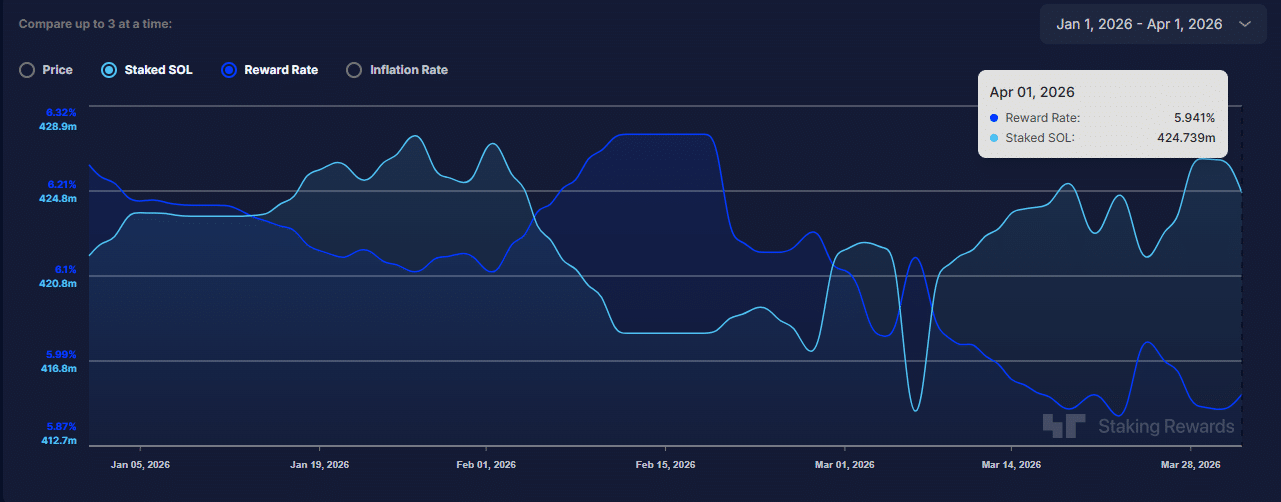
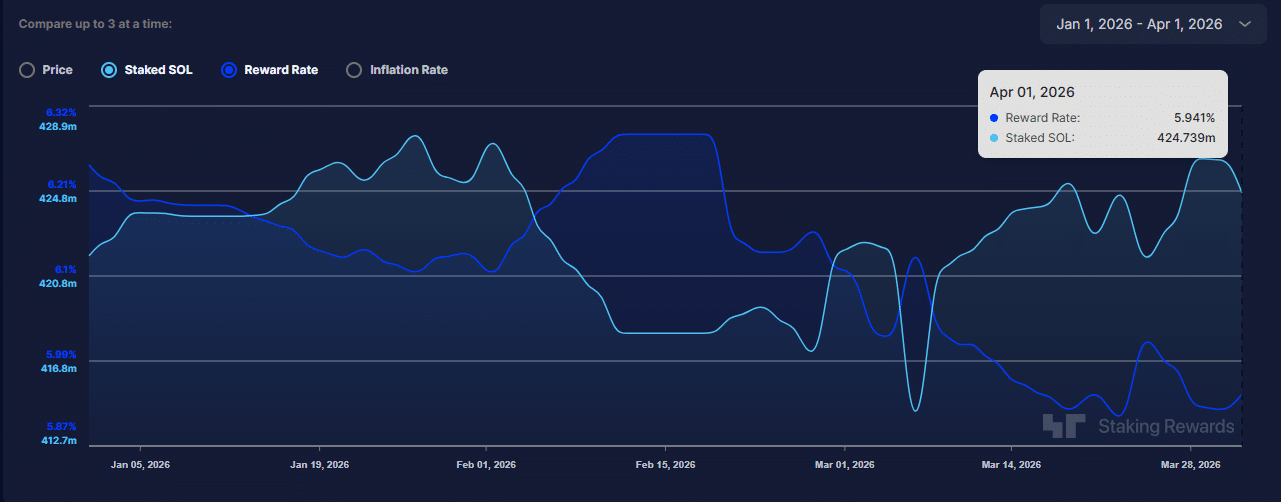
Source: Staking Rewards

In March, the renewed staking demand recovered to January levels, 68% of the total SOL supply.

Over the same period, SOL’s price bounced back about 20% from $80 to nearly $100. It remains to be seen whether the GalaxyOne update will trigger meaningful staking demand and boost SOL’s price.


Final Summary

  • SOL staking demand recovered back to Q1 highs above 420 million SOL after a brief 3% dip.
  • The Q1 staking demand partly fueled SOL’s 20% surge in March and could benefit more if GalaxyOne’s move drives renewed staking appetite.


Trending Cryptos

Related Questions

QWhat is the estimated staking yield for Solana on GalaxyOne and until when are there zero fees?

AThe estimated staking yield for Solana on GalaxyOne is 6.50%, and there are zero platform commission fees through December 31, 2026.

QWhat other cryptocurrency, besides Solana, does GalaxyOne plan to offer staking for soon?

AGalaxyOne plans to offer staking for Ethereum (ETH) soon.

QHow does the article describe the potential market impact of increased staking demand on SOL's price?

AThe article states that rising staking demand can be bullish for SOL as it exerts buying pressure, especially if players acquire SOL directly from spot markets for staking. It notes that staking demand partly fueled a 20% price surge in March.

QWhat percentage of the total SOL supply was being staked when demand recovered to January levels in March?

A68% of the total SOL supply was being staked when demand recovered to January levels in March.

QPrior to offering crypto staking, what were the two main high-yield products offered by GalaxyOne?

APrior to offering crypto staking, GalaxyOne offered high yield for cash deposits and stock lending options.

Related Reads

Bitcoin Withdrawals Continue: 8 Years of Storage in a Coldcard Cold Wallet Ended in Zero

Coldcard Hardware Wallet Hacked: Losses Mount Due to Vulnerable Seed Generation A critical vulnerability in Coldcard hardware wallets has led to a continued wave of fund thefts. According to Galaxy Research, the total stolen has reached 1,367.05 BTC (approx. $88.6 million) from 4,585 addresses, a significant increase from the initial 594.5 BTC reported on July 30, 2026. Most of the stolen funds remain on the attackers' addresses. The issue is not with the current firmware, which Coinkite has updated, but with seed phrases generated on vulnerable devices between March 2021 and the release of fixed firmware versions. Due to a programmer error, devices switched from using a hardware random number generator to the software-based Yasmarang generator, which was initialized with publicly accessible data like the chip's serial number. This made the seed phrases predictable through offline brute-force attacks, meaning wallets remain at risk until funds are moved to a new wallet generated with the patched firmware. Affected devices include Mk2/Mk3 with firmware 4.0.1–4.1.9 (and up to 5.0.3), Mk4/Mk5 up to version 5.6.0, and Q models up to 1.5.0Q. The only exceptions are seeds created with a high-entropy method like at least 50 independent dice rolls or a strong unique BIP-39 passphrase. All other owners must generate a new seed on the fixed firmware and transfer their assets. A case highlighting the human impact involves a 39-year-old long-term investor who lost 2 BTC (approx. $130,000) in minutes. He had accumulated the Bitcoin over eight years through physical labor, viewing it as a financial lifeline and a retirement plan in a country suffering from hyperinflation. His story underscores that even conservative "buy and hold in cold storage" strategies can be compromised by such underlying technical flaws. From a technical perspective, this incident echoes historical failures where weak random number generators undermined cryptographic security, challenging the assumption that offline storage is automatically foolproof.

cryptonews.ru5h ago

Bitcoin Withdrawals Continue: 8 Years of Storage in a Coldcard Cold Wallet Ended in Zero

cryptonews.ru5h ago

Trading

Spot

Hot Articles

Discussions

Welcome to the HTX Community. Here, you can stay informed about the latest platform developments and gain access to professional market insights. Users' opinions on the price of SOL (SOL) are presented below.

活动图片














