From Safe Haven to Risk Basket: Why Gold, Silver, and BTC Are Becoming Increasingly Similar?

marsbitPublished on 2026-02-06Last updated on 2026-02-06

Abstract

In January 2026, gold, silver, and Bitcoin experienced a synchronized sharp decline, challenging traditional asset classifications. The pricing of precious metals has shifted from physical demand to financialized markets, driven by the same macro factors—dollar liquidity, real interest rates, and risk appetite—that influence Bitcoin. Institutional investors and algorithmic trading systems now dominate marginal price movements, treating all three as "non-sovereign scarce assets" within the same risk basket. Silver, with its leverage and industrial role, acted as a volatility amplifier, while Bitcoin's decentralized narrative weakened due to institutionalization. Physical markets for gold and silver showed resilience with central bank buying and industrial demand, creating a two-tier structure: long-term support from physical buyers and short-term volatility from leveraged paper markets. The crypto ecosystem, including altcoins and DeFi, faces pressure as Bitcoin's value proposition aligns more with macro liquidity tools than decentralized ideals.

Author: Nikka / WolfDAO (X: @10xWolfdao)

In January 2026, gold, silver, and BTC plummeted simultaneously, breaking the classification of traditional safe-haven and speculative assets. The pricing power of precious metals has long shifted to financialized markets, driven by the same macro factors as BTC—such as dollar liquidity and real interest rates—and are bought and sold together by the same institutional funds. Silver, with its high leverage, acts as a volatility amplifier, and all three trigger leveraged liquidations at liquidity turning points. The paper market and physical market for precious metals are diverging, while BTC's decentralization narrative is being diluted by institutionalization, putting pressure on the crypto ecosystem.

Anomalous Synchronization

On January 30, 2026, gold plunged over 12% from its all-time high of $5,600 per ounce, marking its largest single-day drop in nearly 40 years. Silver fell even more sharply, dropping 27% in one day and another 6.7% the next day. Bitcoin fell below $75,000, touching the $70,000 range over the weekend, and as of this week, it has dropped below the $60,000 mark, with market panic intensifying.

In traditional understanding, this should not happen. Gold and silver are safe-haven assets—low volatility, risk-resistant, and wealth during crises. Bitcoin is a speculative asset—high volatility, high risk, and both loved and hated. They should fluctuate at different times, in different ways, and for different reasons.

But the real market is proving in the most direct way: this classification system has failed. At least in terms of pricing logic, precious metals and Bitcoin are being treated as the same type of asset.

The issue is not that gold and silver have "become unsafe" but that the forces determining their prices have fundamentally changed.

The Overlooked Shift

Let’s start with a key fact: The prices of gold and silver are no longer primarily determined by "safe-haven demand."
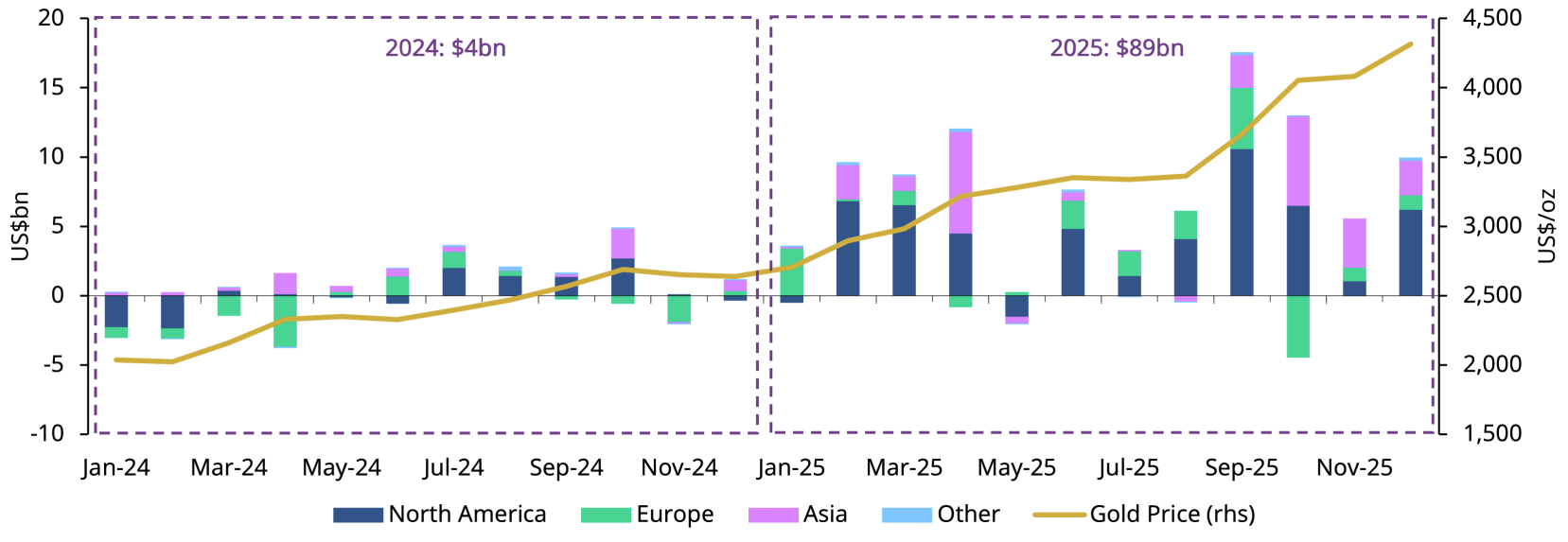
source: gold.org

In 2025, global gold ETF inflows hit a record $89 billion, doubling the assets under management to $559 billion. The proportion of gold in global financial assets has risen from its low in 2010 to 2.8% in the third quarter of 2025.

This 2.8% marks a profound structural shift: the pricing power of precious metals has shifted from physical demand to financialized markets.

Today, the marginal price fluctuations of gold and silver are driven by the same global macro funds: hedge funds, CTA strategies, systematic trend funds, and cross-market institutional accounts. These funds don’t care about "whether gold is a safe haven"; they only care about three variables:

  • Dollar liquidity
  • Real interest rates
  • The pace of risk appetite changes

JP Morgan research shows that changes in U.S. Treasury yields can explain about 70% of gold’s quarterly price fluctuations. This means gold pricing has become highly macro-driven and systematic. When you see gold price movements, they are no longer driven by India’s wedding season or Chinese retail investors’ buying enthusiasm but by Wall Street’s quantitative models and algorithmic trading systems.

The Same Button

This explains why gold, silver, and Bitcoin have recently fluctuated sharply at the same time.

They are all exposed to the same macro factor: violent swings in global liquidity expectations.

When the market bets on rate cuts, a weaker dollar, or diluted purchasing power, these three assets are bought simultaneously—not because they are "safe havens" but because, in quantitative models, they are all "non-sovereign scarce assets."

When inflation proves sticky, rate expectations rebound, the dollar strengthens, or risk models trigger deleveraging, they are sold off simultaneously—not because they are "high risk" but because they are in the same risk basket.

Price fluctuations are not due to "changes in asset attributes" but because the participants and trading methods driving pricing have become homogenized.

January 30 is the best proof. Trump nominated Kevin Warsh as Fed chair, which the market interpreted as a hawkish signal. The dollar rebounded, and immediately:

  • Gold fell from $5,600 to below $4,900
  • Silver plummeted from $120 to $75
  • Bitcoin slid from $88,000 to $81,000

Three assets, same moment, same direction, same violence. This is not a coincidence but direct evidence that they are priced by the same trading system.

Silver: The Amplifier Effect

Silver’s performance is particularly representative.

Compared to gold, silver has dual attributes as both a precious metal and an industrial metal, with higher leverage and more fragile liquidity. By the end of 2025, silver’s 30-day realized volatility surged above 50%, while Bitcoin’s compressed to the 40% range—a significant reversal.

Silver’s rapid rally and sharp decline were essentially due to concentrated inflows and outflows of macro long positions, not any structural change in fundamentals over the short term. In January 2026, the Chicago Mercantile Exchange raised silver futures margin requirements from historical lows to 15–16.5%, ending the era of low-cost "paper silver" speculation.

When prices fell, highly leveraged speculators couldn’t meet the new margin requirements and were forced to liquidate. This triggered cascading liquidations—prices fell further, and more positions were forcibly closed. This "margin trap" is identical to the 1980 move to crush the Hunt Brothers’ silver accumulation by raising margins.

This price action is almost identical to Bitcoin’s behavior near liquidity turning points.

The Truth of the Paradox

This also explains a seemingly contradictory phenomenon: safe-haven assets plummet when "risk arrives."

The reason is not that they have lost their safe-haven attributes but that when systemic risk rises to a certain level, the market prioritizes "cash" and "liquidity" over "long-term preservation logic."

When volatility spikes, liquidity often evaporates. Market makers narrow quote sizes, spreads widen, and price gaps appear. In such an environment, all highly financialized, quickly liquidatable assets with leveraged exposure are sold off simultaneously—whether they are called gold, silver, or Bitcoin.

As Saxo Bank’s Ole Hansen said: "Volatility reinforces itself." When prices fluctuate violently, market structure takes over everything. In this cycle, the "intrinsic attributes" of assets play almost no role.

A Tale of Two Markets

But this is not the whole truth.

While the paper market crashed, the physical market showed opposite signals. After silver’s plunge, physical silver premiums in Shanghai and Dubai soared to $20 above the Western spot price. Major silver miner Fresnillo has cut its 2026 production guidance to 42–46.5 million ounces. Industrial demand (solar, electric vehicles, semiconductors) remains strong.

This split reveals a key contradiction:

  • Paper market: Highly financialized, extremely volatile, driven by macro funds
  • Physical market: Supply-constrained, demand-supported, relatively stable

The same split exists in the gold market. In 2026, central banks are still expected to buy 750–950 tons of gold, marking the third consecutive year of purchases exceeding 1,000 tons. These "traditional" buyers—mainly emerging market central banks—buy gold for dedollarization, reserve diversification, and long-term value storage. They don’t engage in short-term trading, don’t use leverage, and aren’t forced to liquidate by margin calls.

This creates a two-tier structure:

  • Long-term floor: Central banks provide sustained buying, setting a price bottom
  • Short-term volatility: Institutional investors and algorithms dominate marginal pricing, creating extreme fluctuations

Narrative Collapse

A deeper issue: The narrative system long relied upon by the crypto market is collapsing.

The "decentralized safe haven" narrative is being diluted by institutionalization. When Bitcoin falls sharply over weekends with thin liquidity, it is largely due to leveraged trading and futures market liquidations—products of centralized finance. The fundamentalists who hold private keys and adhere to "not your keys, not your coins" have long been marginalized in pricing power.

This change affects not just Bitcoin but the entire crypto ecosystem.

Altcoins face greater pressure: If even Bitcoin has lost its unique value proposition and is grouped into the "macro liquidity trading tool" basket, where will altcoins with weaker narratives and more fragile fundamentals go? When institutions allocate crypto assets, will they choose the already "tamed" BTC or risk investing in Ethereum, Solana, or other public chains?

Ethereum fell 4% to $2,660 during the same period, underperforming Bitcoin. This hints at a brutal possibility: in macro risk models, funds will flow集中 to "the gold of the crypto market" (BTC) and abandon assets seen as "the silver or copper of the crypto market."

DeFi’s paradox: Decentralized finance was once seen as the most revolutionary innovation in crypto, promising lending, trading, and other services without relying on traditional financial intermediaries. But if the underlying assets (BTC, ETH) are entirely priced by traditional financial markets, how much "decentralization" do DeFi protocols really have left?

You can trade using decentralized protocols, but if price discovery happens on Wall Street trading desks, Chicago futures markets, and quantitative model servers, this decentralization is only superficial.


Trending Cryptos

Related Questions

QWhy did gold, silver, and Bitcoin experience a synchronized sharp decline in January 2026, breaking traditional asset classifications?

AThey experienced a synchronized sharp decline because their pricing is now driven by the same macro factors—such as dollar liquidity, real interest rates, and risk appetite—and are traded by the same institutional funds using similar quantitative models and algorithmic systems, rather than their traditional roles as safe-haven or speculative assets.

QWhat key structural shift in the precious metals market has led to gold and silver being priced like financial assets rather than physical commodities?

AThe key structural shift is the financialization of the precious metals market, where pricing power has moved from physical demand to financial markets. Global gold ETF inflows reached a record $89 billion in 2025, and institutional investors like hedge funds and CTAs now drive marginal price movements based on macro factors, not physical supply and demand.

QHow does silver act as a 'volatility amplifier' compared to gold and Bitcoin in the current market structure?

ASilver acts as a volatility amplifier due to its high leverage, lower liquidity, and dual role as both a precious and industrial metal. Its leverage makes it more susceptible to margin calls and cascading liquidations during market stress, as seen when CME raised margin requirements in January 2026, triggering sharp price swings.

QWhat contradiction exists between the 'paper market' and the 'physical market' for assets like gold and silver?

AThe paper market is highly financialized, driven by macro funds and algorithms, leading to extreme volatility and leverage-induced price swings. In contrast, the physical market is supported by steady demand from banks and industrial users, with central banks buying gold for long-term reserve diversification, creating a stable price floor despite paper market turbulence.

QHow has the institutionalization of Bitcoin diluted its 'decentralized haven' narrative and impacted the broader ecosystem?

AInstitutionalization has diluted Bitcoin's decentralized narrative because its price is now heavily influenced by traditional financial mechanisms like futures markets, leverage trading, and macro liquidity factors. This shift marginalizes core 'not your keys, not your coins' holders and pressures the broader crypto ecosystem, as altcoins and DeFi protocols lose their unique value propositions when underlying asset pricing is dominated by Wall Street.

Related Reads

After Three Consecutive Quarters of Decline, Can the Crypto Market Find a Window for Stabilization in Q3?

The cryptocurrency market has just concluded its worst-performing quarter since 2022, with total capitalization dropping 12.6% to $2.1 trillion. All core metrics indicate capital is leaving the sector, not just rotating within it. Bitcoin fell 14.2% and Ethereum dropped 25.4% in Q2, breaking their previous correlation with US tech stocks. A key driver is the reversal in US spot Bitcoin ETF flows, which saw a net outflow of approximately $4.67 billion in Q2, including a record monthly outflow near $4.5 billion in June. While recent data suggests long-term holders are accumulating again, sustained ETF outflows mean continued selling pressure. Market focus is now singularly on the Federal Reserve. The upcoming July FOMC meeting is seen as the most critical event for Q3. A dovish signal could support Bitcoin reclaiming a $68,000-$84,000 range, while a hawkish stance might establish a new trading band around $50,000-$56,000. Additionally, regulatory uncertainty persists, with the progress of the crucial *CLARITY Act* stalling in the Senate, reducing its perceived 2026 passage probability to 40-45%. Despite the broad downturn, a few sectors showed growth. Prediction markets saw nominal volume surge 48.7% year-over-year to $113.8 billion, and tokenized collectibles transaction volume rose 143% quarterly to $1.4 billion. The Real-World Asset (RWA) tokenization sector also continued steady growth, now representing ~$28.1 billion in on-chain value. The market's foundation for an extreme crash appears limited, with Bitcoin price hovering near its 200-week moving average. However, the trading paradigm has shifted from narrative-driven speculation to decisions based on price action, policy developments, and interest rate expectations, making a broad sentiment-driven rally unlikely in the near term.

marsbit12h ago

After Three Consecutive Quarters of Decline, Can the Crypto Market Find a Window for Stabilization in Q3?

marsbit12h ago

BIT Trading Moment: BTC Still Suppressed by Weekly 200 EMA, Rejection May Restart Decline; Storage and Semiconductors that Surged Last Night Begin Falling in Evening Trading

**Crypto & Stock Market Wrap: Bitcoin Tests Resistance, Stocks Retreat After AI Surge** Bitcoin consolidates around $66,000, facing key resistance near $68,000—an area seen as a major psychological and technical hurdle where previous rallies have failed. Analysts note the cryptocurrency is caught between its 200-week moving average (~$63,333) and 200-week EMA (~$68,328). A clear break above $68k is needed to signal a stronger bullish trend, while a rejection could lead to a retest of $63k support. Market sentiment remains cautious, with low futures open interest pointing to a low-liquidity rebound rather than a full bull market. Bitcoin spot ETFs saw another $203 million inflow. US stock futures pointed lower after a strong Tuesday session led by a massive rebound in semiconductors and memory stocks. The rally was fueled by renewed optimism about AI-driven hardware demand, with Micron, SanDisk, and SK Hynix surging. However, those gains reversed in pre-market trading. Super Micro Computer (SMCI) soared over 20% after hours on strong guidance and a record backlog. Other standouts included Rocket Lab and nuclear energy plays Oklo and X-Energy. Rising oil prices (Brent above $91) and climbing Treasury yields (10-year near 4.64%), however, are reigniting inflation concerns and acting as a headwind for equities. In Asia, markets were mixed. South Korea's KOSPI pared early gains to close slightly higher as semiconductor stocks like SK Hynix gave back initial surges. Japan's Nikkei edged lower as the yen hit a fresh 38-year low against the dollar, raising fears of potential market intervention. Key events to watch include the Samsung Galaxy launch, AMD's AI event, and a slew of major tech earnings from Alphabet, Tesla, and IBM after the close on Wednesday, followed by the ECB meeting and Intel's earnings on Thursday.

marsbit13h ago

BIT Trading Moment: BTC Still Suppressed by Weekly 200 EMA, Rejection May Restart Decline; Storage and Semiconductors that Surged Last Night Begin Falling in Evening Trading

marsbit13h ago

Former CFTC Chairman, Circle President Tarbert: Preaching Long-Termism While Cashing Out $30 Million Himself

Former CFTC Chairman and Circle President Heath Tarbert has consistently advocated for a long-term vision in public, urging patience from investors as Circle’s stock price has fallen significantly from its peak. However, it has been revealed that since Circle’s IPO, Tarbert has continuously sold his CRCL shares through pre-arranged trading plans, cashing out approximately $30 million, without making any public market purchases. This contrast between his public messaging and personal actions has drawn criticism. Tarbert joined Circle in July 2023 as Chief Legal Officer, leveraging his regulatory experience to help guide the company through its IPO and expansion. Despite promoting stablecoins as long-term infrastructure, he established a 10b5-1 trading plan just before Circle went public, leading to substantial stock sales over the following year. In March 2026, he initiated another plan to sell more shares. His career trajectory highlights a pattern of moving between high-level regulatory roles and influential positions in the financial sector. After resigning as CFTC Chairman in early 2021, he joined Citadel Securities as Chief Legal Officer just 27 days later, during a period of intense regulatory scrutiny for the firm. He later joined Circle, aiding its efforts to navigate regulatory challenges for its public listing. While Tarbert's expertise in policy and compliance is valuable to companies like Circle, his actions—advocating long-term confidence while personally divesting—raise questions about the alignment between his public statements and his private financial decisions, leaving investors who followed his advice to bear the market risks.

marsbit13h ago

Former CFTC Chairman, Circle President Tarbert: Preaching Long-Termism While Cashing Out $30 Million Himself

marsbit13h ago

Gate Research Institute: The 'Wall Street-ization' Wave of Crypto Financial Products – Competition or Integration?

The article titled "Gate Research Institute: Are Crypto Financial Products Sparking a 'Wall Street' Wave—Competition or Convergence?" explores the evolving relationship between the crypto ecosystem and traditional finance (TradFi). The piece begins by reflecting on Bitcoin's original 2009 vision of decentralization, disintermediation, and moving away from banks. It then contrasts this with the 2024 landscape, where key crypto assets like Bitcoin are increasingly held through Wall Street products like ETFs issued by giants like BlackRock. The article questions whether this signifies that TradFi is systematically taking over the rights to issue, price, custody, and distribute crypto financial assets. The core argument is that this is not a zero-sum takeover but rather a bidirectional convergence where each side addresses the other's weaknesses. Crypto offers 24/7 global markets, programmable settlement, and open access but lacks compliant channels, institutional-grade custody, deep fiat liquidity, and mainstream distribution. TradFi possesses these but is constrained by legacy systems, limited operating hours, and slow settlement. Two primary convergence paths are highlighted: * **Path A (CEX to TradFi):** Exemplified by Gate, which has progressed from offering tokenized stocks and CFDs to providing direct, real stock trading (US, Hong Kong, South Korea) within its platform, using USDT. * **Path B (TradFi to Crypto):** Exemplified by Robinhood, which has integrated crypto trading, acquired exchanges like Bitstamp, and is moving traditional assets like stocks onto the blockchain via tokenization and its own Layer 2. Both paths are ultimately competing to become the next-generation, unified financial account—a "super account" where users can seamlessly trade cryptocurrencies, stocks, ETFs, RWA (Real World Assets), and tokenized treasury products in one interface. The growth of RWA and tokenized treasuries (e.g., BlackRock's BUIDL) is presented as the asset-layer fusion, providing stable, yield-bearing assets on-chain and acting as a bridge between the two worlds. In conclusion, the "Wall Street-ization" of crypto is framed as a mutual transformation. Decentralized ideals persist in the protocol layer, while at the application layer, a more efficient, global, and accessible unified capital market is emerging from this convergence. The future competition lies not between crypto exchanges and stockbrokers, but between platforms vying to offer the most comprehensive asset coverage, liquidity, and user experience within a single account.

marsbit13h ago

Gate Research Institute: The 'Wall Street-ization' Wave of Crypto Financial Products – Competition or Integration?

marsbit13h ago

Trading

Spot

Hot Articles

What is $BITCOIN

DIGITAL GOLD ($BITCOIN): A Comprehensive Analysis Introduction to DIGITAL GOLD ($BITCOIN) DIGITAL GOLD ($BITCOIN) is a blockchain-based project operating on the Solana network, which aims to combine the characteristics of traditional precious metals with the innovation of decentralized technologies. While it shares a name with Bitcoin, often referred to as “digital gold” due to its perception as a store of value, DIGITAL GOLD is a separate token designed to create a unique ecosystem within the Web3 landscape. Its goal is to position itself as a viable alternative digital asset, although specifics regarding its applications and functionalities are still developing. What is DIGITAL GOLD ($BITCOIN)? DIGITAL GOLD ($BITCOIN) is a cryptocurrency token explicitly designed for use on the Solana blockchain. In contrast to Bitcoin, which provides a widely recognized value storage role, this token appears to focus on broader applications and characteristics. Notable aspects include: Blockchain Infrastructure: The token is built on the Solana blockchain, known for its capacity to handle high-speed and low-cost transactions. Supply Dynamics: DIGITAL GOLD has a maximum supply capped at 100 quadrillion tokens (100P $BITCOIN), although details regarding its circulating supply are currently undisclosed. Utility: While precise functionalities are not explicitly outlined, there are indications that the token could be utilized for various applications, potentially involving decentralized applications (dApps) or asset tokenization strategies. Who is the Creator of DIGITAL GOLD ($BITCOIN)? At present, the identity of the creators and development team behind DIGITAL GOLD ($BITCOIN) remains unknown. This situation is typical among many innovative projects within the blockchain space, particularly those aligning with decentralized finance and meme coin phenomena. While such anonymity may foster a community-driven culture, it intensifies concerns about governance and accountability. Who are the Investors of DIGITAL GOLD ($BITCOIN)? The available information indicates that DIGITAL GOLD ($BITCOIN) does not have any known institutional backers or prominent venture capital investments. The project seems to operate on a peer-to-peer model focused on community support and adoption rather than traditional funding routes. Its activity and liquidity are primarily situated on decentralized exchanges (DEXs), such as PumpSwap, rather than established centralized trading platforms, further highlighting its grassroots approach. How DIGITAL GOLD ($BITCOIN) Works The operational mechanics of DIGITAL GOLD ($BITCOIN) can be elaborated on based on its blockchain design and network attributes: Consensus Mechanism: By leveraging Solana’s unique proof-of-history (PoH) combined with a proof-of-stake (PoS) model, the project ensures efficient transaction validation contributing to the network's high performance. Tokenomics: While specific deflationary mechanisms have not been extensively detailed, the vast maximum token supply implies that it may cater to microtransactions or niche use cases that are still to be defined. Interoperability: There exists the potential for integration with Solana’s broader ecosystem, including various decentralized finance (DeFi) platforms. However, the details regarding specific integrations remain unspecified. Timeline of Key Events Here is a timeline that highlights significant milestones concerning DIGITAL GOLD ($BITCOIN): 2023: The initial deployment of the token occurs on the Solana blockchain, marked by its contract address. 2024: DIGITAL GOLD gains visibility as it becomes available for trading on decentralized exchanges like PumpSwap, allowing users to trade it against SOL. 2025: The project witnesses sporadic trading activity and potential interest in community-led engagements, although no noteworthy partnerships or technical advancements have been documented as of yet. Critical Analysis Strengths Scalability: The underlying Solana infrastructure supports high transaction volumes, which could enhance the utility of $BITCOIN in various transaction scenarios. Accessibility: The potential low trading price per token could attract retail investors, facilitating wider participation due to fractional ownership opportunities. Risks Lack of Transparency: The absence of publicly known backers, developers, or an audit process may yield skepticism regarding the project's sustainability and trustworthiness. Market Volatility: The trading activity is heavily reliant on speculative behavior, which can result in significant price volatility and uncertainty for investors. Conclusion DIGITAL GOLD ($BITCOIN) emerges as an intriguing yet ambiguous project within the rapidly evolving Solana ecosystem. While it attempts to leverage the “digital gold” narrative, its departure from Bitcoin's established role as a store of value underscores the need for a clearer differentiation of its intended utility and governance structure. Future acceptance and adoption will likely depend on addressing the current opacity and defining its operational and economic strategies more explicitly. Note: This report encompasses synthesised information available as of October 2023, and developments may have transpired beyond the research period.

987 Total ViewsPublished 2025.05.13Updated 2025.05.13

What is $BITCOIN

Discussions

Welcome to the HTX Community. Here, you can stay informed about the latest platform developments and gain access to professional market insights. Users' opinions on the price of BTC (BTC) are presented below.

活动图片














