From Geopolitical Tensions to Liquidity Tightening: BTC Dragged into Uncontrolled Market Conditions

marsbitPublished on 2026-01-30Last updated on 2026-01-30

Abstract

"Bitcoin experienced a sharp decline, dropping from around $88,000 to below $81,200, with a 24-hour loss exceeding 7%. The sell-off was driven by multiple factors converging simultaneously. Escalating geopolitical tensions in the Middle East, particularly involving the U.S. and Iran, increased market uncertainty and risk aversion. Meanwhile, the Federal Reserve's latest FOMC meeting maintained interest rates and dashed hopes for near-term rate cuts, leading to a repricing of liquidity expectations. The downturn was not isolated to crypto; U.S. equities and precious metals like gold and silver also fell, indicating a market-wide reduction in risk exposure. Additionally, Bitcoin ETFs saw sustained outflows, with over $1 billion in net withdrawals in just one week, reducing market liquidity and amplifying downward pressure. This collective 'de-risking' event forced a breakdown of key technical levels, including the 100-week moving average, triggering leveraged liquidations. Market stability now depends on reclaiming these technical supports and the return of risk capital."

Author | Asher(@Asher_ 0210)
"The big crash" has happened again.

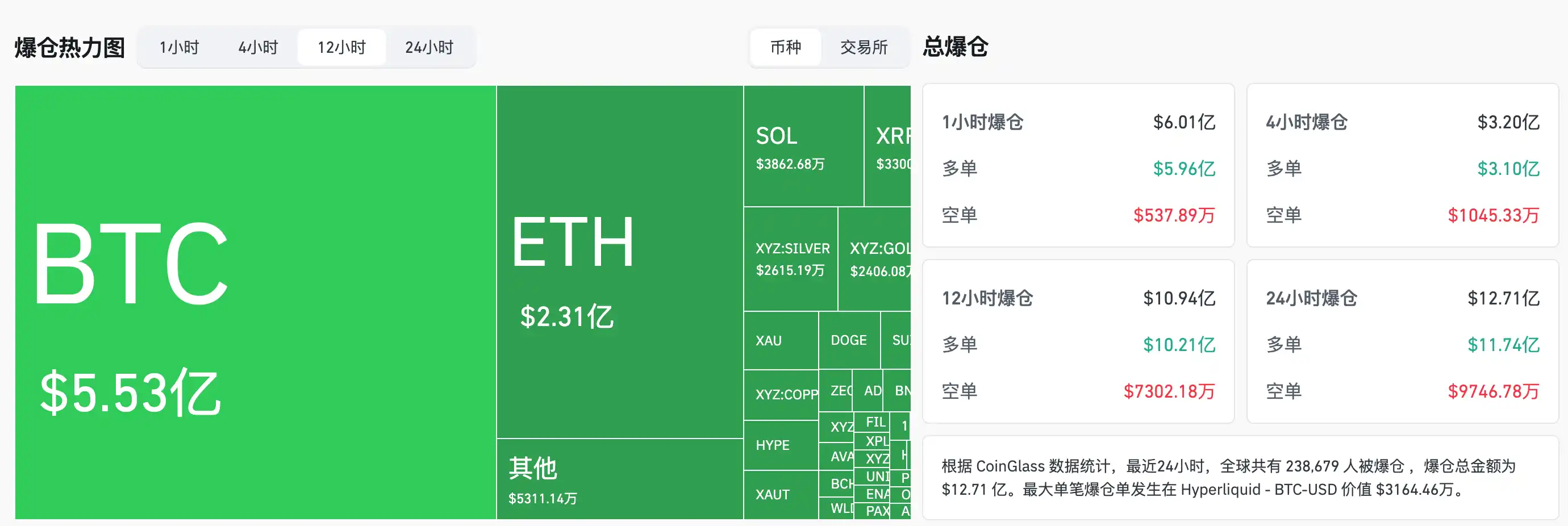
OKX market data shows that from last night to this morning Beijing time, BTC quickly fell from around $88,000, once dropping below $81,200, with a 24-hour decline of over 7%; ETH fell from $2,940 to a low of $2,690, with a 24-hour decline of nearly 10%; SOL dropped from $123 to around $112, with a 24-hour decline of over 8%. Coinglass data shows that in the past 12 hours, the market saw liquidations of $1.094 billion, with long positions accounting for as much as $1.021 billion; nearly 240,000 people were liquidated in 24 hours.
This decline was not triggered by a single negative factor, but rather the result of multiple factors being released simultaneously at the same point in time.

Middle East tensions suddenly escalate, geopolitical risks re-emerge in the market

The sudden escalation of geopolitical risk is one of the earliest important background factors factored into last night's market decline.

Latest news shows that the US aircraft carrier USS Abraham Lincoln and its strike group have entered a state of "lights out" and communication blackout. This move is usually seen as a standard operating procedure before major military actions, leading the market to speculate that actions related to Iran are entering a highly sensitive phase.

At the same time, statements from Iran have also clearly shifted to a posture of readiness for combat. Iran's First Vice President Aref, speaking about the regional situation, stated that Iran has maintained a state of combat readiness since the current administration took office, will not initiate war, but if conflict is provoked, it will defend itself with a firm stance, emphasizing that "the outcome of the war will not be decided by the enemy." He pointed out that it is currently necessary to prepare for a state of war.

Although the situation has not yet evolved into substantive conflict, this state of being "highly opaque, unverifiable, and difficult to predict" is itself enough to influence market behavior. Against a backdrop of already tight liquidity and receding risk appetite, geopolitical uncertainty was quickly priced in, prompting funds to倾向于 reduce directional exposure rather than continue betting on high-volatility assets.

FOMC "hawkish landing," liquidity expectations repriced

The decline in cryptocurrency prices still cannot be separated from the Federal Reserve.

At the January FOMC meeting, the Fed kept the benchmark interest rate unchanged in the range of 3.50% to 3.75%, and emphasized in its statement that the unemployment rate has stabilized and inflation remains at a relatively high level. The stance itself did not significantly exceed market expectations, but it emotionally completed an "expectation finale"—the market's vague幻想 of a near-term rate cut, or even a policy pivot, was officially compressed or even eliminated.

For risk assets, such moments often do not appear in the form of "new negatives," but rather as a realization that "positive factors can no longer be further透支." Since 2025, Bitcoin has seen pullbacks multiple times after FOMC meetings, which is a repeated演绎 of this mechanism: it's not that policy suddenly turned hawkish, but that the market had to admit that liquidity would not arrive as early as anticipated.

When positions are already built up and leverage is already high, this kind of "confirmation" itself is enough to trigger risk release—it is not the first push that topples the dominoes, but rather what causes all the already precarious structures to simultaneously lose their support.

Not just the crypto market falling, US stocks and precious metals also "turn sour" simultaneously

More alarmingly, this decline is not a "solo performance" by the crypto market.

In US stocks, the decline in stock indices became an important signal of weakening market risk appetite. The Nasdaq 100 index fell about 1.6%, the S&P 500 index fell about 0.75%, and the Dow Jones Industrial Average also fell about 0.2%. The three major indices were generally under pressure, with the technology sector performing particularly weakly, dragging down overall market risk appetite.

At the same time, precious metals market, originally seen as "safe-haven assets," also experienced剧烈波动. After a recent strong rally, gold prices saw a sharp short-term pullback last night, with significant profit-taking emerging in the market; silver also retreated rapidly from its highs, with a notable decline. This indicates that funds are not simply switching from risk assets to safe-haven assets, but are rather reducing risk exposure across the board in a high-volatility environment.

When stocks fall, crypto assets are under pressure, and precious metals also pull back simultaneously, the signal sent by the market is quite clear. Funds are simultaneously reducing exposure across multiple asset classes, with overall risk appetite contracting rapidly.

In such an environment, Bitcoin naturally finds it difficult to remain unscathed. It is not truly regarded by the market as a safe-haven asset, and due to its own high volatility, it often becomes one of the first to be sold when sentiment turns risk-averse.

Sustained ETF outflows significantly reduce the crypto market's capacity to absorb selling

Changes in the capital flow provided the final piece of the puzzle for this decline.

Looking at the data for Bitcoin spot ETFs, funds are continuously withdrawing. Data shows that in the past week alone, BTC spot ETFs saw sustained net outflows, with multiple days recording outflows of over $100 million per day, with the cumulative net outflow scale reaching over $1 billion.
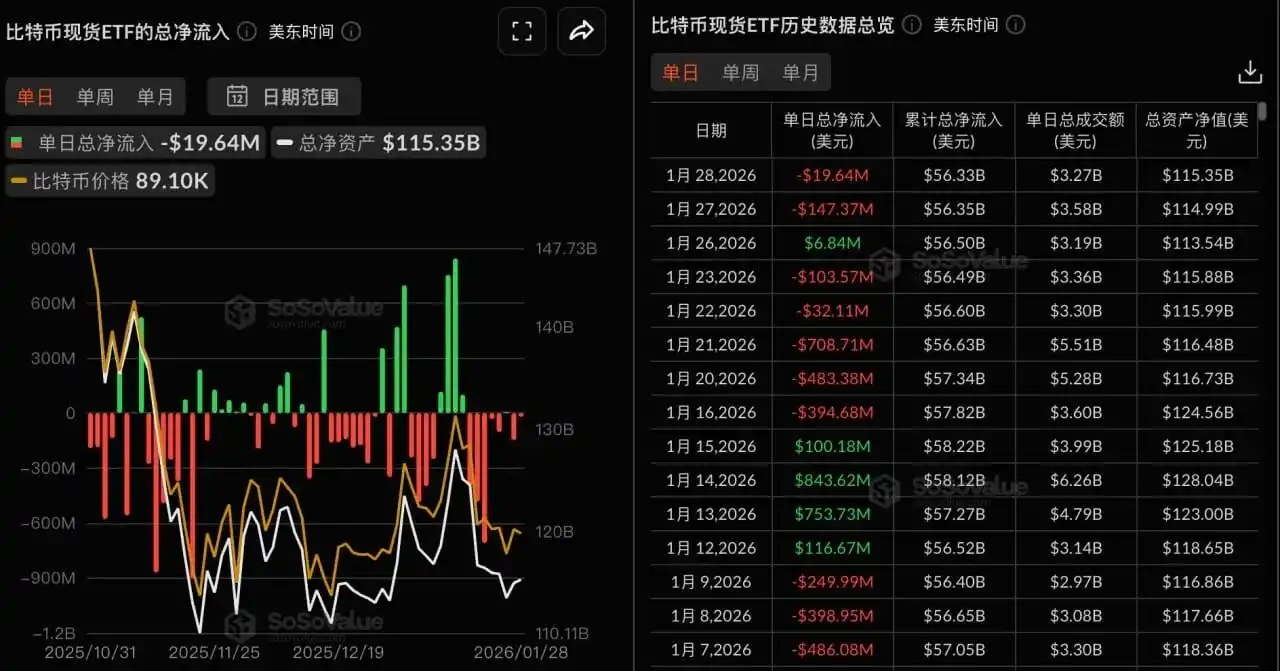
More importantly, the withdrawal of ETF funds is not a one-time宣泄, but rather a continuous, multi-day, trend-driven reduction in positions. This means that institutional funds are not choosing to "buy the dip and provide support" during the pullback, but are more inclined to reduce overall risk exposure and wait for clearer macro and market signals.

In such a capital environment, the market does not have a "buffer." When prices fall, ETFs do not provide sustained buying power; the market relies more on existing funds to消化 selling pressure on their own. Once key price levels are broken, selling behavior quickly dominates, while buying interest明显 lags, forcing prices to rapidly探 lower to find a new balance.

Not a black swan, but a concentrated release of "forced de-risking"

The essence of BTC's current decline is not caused by a single突发 negative factor alone, but is the result of the market's repricing of risk assets overall under the叠加 of multiple risk factors. Geopolitical uncertainty intensified, macro liquidity expectations were修正, and against the backdrop of sustained net outflows from ETFs, the crypto market lacked stable structural support, ultimately triggering the market's主动 "braking" behavior.

When long-term funds and passive buying are absent, the market often completes the first stage of risk clearing by having prices break through key trend levels downward, forcing trend-following strategies and leveraged funds to exit被动, thereby completing the first stage of risk clearing. In this process, Bitcoin broke below the highly watched 100-week moving average (around $85,000), a level that has acted as a "safety net"多次 during adjustments since last year and is also the default defense line for many trend models and leveraged positions.

Judging from the outcome, the market has now completed the first round of rapid deleveraging and emotional clearing, but true stabilization still depends on two conditions: first, whether key technical levels can be recaptured and held firmly, and second, whether risk capital is willing to return to the market to participate in pricing. Before that, high volatility and low confidence may still be the阶段性主旋律.


Trending Cryptos

Related Questions

QWhat were the main factors that led to the sharp decline in Bitcoin and other cryptocurrencies as described in the article?

AThe decline was triggered by a combination of factors including escalating geopolitical tensions in the Middle East, a hawkish stance from the Federal Reserve's FOMC meeting leading to repricing of liquidity expectations, and continuous outflows from Bitcoin ETFs which reduced market support.

QHow did geopolitical tensions contribute to the cryptocurrency market downturn?

AGeopolitical risks, particularly the heightened tensions between the US and Iran with military preparations and Iran's readiness for conflict, created uncertainty. This led to reduced risk appetite, prompting investors to lower exposure to high-volatility assets like cryptocurrencies.

QWhat was the Federal Reserve's FOMC meeting's impact on market expectations and crypto prices?

AThe FOMC maintained interest rates and emphasized stable unemployment and high inflation, dashing market hopes for near-term rate cuts or policy easing. This 'hawkish landing' forced a repricing of liquidity expectations, triggering risk-off sentiment and selling pressure on cryptocurrencies.

QWhy did the article mention that the decline was not limited to cryptocurrencies?

AThe downturn was broad-based, affecting not only cryptocurrencies but also US stock indices (like Nasdaq and S&P 500) and precious metals (gold and silver). This indicated a widespread reduction in risk exposure across multiple asset classes, not a isolated crypto market event.

QHow did Bitcoin ETF flows affect the market's ability to handle the sell-off?

ABitcoin ETFs experienced sustained outflows, with over $1 billion in net outflows in a week, indicating institutional investors were reducing risk exposure rather than buying the dip. This lack of buying support weakened market resilience, leading to steeper price declines as sell orders overwhelmed limited demand.

Related Reads

Bitcoin Mining Farms Are Becoming AI Factories

Bitcoin mines are transforming into AI factories. This shift is driven by the convergence of three key assets from the previous crypto cycle: infrastructure, talent, and capital. Crypto mining companies like Crusoe, CoreWeave, and Bitdeer are repurposing their core competency—securing power, land, and grid connections in remote locations—to build data centers for AI clients. These firms are signing multi-billion dollar, long-term contracts with companies like Anthropic, AWS, and Microsoft, as AI's demand for reliable, high-capacity compute surpasses the profitability of Bitcoin mining. Simultaneously, crypto entrepreneurs and engineers are applying their skills to new AI ventures. Examples include OpenSea's co-founder launching OpenRouter (an AI model aggregator), and former Coinbase engineers building Fal.ai (a generative media infrastructure platform). Their experience in building scalable, global software networks translates effectively to the AI space. Furthermore, capital accumulated during the crypto boom is now fueling AI. Figures like Jed McCaleb (co-founder of Ripple) funded Voltage Park, a large-scale GPU cloud provider. Notably, some crypto investments, like FTX's early bets on Anthropic and Cursor, have generated astronomical paper returns, demonstrating how high-risk crypto capital flowed into AI before it became mainstream. The transition is not just about repurposing hardware, but about redirecting critical resources—power infrastructure, distributed systems expertise, and venture funding—to the next technological frontier: artificial intelligence.

链捕手38m ago

Bitcoin Mining Farms Are Becoming AI Factories

链捕手38m ago

Morpho Launches Fixed-Rate Product Midnight: Lenders and Borrowers Set Their Own Rates, Ending the Era of Interest Rate Models

Morpho Launches Fixed-Rate Product Midnight: Lenders and Borrowers Set Their Own Rates, Ending the Era of Algorithmic Interest Models On-chain lending has grown to $60 billion but remains minuscule compared to traditional finance's $200 trillion annual credit volume. Morpho identifies the lack of fixed rates and maturity dates as key bottlenecks. Institutions need predictability, not the passive floating rates set by algorithmic models. Midnight allows lenders and borrowers to directly quote rates, set terms, and become price makers, not takers. Fixed-rate lending is now viable due to cheaper, faster blockchains and the entry of institutions demanding control and certainty over returns, costs, and duration. Morpho Blue previously gave users control over risk; Midnight adds control over interest rates. Past attempts at on-chain fixed-rate lending failed primarily because they were built on top of floating-rate pools (creating unpredictability) or lacked sufficient active participants. Midnight avoids these pitfalls as a standalone primitive with fixed rates at its core, built upon Morpho Blue's existing large and active user base. Midnight offers distinct value: institutions gain predictable term structures and full control; fintech companies can offer tailored fixed-rate products; lenders/borrowers achieve predictability and efficiency; and curators can now differentiate by configuring both risk and interest rates. Morpho Midnight is not a replacement for Morpho Blue. The Morpho network will now feature two complementary market structures: floating-rate/open-term (Blue) for flexibility and fixed-rate/fixed-term (Midnight) for predictability. Liquidity can flow between them. The launch will be gradual, prioritizing security. Initially, it will support direct lending on Base network with one trading pair (cbBTC/USDC) and limited maturity dates. Advanced features like auto-rollovers will be introduced later.

marsbit38m ago

Morpho Launches Fixed-Rate Product Midnight: Lenders and Borrowers Set Their Own Rates, Ending the Era of Interest Rate Models

marsbit38m ago

Trading

Spot

Hot Articles

What is $BITCOIN

DIGITAL GOLD ($BITCOIN): A Comprehensive Analysis Introduction to DIGITAL GOLD ($BITCOIN) DIGITAL GOLD ($BITCOIN) is a blockchain-based project operating on the Solana network, which aims to combine the characteristics of traditional precious metals with the innovation of decentralized technologies. While it shares a name with Bitcoin, often referred to as “digital gold” due to its perception as a store of value, DIGITAL GOLD is a separate token designed to create a unique ecosystem within the Web3 landscape. Its goal is to position itself as a viable alternative digital asset, although specifics regarding its applications and functionalities are still developing. What is DIGITAL GOLD ($BITCOIN)? DIGITAL GOLD ($BITCOIN) is a cryptocurrency token explicitly designed for use on the Solana blockchain. In contrast to Bitcoin, which provides a widely recognized value storage role, this token appears to focus on broader applications and characteristics. Notable aspects include: Blockchain Infrastructure: The token is built on the Solana blockchain, known for its capacity to handle high-speed and low-cost transactions. Supply Dynamics: DIGITAL GOLD has a maximum supply capped at 100 quadrillion tokens (100P $BITCOIN), although details regarding its circulating supply are currently undisclosed. Utility: While precise functionalities are not explicitly outlined, there are indications that the token could be utilized for various applications, potentially involving decentralized applications (dApps) or asset tokenization strategies. Who is the Creator of DIGITAL GOLD ($BITCOIN)? At present, the identity of the creators and development team behind DIGITAL GOLD ($BITCOIN) remains unknown. This situation is typical among many innovative projects within the blockchain space, particularly those aligning with decentralized finance and meme coin phenomena. While such anonymity may foster a community-driven culture, it intensifies concerns about governance and accountability. Who are the Investors of DIGITAL GOLD ($BITCOIN)? The available information indicates that DIGITAL GOLD ($BITCOIN) does not have any known institutional backers or prominent venture capital investments. The project seems to operate on a peer-to-peer model focused on community support and adoption rather than traditional funding routes. Its activity and liquidity are primarily situated on decentralized exchanges (DEXs), such as PumpSwap, rather than established centralized trading platforms, further highlighting its grassroots approach. How DIGITAL GOLD ($BITCOIN) Works The operational mechanics of DIGITAL GOLD ($BITCOIN) can be elaborated on based on its blockchain design and network attributes: Consensus Mechanism: By leveraging Solana’s unique proof-of-history (PoH) combined with a proof-of-stake (PoS) model, the project ensures efficient transaction validation contributing to the network's high performance. Tokenomics: While specific deflationary mechanisms have not been extensively detailed, the vast maximum token supply implies that it may cater to microtransactions or niche use cases that are still to be defined. Interoperability: There exists the potential for integration with Solana’s broader ecosystem, including various decentralized finance (DeFi) platforms. However, the details regarding specific integrations remain unspecified. Timeline of Key Events Here is a timeline that highlights significant milestones concerning DIGITAL GOLD ($BITCOIN): 2023: The initial deployment of the token occurs on the Solana blockchain, marked by its contract address. 2024: DIGITAL GOLD gains visibility as it becomes available for trading on decentralized exchanges like PumpSwap, allowing users to trade it against SOL. 2025: The project witnesses sporadic trading activity and potential interest in community-led engagements, although no noteworthy partnerships or technical advancements have been documented as of yet. Critical Analysis Strengths Scalability: The underlying Solana infrastructure supports high transaction volumes, which could enhance the utility of $BITCOIN in various transaction scenarios. Accessibility: The potential low trading price per token could attract retail investors, facilitating wider participation due to fractional ownership opportunities. Risks Lack of Transparency: The absence of publicly known backers, developers, or an audit process may yield skepticism regarding the project's sustainability and trustworthiness. Market Volatility: The trading activity is heavily reliant on speculative behavior, which can result in significant price volatility and uncertainty for investors. Conclusion DIGITAL GOLD ($BITCOIN) emerges as an intriguing yet ambiguous project within the rapidly evolving Solana ecosystem. While it attempts to leverage the “digital gold” narrative, its departure from Bitcoin's established role as a store of value underscores the need for a clearer differentiation of its intended utility and governance structure. Future acceptance and adoption will likely depend on addressing the current opacity and defining its operational and economic strategies more explicitly. Note: This report encompasses synthesised information available as of October 2023, and developments may have transpired beyond the research period.

974 Total ViewsPublished 2025.05.13Updated 2025.05.13

What is $BITCOIN

Discussions

Welcome to the HTX Community. Here, you can stay informed about the latest platform developments and gain access to professional market insights. Users' opinions on the price of BTC (BTC) are presented below.

活动图片