From Frenzy to Chill: Solana Falls Below $80, Meme Narrative Recedes

比推Published on 2026-02-13Last updated on 2026-02-13

Abstract

Foresight News reports that Solana (SOL) has experienced a significant downturn, falling below $80 and hitting a low of $67 in early February—its lowest point since December 2023. The token has declined for five consecutive months, with a peak drop of over 71% from its October 2025 high. Key NFT projects like Mad Lads also saw major devaluations. During the bull market, SOL rose dramatically from $8 to $295, fueled largely by meme coin mania on platforms like Pump.fun. Meme activity, including tokens like Dogwifhat and Bonk, drove high engagement, further amplified by Donald Trump’s token launch on Solana. However, the meme trend has since cooled, with trading volume on Pump.fun dropping to one-sixth of its peak. Attention and capital have partially shifted to BNB Chain, where meme platforms gained traction in late 2025. Solana also faces growing competition from other blockchains. Ethereum’s upgrades have improved its scalability and reduced fees, narrowing Solana’s speed advantage. Base chain has also grown, attracting users with AI-related tokens. Additionally, real-world asset (RWA) tokenization remains dominated by Ethereum, limiting Solana’s expansion in that sector. Despite earlier support from corporate digital asset treasuries (DATs)—which bought SOL as treasury assets—the overall bear market and declining confidence have outweighed buy-side pressure. Both Bitcoin and Ethereum have also seen significant price drops recently. Solana’s co-founder has openly sought ...

Author: Ma He, Foresight News

Original Title: Meme Recedes, Narrative Cools: Falling Below $80, Solana's Cycle Dividend Ends


Even one of the most successful public blockchains, Solana, has entered a winter moment.

During the market crash on February 5th, Solana's token SOL once fell to $67, hitting a new low since December 2023. As of now, SOL's latest quoted price is $80, with a 24-hour drop of 3.57%. Looking at the monthly chart, SOL has been declining for 5 consecutive months since the high in October 2025, with a maximum drop of over 71% during this period. The floor price of its ecosystem's most famous NFT representative, Mad Lads, once fell to 22 SOL, approximately $1,760, while at its peak, this NFT was once worth over $40,000.

Looking back during this bull market, SOL rose from a low of $8 all the way to $295, performing quite impressively among public blockchains. Coupled with the explosion of the Meme track, even US President Trump chose to launch his token first on the Solana network, during which countless wealth stories emerged.

However, as the market turns bearish, coin prices fall, TVL is halved, on-chain transaction volume plummets, and the growth flywheel stalls, Solana also faces its own various problems.

Meme Craze Ends

This cycle, the Meme craze began on Solana. From late 2024 to early 2025, Solana launched the "Meme Summer" through the Pump.fun platform, with the number of new tokens issued daily once breaking ten thousand, and the transaction volume peak exceeding $6 billion. Meme coins like Dogwifhat and Bonk saw their market capitalization soar, pushing Solana's overall activity to its peak. This reached its zenith when Trump issued TRUMP, creating a historic high of $295. However, as various frauds emerged and the wealth effect dissipated, starting from mid-2025, the Meme craze began to cool, with many projects having a graduation rate of less than 2%, and capital began to outflow.
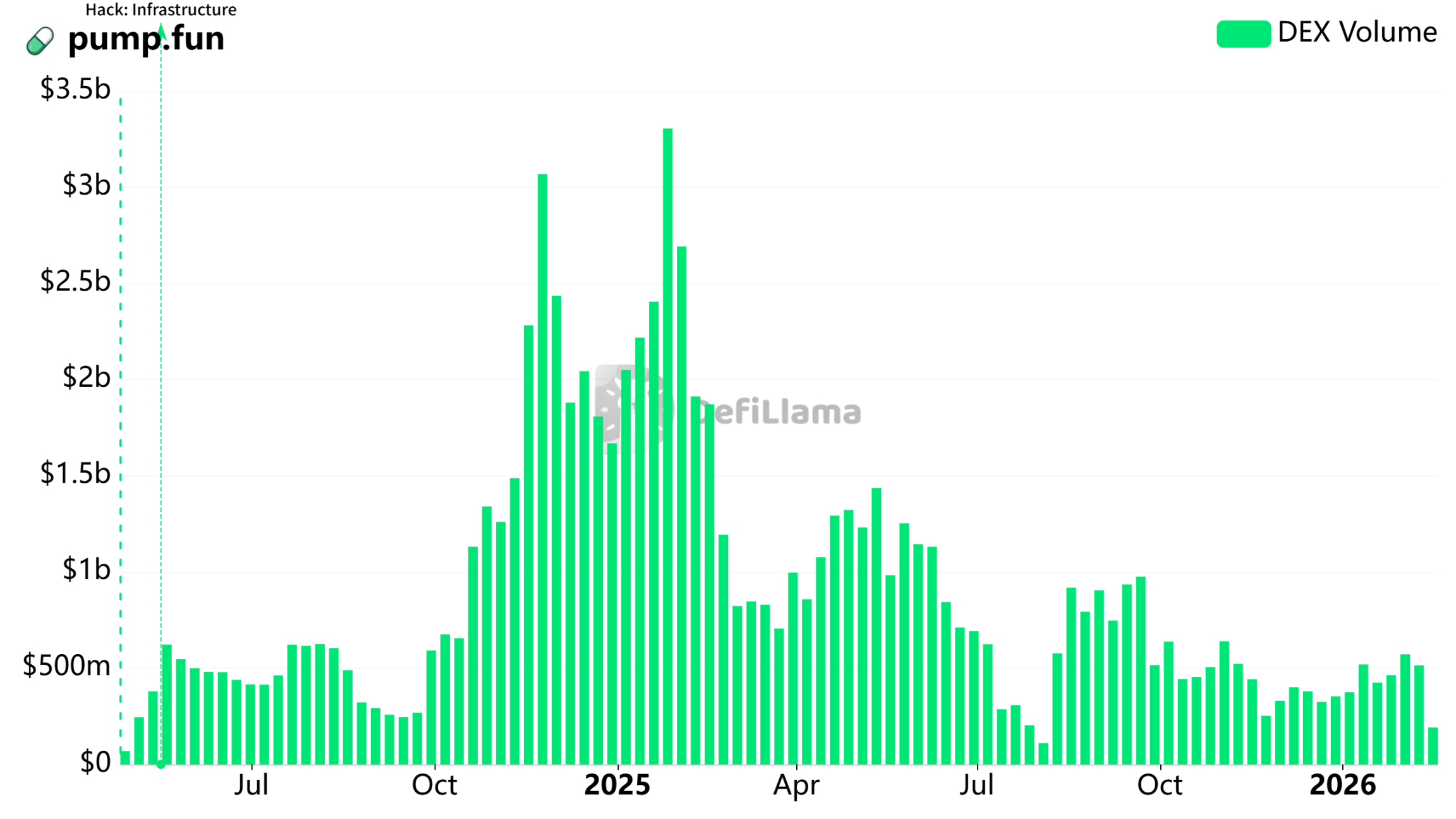
Defilama data shows that around the first few months of 2025, the transaction volume of the Meme platform pump.fun reached a historical high. The weekly transaction volume exceeded $3 billion twice, followed by a continuous decline. In early 2026, its transaction volume hovered around $500 million, one-sixth of its peak.

At the same time, some Meme traffic shifted to BNB Chain. BNB Chain rapidly rose through the Four.Meme platform. In the second half of 2025, Chinese-themed Memes like "Binance Life" and "I'm F*cking Coming" sparked FOMO sentiment. BNB Chain's Meme market capitalization grew from almost zero to hundreds of millions of dollars, with a 24-hour transaction volume reaching $460 million. In comparison, although Solana's Meme market capitalization still amounts to billions of dollars, growth has stagnated, with many projects falling over 95% from their peaks.

In October 2025, BNB Chain once replaced Solana on the trending Meme list, with obvious capital rotation: when BNB Chain Memes surged, Solana's capital contracted; after BNB Chain receded, capital partially flowed back, but the momentum had weakened. Furthermore, under the influence of influential figures CZ/He Yi, BNB Chain saw short-term growth stimulation, while Solana's Pump.fun, despite its first-mover advantage, weakened due to narrative exhaustion and a lack of incremental funds.

The end of the Meme wave means that the demand for its public chain token has also decreased simultaneously.

Public Chain Narrative Cools

Additionally, the overall cooling of the public chain narrative has further weakened Solana's ecosystem expansion plans. Between 2025-2026, the crypto market retreated from early high leverage and excessive narrative expansion. Many weak narratives, such as celebrity tokens and the Meme craze, quickly faded, shifting focus to areas with more practicality and institutional support. Solana's narrative as a "high-speed public chain" once attracted developers, but as the market entered the "deep water of value," investors tended to prefer mainstream assets like Bitcoin and Ethereum for their "digital gold" or "settlement layer" positioning, leading to a continued overall bear market and intensified capital outflow from Solana.

This narrative fatigue reflects that public chain competition has shifted from pure TPS competition to ecological maturity and regulatory adaptability. Solana's previous TPS and ecological advantages have been diluted. Whether in terms of Memes or airdrop incentives, Solana's appeal to new users has weakened.

Meanwhile, the significant speed improvement of the Ethereum mainnet has also weakened Solana's core advantage. Through the Fusaka upgrade in 2025, Ethereum increased data blob capacity from 3 to 6-9 and introduced the PeerDAS mechanism, significantly reducing transaction fees and increasing throughput. Transaction volume and active addresses subsequently rebounded.
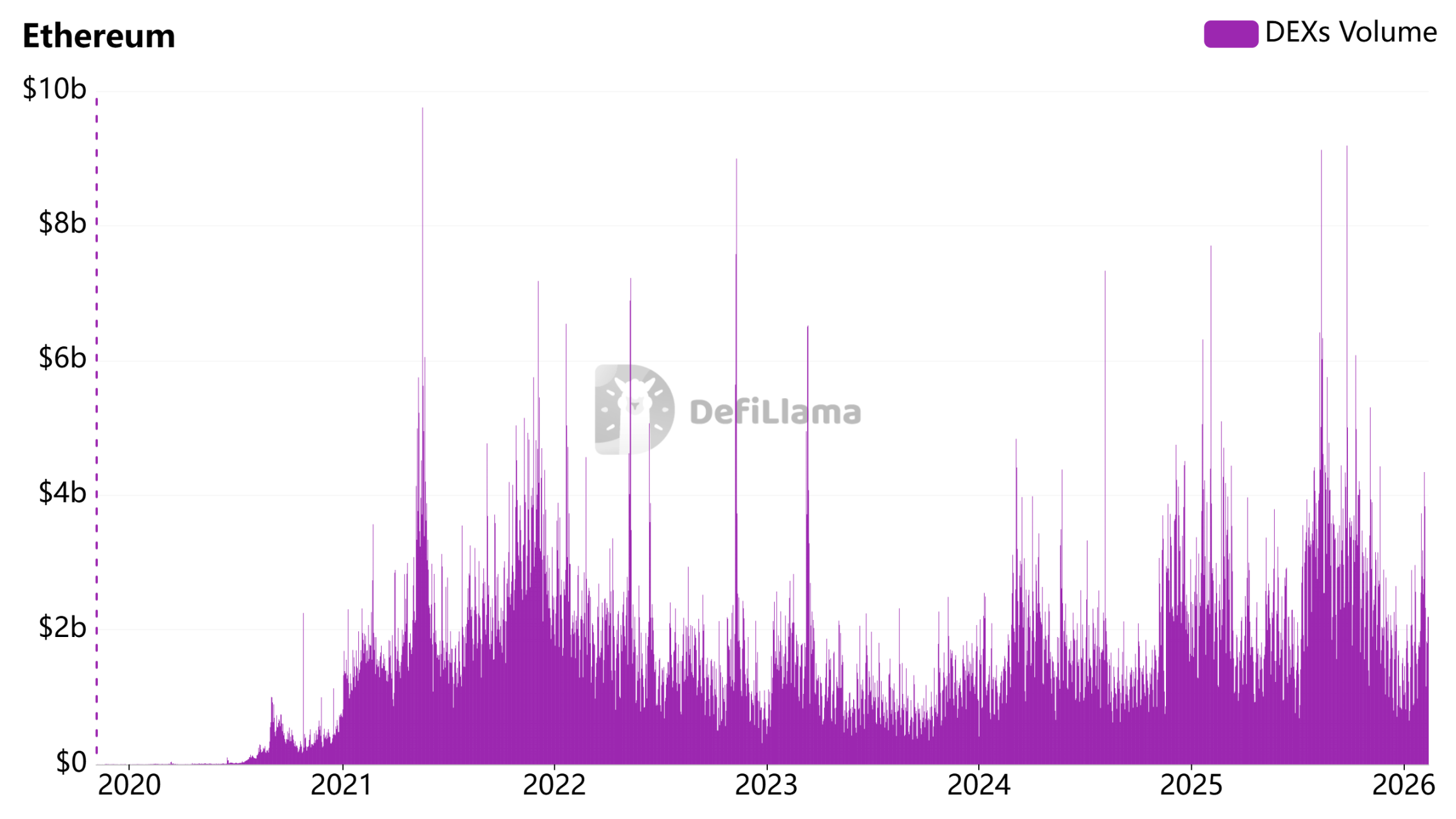
Data shows that DEX trading volume on Ethereum saw an overall upward trend in late 2025. Entering 2026, the Glamsterdam upgrade will achieve near-perfect parallel processing, further accelerating block verification and reducing fees, bringing the mainnet closer to an "operating system" level. These improvements bring Ethereum mainnet's TPS and cost close to Solana's levels, while retaining higher security and decentralization, reducing the necessity for users to switch to Solana.

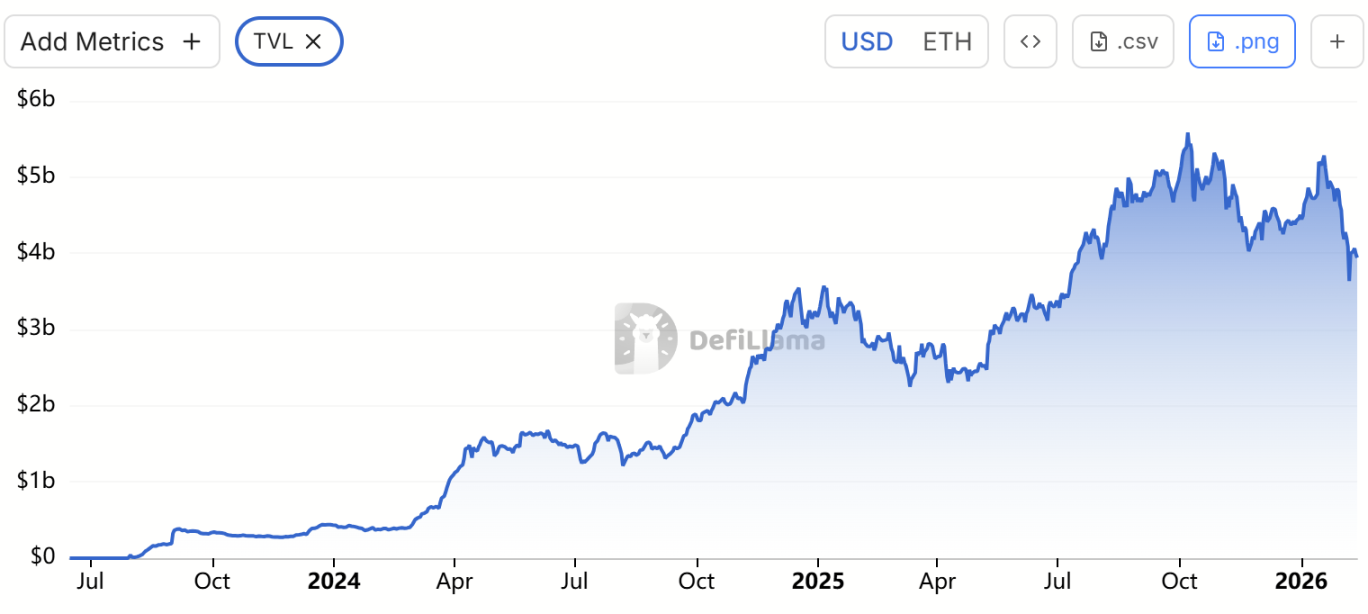
Another rising competitor, Base, is also growing rapidly, particularly with AI tokens attracting many users. According to DefiLlama data, its TVL is still maintained at a high level of $4 billion.
Under the tokenization boom, RWA occurs more on Ethereum, further marginalizing Solana's ecosystem. As of February 12, 2026, data from rwa.xyz shows that RWA assets on the Ethereum mainnet are $14.9 billion, while Solana is only $1.7 billion, still a significant gap. The tokenization trend of RWA emphasizes stability and compliance, with Ethereum's leading position making it difficult for Solana to get a share.

Digital Asset Treasury Buyers Fail to Offset Overall Bear Market Selling Pressure

From the perspective of Digital Asset Treasuries (DAT), in 2025, the DAT model was once all the rage. Many publicly traded companies such as Forward Industries, Upexi, and Sharps Technology purchased large amounts of SOL as treasury assets through private financing or debt issuance.
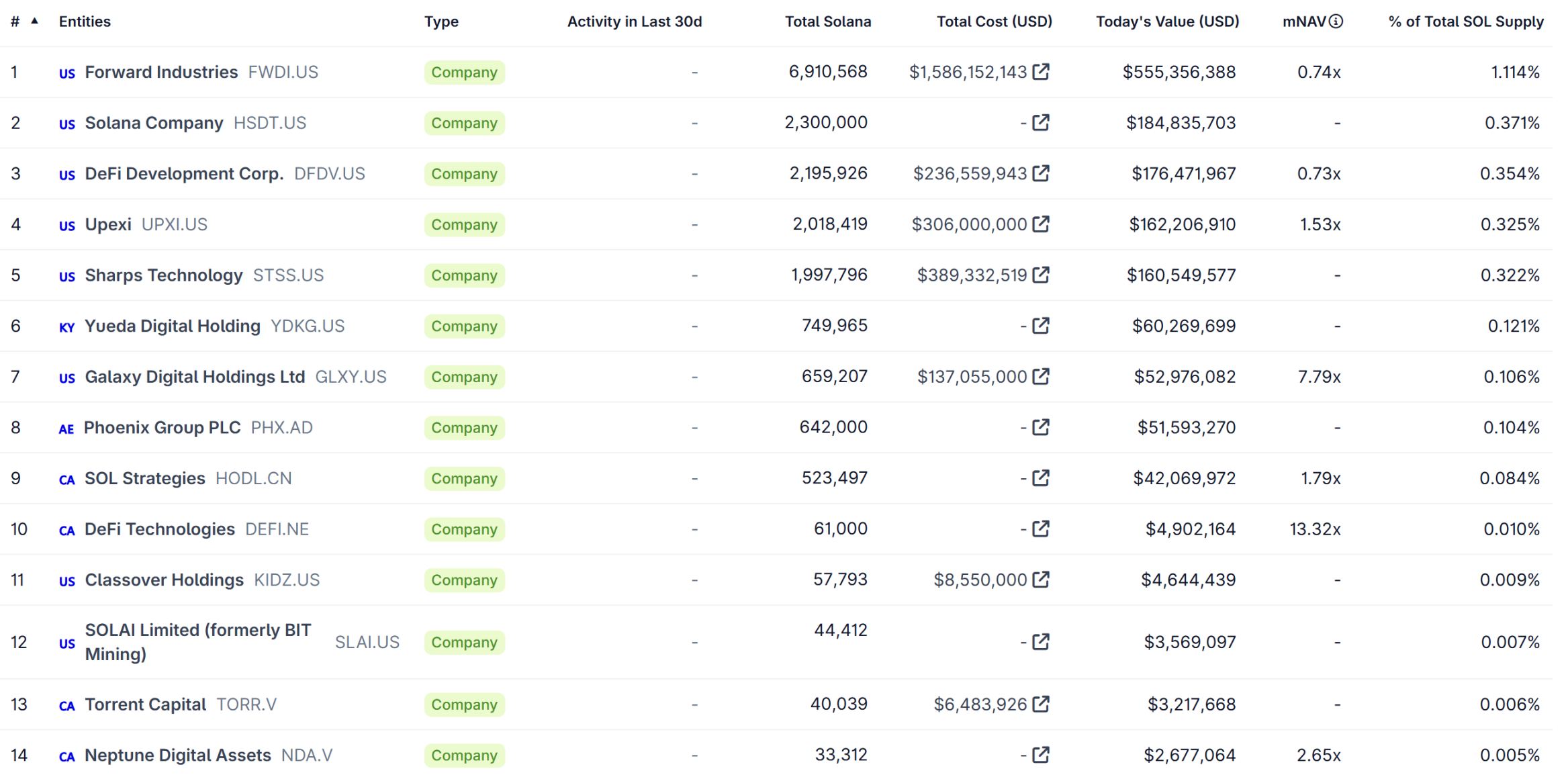
Entering 2026, as the SOL price fell from the 2025 peak of around $200 to about $80, the market capitalization of these DAT companies shrank significantly. For example, Forward Industries spent $1.58 billion to purchase SOL, now worth only $555 million, shaking some investors' confidence.

Furthermore, the DAT buying frenzy has weakened, with fewer new joiners. Although the early purchased locked SOL reduces circulating supply, it has failed to offset the overall market bearish pressure.

Bitcoin and Ethereum prices have also been hit hard in the bear market of recent months. BTC fell from $126,000 to the current $67,000, and ETH fell from $4,900 to the current $2,000.

In January 2026, Solana founder toly asked on X in Chinese: What do you think is Solana's biggest challenge now? The comments section received a variety of feedback and answers, including: no direct exchange, users have less perception of other product ecosystems besides Meme, etc.

Perhaps Solana will find its own solutions.


Twitter:https://twitter.com/BitpushNewsCN

Bitpush TG Discussion Group:https://t.me/BitPushCommunity

Bitpush TG Subscription: https://t.me/bitpush

Original link:https://www.bitpush.news/articles/7611730

Trending Cryptos

Related Questions

QWhat was the lowest price Solana (SOL) reached during the recent market crash, and what was its peak price during the bull run?

ADuring the market crash, Solana (SOL) fell to a low of $67, its lowest since December 2023. Its peak price during the bull run was $295.

QWhat was the primary driver of Solana's growth and activity during the recent bull cycle?

AThe primary driver was the Meme coin frenzy, which was largely facilitated by the Pump.fun platform on Solana, leading to massive daily token issuance and high trading volumes.

QWhich competing blockchain saw a rise in Meme coin activity, partially at the expense of Solana?

ABNB Chain saw a significant rise in Meme coin activity through its Four.Meme platform, attracting some of the Meme-related traffic and capital that was previously on Solana.

QHow did Ethereum's technical upgrades impact its competitive position against Solana?

AEthereum's Fusaka and upcoming Glamsterdam upgrades significantly increased its transaction throughput (TPS) and reduced fees, bringing its performance closer to Solana's while maintaining higher security and decentralization, thus reducing the incentive for users to switch to Solana.

QWhat is one major challenge for Solana's ecosystem mentioned in the article, beyond the decline of Meme coins?

AOne major challenge is the lack of user perception and engagement with products and ecosystems on Solana beyond Meme coins, as well as the overall cooling of the public chain narrative where investors are focusing more on established assets like Bitcoin and Ethereum.

Related Reads

Qualcomm: AI Hype Subsides, When Will Smartphones Emerge from the Gloom?

Qualcomm reported its Q3 FY2026 results (ending June 2026), with revenue of $9.95B, down 4% YoY but above expectations. Gross margin declined to 53.1%, pressured by rising costs across manufacturing and memory. Key business segments showed mixed performance: Handset revenue fell 19.6% YoY to $5.09B, dragged by an 11% decline in non-Apple Android shipments and weaker high-end mix. Conversely, Automotive revenue surged 61% to $1.59B, and IoT grew 9% to $1.83B. Core operating profit dropped 41% YoY due to margin compression and higher expenses. Management's Q4 FY2026 guidance projects revenue of $9.7B-$10.5B, in line with consensus, but Non-GAAP EPS guidance of $2.05-$2.25 fell short of expectations. Amidst persistent weakness in its core handset market, Qualcomm is pursuing growth in AI, focusing on Edge AI (smartphones, PCs, automotive) and Data Center AI. Its data center strategy includes four pillars: AI accelerators (e.g., AI200), commercial CPUs (Dragonfly C1000), custom silicon, and connectivity solutions. While these initiatives initially boosted its stock, concerns over AI capital expenditure sustainability have since erased those gains. The company targets $5B in data center revenue for FY2027 and $15B for FY2029. The report concludes that with the traditional handset business still under pressure, the data center opportunity is currently viewed as a longer-term option, and a more conservative valuation based on core operations may be warranted until AI contributions materialize.

marsbit2m ago

Qualcomm: AI Hype Subsides, When Will Smartphones Emerge from the Gloom?

marsbit2m ago

From TPU to Self-Evolving Agents: How Jeff Dean Predicts the Next Step in AI

At the 2026 YC Startup School, Jeff Dean outlined his vision for AI's next phase, shifting focus from simply scaling models to building intelligent, autonomous systems. He believes AI's progress is no longer just about creating smarter models, but about integrating them into systems capable of long-term, iterative work, automated experimentation, and continuous learning. This evolution moves the competition from "who has the bigger model" to "who can best organize intelligence." Dean suggests AI capabilities are now comparable to a junior engineer, enabling the automation of complex workflows. However, the true challenge and opportunity lie in managing these AI "workers" at scale. He emphasizes the importance of **context engineering**—structuring tools, memory, and feedback loops—over raw model power. For startups, this means building deep expertise in niche domains where general models currently fail (near 0-1% success rates), leveraging proprietary data, specialized tools, and domain-specific evaluators. A recurring theme is re-examining fundamental constraints. Dean's past work, like moving Google's search index to memory or creating the TPU, stemmed from questioning outdated assumptions about hardware and cost. He sees similar inflection points today, particularly in **specialized inference hardware** to drastically reduce latency and energy consumption for real-time Agent operation. Notably, he points out that in modern AI systems, the dominant cost is often not computation but **data movement**. Reliable, long-running Agents require robust system design, borrowing concepts from distributed computing like checkpointing, state management, and parallel exploration to handle failures and maintain progress over days or weeks. As AI automates execution, the scarcest human skills will shift to **defining clear specifications**, **judging what problems are worth solving** (taste), and designing effective feedback loops. Ultimately, Dean's framework prioritizes understanding the problem deeply, identifying the true bottlenecks, and systematically building closed-loop systems where AI can not only perform tasks but also improve AI itself.

marsbit2m ago

From TPU to Self-Evolving Agents: How Jeff Dean Predicts the Next Step in AI

marsbit2m ago

Trading

Spot

Hot Articles

Discussions

Welcome to the HTX Community. Here, you can stay informed about the latest platform developments and gain access to professional market insights. Users' opinions on the price of MEME (MEME) are presented below.

活动图片