From Ethereum to AI's 'CROPS': What Exactly Is This 'Slow Variable' That Vitalik Has Repeatedly Emphasized?

marsbitPublished on 2026-06-06Last updated on 2026-06-06

Abstract

Recently, Vitalik Buterin has frequently emphasized the concept of "CROPS," first outlined in the Ethereum Foundation's March mandate as core principles guiding its focus: Censorship Resistance, Capture Resistance, Open Source, Privacy, and Security. CROPS represents Ethereum's commitment to providing foundational capabilities for user sovereignty—enabling asset ownership, identity expression, and coordination without reliance on centralized platforms or surrendering ultimate control. This framework is gaining new urgency with the rise of AI, particularly AI agents managing digital assets and automating transactions. While AI offers convenience, it risks centralizing user data, intent, and control if dependent on opaque, centralized services. Vitalik argues for "CROPS AI"—AI that is open, privacy-preserving, secure, and capable of local execution to maintain user agency. He highlights convergence between "CROPS Ethereum access layers" and "CROPS AI," such as using zero-knowledge proofs for private remote LLM calls and Ethereum RPC reads, ensuring users can access services without exposing sensitive information. Ultimately, CROPS is not just an abstract ideal but a practical guide for Ethereum's development and AI integration. It addresses the critical long-term question: as digital systems grow more powerful, how can users retain control over their privacy, assets, and autonomy? In an AI-driven era, these principles may define Ethereum's enduring value—prioritizing verifiab...

Over the past period, Vitalik has repeatedly mentioned a somewhat unfamiliar term: CROPS.

The systematic emergence of this concept can be traced back to March 13th. The Ethereum Foundation's Board of Directors released the 'EF Mandate' document, clearly stating that the primary focus will be on Ethereum's censorship resistance, open source, privacy, and security—namely, CROPS—and using this to serve user self-sovereignty while maintaining capture resistance and a more seamless user experience.

This statement is actually very important, especially as AI begins to enter wallet and automated execution scenarios, CROPS is no longer confined to Ethereum's value proposition but could become an issue of whether users can continue to control their digital lives in the AI era.

I. What Exactly is CROPS?

To understand CROPS, one must first break free from a common misconception: Ethereum certainly needs to improve performance and reduce costs, but it's not just competing with other blockchains to see who is faster or has lower fees.

While speed and cost are indeed the most intuitive factors for short-term user experience, if you zoom out and look at the longer term, Ethereum's stance has become increasingly clear over the past two years: what it truly aims to provide is a set of more fundamental capabilities: users can hold assets, express identity, sign transactions, and participate in coordination without relying on a single platform, without surrendering ultimate control, and without being arbitrarily blocked by a centralized service.

This is the significance of CROPS.

In the context of the EF Mandate, CROPS primarily points to five directions, which are also the acronym for their keywords: Censorship Resistance, Capture Resistance (this was actually added later by Vitalik), Open Source, Privacy, Security.

  • C - Censorship Resistance: Ensuring transactions and smart contracts are immutable and cannot be halted due to any external political or centralized entity pressure.
  • R - Capture Resistance: Preventing Ethereum's governance, development roadmap, and critical entry points from being controlled long-term by a minority of interested parties.
  • O - Open Source / Openness: Adhering to completely open-source code and maintaining absolute freedom of access for the ecosystem.
  • P - Privacy: Preserving users' right not to be scrutinized through cryptographic technologies on a transparent ledger.
  • S - Security: Upholding the bottom line, providing unbreakable ultimate settlement security.

Looking at these items together, they actually constitute a set of selection and guiding principles with a clear orientation, which is also very much in line with Ethereum's consistent value-driven path.

For example, at the protocol layer, it means Ethereum needs to continuously improve censorship resistance, client diversity, validator decentralization, formal verification, etc. At the application layer, wallets, RPCs, browsers, signature interfaces, and account systems also need to reduce dependence on centralized entry points. At the user experience layer, security cannot rely solely on users understanding complex transactions; it must be preemptively integrated through clearer signature displays, more verifiable interactions, and more comprehensive risk warnings before actions occur.

This is also why EF has recently advanced some more specific directions around security, privacy, protocol resilience, and ecosystem public goods, such as the Ethereum Audit Subsidy program, which attempts to lower the barrier for Ethereum ecosystem developers to obtain high-quality security audits. Viewed more broadly, this is not just about subsidizing costs, but about pushing 'security' further from a high-cost service affordable only to a few large projects towards more small and medium-sized developers.

In late May, Vitalik also reiterated his views on EF's future direction, emphasizing that EF should become a smaller, more distinct, and more focused organization dedicated to long-term sustainability, rather than trying to cover every need in the ecosystem. The reason is pragmatic: after all, EF does not possess infinite resources nor a continuous revenue stream from staking or transaction fees. Therefore, it should direct its limited resources towards tasks that are crucial for Ethereum to achieve CROPS values and that other entities find difficult to reliably undertake.

In other words, at this transformative historical stage Ethereum is currently in, CROPS is not an abstract slogan of 'principle over reality,' but rather more like an external definition and constraint on what EF should and should not do.

II. When CROPS Meets AI: The Convergence of Two Parallel Universes

Vitalik Buterin recently brought CROPS into a larger discussion by placing it in the context of AI.

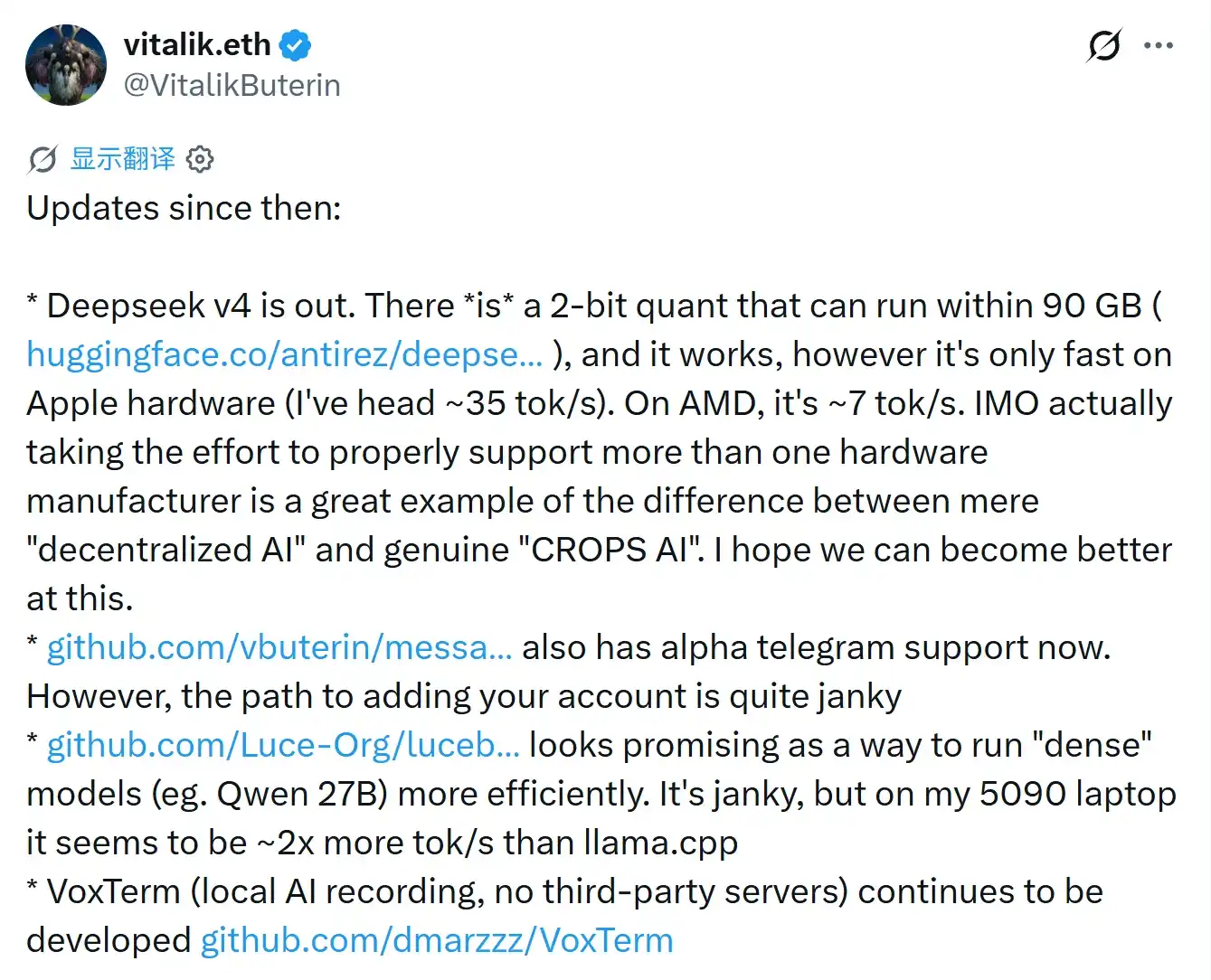
On May 28th, Vitalik Buterin posted an update on his progress with local AI, stating that DeepSeek V4 had released a 2-bit quantized version that could run within about 90 GB of VRAM, achieving speeds of around 35 tokens/second on Apple hardware and about 7 tokens/second on AMD hardware. He noted that a true 'CROPS AI' should support multiple hardware platforms, not just be 'decentralized AI.'

Simultaneously, he pointed out significant overlap between the CROPS Ethereum access layer and CROPS AI, for example, using zero-knowledge proofs for paid remote LLM calls and private Ethereum RPC reads. He suggested there should also be more AI models fine-tuned for Ethereum scenarios in the future, aimed at improving smart contracts, protocol code, and ecosystem security.

This essentially places Ethereum and AI within the same problem framework.
Previously, discussions about AI often focused on model capabilities—whether they can write code, and especially whether they can perform complex tasks as human substitutes. However, from a user safety perspective, the real change brought by AI is not just 'increased capability,' but that it is altering the entry points for digital operations.

To reiterate an old point: in the past, applications were relatively clear, separate interfaces. We opened wallets to transfer funds, opened DApps to trade, opened browsers to search, opened social products to post. Each application had relatively clear boundaries. But with the emergence of AI Agents, these boundaries are becoming increasingly blurred. Users no longer click functions one by one; instead, they express intent in natural language:

Help me find the optimal cross-chain route, help me make a swap, help me organize my assets, help me execute a certain DeFi strategy, help me generate and send a transaction...

This sounds convenient, but it also implies a more critical question: when AI becomes your digital agent, what transactions is it signing on your behalf, and what privacy is it exposing?

If AI runs entirely on centralized cloud services, users' asset information, transaction intent, address relationships, identity preferences, and operational habits could be concentrated in the hands of a few service providers. Especially when executing on-chain operations relying on opaque APIs, centralized RPCs, black-box plugins, and unverifiable inference processes, users might become more convenient but also less aware of what they are actually surrendering.

This is the question CROPS AI must answer.

A CROPS-compliant AI is not just about being capable; it should also be as censorship-resistant, open, privacy-preserving, and secure as possible. It should ideally run locally, or at least minimize reliance on centralized cloud services for sensitive scenarios, minimize information leakage, and allow users to understand, confirm, and retain ultimate control.

In other words, AI cannot just be a smarter black box. Especially in Web3 scenarios, AI in the future may not only help you summarize articles, write code, or provide customer service, but directly participate in asset management and automated execution.

The closer it gets to user assets, the more important CROPS becomes.

This is also why there is overlap between the CROPS Ethereum access layer and CROPS AI.

III. What Web3 Incremental Opportunities Lie in This Intersection?

From this perspective, Vitalik's recent mention of the overlap between CROPS Ethereum Access Layer and CROPS AI is very natural.

Because whether it's Ethereum or AI, the core problem users face is becoming the same: how can I use AI assistance without completely handing over my privacy, identity, assets, and right to choose to centralized intermediaries?

  • On the Ethereum side, this manifests as: How do users access on-chain data? How do they connect to RPCs? How do they sign transactions? How do they confirm if a DApp interaction is safe? How do they avoid having all wallet queries, balance reads, and transaction broadcasts pass through a few centralized services?
  • On the AI side, this manifests as: How do users call models? How can they ensure prompts and personal data are not misused? How can local models handle sensitive tasks? How, when needing remote large model capabilities, can they minimize exposure of their identity and intent?

These two sets of problems seem different, but are fundamentally similar.

For example, when Ethereum users query balances, read transaction history, or simulate transaction outcomes, they often need to go through RPC services. While RPCs appear to be mere technical interfaces, they can know your IP, addresses, query habits, asset structure, and interaction paths. If such data is centrally collected, users' on-chain privacy can be gradually pieced together.

But AI users calling remote models may also expose their preferences, financial information, or even identity clues. If users employ AI for wallet operations in the future, the risks would be further amplified.

Therefore, the ZK-paid remote LLM calls and private Ethereum RPC reads Vitalik mentioned essentially attempt to solve the same problem: how can we obtain services while invoking remote capabilities without exposing all our information?

This is where CROPS Ethereum and CROPS AI intersect. On one side is a more private, verifiable, and lower-trust-assumption on-chain access layer; on the other is a more open, localized, and secure AI execution environment. Combined, they may form a new entry point for users into the digital world in the future.

Extending outward along the underlying logic of CROPS, the entire Web3 ecosystem (especially the wallet layer as a traffic entry point) will undoubtedly take on more roles.

As users begin to express on-chain needs in natural language, a wallet is no longer just a signing tool but the control console for a user's digital actions. It needs to help users determine: Can this DApp connect? What exactly will this transaction do? Is this AI Agent calling unnecessary data?

From this perspective, CROPS is not an abstract value but will directly influence the design direction of wallet products and drive the development shift for the next decade in integrated Web3 interaction experiences and the wallet sector.

Conclusion

Although, in the current market sentiment, many people might not pay as much attention to purely conceptual topics anymore.

But the colder the market, the easier it is to overlook those technical variables that may not be 'sexy' in the short term but truly determine the direction in the long run.

CROPS is worth paying attention to, not because it creates a new hype cycle, but because it reframes the long-term problems of Ethereum and AI within a single framework: as digital systems become increasingly powerful, can users continue to retain their own control?

After all, security and privacy cannot just be patches applied after the fact.

From this perspective, in an era where AI is accelerating its takeover of the digital world, these factors may be the truly positive variables that make Ethereum worth continued building and usage.

In an era where AI is accelerating its takeover of the digital world, being more understandable, more verifiable, more private, and more secure may be the real reasons Ethereum continues to be worth building and using.


Trending Cryptos

Related Questions

QAccording to the article, what does the acronym CROPS stand for in the context of the Ethereum Foundation's mandate?

ACROPS stands for Censorship Resistance, Capture Resistance, Open Source / Openness, Privacy, and Security. It represents a set of core guiding principles for Ethereum.

QWhy does the article argue that CROPS is becoming critically important in the age of AI, particularly for Web3?

AThe article argues that as AI Agents begin to automate wallet operations and execute complex tasks on-chain, they gain proximity to user assets and sensitive data. CROPS principles are vital to ensure that AI does not become a 'black box' that compromises user sovereignty, privacy, and security, preventing users from losing control to centralized AI service providers.

QWhat is the common problem that both CROPS for Ethereum Access Layer and CROPS for AI are trying to solve, according to Vitalik Buterin's perspective mentioned in the article?

ABoth aim to solve the problem of how users can access remote services or capabilities (like RPCs or large language models) without fully exposing their personal information, identity, assets, or transaction intent. The goal is to obtain the service while preserving privacy and minimizing trust assumptions in centralized intermediaries.

QHow might the role of a wallet evolve in a future where CROPS principles guide interactions with both Ethereum and AI, as described in the article?

AThe wallet could evolve from a simple signing tool into a user's central digital action console or control panel. It would need to help users verify DApp safety, understand complex transaction implications, and monitor AI Agent behavior to prevent unnecessary data calls, thus becoming crucial for safeguarding user sovereignty in a world of automated, natural-language-driven interactions.

QWhat is the significance of the Ethereum Audit Subsidy program in relation to the CROPS framework, particularly the 'Security' aspect?

AThe Ethereum Audit Subsidy program is an example of applying the CROPS framework concretely. By lowering the cost barrier for high-quality security audits, it moves 'security' from being an expensive service only for large projects to a more accessible public good for smaller developers. This enhances the overall security and capture resistance of the ecosystem, aligning with CROPS's long-term, sustainability-focused goals.

Related Reads

Base Under Pressure

**Title: The Pressure Mounts for Base** Base, the Ethereum Layer 2 scaling solution backed by Coinbase, is facing significant pressure and public scrutiny from its leadership following the launch of Robinhood Chain. Base co-founder Jesse Pollak recently acknowledged strategic missteps, admitting that the chain's past focus on social and creator tokens (e.g., through Farcaster, Zora) failed to deliver sustainable adoption. He has refocused on core infrastructure, handing leadership of the Base App back to Coinbase's Cobie. While Base remains a top L2 contender alongside OP Mainnet and Arbitrum, and boasts the highest TVL (nearly $12B), its weaknesses are being highlighted by the new competitor. Key criticisms include its slow progress on decentralization. Base has faced issues with its single sequencer causing block production halts, and L2BEAT is reportedly considering downgrading its decentralization rating from Stage 1 to Stage 0. This contrasts sharply with the rapid initial success of Robinhood Chain, whose DEX quickly entered the top five by volume. The leadership styles of the parent companies are also being compared: Robinhood's CEO actively engages with new projects, while a recent incident where Coinbase's Brian Armstrong briefly changed his profile picture—sparking and then crashing a related meme token—drew community ire and mockery. Pollak stated Base is working with Coinbase on tokenized stocks backed 1:1 by real equity, differentiating it from Robinhood's derivatives model. However, the article argues that Base's most urgent task is to address its long-standing technical and trust issues. With more traditional finance players likely to emulate Robinhood's path, Base must use this competitive pressure to solidify its position as long-term financial infrastructure.

Foresight News7m ago

Base Under Pressure

Foresight News7m ago

White House Concession Removes Ethical Hurdle, Clarity Act Races Against Final Window Before Recess?

On July 21st, industry sources reported that the Trump administration has agreed to include an ethics provision in the "Clarity Act" (Digital Asset Market Clarity Act of 2025). This concession addresses the long-standing conflict-of-interest concerns regarding government officials and the crypto industry, potentially removing the final major obstacle to the bill's progress. Additionally, Patrick Witt, the executive director of the White House's Digital Asset Advisory Committee, confirmed he will remain in his role to help finalize the bill, alleviating previous concerns about his potential departure. The Clarity Act aims to establish a unified federal regulatory framework for the U.S. digital asset market. Its core objective is to resolve regulatory ambiguity by defining different types of digital assets (digital commodities, investment contract assets, and permitted payment stablecoins) and clarifying the respective oversight roles of the SEC and CFTC. This would end the long-running jurisdictional dispute between the two agencies and provide clearer compliance paths for the industry. With the ethics issue moving toward resolution, the most urgent challenge now is time. The U.S. Congress is set to begin its August recess in mid-August, leaving only a few working weeks to finalize the text and advance the bill through the Senate. Industry advocates, like the Blockchain Association's Kristin Smith, stress that this is a critical moment. If negotiations conclude successfully in the coming weeks, the Clarity Act could pass a key hurdle before the recess; otherwise, it may face significant delays. If enacted, the Clarity Act could mark a historic turning point in crypto regulation. By providing a clearer and more predictable legal framework, it aims to reduce uncertainty for businesses, developers, and traditional financial institutions looking to enter the digital asset space, potentially setting a global benchmark for market structure regulation.

Odaily星球日报12m ago

White House Concession Removes Ethical Hurdle, Clarity Act Races Against Final Window Before Recess?

Odaily星球日报12m ago

AI Era, Industrial Revolution, and Future Civilization Interview — Zhang Dingwen: The Future Does Not Belong to Chasers

"AI Era, Industrial Revolution and Future Civilization: An Interview with Zhang Dingwen – The Future Does Not Belong to Those Who Chase" In this interview, entrepreneur Zhang Dingwen reflects on his entrepreneurial journey and philosophy, moving beyond discussions of financing or success to emphasize understanding the "era" itself. He argues that true entrepreneurs should not chase short-term trends ("winds"), but position themselves in the direction of long-term technological and societal evolution. Zhang shares key lessons from his early days, including the realization that user value does not automatically translate to commercial value. For him, the core of entrepreneurship is not building a company but constantly upgrading one's own "cognition" – the ability to interpret information, ask the right questions, and understand the underlying "causes" behind business outcomes, not just the effects. His thinking has evolved from a focus on creating good products to a strategic focus on building "entrances" – platforms that naturally connect users to digital services. He sees smart wearables, like watches, not merely as hardware but as potential future gateways combining technological, financial, social, and even fashion attributes to create sustained user relationships and ecosystems. Ultimately, Zhang's vision transcends individual products or companies. He discusses business competition in three stages: product, platform, and finally, "civilization" – where the greatest companies influence how society operates by defining new rules and ways of life. He believes the mission of a truly great enterprise is to solve problems of its time, build enduring trust, and contribute lasting value, leaving behind not just wealth but a positive impact on how the world works. The future, he concludes, belongs not to the fastest, but to those with the correct long-term direction and a commitment to continuous learning and evolution.

marsbit24m ago

AI Era, Industrial Revolution, and Future Civilization Interview — Zhang Dingwen: The Future Does Not Belong to Chasers

marsbit24m ago

Cryptocurrency & Stock Market Barometer丨Strategy Cash Reserves Increase to $3.23 Billion, Halting BTC Purchases; Vanguard and Other Asset Managers Increase Holdings in Strategy Stock (July 21)

Market Overview & Warnings: The article warns of high volatility in South Korean stocks and continued dependence on U.S. stocks on geopolitics. Chinese A-shares remain under pressure. It advises against using leverage in current equity markets. For crypto-linked stocks, most have limited growth except Robinhood, with caution advised. U.S. Stock Market: Bearish bets on U.S. stocks, particularly targeting AI-related companies, have reached record highs since 2010, signaling deep skepticism about the sustainability of the AI-driven rally. Tech and chip stocks led a market decline, with the Philadelphia Semiconductor Index potentially entering a bear market. Increased expectations for Federal Reserve interest rate hikes and geopolitical tensions contributed to the negative sentiment. Bitcoin Treasury Company Updates: * Strategy: Increased its cash reserves to $3.23 billion and paused Bitcoin purchases. Several major asset managers, including Vanguard Group and Capital Group, increased their holdings of Strategy (MSTR) stock. * Global corporate Bitcoin buying slowed significantly to just $1.33 million last week. * Other notable activity: Strive purchased 21 BTC; ORANGE JUICE raised $40 million for Bitcoin acquisitions; Bitcoin Japan Corp. raised $60 million, allocating $4.08 million for its first BTC purchase. Other Crypto Treasury Holdings: * Ethereum: BitMine increased its ETH holdings to 5.78 million, nearing its 5% of supply goal. Its total crypto assets, cash, and securities are valued at $11.5 billion. * Solana: No significant corporate treasury activity reported. * Altcoins: HypeStrat made no adjustments to its treasury; its mNAV ratio fell to a long-term low. (Note: This summary is for informational purposes only and does not constitute investment advice.)

marsbit24m ago

Cryptocurrency & Stock Market Barometer丨Strategy Cash Reserves Increase to $3.23 Billion, Halting BTC Purchases; Vanguard and Other Asset Managers Increase Holdings in Strategy Stock (July 21)

marsbit24m ago

Trading

Spot

Hot Articles

Discussions

Welcome to the HTX Community. Here, you can stay informed about the latest platform developments and gain access to professional market insights. Users' opinions on the price of ETH (ETH) are presented below.

活动图片