From ETH to SOL: Why Will L1s Ultimately Lose to Bitcoin?

coinvoicePublished on 2025-12-08Last updated on 2025-12-08

Abstract

The article "From ETH to SOL: Why L1s Will Ultimately Lose to Bitcoin?" argues that Bitcoin (BTC) is increasingly dominating the "cryptomoney" narrative, leaving little room for other Layer-1 (L1) blockchains to compete for monetary premium. The core of the argument is that approximately 81% of the total crypto market cap is invested in assets viewed as money or potential money, with BTC alone accounting for 55%. While L1s like ETH, XRP, BNB, and SOL represent a significant portion of the remaining value, their valuations are not primarily driven by revenue or real economic activity. Data shows that L1 revenues have been declining annually, yet their price-to-earnings ratios have soared, suggesting their market caps are almost entirely propped up by speculation on future monetary premium, not fundamentals. The performance of L1s against BTC further supports this. Since December 2022, eight of the top ten L1s have underperformed BTC, with six lagging by over 40%. Solana (SOL) was a notable exception, outperforming BTC by 87%. However, this gain is put into perspective by its ecosystem's explosive growth: a ~3,000% increase in DeFi TVL, fees, and DEX volume. This indicates that an L1 must achieve astronomical, orders-of-magnitude growth to merely eke out a modest performance lead over BTC. The conclusion is that the trend of BTC consolidating monetary premium at the expense of L1s is irreversible. The narrative that an L1 could become "money" is losing credibility as investo...

Original Title:Can L1s Compete Against BTC as Cryptomoney?

Original Author: AvgJoesCrypto, Messari

Original Compilation: Dingdang, Odaily Planet Daily

Editor's Note: Recently, Haseeb Qureshi, a well-known partner at Dragonfly, published a lengthy article rejecting cynicism and embracing exponential thinking, unexpectedly bringing the community discussion back to the core issue: How much value do L1s really have left? The following content is excerpted from the upcoming "The Crypto Theses 2026" by @MessariCrypto, compiled by Odaily Planet Daily.

Cryptocurrency Drives the Entire Industry

It is crucial to refocus the discussion on "cryptocurrency" itself, as most capital in the crypto industry is ultimately seeking exposure to "monetized assets." The total market capitalization of the crypto market is currently $3.26 trillion, with BTC accounting for $1.80 trillion, or 55%. Of the remaining $1.45 trillion, approximately $0.83 trillion is concentrated in various L1 public chains. This means that about $2.63 trillion, or roughly 81% of the entire market's capital, is invested in assets that the market already views as money or believes may gain a monetary premium in the future.
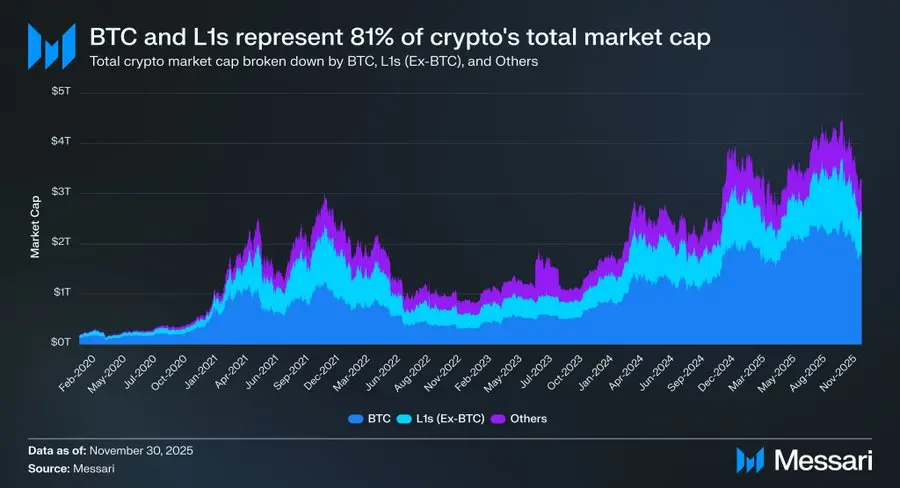
In this context, whether you are a trader, investor, capital manager, or developer, understanding how the market assigns or withdraws monetary premiums is essential. In the crypto industry, nothing drives valuation changes more than the market's willingness to view an asset as "money." Therefore, predicting which assets will gain monetary premiums in the future is arguably the most critical variable when building an investment portfolio.

So far, we have focused primarily on BTC, but it is also necessary to discuss those L1 assets among the remaining $0.83 trillion that "may or may not be money." As mentioned earlier, we expect BTC to continue capturing market share from gold and other non-sovereign stores of value in the coming years. But this raises a question: How much room is left for L1s? When the tide rises, will all boats (assets) rise (benefit)? Or will BTC, in its pursuit of gold, also absorb some of the monetary premium from L1 public chains?
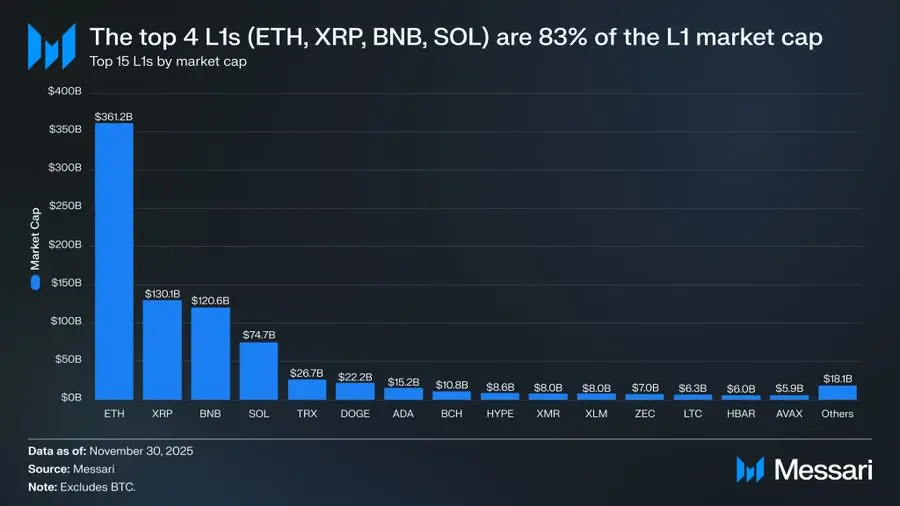
To answer these questions, we first need to look at the current valuation landscape of L1s. The top four L1s by market cap—ETH ($361.15 billion), XRP ($130.11 billion), BNB ($120.64 billion), and SOL ($74.68 billion)—have a combined market cap of $686.58 billion, accounting for 83% of the entire L1 sector. After these top four, there is a significant gap in market cap (e.g., TRX at $26.67 billion), but the tail end still holds considerable value. The total market cap of L1s outside the top 15 is still $18.06 billion, representing 2% of the total L1 market cap.

More importantly, L1 market cap is not equivalent to pure "monetary premium." There are three main valuation frameworks for L1s:

(i) Monetary Premium

(ii) Real Economic Value (REV)

(iii) Economic Security Demand

Therefore, a project's market cap is not solely determined by the market viewing it as money.

What Drives L1 Valuations Is Monetary Premium, Not Revenue

Despite the existence of multiple valuation frameworks, the market is increasingly inclined to evaluate L1s from the perspective of "monetary premium" rather than a "revenue-driven" angle. Over the past few years, the overall price-to-earnings (P/E) ratio for all L1s with a market cap exceeding $1 billion has generally remained between 150x and 200x. However, this aggregate data is misleading because it includes TRON and Hyperliquid. Over the past 30 days, TRX and HYPE contributed 70% of the revenue in this group but accounted for only 4% of the total market cap.
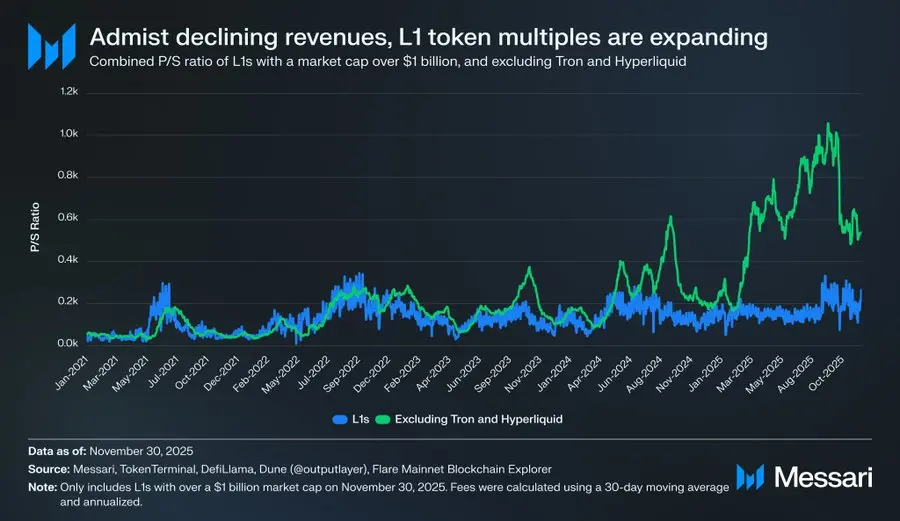
After removing these two outliers, the real story emerges. Despite continuously declining revenue, L1 valuations are rising. The adjusted P/E ratio shows a clear upward trend:

· November 30, 2021: 40x

· November 30, 2022: 212x

· November 30, 2023: 137x

· November 30, 2024: 205x

· November 30, 2025: 536x

If interpreted from an REV perspective, one might argue that the market is pricing in future revenue growth. However, this explanation does not hold, as revenue for the same group (still excluding TRON and Hyperliquid) has declined almost every year:

· 2021: $12.33 billion

· 2022: $4.89 billion (YoY -60%)

· 2023: $2.72 billion (YoY -44%)

· 2024: $3.55 billion (YoY +31%)

· 2025: Annualized $1.70 billion (YoY -52%)

In our view, the simplest and most straightforward explanation is: These valuations are primarily driven by monetary premium, not current or future revenue.

L1s Have Consistently Underperformed Bitcoin

If L1 valuations are primarily driven by the market's expectation of their monetary premium, the next question is: What shapes this expectation? A simple method is to compare their price performance with BTC's. If changes in monetary premium mainly reflect BTC's movements, these assets should perform similarly to BTC's "beta coefficient"; if the monetary premium comes from each L1's unique factors, their correlation with BTC should be weaker, and their performance should be more idiosyncratic.
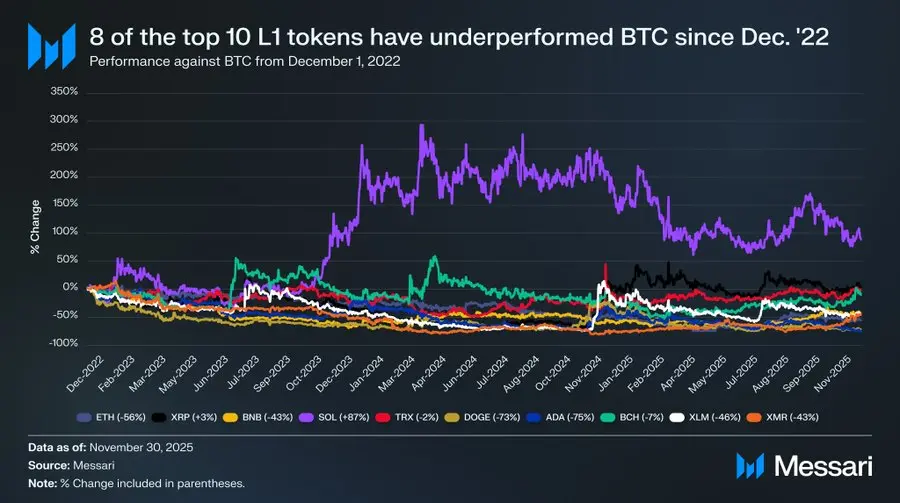
As representatives of L1s, we selected the top ten L1 tokens by market cap (excluding HYPE) and measured their performance relative to BTC since December 1, 2022. These ten assets represent about 94% of the L1 market cap, making them highly representative. During this period, eight assets underperformed BTC in absolute returns, with six lagging by more than 40%. Only two assets outperformed BTC: XRP and SOL. However, XRP's excess return was only 3%, and given its history of being driven by retail capital, we will not overinterpret this. The only asset with significant excess returns was SOL, which beat BTC by 87%.
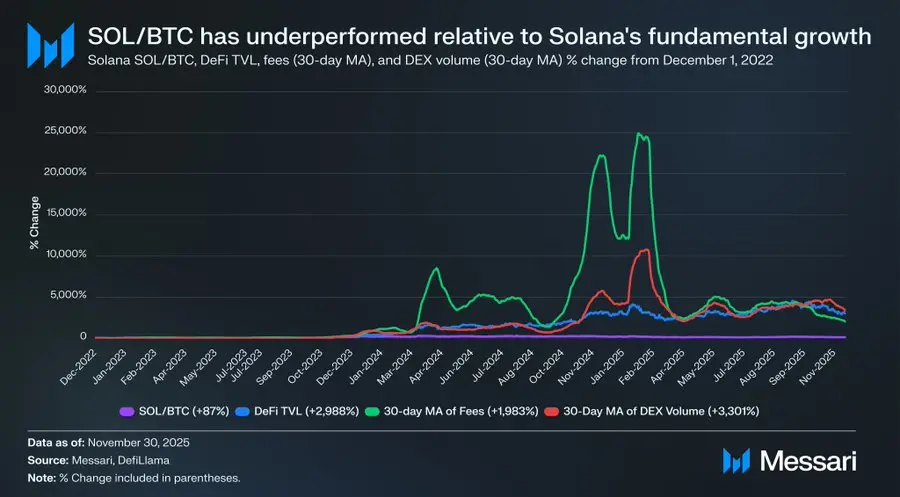
But upon closer examination, SOL's "outperformance" may not be as strong as it appears. During the same period that SOL outperformed BTC by 87%, Solana's fundamentals experienced exponential growth: DeFi TVL increased by 2,988%, fees grew by 1,983%, and DEX trading volume surged by 3,301%. By any reasonable measure, the Solana ecosystem expanded by 20 to 30 times since the end of 2022, yet SOL's price only outperformed BTC by 87%.

Please read that sentence again.

To achieve truly significant excess returns against BTC, an L1 doesn't need ecosystem growth of 200% or 300%—it needs growth of 2,000%-3,000% just to barely gain a few dozen percentage points of outperformance.

Combining the above, our judgment is: Although the market still prices L1s based on the expectation that they "may gain monetary premium in the future," confidence in these expectations is quietly waning. Meanwhile, the market's monetary premium for BTC as "cryptomoney" remains unshaken, and one could even argue that BTC's lead over various L1s is continuously widening.

Although cryptocurrency itself does not require fees or revenue to support its valuation, these metrics are crucial for L1s. Unlike BTC, the narrative for L1s depends on building an ecosystem (applications, users, throughput, economic activity, etc.) to support their token value. However, if an L1's ecosystem is showing annual declines (partly reflected in decreasing revenue and fees), it loses its only competitive advantage relative to BTC. Without real economic growth, its "cryptomoney" story becomes increasingly difficult for the market to accept.

Looking Ahead

Looking ahead, we do not believe this trend will reverse in 2026 or beyond. With few possible exceptions, we expect the L1 sector to continue losing market share, further squeezed by BTC. Since their valuations primarily rely on expectations of future monetary premium, as the market gradually concludes that BTC has the strongest claim to the "cryptomoney" narrative, L1 valuations will continue to contract. Although BTC will also face challenges in the coming years, these issues remain too distant and variable to provide effective support for the monetary premium of competing L1s.

For L1s, the bar for proving their value has been raised. Their narratives are no longer sufficiently attractive compared to BTC's, nor can they rely on market euphoria to support their valuations long-term. The era when the story of "we might become money in the future" could support trillion-dollar market caps is closing. Investors now have a decade of data proving that an L1's monetary premium can only be sustained when the ecosystem experiences extreme growth. Once growth stalls, L1s will consistently underperform BTC, and the monetary premium will dissipate.


Related Questions

QWhat percentage of the total crypto market capitalization is currently held by assets that the market views as or expects to become monetized assets?

AApproximately 81% of the total market capitalization, or about $2.63 trillion, is held in assets the market views as money or expects to gain a monetary premium.

QAccording to the article, what are the three main valuation frameworks for Layer-1 (L1) blockchains?

AThe three main valuation frameworks for L1s are: (i) Monetary Premium, (ii) Real Economic Value (REV), and (iii) Economic Security Demand.

QWhat trend does the article identify regarding the price-to-earnings (P/E) ratios of major L1s when excluding outliers like TRON and Hyperliquid?

AThe article identifies a clear upward trend in the adjusted P/E ratios of major L1s, rising from 40x in November 2021 to 536x in November 2025, even as their revenues have been declining.

QWhich was the only major L1 asset that significantly outperformed Bitcoin (BTC) in terms of price performance from December 2022, and by what percentage?

ASolana (SOL) was the only major L1 that significantly outperformed Bitcoin, beating it by 87%.

QWhat is the article's primary conclusion about the future trend of L1 valuations relative to Bitcoin?

AThe article concludes that the trend of L1s losing market share to Bitcoin will not reverse; it expects the L1 sector to continue being squeezed by BTC as the market increasingly sees Bitcoin as having the strongest claim to the 'cryptomoney' narrative, causing L1 valuations to contract.

Related Reads

OpenAI Goes Left, DeepSeek Goes Right

On April 24, 2026, DeepSeek released V4, a Chinese large language model offering a free "million-token context window," enabling it to process vast amounts of data like entire books or years of corporate documents in one go. In contrast, OpenAI’s GPT-5.5, released around the same time, is more powerful but significantly more expensive, charging up to $180 per million output tokens. DeepSeek’s strategy represents a shift from a pure AI research firm to a heavy-infrastructure player, building data centers in Inner Mongolia’s Ulanqab to bypass U.S. chip export restrictions. This move, supported by Huawei’s Ascend chips and China’s cheap green electricity, highlights a fundamental divergence in AI development models: U.S. firms focus on high-cost, high-margin services, while Chinese players like DeepSeek prioritize accessibility and affordability. Facing intense talent poaching from tech giants, DeepSeek is seeking a $44 billion valuation funding round to retain researchers and scale infrastructure. Meanwhile, Chinese manufacturers are compressing AI models to run on smartphones, making AI accessible offline and across the Global South. Through open-source models and localized solutions, Chinese AI is empowering non-English speakers and low-income users, driving a form of "digital equality." While Silicon Valley builds walled gardens, DeepSeek and others are turning AI into a public utility—like tap water—flowing freely to those previously left behind.

marsbit23m ago

OpenAI Goes Left, DeepSeek Goes Right

marsbit23m ago

$292 Million KelpDAO Cross-Chain Bridge Hack: Who Should Foot the Bill?

On April 18, 2026, an attacker stole 116,500 rsETH (worth ~$292M) from KelpDAO’s cross-chain bridge in 46 minutes—the largest DeFi exploit of 2026. The stolen assets were deposited into Aave V3 as collateral, causing $177–200M in bad debt and triggering a cascade of losses across nine DeFi protocols. Aave’s TVL dropped by ~$6B overnight. This legal analysis argues that KelpDAO and LayerZero Labs share concurrent liability, with fault apportioned 60%/40%. KelpDAO negligently configured its bridge with a 1-of-1 decentralized verifier network (DVN)—a single point of failure—despite LayerZero’s explicit recommendation of a 2-of-3 setup. LayerZero, which operated the compromised DVN, failed to secure its RPC infrastructure against a known poisoning attack vector. Both protocols’ terms of service cap liability at $200 (KelpDAO) or $50 (LayerZero), but these limits are likely unenforceable due to unconscionability, gross negligence exceptions, and potential securities law invalidation (if rsETH is deemed a security under the Howey test). Aave’s governance also faces fiduciary duty claims for raising rsETH’s loan-to-value ratio to 93%—far above competitors’ 72–75%—without adequately assessing bridge risks, amplifying the systemic fallout. Practical recovery targets include LayerZero Labs (a registered Canadian entity), KelpDAO’s founders, auditors, and identifiable Aave governance delegates. The incident underscores escalating legal risks for DeFi protocols, infrastructure providers, and governance participants.

marsbit1h ago

$292 Million KelpDAO Cross-Chain Bridge Hack: Who Should Foot the Bill?

marsbit1h ago

Insider Trading in War: 5 People Involved, the Highest Earner Was Arrested

On April 24, the U.S. Department of Justice arrested U.S. Army Special Forces Staff Sergeant Gannon Ken Van Dyke for insider trading related to the capture of Venezuelan President Nicolás Maduro on January 3. Van Dyke allegedly profited over $400,000 by placing bets on a prediction market, Polymarket, using insider knowledge of the covert operation. According to the indictment, Van Dyke registered an account (0x31a5) on December 26 and made a series of bets predicting Maduro’s capture and U.S. military involvement in Venezuela. He withdrew most of his funds on the day of the operation and attempted to obscure his tracks by transferring assets through crypto and brokerage accounts. This case marks the first time the DOJ has prosecuted insider trading on Polymarket. PolyBeats had previously identified five suspicious accounts, including Van Dyke’s—the highest earner—in January. The other accounts, with profits ranging from $34,000 to $145,000, remain under unofficial scrutiny but have not been charged. Their lower profits, indirect access to information, and unclear legal boundaries may complicate prosecution. Polymarket has since strengthened its market integrity rules, explicitly prohibiting trading based on confidential or insider information. Van Dyke’s arrest, nearly four months after his trades, signals increased regulatory attention and the persistent traceability of blockchain-based transactions.

marsbit1h ago

Insider Trading in War: 5 People Involved, the Highest Earner Was Arrested

marsbit1h ago

Trading

Spot
Futures

Hot Articles

What is $BITCOIN

DIGITAL GOLD ($BITCOIN): A Comprehensive Analysis Introduction to DIGITAL GOLD ($BITCOIN) DIGITAL GOLD ($BITCOIN) is a blockchain-based project operating on the Solana network, which aims to combine the characteristics of traditional precious metals with the innovation of decentralized technologies. While it shares a name with Bitcoin, often referred to as “digital gold” due to its perception as a store of value, DIGITAL GOLD is a separate token designed to create a unique ecosystem within the Web3 landscape. Its goal is to position itself as a viable alternative digital asset, although specifics regarding its applications and functionalities are still developing. What is DIGITAL GOLD ($BITCOIN)? DIGITAL GOLD ($BITCOIN) is a cryptocurrency token explicitly designed for use on the Solana blockchain. In contrast to Bitcoin, which provides a widely recognized value storage role, this token appears to focus on broader applications and characteristics. Notable aspects include: Blockchain Infrastructure: The token is built on the Solana blockchain, known for its capacity to handle high-speed and low-cost transactions. Supply Dynamics: DIGITAL GOLD has a maximum supply capped at 100 quadrillion tokens (100P $BITCOIN), although details regarding its circulating supply are currently undisclosed. Utility: While precise functionalities are not explicitly outlined, there are indications that the token could be utilized for various applications, potentially involving decentralized applications (dApps) or asset tokenization strategies. Who is the Creator of DIGITAL GOLD ($BITCOIN)? At present, the identity of the creators and development team behind DIGITAL GOLD ($BITCOIN) remains unknown. This situation is typical among many innovative projects within the blockchain space, particularly those aligning with decentralized finance and meme coin phenomena. While such anonymity may foster a community-driven culture, it intensifies concerns about governance and accountability. Who are the Investors of DIGITAL GOLD ($BITCOIN)? The available information indicates that DIGITAL GOLD ($BITCOIN) does not have any known institutional backers or prominent venture capital investments. The project seems to operate on a peer-to-peer model focused on community support and adoption rather than traditional funding routes. Its activity and liquidity are primarily situated on decentralized exchanges (DEXs), such as PumpSwap, rather than established centralized trading platforms, further highlighting its grassroots approach. How DIGITAL GOLD ($BITCOIN) Works The operational mechanics of DIGITAL GOLD ($BITCOIN) can be elaborated on based on its blockchain design and network attributes: Consensus Mechanism: By leveraging Solana’s unique proof-of-history (PoH) combined with a proof-of-stake (PoS) model, the project ensures efficient transaction validation contributing to the network's high performance. Tokenomics: While specific deflationary mechanisms have not been extensively detailed, the vast maximum token supply implies that it may cater to microtransactions or niche use cases that are still to be defined. Interoperability: There exists the potential for integration with Solana’s broader ecosystem, including various decentralized finance (DeFi) platforms. However, the details regarding specific integrations remain unspecified. Timeline of Key Events Here is a timeline that highlights significant milestones concerning DIGITAL GOLD ($BITCOIN): 2023: The initial deployment of the token occurs on the Solana blockchain, marked by its contract address. 2024: DIGITAL GOLD gains visibility as it becomes available for trading on decentralized exchanges like PumpSwap, allowing users to trade it against SOL. 2025: The project witnesses sporadic trading activity and potential interest in community-led engagements, although no noteworthy partnerships or technical advancements have been documented as of yet. Critical Analysis Strengths Scalability: The underlying Solana infrastructure supports high transaction volumes, which could enhance the utility of $BITCOIN in various transaction scenarios. Accessibility: The potential low trading price per token could attract retail investors, facilitating wider participation due to fractional ownership opportunities. Risks Lack of Transparency: The absence of publicly known backers, developers, or an audit process may yield skepticism regarding the project's sustainability and trustworthiness. Market Volatility: The trading activity is heavily reliant on speculative behavior, which can result in significant price volatility and uncertainty for investors. Conclusion DIGITAL GOLD ($BITCOIN) emerges as an intriguing yet ambiguous project within the rapidly evolving Solana ecosystem. While it attempts to leverage the “digital gold” narrative, its departure from Bitcoin's established role as a store of value underscores the need for a clearer differentiation of its intended utility and governance structure. Future acceptance and adoption will likely depend on addressing the current opacity and defining its operational and economic strategies more explicitly. Note: This report encompasses synthesised information available as of October 2023, and developments may have transpired beyond the research period.

363 Total ViewsPublished 2025.05.13Updated 2025.05.13

What is $BITCOIN

Discussions

Welcome to the HTX Community. Here, you can stay informed about the latest platform developments and gain access to professional market insights. Users' opinions on the price of BTC (BTC) are presented below.

活动图片














