From Bitcoin Core to Trump's Cabinet: Uncovering Epstein, Peter Thiel, and Putin's Crypto Power Network

marsbitPublished on 2026-02-09Last updated on 2026-02-09

Abstract

From Bitcoin Core to Trump's Cabinet: Uncovering Epstein, Peter Thiel, and Putin's Crypto Power Network This investigation reveals how Jeffrey Epstein leveraged his international connections to position cryptocurrency at the center of geopolitics. Through recently disclosed emails, the article traces the complex ties between Epstein, Silicon Valley billionaire Peter Thiel, former Trump strategist Steve Bannon, and high-ranking Russian officials. Epstein advised Russia to use Bitcoin to achieve a "leapfrog" reshaping of the global financial system, provided critical funding to Blockstream to sustain Bitcoin Core development, and was deeply involved in Thiel's venture capital firm. These early crypto-political maneuvers, now influencing global elections and state power through figures like J.D. Vance, represent Epstein's most隐秘 and damaging legacy. The network connected Kremlin interests, far-right populist movements, and Silicon Valley's anti-regulatory ideology, using cryptocurrency as a tool for political disruption and unaccountable financial influence.

Author: Byline Times

Translated by: Deep Tide TechFlow

Original Link:In Putin’s Orbit: The Crypto Politics of Jeffrey Epstein and Peter Thiel

Deep Tide Introduction: This article reveals how Jeffrey Epstein used his complex international network to push cryptocurrency to the center stage of geopolitics. Through recently disclosed emails, the article traces the intricate connections between Epstein, Silicon Valley magnate Peter Thiel, former Trump strategist Steve Bannon, and high-level Russian officials. Epstein not only advised Russia to use Bitcoin to 'leapfrog' and reshape the financial system but also injected capital into Blockstream at a critical moment to sustain Bitcoin Core development, and was deeply involved in Thiel's venture capital firm. These early crypto-political maneuvers are now, through the rise of figures like J.D. Vance, profoundly influencing global democratic elections and the contest for national power, becoming Epstein's most hidden and destructive legacy.

In 1957, when the Soviet Union launched the first artificial satellite, 'Sputnik,' into space, the Western world was caught off guard by a technological and cultural revolution that had been brewing for almost a decade.

In a 2013 email, Jeffrey Epstein invoked the 'Sputnik' analogy to a senior Russian official, stating that 'Russia taking the lead in finance, the same thing could happen now.' He argued that instead of merely imitating Silicon Valley and catching up with Microsoft, Apple, and Google, Russia could achieve a 'leapfrog development over global society by reinventing the 21st-century financial system' through a new type of currency and securitization.

This Russian official was Sergey Belyakov. After graduating from the FSB (Federal Security Service) spy academy, Belyakov served as a senior advisor to Oleg Deripaska, one of Vladimir Putin's most devoted oligarchs and international agents—Deripaska himself was a close associate of Epstein and Labour Party colleague Peter Mandelson. By 2013, he had become Deputy Minister of Economic Development of Russia.

Epstein reminded Belyakov that he had helped establish the US derivatives market in the 1970s, which was a precursor to the 'more advanced, disruptive securitization plans now made feasible by technology.'

Epstein insisted that Russia had a unique advantage in executing this 'grand vision of establishing a new global currency... which is larger than any single project conceived by any government, and its core is actually not difficult to achieve.'

He had reason to believe his words would be heard at the highest levels.

In a letter dated May 22, 2013, Epstein revealed: 'Putin asked me to be present at the economic conference in St. Petersburg. I refused him. If he wants to meet, he needs to set aside real, dedicated time and privacy.'
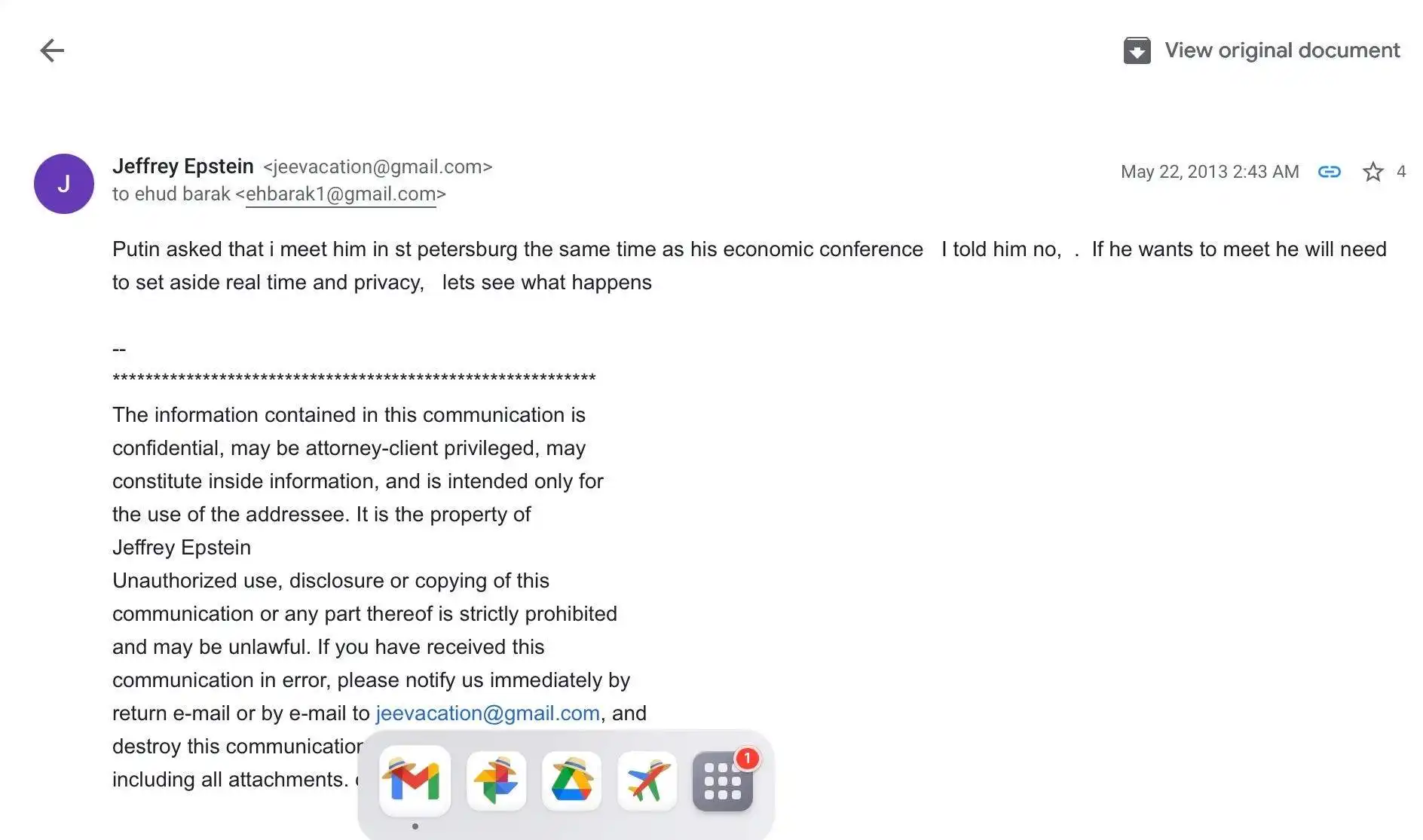
Caption: Clues to Epstein's relationship with the Kremlin

This was not baseless chatter. Epstein shared this information with former Israeli Prime Minister Ehud Barak, who was to meet Putin in person a few weeks later and could easily verify this claim through Kremlin channels.

In January 2014, Thorbjørn Jagland (then Secretary General of the Council of Europe) wrote to Epstein, stating he was planning to meet the Russian president in Sochi. Epstein told Jagland to 'explain to Putin that there should be a sophisticated Russian version of Bitcoin,' calling it 'the most advanced financial instrument globally.'

This is the prism through which to understand the rest of the crypto network built around Epstein, Vladimir Putin, Peter Thiel, and Steve Bannon.

Social Capital

Peter Thiel, co-founder of Palantir and a core member of the so-called 'PayPal Mafia' alongside Elon Musk, is an avid follower of cryptocurrency, valuing its ability to provide an alternative to government-controlled fiat currency. He once declared: 'Bitcoin is what PayPal should have been.'

He had long been a target of Epstein.

As early as 2012, Epstein received an email from fintech entrepreneur Ian Osborne suggesting they 'have a drink with Peter Thiel,' calling Thiel 'the best person to study currency,' and linking him to Abu Dhabi's sovereign wealth fund.

In 2013, Epstein urged former Israeli minister Ehud Barak to 'spend some real time with Peter Thiel.'

By July 2014, Thiel and Epstein were exchanging emails about Bitcoin regulation at the New York Stock Exchange. In September of the same year, Epstein hosted consecutive meetings with Thiel and William Burns, who was then Deputy Secretary of State in the Obama administration and is now the Director of the CIA (Central Intelligence Agency).

By 2015, Epstein proposed Thiel as one of the people Belyakov should meet. Following Epstein's advice, Belyakov contacted Thiel directly, and Thiel asked his executive assistant to schedule a face-to-face meeting for July 2015.

Epstein had multiple interests here. First was cryptocurrency. Emails from MIT (Massachusetts Institute of Technology) show that Joi Ito solicited and accepted donations from Epstein, which helped pay the salaries of Bitcoin Core developers after the Bitcoin Foundation collapsed. Another email thread shows Epstein was involved in the seed round financing of Bitcoin infrastructure development company Blockstream in 2014, increasing his allocation from $50,000 to $500,000 after Ito requested more shares in the oversubscribed deal.

But just as Thiel was interested in blockchain currency, surveillance, and data systems like Palantir, Epstein joined in, investing $40 million in Thiel's Valar Ventures. According to Ehud Barak, Thiel and Epstein 'co-owned' the firm and used it to take a share in the Israeli surveillance technology company Carbyne.

(A spokesperson for Peter Thiel later denied this, stating that Epstein was merely a 'limited partner (LP).')

As Epstein and Thiel aligned financially, their political inclinations also converged. Both were unusually important early supporters of Donald Trump's first presidential term. A brief exchange in the emails captures the tone of this relationship. Epstein wrote to Peter Thiel: 'I like your exaggeration about Trump, it's not a lie,' then suggested Thiel 'come see me in the Caribbean.'

Thiel broke with most of Silicon Valley, publicly supported Trump, and injected millions of dollars into pro-Trump super PACs. Epstein's communications show he closely followed Trump's polls against Hillary, campaign staff, and appointments related to Bitcoin and fintech.

In his speech at the 2016 Republican National Convention, Thiel used the platform of Trump's coronation to attack 'financial bubbles' and praise 'new forms of money,' later telling audiences that Bitcoin could be 'China's financial weapon' or a hedge against the dollar's reserve status.

As Russia's interference activities around the US election escalated through massive social media offensives and hacking of the Hillary campaign's emails, Epstein also arranged a luncheon at his New York townhouse, attended by Trump supporters Thiel, Tom Barrack, and Russia's Permanent Representative to the UN, Vitaly Churkin—a seasoned Kremlin operator.

After Churkin's sudden death in 2017, Epstein emailed Thiel: 'My Russian ambassador friend died. Life is short, eat dessert first.'

"Brexit is Just the Beginning"

Epstein was a frequent visitor to the UK, even beyond his connections to Ghislaine Maxwell and Andrew Mountbatten, and he closely watched British finance and politics.

In recently disclosed information and emails, he saw the UK's decision to leave the EU in the June 2016 vote as a political reshuffling and trading opportunity—something that could be shorted financially and leveraged politically. As he wrote to Peter Thiel about the chaos triggered by the referendum: 'Brexit is just the beginning.'

To achieve broader goals, beyond his maneuvers in Silicon Valley and Russia, Epstein invested significant time and intellectual capital in a major project led by former Trump campaign manager, White House Chief of Staff, Breitbart publisher, and Cambridge Analytica co-founder Steve Bannon, who had just lost his position as White House Chief of Staff and was looking for a new role.

He initially found opportunity in the pan-European populist 'Movement' (The Movement), founded in 2017 by allies like Nigel Farage's partner Laure Ferrari and People's Party leader Mischaël Modrikamen, initially led by Bannon's friend Nigel Farage himself.

Registered in Brussels, the organization's mission was to unite 'populist and conservative movements in Europe,' defending 'national sovereignty' and 'effective national borders.'

Behind the scenes, Jeffrey Epstein became a funder and strategist for Bannon's Movement, providing financial advice on how to circumvent financial regulations, offering transportation and accommodation, and introducing key figures in Europe.

During the turbulent Brexit transition, as Theresa May's government struggled to find a solution acceptable to the Brexit right wing, Bannon was flying to the UK to organize opposition.

In 2018, Bannon told Epstein he was meeting with Boris Johnson, Nigel Farage, and Jacob Rees-Mogg to organize them to overthrow Theresa May. Writer Michael Wolff wrote to Epstein, claiming to be an intermediary with leadership challenger Boris Johnson.

However, the UK was just one stop in Bannon's international populist plan. He soon texted Epstein about his broader European ambitions, claiming: 'My advisory role now covers Front National, Salvini's League, Germany's AfD, the Swiss People's Party, Orban, Land and Freedom Party, Farage—next May is the European Parliament election—we can increase from 92 seats to 200—block any crypto legislation or anything we want.'

By the time Theresa May was replaced by Boris Johnson in 2019, Bannon was ecstatic: 'May is gone... we really crushed them... we are on a roll.'

Even then, cryptocurrency never left the agenda, with Bannon agreeing: 'Crypto is currency, blockchain is equivalent to Internet 2.0.'

The Legacy of Crypto Politics

The UK left the EU in 2020. Epstein was arrested and subsequently died in prison. Farage's UKIP was replaced by his more domestically focused Reform UK. However, the lessons about fintech and its ability to reshape or disrupt democracy did not disappear.

When Farage's confidant, former UKIP MEP and Reform UK Wales leader Nathan Gill, was arrested in September 2021 on suspicion of accepting pro-Russian bribes, he was actually on his way to attend a Kremlin-backed forum on Russia's DEG electronic voting system.

He was scheduled to give a speech titled 'The Same Technology That Gives Us Crypto Will Also Change How We Vote,' explicitly linking blockchain to election infrastructure.

Subsequently, Farage's Reform UK became the first UK political party to solicit cryptocurrency donations through an overseas processor not fully regulated by the FCA (Financial Conduct Authority)—precisely the kind of opaque funding channel anti-corruption experts had warned about.

Meanwhile, Vice President J.D. Vance—whose Ohio Senate campaign was heavily funded by Thiel and who echoes Thiel's grievances against the 'Deep State' and globalism—is now at the core of Trump's plans as Vice President and the clearest advocate of national conservatism within the government.

Vance's rise implants Thiel's worldview into the executive branch: a politics that sees technology (from surveillance companies like Palantir to Bitcoin and other cryptocurrencies) as tools of national power and civilizational competition, rather than neutral infrastructure.

Against the backdrop of Epstein's 2013 Sputnik email to Moscow—urging Russia to 'reinvent the 21st-century financial system' by creating 'a new type of currency on a global scale'—the layers of the crypto-political project are exposed through Epstein's documents.

Although Epstein is no longer alive, the cryptocurrency infrastructure he helped save, Silicon Valley's ideological resistance to regulation, and the dark, unaccountable influence of crypto politics in democratic elections remain some of his most destructive legacies.

Updated on February 5, 2026, to include comments from Thiel's representative regarding Epstein's role in Valar Ventures.


Related Questions

QWhat was Jeffrey Epstein's proposal to Russian officials regarding the financial system in 2013?

AEpstein proposed that Russia should not just imitate Silicon Valley but instead achieve a 'leapfrog development' over global society by reinventing the 21st-century financial system through a new type of currency and securitization, suggesting that Russia had a unique advantage in creating a 'global new currency'.

QHow did Jeffrey Epstein influence the development of Bitcoin Core according to the disclosed emails?

AEpstein provided donations that helped pay the salaries of Bitcoin Core developers after the Bitcoin Foundation collapsed. He was also involved in the seed round financing of Blockstream in 2014, increasing his allocation from $50,000 to $500,000 upon request.

QWhat role did Peter Thiel play in the relationship between Epstein and Russian officials?

AEpstein recommended Peter Thiel as a key contact for Russian Deputy Minister Sergey Belyakov. Thiel subsequently arranged a face-to-face meeting with Belyakov in July 2015, facilitated by Epstein's influence and network.

QHow did Steve Bannon and Jeffrey Epstein collaborate in the context of European populist movements?

AEpstein became a funder and strategist for Bannon's 'The Movement,' a pan-European populist initiative. He provided financial advice on circumventing regulations, offered travel and accommodation support, and introduced key European figures to advance their political goals, including influencing elections and crypto legislation.

QWhat is the connection between Nigel Farage's Reform UK and cryptocurrency, as mentioned in the article?

AReform UK became the first UK political party to solicit cryptocurrency donations through an overseas processor not fully regulated by the UK's Financial Conduct Authority (FCA), creating an opaque channel for funds that raised concerns among anti-corruption experts.

Related Reads

$500 to Buy OpenAI Stock: Silicon Valley's Most Respectable Liquidity Invitation

Silicon Valley's largest venture capital platform, AngelList, has launched a new fund called USVC, allowing U.S. retail investors to buy into high-profile AI companies like OpenAI, Anthropic, and xAI with a minimum investment of $500—no accredited investor status required. Promoted by AngelList co-founder Naval Ravikant, the fund is framed as an opportunity for ordinary people to access high-growth private tech investments traditionally reserved for VCs. However, critics argue it functions more like an exit vehicle for early insiders. USVC acquires shares not through primary rounds but largely via secondary transactions—purchasing stakes from early investors, VC funds, and employees looking to cash out at peak valuations. With companies like xAI heavily weighted in the portfolio, the fund effectively channels retail money into providing liquidity for insiders who entered at much lower valuations. The fund’s structure raises concerns: shares are illiquid, with no secondary market, and buybacks are limited and discretionary. The actual annual fee reaches 3.61%, far above the advertised 1% management fee. This model parallels the "low float, high fully diluted valuation" strategy seen in crypto, where early investors profit by selling to latecomers at inflated prices. The timing—alongside similar moves by platforms like Robinhood—suggests that Silicon Valley’s sudden interest in retail inclusion may be less about democratizing access and more about securing exits for insiders.

marsbit22m ago

$500 to Buy OpenAI Stock: Silicon Valley's Most Respectable Liquidity Invitation

marsbit22m ago

Trading

Spot
Futures

Hot Articles

What is SONIC

Sonic: Pioneering the Future of Gaming in Web3 Introduction to Sonic In the ever-evolving landscape of Web3, the gaming industry stands out as one of the most dynamic and promising sectors. At the forefront of this revolution is Sonic, a project designed to amplify the gaming ecosystem on the Solana blockchain. Leveraging cutting-edge technology, Sonic aims to deliver an unparalleled gaming experience by efficiently processing millions of requests per second, ensuring that players enjoy seamless gameplay while maintaining low transaction costs. This article delves into the intricate details of Sonic, exploring its creators, funding sources, operational mechanics, and the timeline of significant events that have shaped its journey. What is Sonic? Sonic is an innovative layer-2 network that operates atop the Solana blockchain, specifically tailored to enhance the existing Solana gaming ecosystem. It accomplishes this through a customised, VM-agnostic game engine paired with a HyperGrid interpreter, facilitating sovereign game economies that roll up back to the Solana platform. The primary goals of Sonic include: Enhanced Gaming Experiences: Sonic is committed to offering lightning-fast on-chain gameplay, allowing players and developers to engage with games at previously unattainable speeds. Atomic Interoperability: This feature enables transactions to be executed within Sonic without the need to redeploy Solana programmes and accounts. This makes the process more efficient and directly benefits from Solana Layer1 services and liquidity. Seamless Deployment: Sonic allows developers to write for Ethereum Virtual Machine (EVM) based systems and execute them on Solana’s SVM infrastructure. This interoperability is crucial for attracting a broader range of dApps and decentralised applications to the platform. Support for Developers: By offering native composable gaming primitives and extensible data types - dining within the Entity-Component-System (ECS) framework - game creators can craft intricate business logic with ease. Overall, Sonic's unique approach not only caters to players but also provides an accessible and low-cost environment for developers to innovate and thrive. Creator of Sonic The information regarding the creator of Sonic is somewhat ambiguous. However, it is known that Sonic's SVM is owned by the company Mirror World. The absence of detailed information about the individuals behind Sonic reflects a common trend in several Web3 projects, where collective efforts and partnerships often overshadow individual contributions. Investors of Sonic Sonic has garnered considerable attention and support from various investors within the crypto and gaming sectors. Notably, the project raised an impressive $12 million during its Series A funding round. The round was led by BITKRAFT Ventures, with other notable investors including Galaxy, Okx Ventures, Interactive, Big Brain Holdings, and Mirana. This financial backing signifies the confidence that investment foundations have in Sonic’s potential to revolutionise the Web3 gaming landscape, further validating its innovative approaches and technologies. How Does Sonic Work? Sonic utilises the HyperGrid framework, a sophisticated parallel processing mechanism that enhances its scalability and customisability. Here are the core features that set Sonic apart: Lightning Speed at Low Costs: Sonic offers one of the fastest on-chain gaming experiences compared to other Layer-1 solutions, powered by the scalability of Solana’s virtual machine (SVM). Atomic Interoperability: Sonic enables transaction execution without redeployment of Solana programmes and accounts, effectively streamlining the interaction between users and the blockchain. EVM Compatibility: Developers can effortlessly migrate decentralised applications from EVM chains to the Solana environment using Sonic’s HyperGrid interpreter, increasing the accessibility and integration of various dApps. Ecosystem Support for Developers: By exposing native composable gaming primitives, Sonic facilitates a sandbox-like environment where developers can experiment and implement business logic, greatly enhancing the overall development experience. Monetisation Infrastructure: Sonic natively supports growth and monetisation efforts, providing frameworks for traffic generation, payments, and settlements, thereby ensuring that gaming projects are not only viable but also sustainable financially. Timeline of Sonic The evolution of Sonic has been marked by several key milestones. Below is a brief timeline highlighting critical events in the project's history: 2022: The Sonic cryptocurrency was officially launched, marking the beginning of its journey in the Web3 gaming arena. 2024: June: Sonic SVM successfully raised $12 million in a Series A funding round. This investment allowed Sonic to further develop its platform and expand its offerings. August: The launch of the Sonic Odyssey testnet provided users with the first opportunity to engage with the platform, offering interactive activities such as collecting rings—a nod to gaming nostalgia. October: SonicX, an innovative crypto game integrated with Solana, made its debut on TikTok, capturing the attention of over 120,000 users within a short span. This integration illustrated Sonic’s commitment to reaching a broader, global audience and showcased the potential of blockchain gaming. Key Points Sonic SVM is a revolutionary layer-2 network on Solana explicitly designed to enhance the GameFi landscape, demonstrating great potential for future development. HyperGrid Framework empowers Sonic by introducing horizontal scaling capabilities, ensuring that the network can handle the demands of Web3 gaming. Integration with Social Platforms: The successful launch of SonicX on TikTok displays Sonic’s strategy to leverage social media platforms to engage users, exponentially increasing the exposure and reach of its projects. Investment Confidence: The substantial funding from BITKRAFT Ventures, among others, emphasizes the robust backing Sonic has, paving the way for its ambitious future. In conclusion, Sonic encapsulates the essence of Web3 gaming innovation, striking a balance between cutting-edge technology, developer-centric tools, and community engagement. As the project continues to evolve, it is poised to redefine the gaming landscape, making it a notable entity for gamers and developers alike. As Sonic moves forward, it will undoubtedly attract greater interest and participation, solidifying its place within the broader narrative of blockchain gaming.

1.1k Total ViewsPublished 2024.04.04Updated 2024.12.03

What is SONIC

What is $S$

Understanding SPERO: A Comprehensive Overview Introduction to SPERO As the landscape of innovation continues to evolve, the emergence of web3 technologies and cryptocurrency projects plays a pivotal role in shaping the digital future. One project that has garnered attention in this dynamic field is SPERO, denoted as SPERO,$$s$. This article aims to gather and present detailed information about SPERO, to help enthusiasts and investors understand its foundations, objectives, and innovations within the web3 and crypto domains. What is SPERO,$$s$? SPERO,$$s$ is a unique project within the crypto space that seeks to leverage the principles of decentralisation and blockchain technology to create an ecosystem that promotes engagement, utility, and financial inclusion. The project is tailored to facilitate peer-to-peer interactions in new ways, providing users with innovative financial solutions and services. At its core, SPERO,$$s$ aims to empower individuals by providing tools and platforms that enhance user experience in the cryptocurrency space. This includes enabling more flexible transaction methods, fostering community-driven initiatives, and creating pathways for financial opportunities through decentralised applications (dApps). The underlying vision of SPERO,$$s$ revolves around inclusiveness, aiming to bridge gaps within traditional finance while harnessing the benefits of blockchain technology. Who is the Creator of SPERO,$$s$? The identity of the creator of SPERO,$$s$ remains somewhat obscure, as there are limited publicly available resources providing detailed background information on its founder(s). This lack of transparency can stem from the project's commitment to decentralisation—an ethos that many web3 projects share, prioritising collective contributions over individual recognition. By centring discussions around the community and its collective goals, SPERO,$$s$ embodies the essence of empowerment without singling out specific individuals. As such, understanding the ethos and mission of SPERO remains more important than identifying a singular creator. Who are the Investors of SPERO,$$s$? SPERO,$$s$ is supported by a diverse array of investors ranging from venture capitalists to angel investors dedicated to fostering innovation in the crypto sector. The focus of these investors generally aligns with SPERO's mission—prioritising projects that promise societal technological advancement, financial inclusivity, and decentralised governance. These investor foundations are typically interested in projects that not only offer innovative products but also contribute positively to the blockchain community and its ecosystems. The backing from these investors reinforces SPERO,$$s$ as a noteworthy contender in the rapidly evolving domain of crypto projects. How Does SPERO,$$s$ Work? SPERO,$$s$ employs a multi-faceted framework that distinguishes it from conventional cryptocurrency projects. Here are some of the key features that underline its uniqueness and innovation: Decentralised Governance: SPERO,$$s$ integrates decentralised governance models, empowering users to participate actively in decision-making processes regarding the project’s future. This approach fosters a sense of ownership and accountability among community members. Token Utility: SPERO,$$s$ utilises its own cryptocurrency token, designed to serve various functions within the ecosystem. These tokens enable transactions, rewards, and the facilitation of services offered on the platform, enhancing overall engagement and utility. Layered Architecture: The technical architecture of SPERO,$$s$ supports modularity and scalability, allowing for seamless integration of additional features and applications as the project evolves. This adaptability is paramount for sustaining relevance in the ever-changing crypto landscape. Community Engagement: The project emphasises community-driven initiatives, employing mechanisms that incentivise collaboration and feedback. By nurturing a strong community, SPERO,$$s$ can better address user needs and adapt to market trends. Focus on Inclusion: By offering low transaction fees and user-friendly interfaces, SPERO,$$s$ aims to attract a diverse user base, including individuals who may not previously have engaged in the crypto space. This commitment to inclusion aligns with its overarching mission of empowerment through accessibility. Timeline of SPERO,$$s$ Understanding a project's history provides crucial insights into its development trajectory and milestones. Below is a suggested timeline mapping significant events in the evolution of SPERO,$$s$: Conceptualisation and Ideation Phase: The initial ideas forming the basis of SPERO,$$s$ were conceived, aligning closely with the principles of decentralisation and community focus within the blockchain industry. Launch of Project Whitepaper: Following the conceptual phase, a comprehensive whitepaper detailing the vision, goals, and technological infrastructure of SPERO,$$s$ was released to garner community interest and feedback. Community Building and Early Engagements: Active outreach efforts were made to build a community of early adopters and potential investors, facilitating discussions around the project’s goals and garnering support. Token Generation Event: SPERO,$$s$ conducted a token generation event (TGE) to distribute its native tokens to early supporters and establish initial liquidity within the ecosystem. Launch of Initial dApp: The first decentralised application (dApp) associated with SPERO,$$s$ went live, allowing users to engage with the platform's core functionalities. Ongoing Development and Partnerships: Continuous updates and enhancements to the project's offerings, including strategic partnerships with other players in the blockchain space, have shaped SPERO,$$s$ into a competitive and evolving player in the crypto market. Conclusion SPERO,$$s$ stands as a testament to the potential of web3 and cryptocurrency to revolutionise financial systems and empower individuals. With a commitment to decentralised governance, community engagement, and innovatively designed functionalities, it paves the way toward a more inclusive financial landscape. As with any investment in the rapidly evolving crypto space, potential investors and users are encouraged to research thoroughly and engage thoughtfully with the ongoing developments within SPERO,$$s$. The project showcases the innovative spirit of the crypto industry, inviting further exploration into its myriad possibilities. While the journey of SPERO,$$s$ is still unfolding, its foundational principles may indeed influence the future of how we interact with technology, finance, and each other in interconnected digital ecosystems.

54 Total ViewsPublished 2024.12.17Updated 2024.12.17

What is $S$

What is AGENT S

Agent S: The Future of Autonomous Interaction in Web3 Introduction In the ever-evolving landscape of Web3 and cryptocurrency, innovations are constantly redefining how individuals interact with digital platforms. One such pioneering project, Agent S, promises to revolutionise human-computer interaction through its open agentic framework. By paving the way for autonomous interactions, Agent S aims to simplify complex tasks, offering transformative applications in artificial intelligence (AI). This detailed exploration will delve into the project's intricacies, its unique features, and the implications for the cryptocurrency domain. What is Agent S? Agent S stands as a groundbreaking open agentic framework, specifically designed to tackle three fundamental challenges in the automation of computer tasks: Acquiring Domain-Specific Knowledge: The framework intelligently learns from various external knowledge sources and internal experiences. This dual approach empowers it to build a rich repository of domain-specific knowledge, enhancing its performance in task execution. Planning Over Long Task Horizons: Agent S employs experience-augmented hierarchical planning, a strategic approach that facilitates efficient breakdown and execution of intricate tasks. This feature significantly enhances its ability to manage multiple subtasks efficiently and effectively. Handling Dynamic, Non-Uniform Interfaces: The project introduces the Agent-Computer Interface (ACI), an innovative solution that enhances the interaction between agents and users. Utilizing Multimodal Large Language Models (MLLMs), Agent S can navigate and manipulate diverse graphical user interfaces seamlessly. Through these pioneering features, Agent S provides a robust framework that addresses the complexities involved in automating human interaction with machines, setting the stage for myriad applications in AI and beyond. Who is the Creator of Agent S? While the concept of Agent S is fundamentally innovative, specific information about its creator remains elusive. The creator is currently unknown, which highlights either the nascent stage of the project or the strategic choice to keep founding members under wraps. Regardless of anonymity, the focus remains on the framework's capabilities and potential. Who are the Investors of Agent S? As Agent S is relatively new in the cryptographic ecosystem, detailed information regarding its investors and financial backers is not explicitly documented. The lack of publicly available insights into the investment foundations or organisations supporting the project raises questions about its funding structure and development roadmap. Understanding the backing is crucial for gauging the project's sustainability and potential market impact. How Does Agent S Work? At the core of Agent S lies cutting-edge technology that enables it to function effectively in diverse settings. Its operational model is built around several key features: Human-like Computer Interaction: The framework offers advanced AI planning, striving to make interactions with computers more intuitive. By mimicking human behaviour in tasks execution, it promises to elevate user experiences. Narrative Memory: Employed to leverage high-level experiences, Agent S utilises narrative memory to keep track of task histories, thereby enhancing its decision-making processes. Episodic Memory: This feature provides users with step-by-step guidance, allowing the framework to offer contextual support as tasks unfold. Support for OpenACI: With the ability to run locally, Agent S allows users to maintain control over their interactions and workflows, aligning with the decentralised ethos of Web3. Easy Integration with External APIs: Its versatility and compatibility with various AI platforms ensure that Agent S can fit seamlessly into existing technological ecosystems, making it an appealing choice for developers and organisations. These functionalities collectively contribute to Agent S's unique position within the crypto space, as it automates complex, multi-step tasks with minimal human intervention. As the project evolves, its potential applications in Web3 could redefine how digital interactions unfold. Timeline of Agent S The development and milestones of Agent S can be encapsulated in a timeline that highlights its significant events: September 27, 2024: The concept of Agent S was launched in a comprehensive research paper titled “An Open Agentic Framework that Uses Computers Like a Human,” showcasing the groundwork for the project. October 10, 2024: The research paper was made publicly available on arXiv, offering an in-depth exploration of the framework and its performance evaluation based on the OSWorld benchmark. October 12, 2024: A video presentation was released, providing a visual insight into the capabilities and features of Agent S, further engaging potential users and investors. These markers in the timeline not only illustrate the progress of Agent S but also indicate its commitment to transparency and community engagement. Key Points About Agent S As the Agent S framework continues to evolve, several key attributes stand out, underscoring its innovative nature and potential: Innovative Framework: Designed to provide an intuitive use of computers akin to human interaction, Agent S brings a novel approach to task automation. Autonomous Interaction: The ability to interact autonomously with computers through GUI signifies a leap towards more intelligent and efficient computing solutions. Complex Task Automation: With its robust methodology, it can automate complex, multi-step tasks, making processes faster and less error-prone. Continuous Improvement: The learning mechanisms enable Agent S to improve from past experiences, continually enhancing its performance and efficacy. Versatility: Its adaptability across different operating environments like OSWorld and WindowsAgentArena ensures that it can serve a broad range of applications. As Agent S positions itself in the Web3 and crypto landscape, its potential to enhance interaction capabilities and automate processes signifies a significant advancement in AI technologies. Through its innovative framework, Agent S exemplifies the future of digital interactions, promising a more seamless and efficient experience for users across various industries. Conclusion Agent S represents a bold leap forward in the marriage of AI and Web3, with the capacity to redefine how we interact with technology. While still in its early stages, the possibilities for its application are vast and compelling. Through its comprehensive framework addressing critical challenges, Agent S aims to bring autonomous interactions to the forefront of the digital experience. As we move deeper into the realms of cryptocurrency and decentralisation, projects like Agent S will undoubtedly play a crucial role in shaping the future of technology and human-computer collaboration.

549 Total ViewsPublished 2025.01.14Updated 2025.01.14

What is AGENT S

Discussions

Welcome to the HTX Community. Here, you can stay informed about the latest platform developments and gain access to professional market insights. Users' opinions on the price of S (S) are presented below.

活动图片












