Contract Audit Passed, Thermometer Did Not: Polymarket's 'Physical Vulnerability' Moment

marsbitPublished on 2026-04-23Last updated on 2026-04-23

Abstract

According to reports, an individual manipulated temperature sensors at Paris Charles de Gaulle Airport (LFPG) on April 6th and 15th, causing brief, anomalous spikes of over 3°C. These events were allegedly orchestrated to profit from corresponding low-probability bets on the prediction market Polymarket, turning a small investment into approximately $34,000. The French national meteorological service, Météo-France, filed a criminal lawsuit after discovering signs of physical tampering. The attack required minimal technical skill; the perpetrator reportedly used a battery-powered hairdryer to briefly heat the publicly accessible sensor. Polymarket’s market for Paris temperature settles based on the day's highest recorded temperature from a data chain that runs from the physical sensor to Météo-France, to Weather Underground, and finally to its smart contract. In response, Polymarket did not void the profits or make an official statement. It silently changed the data source for its Paris market from LFPG to Le Bourget Airport (LFPB), a location with similarly unprotected sensors. This incident highlights a critical vulnerability: while the smart contracts are audited and secure, the physical data sources feeding them remain exposed and easy to manipulate.

Original Author: Sanqing, Foresight News

According to French media Le Monde, on April 6th and 15th, the meteorological sensors at Paris Charles de Gaulle Airport experienced two anomalies. The temperature surged by more than 3°C within minutes before quickly returning to normal, as if nothing had happened. Behind each anomaly, someone had placed bets on the corresponding low-probability temperature range on Polymarket in advance. From a principal of just tens of dollars, they collectively walked away with approximately $34,000 from these two incidents. The account that placed the first bet was created just two days before the anomaly occurred.
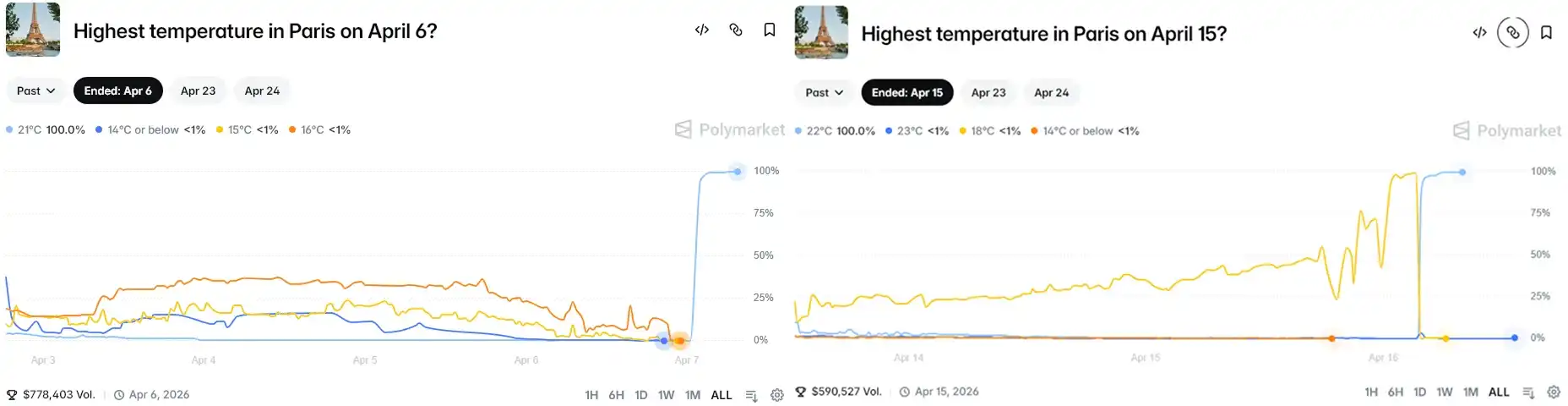
Météo-France subsequently conducted a physical inspection of the sensors and found signs of human intervention. They filed a criminal complaint with the Charles de Gaulle Airport Gendarmerie, with the charge being "interfering with an automated data processing system." According to an analysis in an AR15 forum post, based on Article 323-2 of the French Penal Code, and because Météo-France is a public institution, the related charges could carry a maximum penalty of 7 years imprisonment and a fine of 300,000 euros.

The Technical Sophistication of This Scam Is Approximately Zero

The settlement chain for Polymarket's Paris temperature market is as follows: Physical Sensor → Météo-France → Weather Underground → Polymarket Contract.

On this chain, the smart contract part is audited, data transmission is automated, and Weather Underground's data scraping is real-time. The only weak point is at the very beginning: a thermometer standing by the airport roadside, without fencing, without cameras, accessible to anyone who walks by.

All the attacker needed was a battery-powered heat gun/hairdryer.

Polymarket bases its settlement on the day's maximum temperature. This means that creating one brief temperature peak is enough to rewrite the official record for the day.

Acting in the evening or at night is more ideal, as the daytime high has usually already passed, making subsequent readings more likely to become the new record. Therefore, the suspect chose 7 PM on April 6th and 9:30 PM on April 15th.

The operational procedure was likely: buy the low-probability option in advance, walk to the sensor at night, turn on the heat gun, wait for the reading to cross the target temperature, stop, leave, and wait for on-chain settlement.

The entire operation required no technical skill whatsoever, just some understanding of the settlement mechanism and a willingness to walk to the edge of the airport.

Polymarket's Response: Quietly Swapped the Thermometer

Polymarket has not issued any official statement regarding this incident. The only thing it did was change the settlement data source for the Paris temperature market from Charles de Gaulle Airport (LFPG) to Le Bourget Airport (LFPB).
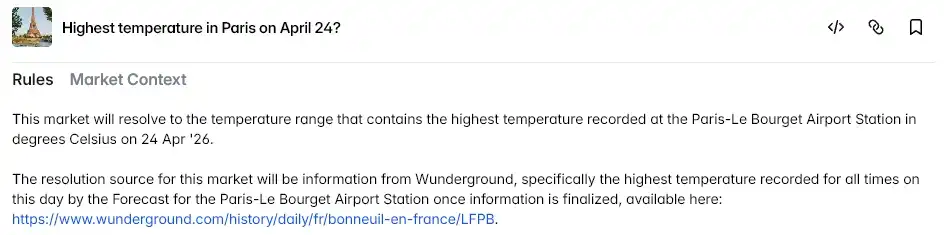
The profits from the two accounts were not revoked; the market settled normally according to the on-chain records.

The sensor at Le Bourget Airport is also placed outdoors, similarly without physical protection. They changed the address, but the problem remains entirely unchanged.

This is not Polymarket's first controversy. In October 2024, a French trader was accused of manipulating Trump election odds using 4 linked accounts, reportedly profiting $85 million; in March 2025, a whale used 5 million tokens to forcibly push through a UMA governance vote, settling a controversial market with a "Yes" outcome, involving $7 million; in January and March 2026, anomalous bets appeared in markets related to Venezuela and Iran respectively, with the latter already drawing attention from the US Congress...

Previous incidents at least required millions of dollars in capital or governance tokens; this time the cost was just a heat gun.

The Contract Was Audited, The Thermometer Was Not

This story has an absurd sense of humor. A prediction market running on the blockchain, touting decentralization and immutability, was thoroughly exploited twice by a battery-powered heat gun. Cryptography was of no help in this matter because it never verifies whether the input data is real.

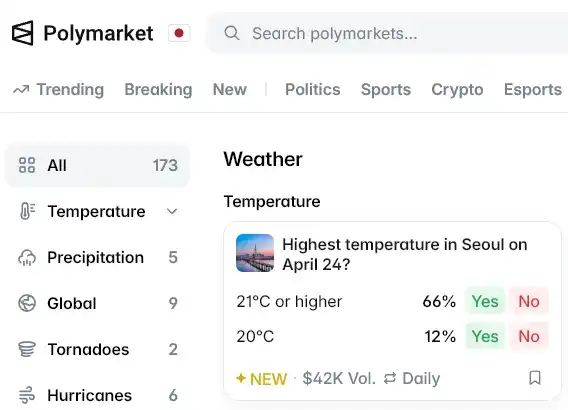
Polymarket currently has 173 active weather markets. The settlement basis for most of these markets is a single physical sensor in some location.
When a sensor is used as a meteorological tool, its credibility comes from the fact that no one has a motive to tamper with it. Polymarket gave it a new incentive structure but provided no new physical protection.

The Météo-France thermometer dutifully recorded the temperature it sensed. It just didn't know it had become a financial settlement terminal.


Related Questions

QWhat was the key vulnerability exploited in the Polymarket Paris temperature market incident?

AThe physical vulnerability of the meteorological sensor at Charles de Gaulle Airport, which was unprotected and could be easily manipulated with a simple tool like a battery-powered hairdryer.

QHow did the attackers profit from manipulating the temperature sensor?

AThey placed bets on low-probability temperature ranges on Polymarket just before artificially spiking the temperature, turning a small investment of tens of dollars into approximately $34,000 in profits across two incidents.

QWhat was Polymarket's response to the temperature manipulation incidents?

APolymarket did not issue an official statement or reverse the profits. They silently changed the data source for the Paris temperature market from Charles de Gaulle Airport (LFPG) to Le Bourget Airport (LFPB), which had the same physical vulnerability.

QWhat legal consequences might the perpetrators face according to the article?

AUnder French law, specifically Article 323-2, and because Météo-France is a public institution, the charges for interfering with an automated data processing system could result in up to 7 years in prison and a €300,000 fine.

QWhat does the incident reveal about the limitations of blockchain-based prediction markets like Polymarket?

AIt highlights that while smart contracts are audited and the blockchain is secure, the system remains vulnerable if the real-world data inputs (oracles) are not physically secure and can be easily manipulated, undermining the integrity of the market.

Related Reads

SemiAnalysis on the Epic Plunge: It's Not Over Yet

SemiAnalysis Weekly discusses the recent sharp correction in the semiconductor market after a historic first half. Analysts Doug O'Loughlin and Dylan note that despite healthy fundamentals, markets like South Korea's KOSPI have plunged 40%, wiping out leveraged retail investors. A core debate focuses on AI demand versus supply constraints. Dylan cites SemiAnalysis's internal use of AI coding agents, leading to a 100x increase in AI spending, as evidence of powerful demand. Doug agrees demand is strong but questions its exact magnitude, calling it a "trillion-dollar question." His primary concern is physical and financial bottlenecks: a shortage of 100,000 electricians in the US, massive $450B in corporate debt issuance by hyperscalers (funded by a shrinking pension pool), and labor/scale limits in regions like Taiwan, where TSMC constitutes 20% of GDP. The conversation covers market dynamics, including the typical semiconductor cycle where over-ordering leads to crashes, China's growing memory capacity, and the potential for older chips like the H100 to lose value as models scale. Politically, AI is seen as a likely scapegoat in upcoming elections, though not a top-tier voter priority. The analysts conclude that while the long-term potential is significant, the scaling path is narrowing. The challenge is matching exponential compute demands with real-world constraints on capital, labor, and permits, risking scenarios where massive investment outpaces near-term revenue generation.

marsbit4m ago

SemiAnalysis on the Epic Plunge: It's Not Over Yet

marsbit4m ago

After Robinhood's Aggressive Entry, Why is PUMP Defying the Trend and Rising?

Amid a prolonged crypto bear market that has strained many projects, Pump.fun stands out by maintaining strong profitability. Despite a major token unlock in mid-July that was expected to cause selling pressure, its native token PUMP has risen nearly 48% over the past month. Analysis shows only a small portion of unlocked tokens were sold, with 92% of investor allocations still held. A buyback-and-burn mechanism has also supported the price, though daily回购 funds have declined by 77.5% from their peak, partly due to a change in tokenomics and lower platform revenue. Pump.fun remains a top revenue generator in crypto, with annualized revenue of around $450 million, ranking just behind giants like Tether and Circle. However, its daily revenue is down about 69% from its all-time high, reflecting dependence on meme coin market cycles. The platform also faces a class-action lawsuit alleging market manipulation and securities violations. New competition has emerged with Robinhood Chain's launchpad, which recently saw higher weekly volume and active addresses than Pump.fun. While Pump.fun's metrics haven't declined yet, it has responded with a new token launch mechanism called BOOST to improve liquidity. This has increased platform activity but raised community concerns about potential exploitation for short-term pumps. Ultimately, Pump.fun's success remains tightly linked to meme coin speculation and broader market sentiment.

marsbit4m ago

After Robinhood's Aggressive Entry, Why is PUMP Defying the Trend and Rising?

marsbit4m ago

China Business Journal Unveils Cryptocurrency Extortion Scheme

China Business Journal, a state-run Chinese newspaper, has issued a warning about scammers using its name to extort cryptocurrency from companies. According to the publication, fraudsters are sending emails impersonating its journalists. These emails threaten to publish damaging information about a company unless a Bitcoin payment is made. The scammers, using Proton Mail addresses, claim to possess compromising material from a secretive investigation. The newspaper's representatives have clarified that it has no involvement with these messages. They emphasized that the publication does not engage in such practices, never demands payment to suppress stories, and does not negotiate in this manner. The editorial team believes the criminals are exploiting the newspaper's authoritative reputation to pressure companies into making hasty decisions under threat of reputational harm. China Business Journal stated it is collecting evidence of this brand misuse, analyzing the fraudulent emails, and preparing materials for law enforcement. It reserves the right to pursue both civil and criminal liability against the scheme's organizers. Companies are urged to carefully verify any communication purportedly from the newspaper, avoid transferring cryptocurrency to unknown recipients, and report such incidents to the authorities. The newspaper confirmed it will continue its own investigation into the matter.

cryptonews.ru40m ago

China Business Journal Unveils Cryptocurrency Extortion Scheme

cryptonews.ru40m ago

Trading

Spot
活动图片