"Form Over Substance" Fed Hearing: Warsh Avoids Interest Rates, But Offers Reassurance for Crypto

Odaily星球日报Published on 2026-04-22Last updated on 2026-04-22

Abstract

Kevin Wash, nominee for Federal Reserve Chair, testified before the Senate Banking Committee, emphasizing his independence from former President Trump and stating that Trump never asked him to commit to specific interest rate decisions. Wash avoided extensive discussion on monetary policy but called for institutional reforms at the Fed, advocating for a gradual and cautious reduction of the balance sheet without clear signals on rate cuts. The hearing was seen as largely symbolic, with Wash’s confirmation hinging on political negotiations offstage, particularly whether Trump drops his investigation into current Chair Powell. Notably, Wash expressed a crypto-friendly stance, acknowledging digital assets as part of the U.S. financial services industry and committing to divest his own crypto holdings if confirmed. This marks a positive signal for the crypto market from a potential Fed leader.

Original | Odaily Planet Daily (@OdailyChina)

Author | Golem (@web3_golem)
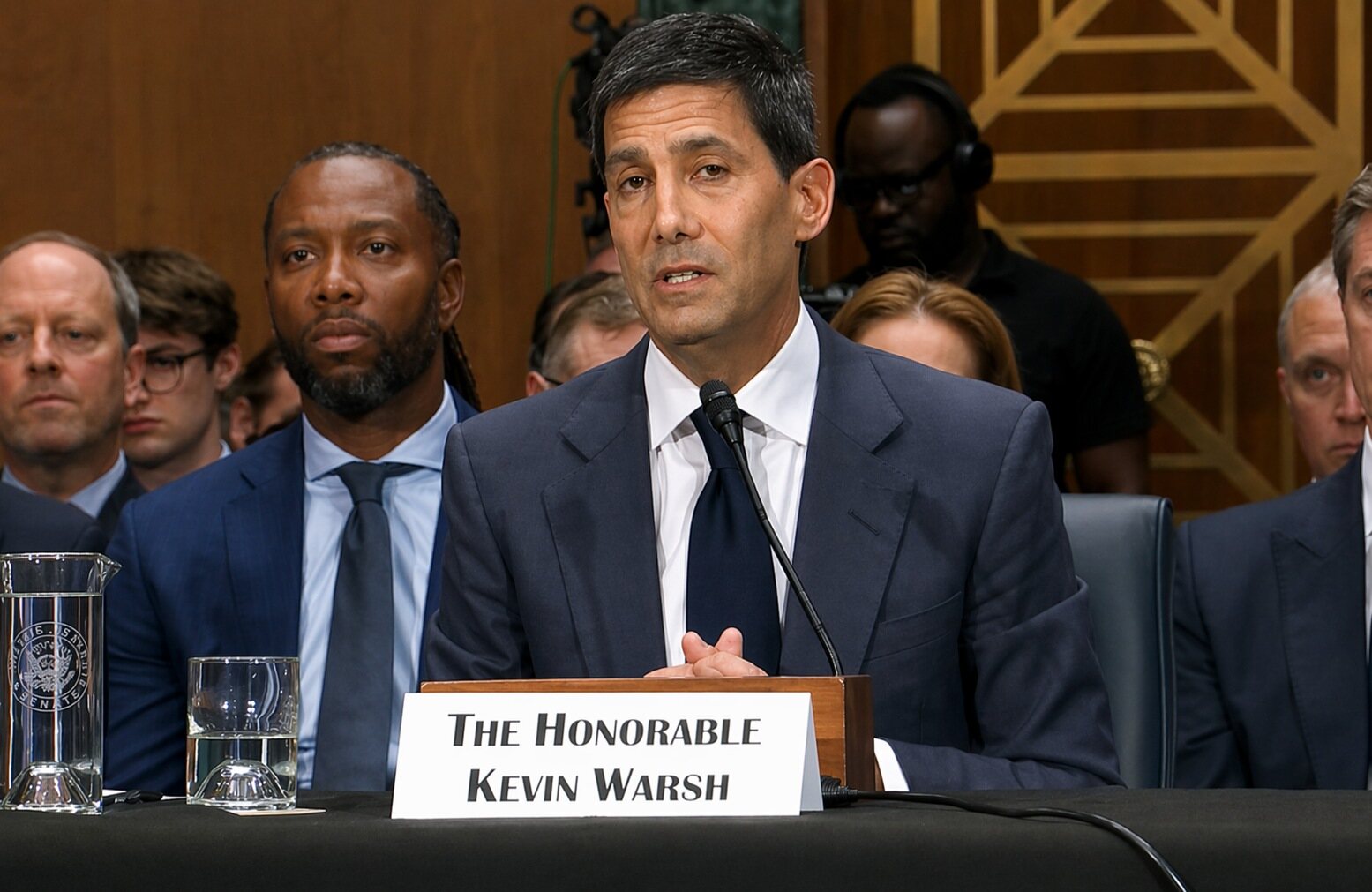
At 10 PM Beijing time on April 21, Federal Reserve Chair nominee Kevin Warsh attended a confirmation hearing before the Senate Banking Committee, where he faced questioning on his commitment to monetary policy and the Fed's independence, according to The Wall Street Journal.

During the hearing, when addressing the issue of the Fed's independence, Warsh stated that he would be independent of Trump, and that Trump had never asked him to commit to any specific interest rate decisions. He further argued that even if Trump had asked, he would never have agreed. Beyond such statements, Warsh largely avoided answering questions related to Trump. On monetary policy, Warsh heavily criticized the Federal Reserve's institutions, arguing that the Fed needs institutional changes in its decision-making processes. However, he made very few specific statements on monetary policy itself, mentioning only that the Fed needs to gradually and cautiously reduce its balance sheet, with no clear statements indicating interest rate cuts.

This might have been intentional on Warsh's part. According to his opening statement obtained in advance by Bloomberg, although Warsh's prepared testimony was nearly 2000 words long—far exceeding the approximately 850 to 900 words of Powell's and former Chair Yellen's initial hearings—it contained very little substantive discussion on the direction of monetary policy. This move by Warsh is consistent with his long-held stance that Fed officials should not pre-commit to interest rate positions.

But for investors following this hearing, regardless of their expectations, the outcome was likely disappointing. In terms of both content and results, the substantive significance of this hearing was minimal. Bloomberg columnist John Authers even characterized it as a political performance of "form over substance" before the hearing began. Ultimately, whether Warsh's nomination is successfully confirmed by the Senate depends on off-stage political maneuvering, not on anything Warsh says at the podium.

The Stubborn Trump and the Innocent Warsh

As previously analyzed by Odaily Planet Daily, the importance of this hearing lay in its potential to decide whether Powell would stay or go after his term ends on May 15. If Warsh's nomination was not confirmed by the Senate this time, Powell would very likely remain as interim Fed Chair after his term expires. (Related reading:Powell's Chance of Staying Soars to 98%, Is Trump's "Firing Order" Just Bluster?)

However, after this hearing, the market still cannot determine whether Warsh's nomination for Fed Chair will be confirmed by the Senate as scheduled, because the main figure obstructing Warsh's nomination, Thom Tillis, didn't even engage in effective dialogue with Warsh.

Thom Tillis had previously stated publicly that he would not support moving Warsh's nomination process to a full Senate vote unless Trump dropped his investigation into Powell. During the April 21 hearing, Thom Tillis did not even question Warsh. Instead, he used a set of slides to justify the cost overruns in the Fed building renovation project. Finally, he stated that his dissatisfaction was not directed at Warsh, whom he called "exceptionally qualified, impeccable," but that he needed this investigation to end before he could support Warsh's confirmation.

Therefore, the content of the hearing could no longer decide the outcome. Whether Trump can finally get rid of Powell on schedule now hinges on whether the Senate confirms Warsh's nomination in time, and whether Warsh's nomination proceeds smoothly again depends on whether Trump is willing to drop the investigation into Powell.

On April 21, Trump also discussed the Fed and interest rates in a new interview. He said he would be disappointed if the new Fed Chair (Warsh) did not cut rates quickly, but he also must get to the bottom of the Fed building cost overruns. Pressuring the new Fed Chair Warsh to cut rates and investigating Powell are parallel actions; Trump shows no sign of backing down.

As John Authers said, the real game is happening outside the hearing room, and Warsh is even "collateral damage." The impasse will be broken either if Thom Tillis concedes, or if Warsh uses the prospect of rate cuts as leverage to persuade Trump to drop the investigation into Powell, allowing Warsh to take charge of the Fed sooner. Warsh's relationship with Trump is not ordinary. Warsh's father-in-law, Ronald Steven Lauder, is the sole heir to the international cosmetics giant Estée Lauder Companies, and he is also a Republican donor and Trump's college classmate. Therefore, if Warsh truly wants to take charge of the Fed soon, he might be able to persuade Trump to drop the investigation.

Otherwise, if this stalemate continues until Powell's term expires and Trump chooses to fire Powell to resolve it, as Odaily Planet Daily previously analyzed, the result would probably be in Powell's favor. It is worth mentioning that, according to monitoring by the Odaily Seer channel, the probability of Powell stepping down as Fed Chair after his term expires on Polymarket remains at 2%. However, upon closer inspection of the settlement rules for this event contract, if Powell's resignation/removal is announced before the market end date, the market will immediately settle to "Yes" regardless of when the announced resignation/removal takes effect.
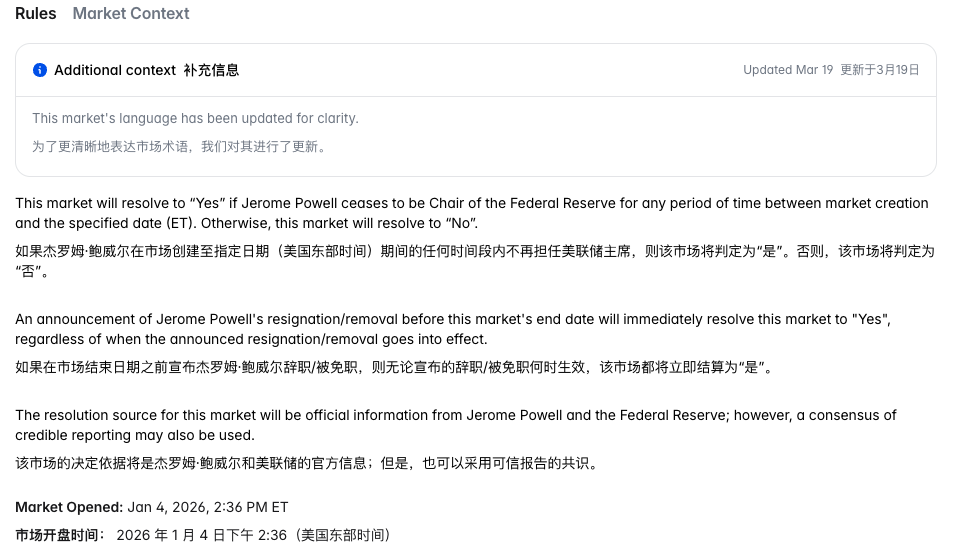
Settlement rules for the market on whether Powell will step down as Fed Chair after his term expires

This means that as soon as Trump announces the firing of Powell, the event would be settled. Although Powell could file a lawsuit to challenge the legal effect of the President's removal during the litigation process, litigation is a lengthy process. Therefore, the rule stating "the market is immediately settled to Yes regardless of when the announced resignation/removal takes effect" becomes a potential loophole. (Odaily Note: The above is only the author's personal judgment and does not constitute any advice)

Warsh: Digital Assets Are Part of the US Financial Services Industry

But for the crypto industry, there was some substance in this hearing. It was previously disclosed that Warsh holds a series of assets including cryptocurrency, Polymarket, and SpaceX stock, which was seen as a sign of his friendly attitude towards the crypto industry.

During the hearing, when questioned about his financial disclosures exceeding $100 million and potential conflicts of interest, Warsh promised to divest related assets before taking office if his nomination is approved. But he further stated that digital assets are part of the US financial services industry, affirming the legitimacy and importance of the crypto industry in the United States. Although it was only briefly mentioned, having someone poised to take one of the most powerful positions in the global economy indicate that they are crypto-friendly is definitely good news.


Related Questions

QWhat was the main focus of Kevin Warsh's Senate confirmation hearing for Fed Chair nominee?

AThe hearing focused on his commitment to monetary policy, Fed independence, and his relationship with Trump, but provided little substantive discussion on specific interest rate policies.

QHow did Kevin Warsh address his holdings in cryptocurrencies during the hearing?

AWarsh pledged to divest his crypto assets if confirmed, but also stated that digital assets are part of the U.S. financial services industry, affirming their legitimacy and importance.

QWhat political obstacle threatens Kevin Warsh's confirmation as Fed Chair?

ASenator Thom Tillis opposes Warsh's confirmation unless Trump drops his investigation into current Fed Chair Jerome Powell, creating a political stalemate.

QWhat did Bloomberg columnist John Authers characterize Kevin Warsh's hearing as?

AJohn Authers characterized the hearing as a political performance 'more form than substance,' with the outcome depending on off-stage political bargaining rather than Warsh's statements.

QAccording to the article, what is the significance of Warsh expressing crypto-friendly views?

AIt is positive news for the crypto industry as the potential head of the world's most powerful economic institution acknowledged its legitimacy and role within U.S. financial services.

Related Reads

SpaceX, OpenAI, Anthropic: The Three AI Giants Racing for IPO, Which One Is Worth Betting On?

SpaceX, OpenAI, and Anthropic are poised for historic IPOs within weeks, potentially raising a combined $180 billion—a sum exceeding the entire internet bubble's fundraising. The hosts of the Limitless Podcast argue this isn't just individual company financing but an unprecedented capital concentration for AI infrastructure, driven by an insatiable need for compute, data centers, power, and chips. SpaceX's IPO is notable for reportedly changing market index rules to allow faster inclusion, potentially funneling trillions in passive retirement funds into its stock, despite its unproven space-based data center business model. In contrast, Anthropic demonstrates explosive growth, with ARR reportedly hitting $45 billion and approaching profitability, fueled by strong enterprise adoption of products like Claude Code. Google's separate $80 billion raise highlights the immense capital pressure, even for giants. The discussion acknowledges bubble risks but leans optimistic. The hosts contend the massive spending is building essential physical infrastructure for the next technological era. A key bottleneck isn't capital but the real-world limits of chip manufacturing and construction speed. As long as demand for AI compute outstrips supply, this investment cycle represents a foundational build-out rather than a purely financial bubble. All three companies are seen as foundational bets on the future, with Anthropic often cited as the most immediately compelling due to its proven revenue trajectory.

marsbit22m ago

SpaceX, OpenAI, Anthropic: The Three AI Giants Racing for IPO, Which One Is Worth Betting On?

marsbit22m ago

From 'Old Guys' to 'New Favorites': How AI Is Revaluing Old Infrastructure from Dell to Nokia?

From "Vintage Tech" to "New AI Darlings": How AI Revalues Old Infrastructure One year ago, tech giants like Dell, Nokia, Cisco, and Western Data were seen as slow-growth, low-valuation stories, far from the AI spotlight dominated by players like Nvidia. Now, these legacy tech stocks are gaining market attention, sparking debate on whether this is genuine industry revaluation or a temporary narrative. As AI moves from model parameters to real-world data centers, the market is recognizing companies with proven delivery and infrastructure capabilities. This shift marks a change in the AI investment thesis: from pure model and GPU focus to the complex systems engineering required for deployment. Companies like Dell, HPE, and Corning are being revalued not for being "sexy" AI innovators, but for their decades of accumulated expertise in supply chains, enterprise delivery, and infrastructure—assets that have become critical in the AI buildout phase. The revaluation is unfolding across three key infrastructure lines: 1. **Servers & System Integration:** Dell and HPE are emerging as crucial system integrators or "general contractors" for AI data centers, translating GPU orders into complete, deployable server racks integrated with power, cooling, and networking. 2. **Networking & Connectivity:** AI's scale demands robust high-speed connections. Corning (fiber optics), Nokia (AI-RAN, 6G), and Cisco (data center switches) are gaining importance for enabling efficient data transfer within and between AI clusters. 3. **Storage:** Beyond high-speed memory (HBM/DRAM), the AI data explosion is driving demand for high-capacity hard drives (HDDs) from companies like Western Digital and Seagate to handle training data, logs, and cold storage cost-effectively. For this revaluation to be substantive and not just a narrative, three criteria are key: 1) Concrete AI-related order and revenue growth (e.g., Dell's AI server sales), 2) Upward revisions to company financial guidance, and 3) Sustainable improvements in profit quality, not just top-line revenue spikes. In essence, AI's transition to a real construction phase is re-pricing "old assets" against "new demand." The opportunity, however, is selective. Only those legacy firms that are demonstrably integrated into the capital expenditure chains of data center and enterprise AI deployment are likely to experience a true "logic re-rating" rather than just a temporary valuation bounce.

marsbit28m ago

From 'Old Guys' to 'New Favorites': How AI Is Revaluing Old Infrastructure from Dell to Nokia?

marsbit28m ago

The Merger of Codex and ChatGPT Marks the Beginning of a Major Reshuffle in Programming Tools

OpenAI is shifting its strategic focus from ChatGPT to Codex, merging them along with the browser tool Atlas into a unified desktop super-app. This move signals an internal belief that Codex, originally a programming tool, represents the next evolution of AI more than conversational models like ChatGPT. Over the past year, Codex's weekly active users have surged past 5 million. The key distinction is that while ChatGPT answers questions, Codex executes tasks. Enterprises increasingly value this ability to get work done over simply receiving advice. Consequently, Codex is attracting professionals beyond developers, including analysts, bankers, marketers, and product managers. OpenAI's reorganization and increased investment in Codex stem from recognizing that the future of AI competition lies in execution capabilities, not just conversation. The company is launching role-specific plugins (e.g., for data analysis, sales, design) to transform Codex into a broad knowledge work platform that automates and redefines white-collar workflows. Beyond being a tool, Codex reflects OpenAI's ambition to redefine software. New features like "Sites"—which generates interactive websites from documents—and collaborative "Annotations" aim to create a paradigm where the AI understands the goal and handles the tools and steps, functioning more like a digital colleague than traditional software. The ultimate goal is a unified experience where the user cares only about the completed task.

marsbit38m ago

The Merger of Codex and ChatGPT Marks the Beginning of a Major Reshuffle in Programming Tools

marsbit38m ago

Interpreting Investment Opportunities in the Age of Great Navigation, Invesco Great Wall Fund Releases '2026 Report on Chinese Enterprises Going Global'

Invesco Great Wall Fund has released its "2026 China Corporate Globalization Report," titled "The 'Great Navigation Era' of Chinese Enterprises." The report analyzes the new trends and investment opportunities as Chinese companies expand globally, moving from simple product exports to comprehensive overseas operations involving services, branding, and local production. Driven by factors like trade friction, the pursuit of higher profit margins abroad, and policy support, globalization is becoming essential for Chinese companies. The report outlines an evolution: from early product export ("Globalization 1.0") to the current "Globalization 2.0," characterized by overseas capacity, capital goods investment, consumer brand expansion, and service exports. Chinese firms' competitive advantages are highlighted, including a vast engineer talent pool, low-cost and robust infrastructure, and complete industrial clusters. Specific sectors with significant出海 potential are identified: * **Capital Goods** (e.g., engineering machinery, power equipment): Benefiting from global demand, especially in Belt & Road markets and the AI-driven power grid upgrade cycle. * **Consumer Brands**: Transitioning from cost to brand advantage, leveraging供应链 efficiency. * **Technology & Innovation**: Including AI applications, optical modules within global tech supply chains, and new energy vehicles focusing on local production. * **Pharmaceuticals**: Chinese biotech firms are becoming preferred partners for global pharma, with potential for breakthrough drugs in areas like oncology and weight loss. The report concludes that corporate globalization represents a sustained, core theme for China's capital markets, though companies must navigate challenges like geopolitics and localization.

marsbit50m ago

Interpreting Investment Opportunities in the Age of Great Navigation, Invesco Great Wall Fund Releases '2026 Report on Chinese Enterprises Going Global'

marsbit50m ago

Trading

Spot
Futures
活动图片