For Those Still Obsessed with Altcoins, Just Buy HOOD

Odaily星球日报Published on 2026-06-16Last updated on 2026-06-16

Abstract

The author expresses bullish sentiment on Robinhood (HOOD) stock, citing multiple positive catalysts. Recent monthly operational data shows record highs in key metrics like total assets, funded customers, and margin balances. On the news front, Robinhood launched its own prediction market (Rothera), received approval to act as an IPO underwriter, and was selected to manage the new "Trump Accounts" for U.S. newborns, ensuring a long-term user base. Insiders and institutions are also buying or raising price targets. The core investment thesis, however, focuses on HOOD's evolving valuation narrative. Historically viewed as a "crypto proxy," its stock price was highly correlated with Bitcoin and its revenue heavily dependent on cryptocurrency trading fees. Recent data indicates this dependence is waning: crypto-related revenue hit a multi-quarter low of 13% of total revenue in Q1 2026, and the stock price has recently decoupled from BTC's trend. The author argues HOOD is transforming into a more diversified platform. Its growth is now driven by equities, options, prediction markets, and IPO-related services. This reduces its cyclical vulnerability to crypto bear markets. Crucially, if the crypto market recovers, HOOD would still benefit from increased trading activity. Therefore, for investors still hoping for gains from altcoins but concerned about their risks and liquidity, the author suggests HOOD offers a compelling alternative with higher safety margins—it can rise with a ...

Original | Odaily Planet Daily(@OdailyChina)

Author|Azuma(@azuma_eth)

Recently, Robinhood (HOOD) stock has performed quite strongly, even briefly breaking back above $100 last night, although it unfortunately couldn't hold that level by the close. Personally, I remain optimistic about HOOD's future performance.

During this downtrend cycle, HOOD has been one of the few targets I have consistently been accumulating (including via rotation). So, I've been wanting to write an article about HOOD for a long time. In previous Odaily Tea Chat sessions, I briefly shared the accumulation logic. Today, taking advantage of the favorable stock price movement, I want to elaborate on it in detail. It must be stated that this is not investment advice and does not represent the platform's view; it is merely my personal thoughts when accumulating HOOD.

Multi-dimensional Analysis of Positive Factors

Regarding the reasons for HOOD's recent rise, you can find many positive explanations across different dimensions.

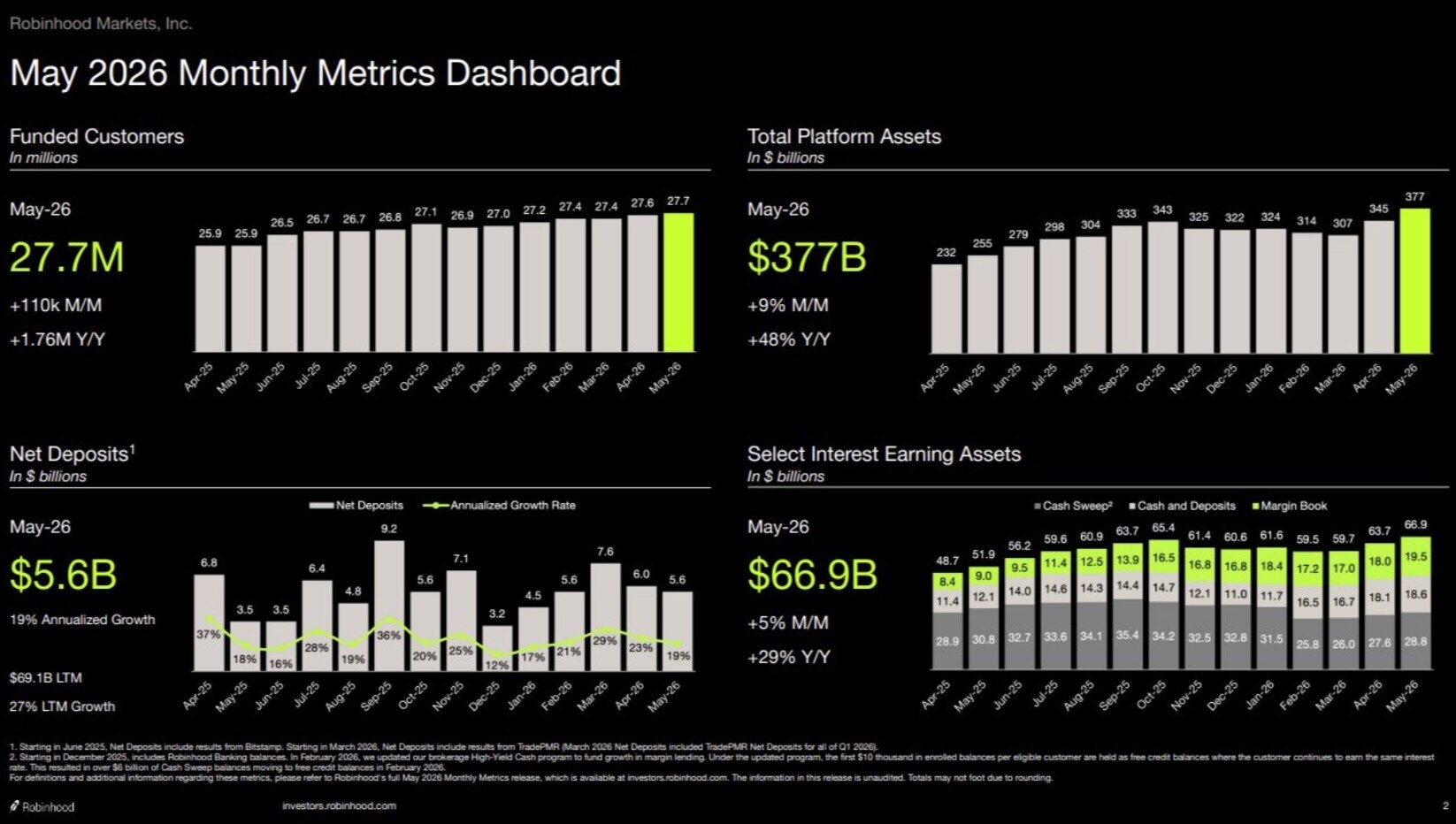
First, looking at fundamentals, Robinhood released its May operational data last week, details as follows.

  • Total Assets: $377 billion, a record high;
  • Funded Customers: 27.7 million, a record high;
  • Margin Book: $19.5 billion, a record high;
  • Event Contracts: 3.9 billion, a record high;
  • Cash & Deposits: $18.6 billion, a record high;
  • Options ADV: 11.6 million contracts, tying the historical record;
  • Equity Volume: $315 billion, the second-highest historical point;
  • Options Contracts: 231 million contracts. The second-highest historical point;
  • The only "lagging" data point is Crypto Volume: $12.2 billion, ranking only 16th in historical monthly data...
Some positive factors on the news front might be more effective in stirring investor sentiment.

  • First, regarding the rapidly growing prediction market, Robinhood has started intercepting Kalshi's flow by building its own prediction market, Rothera. Going forward, related revenue is expected to no longer need to be shared with Kalshi. For details, please refer to the article we published yesterday: 'The First Prediction Market Concept Stock Has Appeared!'.
  • Second, regarding the IPO front, SpaceX's historic IPO brought record-breaking traffic to Robinhood. More crucially, Robinhood's brokerage and clearing arm, Robinhood Securities, was approved last week to act as an IPO underwriter. This means Robinhood is expected to play a more central role in future IPO activities (e.g., Anthropic, OpenAI).
  • Third, Robinhood has been selected by the US Treasury Department to serve as the broker and initial trustee for the "Trump Account." The so-called "Trump Account" is a tax-deferred investment account plan authorized by President Trump on June 9, 2025, under the "Big and Beautiful" Act. It aims to establish government-funded savings accounts for children of US citizens born between January 1, 2025, and January 1, 2029. This means that tens of millions of newborn American children in the coming years will, by default, use Robinhood as their brokerage platform. Details can be found in 'Robinhood Gets a Batch of New Investors, the Oldest is 1, the Youngest is -3'.

There are also some more direct signals in market movements.

  • Robinhood director Meyer Malka has been continuously increasing his holdings of HOOD recently. Over the past week or two, Malka has accumulated over $50 million worth of HOOD.
  • Institutions have also given HOOD more positive price targets. Goldman Sachs maintains a "Buy" rating and has raised its target price from $105 to $108; Mizuho has set a target of $115; Piper Sandler is the most optimistic, giving a target price expectation of $135.

Personally, my initial main reason for accumulating HOOD was optimism about its Q2 earnings report. First, expecting a massive explosion in stock trading-related revenue this quarter under the epic US stock market conditions, and second, the potential surge in prediction market trading volume due to the World Cup, along with the revenue intercept effect of Rothera.

However, the reason for later rotating a significant portion of my holdings (mainly remaining crypto assets) into HOOD follows another logic. This is what this article truly wants to discuss.

The Altcoin Alternative

In early May, a friend asked me what I had bought recently, and I mentioned HOOD. But at that time, HOOD had just dropped from above $90 due to a disappointing Q1 earnings report (mainly due to an unexpected $100 million expense related to the "Trump Account"), and the short-term trend looked quite bad.

My friend asked why. I briefly explained the reasons above. He thought for a moment and said, unfortunately, his positions were mostly trapped, and he had little ammunition left. I asked him what he was holding; unsurprisingly, it was mostly altcoins.

I said to him at the time: "Instead of still holding onto altcoins, why not just rotate into HOOD."

The background for this judgment is that for a long time, cryptocurrency-related revenue has been a significant part of Robinhood's total revenue, and HOOD's stock price movement has been strongly correlated with cryptocurrencies. However, recently, there have been signs that Robinhood is breaking through its dependence on the crypto business and is positively decoupling from this correlation.

First, let's look at Robinhood's cryptocurrency-related revenue over the past five quarters. It's not hard to see that the overall proportion of this revenue stream is on a downward trend, and the Q1 proportion has dropped to its lowest level since 2025.

  • 2025 Q1, Total Revenue $927 million, Crypto Revenue $329 million, share 35%;
  • 2025 Q2, Total Revenue $989 million, Crypto Revenue $160 million, share 16%;
  • 2025 Q3, Total Revenue $1.274 billion, Crypto Revenue $268 million, share 21%;
  • 2025 Q4, Total Revenue $1.283 billion, Crypto Revenue $221 million, share 17%;
  • 2026 Q1, Total Revenue $1.067 billion, Crypto Revenue $134 million, share 13%.

Now, look at the direct comparison between HOOD and BTC price fluctuations. Since the beginning of the year, HOOD mostly followed a similar trend to BTC, but a significant divergence has recently appeared.
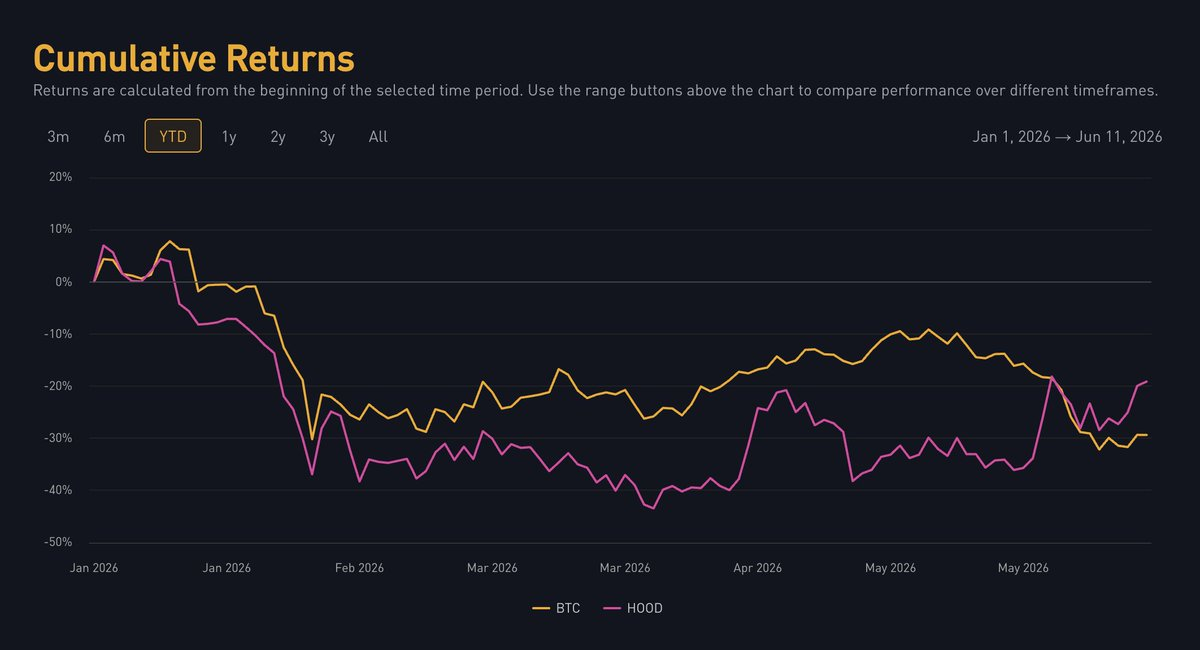
Emphasizing these two points mainly aims to illustrate that the valuation logic surrounding HOOD is beginning to change. In the past, HOOD was often seen as a "shadow stock" of the crypto market, its business performance showing clear cyclicality with crypto bull and bear markets — when the crypto market skyrocketed, retail investors rushed into Robinhood to trade altcoins frantically, commission income surged, and the stock price soared; when the crypto market was sluggish and retail investors withdrew, Robinhood's revenue would quickly decline.

But now, Robinhood is no longer as highly dependent on the crypto business as before. Even if the crypto market continues its current half-dead state, its stock trading, prediction markets, Pre-IPO business, and the newly added underwriting business can still potentially support its earnings growth.

This does not mean the cryptocurrency market will no longer affect HOOD. On the contrary, if the crypto market returns to a bull market in the future, Robinhood's crypto trading revenue will likely explode again, and HOOD can still enjoy the benefits of industry growth.

In more straightforward terms: the crypto space can still affect HOOD, but HOOD no longer depends on the crypto space — if a crypto bull market returns, HOOD will still rise with it; if the crypto space remains half-dead, HOOD doesn't care.

For all those who still hold expectations for altcoins but are increasingly worried about liquidity drying up, narrative failure, and value capture problems, instead of continuing to pin hopes on some token waiting for its next narrative cycle, the current HOOD might be an option with a higher margin of safety.

Related Questions

QWhat are the main reasons the author gives for being optimistic about Robinhood (HOOD) stock's future performance?

AThe author is optimistic due to several key factors: strong operational data for May (record highs in Total Assets, Funded Customers, etc.), positive news developments (like Robinhood building its own prediction market Rothera and being approved as an IPO underwriter), being selected to manage the 'Trump Account' program for millions of newborn US citizens, significant insider buying by director Meyer Malka, and upward price target revisions from major investment banks.

QAccording to the article, what recent trend is observed in Robinhood's revenue dependence on cryptocurrency?

AThe article states that Robinhood's revenue dependence on cryptocurrency has been decreasing. The share of crypto-related revenue in total revenue has dropped from 35% in Q1 2025 to 13% in Q1 2026. This indicates the company is reducing its reliance on the crypto market for its financial performance.

QHow does the author describe the recent relationship between HOOD's stock price and Bitcoin's price movements?

AThe author notes that while HOOD's price often mirrored Bitcoin's movements for much of the year, a recent and significant divergence has occurred. This suggests HOOD's valuation is starting to decouple from the crypto market.

QWhat is the author's core argument for why investors with a 'meme coin obsession' should consider investing in HOOD instead?

AThe author argues that HOOD offers a safer alternative with higher security margins. While it can still benefit from a future crypto bull market, its growing non-crypto businesses (stock trading, prediction markets, IPO underwriting, the 'Trump Account' program) can support its growth even if the crypto market remains stagnant. This makes it less risky than betting on individual altcoins with uncertain prospects.

QWhat specific new business opportunities or roles does the article mention that could drive Robinhood's future growth?

AThe article highlights several new growth drivers: 1) Its own prediction market, Rothera, which allows it to retain more revenue. 2) Approval for its subsidiary, Robinhood Securities, to act as an IPO underwriter for major upcoming listings. 3) Being selected as the broker and initial trustee for the government-funded 'Trump Account' savings program for millions of American newborns.

Related Reads

Bitmine Increases Holdings to 5.7 Million ETH, Included in Russell 1000 Index, Tom Lee Says Only One Step Away from '5% Target'

Bitmine Increases Ethereum Holdings, Nears 5% Supply Target and Joins Russell 1000 Bitmine Immersion Technologies (BMNR) acquired an additional 27,084 ETH last week, bringing its total holdings to 5,700,040 ETH, which represents 4.7% of Ethereum's total supply. This puts the company at 94% of its goal to own 5% of ETH's circulating supply. Despite a challenging week where ETH price fell 8% and BMNR's stock dropped 13%, Bitmine continues its accumulation strategy, with Chairman Tom Lee attributing the market weakness to quarter-end "window dressing" by investors. In a significant development, Bitmine was added to the Russell 1000 large-cap index on June 26. Lee expects this inclusion to attract hundreds of institutional investors, as passive funds and ETFs rebalance to match the index. The company's total assets, including crypto, cash, and securities, stand at $9.8 billion. Of its ETH holdings, 4,879,157 are currently staked, generating an estimated annualized revenue of $211 million. Lee projects this could rise to $246 million once all ETH is staked through its MAVAN network. Bitmine remains the world's largest corporate Ethereum treasury and the second-largest overall corporate crypto treasury, behind Strategy's substantial Bitcoin holdings. Lee reaffirmed the company's commitment to steady buying throughout 2026, expressing belief that the crypto market is still in the early stages of a spring cycle. At the time of writing, ETH was trading around $1,565, while BMNR stock was near $13.56, down over 90% from its 52-week high.

marsbit13m ago

Bitmine Increases Holdings to 5.7 Million ETH, Included in Russell 1000 Index, Tom Lee Says Only One Step Away from '5% Target'

marsbit13m ago

AGI Countdown: OpenAI's Chief Research Officer Makes Major Statement — The Window for Humanity is 'Very Small'

The countdown to AGI has begun, according to OpenAI's Chief Scientist Mark Chen, who states the window for human-centric progress is "very small." Chen argues that AI is reaching a point where models can perform "self-sustaining research," autonomously driving innovation in fields from mathematics to programming. He points to the proliferation of AI's "superhuman" insights—akin to AlphaGo's legendary "Move 37"—across disciplines as evidence of this shift. Chen firmly dismisses claims that scaling laws are plateauing or that pre-training is dead, asserting the field remains on an exponential curve. He cites OpenAI's successful bet on reasoning models like o1 as proof that fundamental breakthroughs are still possible. The future of research, he suggests, lies with "Vibe Researchers"—humans who provide high-level direction and "taste" while AI handles execution and orchestration of complex, long-horizon tasks. However, significant hurdles remain. Chen highlights a "benchmarking crisis," where models can overfit to existing tests without gaining true generalization. He also notes the "jagged frontier" of AI capabilities, where systems excel at advanced reasoning but struggle with contextual, continual learning from everyday experiences. Despite these challenges, he expresses confidence that these gaps will be closed. In a personal reflection, Chen shares that post-AGI, his wish is to open a noodle shop—a metaphor emphasizing that when AI masters knowledge and innovation, uniquely human experiences, warmth, and storytelling will become the ultimate form of value.

marsbit28m ago

AGI Countdown: OpenAI's Chief Research Officer Makes Major Statement — The Window for Humanity is 'Very Small'

marsbit28m ago

China's No.1, Closing in on OpenAI, Mysterious "Sweeping Monk" Rises to Top Seven Globally

A mysterious Chinese AI project named "MopMonk" (meaning "Sweeping Monk") has achieved a top-ranking result on the globally recognized CyberGym cybersecurity benchmark. With a 73.1% success rate, it ranks seventh worldwide and first among Chinese entries, performing closely behind OpenAI. The significance lies in the benchmark itself. CyberGym, created by UC Berkeley, is considered a premier "Olympics" for AI security. It tests models on over 1500 real-world software vulnerabilities, requiring them to not just identify but actually generate working exploits (PoCs) in a complex, offline environment. This moves beyond simple knowledge to testing an AI's practical "execution" capabilities. MopMonk's approach is notable. It uses the open-source MiniMax M3 model from Shanghai as its powerful reasoning "brain," leveraging its strong coding skills and long context window. However, the key to its performance is a custom-built, multi-agent security framework—its "Harness." This system uses structured "vulnerability memory" to efficiently guide the search for exploits, allowing multiple agents to explore in parallel while sharing lessons learned from failures. This engineering layer effectively translates the model's intelligence into actionable, iterative testing steps. The project remains highly secretive, with no official website or team information, embodying the "dark horse" spirit of its literary namesake. Its success highlights a potential industry shift: beyond simply scaling model size, the engineering of specialized agent systems (the Harness) is becoming a critical differentiator for real-world AI application performance, especially in complex domains like cybersecurity.

marsbit56m ago

China's No.1, Closing in on OpenAI, Mysterious "Sweeping Monk" Rises to Top Seven Globally

marsbit56m ago

Will History Repeat Itself? Fidelity Lists Five Catalysts to End the Crypto Winter

Fidelity's new report suggests that the current crypto winter for Bitcoin may be nearing its end, identifying five potential catalysts that could drive a market turnaround based on historical patterns. First, Bitcoin's approximately four-year cycle, driven by its halving mechanism, historically marks peaks and troughs. The last bottom was in November 2022, potentially pointing to the next around November 2026, though cycle length can vary. Second, clearer regulation has often preceded past bull markets. The focus is now on the CLARITY Act, which aims to clarify US digital asset oversight between the SEC and CFTC. Its passage could unlock domestic activity currently held back by legal uncertainty. Third, Federal Reserve monetary policy plays a role. A shift to lower interest rates tends to correlate with rising crypto prices by reducing borrowing costs and boosting risk appetite, though markets may price this in well ahead of any official change. Fourth, the emergence of breakthrough applications can fuel investor interest. Current trends like real-world asset tokenization, AI-related crypto infrastructure, and stablecoins are being watched, but history shows the biggest catalysts are often unexpected. Fifth, a new wave of institutional adoption could be a trigger. While ongoing adoption in 2026 hasn't sparked a new bull run, a major unexpected move—like a significant purchase by a tech giant or adoption as a hedge in a global crisis—could create a powerful new narrative. Fidelity concludes that while the market is in a downturn, historical turning points have often resulted from a combination of such factors, and the next phase for Bitcoin may depend on which of these catalysts materializes first.

Foresight News1h ago

Will History Repeat Itself? Fidelity Lists Five Catalysts to End the Crypto Winter

Foresight News1h ago

Trading

Spot
活动图片