Fireblocks Integrates Canton Network as Bitcoin Hyper Surpasses $31.2M

bitcoinistPublished on 2026-02-03Last updated on 2026-02-03

Abstract

Fireblocks, a major institutional infrastructure provider, has expanded its DeFi capabilities by integrating the Canton Network, enabling asset managers to access fragmented liquidity across blockchains securely. This move highlights the growing demand for efficient cross-chain capital deployment. Meanwhile, Bitcoin Hyper ($HYPER) has surpassed $31.2M in its presale, emerging as a high-performance Bitcoin Layer 2 solution. It integrates the Solana Virtual Machine (SVM) to offer sub-second finality and low-cost execution while leveraging Bitcoin's security. With a capped supply of 21B tokens and a focus on staking rewards, $HYPER aims to drive the next generation of Bitcoin utility.

Fireblocks, the heavyweight of institutional infrastructure, just expanded its DeFi reach.

How? By integrating the Canton Network. It’s a clear signal: the landscape for cross-chain interoperability is growing. By adding support for Canton, Fireblocks isn’t just adding a feature; they’re effectively lowering the drawbridge for asset managers and hedge funds to access fragmented liquidity across different blockchains without risking security.
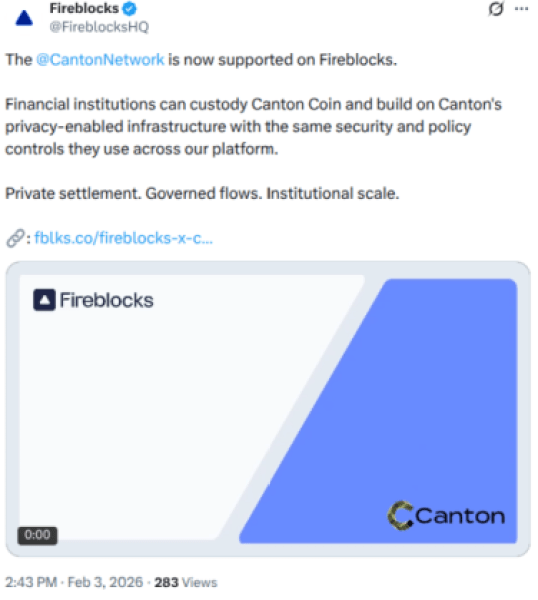
Frankly, this integration matters less for the technical plumbing than for the shift it represents. Institutions are done letting assets gather dust in cold storage; they want the rails to deploy capital efficiently across decentralized finance protocols. The Canton Network integration delivers exactly that, a secure corridor for high-value transfers that cuts through the friction of traditional bridging.

Yet, while Fireblocks solves custody and transfers for institutions, a bigger shift is happening at the execution layer of the market’s largest asset. As liquidity rails improve, the bottleneck moves to the base layers themselves. This creates urgency around Bitcoin, the deepest capital pool but the hardest to program.

Against this backdrop, Bitcoin Hyper ($HYPER) has emerged as a focal point for investors, crossing a massive financial milestone as the market hunts for a solution to Bitcoin’s inherent sluggishness.

Bringing Solana Speeds to Bitcoin’s Base Layer

The market’s appetite for Bitcoin Layer 2 solutions has evolved from experimental curiosity to a demand for raw performance. Bitcoin Hyper ($HYPER) distinguishes itself in this crowded sector by doing something different: integrating the Solana Virtual Machine (SVM) directly into a Bitcoin Layer 2 framework. This architectural choice tackles the age-old ‘trilemma’ head-on: how do you introduce smart contract programmability without sacrificing the settlement security of the Bitcoin mainnet?
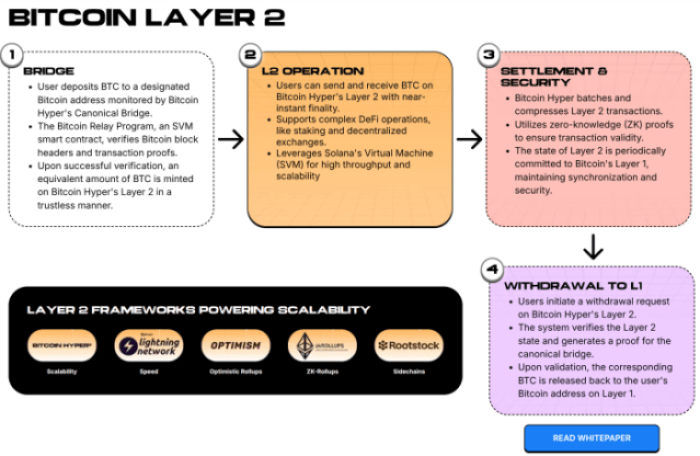
By using a modular blockchain structure, the project delegates settlement to Bitcoin L1 while handling execution on a real-time SVM Layer 2. The result? Sub-second finality and transaction costs under a cent, metrics typically associated with Solana, are now applied to the Bitcoin ecosystem. For developers, this opens the door to building complex DeFi applications, NFT platforms, and gaming dApps using Rust, all while leveraging Bitcoin’s liquidity.

This matters. Most Bitcoin L2s rely on the Ethereum Virtual Machine (EVM), which, while popular, often struggles with the throughput required for high-frequency trading. The SVM integration suggests a strategic pivot toward speed. The protocol employs a single trusted sequencer with periodic L1 state anchoring. That means while execution is rapid, the ultimate truth of the ledger stays secured by Bitcoin’s proof-of-work.

FIND OUT MORE ABOUT $HYPER IN OUR ‘WHAT IS BITCOIN HYPER?’ GUIDE.

Strategic Market Positioning and Liquidity Milestones

The momentum behind high-performance Bitcoin scaling is becoming impossible to ignore as capital gravitates toward the most efficient execution layers.

While institutional giants focus on the ‘plumbing,’ the market is voting with its feet on where the actual value will reside. Bitcoin Hyper ($HYPER) has demonstrated exceptional strength by surpassing $31.2M in its ongoing presale, a milestone that underscores the flight to quality in a crowded L2 market.

This liquidity surge is bolstered by a deflationary tokenomic structure and a governance-first staking model. With a total supply capped at 21B, aligning perfectly with Bitcoin’s core scarcity, the protocol is designed to capture and hold long-term value. Investors are particularly focused on the post-launch staking rewards, which aim to provide high APY to early supporters, incentivizing a stable, committed community over short-term ‘pump and dump’ cycles.

As the industry transitions from simple storage to high-speed asset deployment, $HYPER is positioning itself as the primary engine for the next generation of Bitcoin utility.

BUY BITCOIN HYPER ($HYPER) NOW.

This article is for informational purposes only and does not constitute financial advice. Cryptocurrencies, including presale tokens, are volatile and high-risk assets. Always perform your own due diligence before investing.


Related Questions

QWhat is the significance of Fireblocks integrating the Canton Network?

AFireblocks' integration of the Canton Network is significant because it lowers the barrier for asset managers and hedge funds to access fragmented liquidity across different blockchains securely, representing a major shift towards improved cross-chain interoperability and efficient capital deployment in DeFi.

QHow does Bitcoin Hyper ($HYPER) aim to solve Bitcoin's scalability and speed issues?

ABitcoin Hyper tackles Bitcoin's scalability and speed by integrating the Solana Virtual Machine (SVM) into a Bitcoin Layer 2 framework. This modular structure allows for sub-second finality and transactions under a cent by handling execution on a fast SVM L2 while settling on the secure Bitcoin L1.

QWhat financial milestone has Bitcoin Hyper ($HYPER) recently achieved?

ABitcoin Hyper has surpassed $31.2 million in its ongoing presale, a significant financial milestone that highlights strong investor interest and a 'flight to quality' in the competitive Bitcoin Layer 2 market.

QWhat makes Bitcoin Hyper's tokenomics unique and attractive to investors?

ABitcoin Hyper features a deflationary tokenomic structure with a total supply capped at 21 billion, mirroring Bitcoin's scarcity. It also offers a governance-first staking model with high APY rewards for early supporters, incentivizing long-term holding and a stable community.

QWhy is the integration of SVM considered a strategic advantage for Bitcoin Hyper over other L2 solutions?

AIntegrating the SVM is a strategic advantage because it provides significantly higher throughput and speed compared to the more common Ethereum Virtual Machine (EVM) used by most Bitcoin L2s. This makes it better suited for high-frequency trading and complex DeFi applications, attracting developers who use Rust.

Related Reads

Bitwise: Crypto Becomes a Contrarian Investment, Three Logics to Understand the Current Market

**Summary** Matt Hougan, Bitwise's CIO, analyzes the current crypto market through three key lenses, arguing it has shifted from a momentum-driven to a contrarian investment. **1) Crypto Becomes a Contrarian Play:** The market is weak, with major assets like Bitcoin and Ethereum down significantly. Capital has moved to hot sectors like AI, leaving crypto as an "unloved" asset class. This transforms crypto investing from trend-following to a test of patience and fundamental analysis. Investors now favor projects with solid fundamentals (e.g., Hyperliquid) over speculative ones. **2) Regulatory Overhang:** The uncertain fate of the U.S. CLARITY Act, a major crypto regulatory framework, is a key headwind. With its passage in 2024 seen as far from guaranteed (estimates range from 30-55%), institutional capital remains on the sidelines, choosing less risky alternatives like AI stocks. The market needs clarity—whether the bill passes or fails—more than any specific outcome to move decisively. **3) Capital Rotates to New Fundamentals:** This cycle differs from past bear markets where money fled to Bitcoin. Now, capital seeks smaller assets with strong use cases. While major cryptos fell in May 2024, tokens like Hyperliquid (+72%), Zcash (+50%), and XLM (+44%) rallied on their specific fundamentals. This rotation confirms the new contrarian, fundamentals-driven logic and signals the bear market may be in its later stages. **Conclusion:** Short-term pressure persists due to regulatory uncertainty and competition from AI narratives. Investing in crypto now requires a contrarian mindset—acting against the crowd and focusing on fundamental value. Patience and targeting high-quality projects based on their merits are essential for capturing long-term gains.

marsbit43m ago

Bitwise: Crypto Becomes a Contrarian Investment, Three Logics to Understand the Current Market

marsbit43m ago

ChatGPT Might Be Disappearing Soon

OpenAI announced at its "Intelligence at Work" event that its coding assistant, Codex, will be fully integrated into the ChatGPT app within weeks. This move marks a strategic shift from a conversational AI (Chat) towards a unified "agentic" platform capable of execution. Codex, originally launched to compete with Anthropic's Claude Code, has grown rapidly to 5 million weekly active users, with 20% being non-developers like analysts and designers. Its enterprise revenue now constitutes 40% of OpenAI's total. The integration is the first step in creating a super-app combining ChatGPT (interface), Codex (execution engine), and the Atlas browser (web access). OpenAI also unveiled new Codex features: specialized Agent plugins for six professional roles, an "Annotations" tool for direct document editing, and a "Sites" function to turn work into shareable web apps. Internally, this reflects a power shift; the Codex team now leads core product strategy. While the ChatGPT brand remains for its vast user base, the platform's future is focused on autonomous agents that perform tasks, not just chat. The article notes that competition with Claude Code pushed OpenAI's development, with Codex competing on cost-effectiveness and accessibility rather than raw coding quality. It concludes that the essence of "ChatGPT" is evolving from a chatbot into an AI agent platform, with the name potentially becoming a legacy symbol of its original function.

marsbit53m ago

ChatGPT Might Be Disappearing Soon

marsbit53m ago

WWDC26 Ultimate Preview: The All-New Siri is the Main Course, iOS 27 is Another Year of Refinements

Apple has confirmed WWDC26 will begin on June 8, with the keynote at 10 AM PT (1 AM Beijing Time, June 9). This year's focus is expected to shift significantly from routine OS updates to Apple's progress in AI, particularly a major overhaul of Siri. Reports indicate the highlight will be a new Siri, reportedly powered by Google's Gemini technology. This upgraded assistant is expected to appear as a lightweight bubble from the Dynamic Island and be accessible via a unified "Search or Ask" system-wide entry point. It aims to deeply integrate with iOS 27, iPadOS 27, and macOS 27, accessing personal data like messages, photos, and documents, with a potential standalone Siri app also in development. For iOS 27, leaks suggest incremental improvements rather than major redesigns. Key updates may include a redesigned, more customizable Camera app, enhanced photo editing tools within the Photos app, and potential early system optimizations for a future foldable iPhone. The update is also rumored to prioritize bug fixes, stability, and performance optimization. iPadOS 27 is anticipated to focus on improving productivity features like window management, file systems, and external display support to better utilize the iPad's hardware. macOS 27 is seen as a core platform for Apple Intelligence, likely receiving an optimized Siri, new AI features, and continued refinement of the "Liquid Glass" design language. Notably, macOS 27 may finally drop support for Intel-based Macs. The overarching theme for WWDC26 is whether Apple can effectively integrate AI across its ecosystem. The success of the new Siri and Apple Intelligence will be judged on their ability to move beyond standalone features and become a cohesive, context-aware system layer that understands user workflows across iPhone, iPad, Mac, and other devices, while maintaining Apple's emphasis on privacy and stability. The conference represents Apple's critical attempt to catch up and redefine the AI assistant experience after a perceived slow start in the generative AI era.

marsbit1h ago

WWDC26 Ultimate Preview: The All-New Siri is the Main Course, iOS 27 is Another Year of Refinements

marsbit1h ago

Trading

Spot
Futures

Hot Articles

What is $BITCOIN

DIGITAL GOLD ($BITCOIN): A Comprehensive Analysis Introduction to DIGITAL GOLD ($BITCOIN) DIGITAL GOLD ($BITCOIN) is a blockchain-based project operating on the Solana network, which aims to combine the characteristics of traditional precious metals with the innovation of decentralized technologies. While it shares a name with Bitcoin, often referred to as “digital gold” due to its perception as a store of value, DIGITAL GOLD is a separate token designed to create a unique ecosystem within the Web3 landscape. Its goal is to position itself as a viable alternative digital asset, although specifics regarding its applications and functionalities are still developing. What is DIGITAL GOLD ($BITCOIN)? DIGITAL GOLD ($BITCOIN) is a cryptocurrency token explicitly designed for use on the Solana blockchain. In contrast to Bitcoin, which provides a widely recognized value storage role, this token appears to focus on broader applications and characteristics. Notable aspects include: Blockchain Infrastructure: The token is built on the Solana blockchain, known for its capacity to handle high-speed and low-cost transactions. Supply Dynamics: DIGITAL GOLD has a maximum supply capped at 100 quadrillion tokens (100P $BITCOIN), although details regarding its circulating supply are currently undisclosed. Utility: While precise functionalities are not explicitly outlined, there are indications that the token could be utilized for various applications, potentially involving decentralized applications (dApps) or asset tokenization strategies. Who is the Creator of DIGITAL GOLD ($BITCOIN)? At present, the identity of the creators and development team behind DIGITAL GOLD ($BITCOIN) remains unknown. This situation is typical among many innovative projects within the blockchain space, particularly those aligning with decentralized finance and meme coin phenomena. While such anonymity may foster a community-driven culture, it intensifies concerns about governance and accountability. Who are the Investors of DIGITAL GOLD ($BITCOIN)? The available information indicates that DIGITAL GOLD ($BITCOIN) does not have any known institutional backers or prominent venture capital investments. The project seems to operate on a peer-to-peer model focused on community support and adoption rather than traditional funding routes. Its activity and liquidity are primarily situated on decentralized exchanges (DEXs), such as PumpSwap, rather than established centralized trading platforms, further highlighting its grassroots approach. How DIGITAL GOLD ($BITCOIN) Works The operational mechanics of DIGITAL GOLD ($BITCOIN) can be elaborated on based on its blockchain design and network attributes: Consensus Mechanism: By leveraging Solana’s unique proof-of-history (PoH) combined with a proof-of-stake (PoS) model, the project ensures efficient transaction validation contributing to the network's high performance. Tokenomics: While specific deflationary mechanisms have not been extensively detailed, the vast maximum token supply implies that it may cater to microtransactions or niche use cases that are still to be defined. Interoperability: There exists the potential for integration with Solana’s broader ecosystem, including various decentralized finance (DeFi) platforms. However, the details regarding specific integrations remain unspecified. Timeline of Key Events Here is a timeline that highlights significant milestones concerning DIGITAL GOLD ($BITCOIN): 2023: The initial deployment of the token occurs on the Solana blockchain, marked by its contract address. 2024: DIGITAL GOLD gains visibility as it becomes available for trading on decentralized exchanges like PumpSwap, allowing users to trade it against SOL. 2025: The project witnesses sporadic trading activity and potential interest in community-led engagements, although no noteworthy partnerships or technical advancements have been documented as of yet. Critical Analysis Strengths Scalability: The underlying Solana infrastructure supports high transaction volumes, which could enhance the utility of $BITCOIN in various transaction scenarios. Accessibility: The potential low trading price per token could attract retail investors, facilitating wider participation due to fractional ownership opportunities. Risks Lack of Transparency: The absence of publicly known backers, developers, or an audit process may yield skepticism regarding the project's sustainability and trustworthiness. Market Volatility: The trading activity is heavily reliant on speculative behavior, which can result in significant price volatility and uncertainty for investors. Conclusion DIGITAL GOLD ($BITCOIN) emerges as an intriguing yet ambiguous project within the rapidly evolving Solana ecosystem. While it attempts to leverage the “digital gold” narrative, its departure from Bitcoin's established role as a store of value underscores the need for a clearer differentiation of its intended utility and governance structure. Future acceptance and adoption will likely depend on addressing the current opacity and defining its operational and economic strategies more explicitly. Note: This report encompasses synthesised information available as of October 2023, and developments may have transpired beyond the research period.

363 Total ViewsPublished 2025.05.13Updated 2025.05.13

What is $BITCOIN

Discussions

Welcome to the HTX Community. Here, you can stay informed about the latest platform developments and gain access to professional market insights. Users' opinions on the price of BTC (BTC) are presented below.

活动图片