Figure Technology files ‘second IPO’ to bring native equity issuance to Solana

cointelegraphPublished on 2025-12-12Last updated on 2025-12-12

Abstract

Figure Technology, a blockchain-based financial services firm, has filed for a second public offering with the SEC to issue native equity directly on the Solana blockchain. This initiative, announced at the Solana Breakpoint conference, aims to expand DeFi use cases by enabling on-chain trading through Figure’s alternative trading system rather than traditional exchanges. The tokenized equity would allow investors to use the asset in DeFi protocols for lending or borrowing. Beyond its own shares, Figure plans to facilitate native equity issuance for other companies within the Solana ecosystem. The announcement highlights Solana’s growing role in tokenized assets, with industry experts noting its competitive advantages in speed and throughput for real-world asset tokenization.

Figure Technology, a blockchain-based financial services company focused on tokenized assets and lending, has filed for a second public offering aimed at issuing native equity directly on a public blockchain. The move, which follows the company’s recent Nasdaq listing, is designed to expand decentralized finance (DeFi) use cases on Solana.

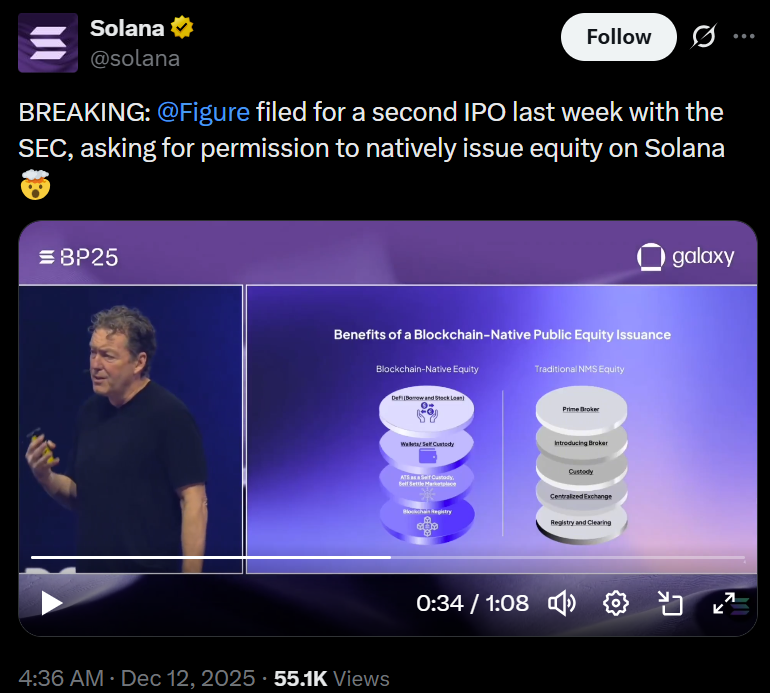
Speaking at the Solana Breakpoint conference, Figure executive chairman Mike Cagney said the company has submitted a filing with the US Securities and Exchange Commission (SEC) to launch what he described as “a new version of Figure equity on a public blockchain,” specifically Solana.

Cagney said the blockchain-native equity would not trade on traditional exchanges such as Nasdaq or the New York Stock Exchange, nor would it rely on introducing brokers like Robinhood or prime brokers such as Goldman Sachs.
Source: Solana

Instead, the security would be issued and traded natively onchain via Figure’s alternative trading system, which he characterized as “effectively a decentralized exchange.”

By issuing equity directly on Solana, investors would be able to take the tokenized security into DeFi protocols, where it could be borrowed against or lent out, Cagney said.

He added that the company’s broader goal extends beyond tokenizing its own shares, with plans to support native equity issuance for other companies directly within the Solana ecosystem:

“One of the focus points that we have is not only bringing that equity over to the Solana ecosystem but allowing for native Solana equity issuance as well.”

Related: Figure Technology boosts IPO size, total deal could reach $800M

Tokenization on Solana is gaining momentum

Already one of the largest public blockchains by activity, Solana is increasingly emerging as a hub for tokenized assets, with its share of the real-world asset (RWA) market expanding steadily over the past year.

While Ethereum continues to dominate tokenization today, Solana is likely to become the financial industry’s preferred network for stablecoins and tokenized assets over time, according to Matt Hougan, chief investment officer at Bitwise.

As Wall Street evaluates the long-term viability of tokenized assets, attention is expected to shift toward blockchains that offer high speed, throughput and fast transaction finality, areas where Solana holds a competitive advantage over many rival networks, Hougan said.

Research from RedStone identified Solana as a “high-performance challenger” in the RWA space, particularly in tokenized US Treasury markets.
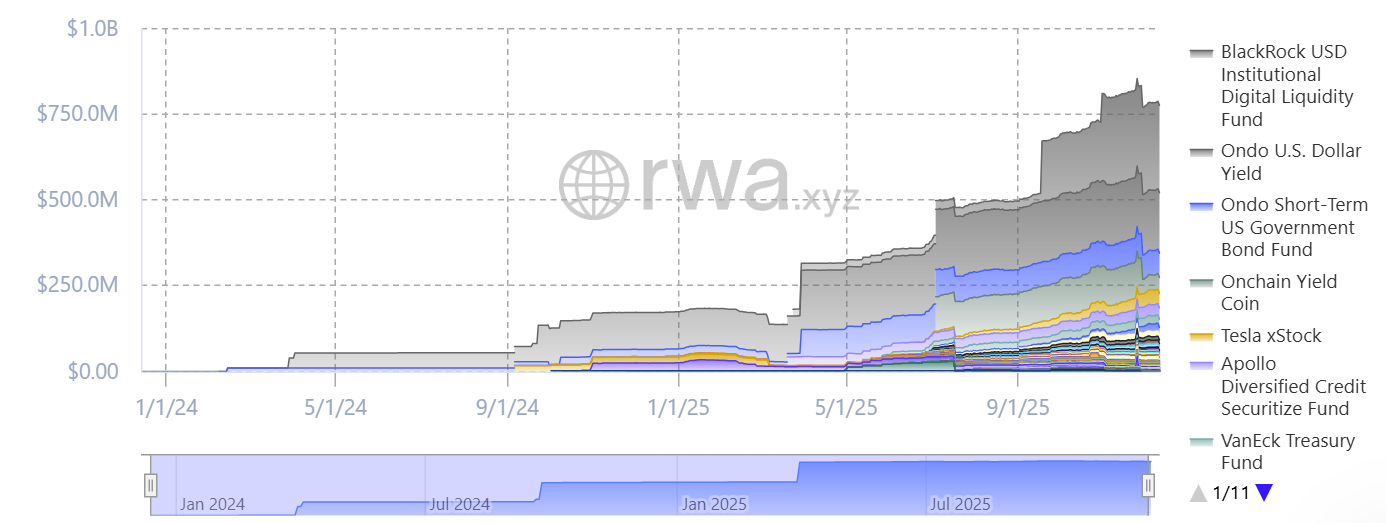
Solana’s RWA metrics, excluding stablecoins. Source: RWA.xyz

Related: Scaramucci predicts ‘exponential opportunity’ for crypto at LONGITUDE

Trending Cryptos

Related Reads

Chipsea Turns from A-share to H-share: Riding the Price Surge Trend, or Gambling on the Cycle?

Xintianxia Technology, a Chinese flash memory chipmaker, is making its second attempt to list on the Hong Kong Stock Exchange after withdrawing its application for a mainland China IPO in late 2023. This move coincides with an upcycle in the memory chip sector. Ranked fifth among global fabless code-type flash memory suppliers in 2025, Xintianxia specializes in NOR Flash and SLC NAND chips. However, it holds a small 1.3% global market share in this niche segment. The company is highly dependent on a concentrated group of suppliers, with its top five accounting for over 80% of procurement in Q1 2026. After posting losses in 2023 and 2024, the company's fortunes reversed sharply in Q1 2026. Revenue grew 77.4% year-over-year to RMB 224 million, with net profit reaching RMB 75.89 million. This dramatic turnaround was primarily driven by strategic inventory stockpiling and significant price increases for its core products, leading to a gross margin surge to 55.63%. However, this aggressive strategy carries major risks. Inventory days have risen significantly, and the company's operating cash flow turned negative in Q1 2026 due to high stockpiling costs. The memory industry's cyclical nature means the current price boom may not last. If a downturn arrives, Xintianxia's high-cost inventory could become a financial burden, a scenario that previously derailed its A-share listing ambitions. Further complicating its IPO journey are corporate governance concerns. The company paid substantial dividends during loss-making years, and several major shareholders, including state-backed funds and the founder, cashed out significant stakes shortly before the Hong Kong listing application. Chinese regulators have requested details on past equity transfers, questioning pricing fairness. In essence, Xintianxia's Hong Kong listing bid is a high-stakes gamble on the sustainability of the current chip price cycle. Its future hinges not just on favorable market conditions but on its ability to withstand the inevitable downturn and prove its long-term operational resilience.

marsbit3m ago

Chipsea Turns from A-share to H-share: Riding the Price Surge Trend, or Gambling on the Cycle?

marsbit3m ago

BlackRock Launches Stablecoin Reserve Fund BRSRV: Bringing Short-Term US Treasuries to Solana, Ethereum, and Tempo

BlackRock Launches Tokenized Stablecoin Reserve Fund BRSRV, Expands to Solana and Tempo Global asset management giant BlackRock has introduced BRSRV (BlackRock Daily Reinvestment Stablecoin Reserve Vehicle), a tokenized money market fund specifically designed for stablecoin reserves. Concurrently, the firm is issuing tokenized, on-chain shares of its existing BSTBL (BlackRock Select Treasury-Based Liquidity Fund). A key development is the expansion of supported blockchains beyond Ethereum to include Solana and Stripe-affiliated chain Tempo for recording share ownership. The transfer agent Securitize will manage the process through approved, whitelisted wallets requiring verified identity, with a minimum initial investment of $3 million. The fund will invest solely in cash, short-term U.S. Treasuries, and overnight repurchase agreements backed by U.S. government securities, explicitly avoiding any crypto assets. BlackRock states the structure aims to qualify as a compliant reserve asset under the U.S. GENIUS Act for payment stablecoins. This launch builds upon BlackRock's broader tokenization strategy, notably following its BUIDL fund introduced in March 2024, which now holds over $26 billion in assets. The move places BlackRock alongside other major institutions like Morgan Stanley and Fidelity in offering products tailored for the stablecoin reserve market, signaling a deepening institutional push into tokenized real-world assets (RWA) and on-chain finance infrastructure.

marsbit4m ago

BlackRock Launches Stablecoin Reserve Fund BRSRV: Bringing Short-Term US Treasuries to Solana, Ethereum, and Tempo

marsbit4m ago

Wall Street Morning Report: AI + Cloud Computing Takes Over the Market Again, Amazon Knocks on the Door of $3 Trillion

Wall Street's August began with a strong rally, driven by easing Middle East tensions as President Trump signaled progress on U.S.-Iran talks, prompting a sharp drop in oil prices. Major indices hit record or near-record highs, with the Dow Jones Industrial Average up 1.32%, the Nasdaq Composite surging 2.13%, and the S&P 500 rising 1.48%. The energy sector was the sole decliner. The AI and cloud computing narrative dominated the tech rally. The "Magnificent Seven" index jumped 3.6%. Amazon's market cap surpassed $3 trillion for the first time following robust AWS results, while Nvidia regained a $5 trillion valuation. Meta, Google, and Microsoft also posted significant gains. Other AI-related stocks like Palantir, CoreWeave, and various semiconductor and infrastructure companies saw strong advances. In other markets, gold held above $4,000, supported by central bank buying. Treasury yields fell as oil prices dropped. The U.S. dollar remained stable despite strong manufacturing data. Japan's substantial currency intervention raised concerns, but U.S. officials reassured markets about the mechanism used. Key events ahead include major industry conferences (Ai4 2026, FMS Summit) and earnings reports from companies like SpaceX, AMD, and Pfizer. The White House is also set to host a meeting with leading AI firms to discuss regulatory frameworks.

marsbit1h ago

Wall Street Morning Report: AI + Cloud Computing Takes Over the Market Again, Amazon Knocks on the Door of $3 Trillion

marsbit1h ago

The July Tech Stock Pullback: Which Funds Are Paying the Price for Buying High?

In July, China's technology stocks experienced a sharp correction, causing significant pain for actively managed mutual funds that aggressively increased their holdings in the sector during the second quarter. The sell-off saw major indices like the ChiNext and STAR 50 fall over 25% and 28% for the month, respectively. Funds that piled into tech at its June peak faced steep losses. Notably, several veteran "value investor" fund managers, known for long-term holdings in consumer staples, made dramatic shifts. Star managers like Zhang Kun (E Fund Blue Chip Selected) and Liu Yanchun (Invesco Great Wall Dingyi) drastically reduced positions in liquor stocks like Kweichow Moutai, switching instead to semiconductor and AI hardware companies like SMIC and Ingenic International. Data shows active equity funds' allocation to the electronics sector reached a historical high of 42.64% by end-Q2. Around 67 funds saw their TMT (Technology, Media, Telecom) weighting surge from an average of 6.75% to 54.99%. The consequences were severe in July: these high-TMT funds fell an average of over 20%, with 12 plunging more than 40%. Examples include Jinhua High-Quality Growth and Guoshou Anbao Wenhui, which fell 26.34% and nearly 40% respectively after raising TMT weights above 70%. The article also highlights issues of "style drift," where funds with names like "high-dividend" held high-P/E tech stocks instead, confusing investors. Newly launched funds suffered even more. For instance, Guotai Haitong New Energy RuiXuan Hybrid, launched in mid-June, saw its net asset value plummet to 0.5509 yuan by July 30, a loss of nearly 45%. Analysts note the extreme sector concentration mirrored past bubbles (e.g., 2021 new energy). The intense, crowded trade itself became a major risk. While tech stocks rebounded sharply on July 31, the funds that chased the high face a longer-term market test.

marsbit1h ago

The July Tech Stock Pullback: Which Funds Are Paying the Price for Buying High?

marsbit1h ago

Trading

Spot

Hot Articles

Discussions

Welcome to the HTX Community. Here, you can stay informed about the latest platform developments and gain access to professional market insights. Users' opinions on the price of SOL (SOL) are presented below.

活动图片