Fidelity’s New Bitcoin Study Challenges The Traditional 60/40 Portfolio

bitcoinistPublished on 2026-03-26Last updated on 2026-03-26

Abstract

Fidelity Digital Assets' new research argues that a zero allocation to bitcoin now requires active justification, as historical data shows BTC was the top-performing asset in 11 of the past 15 years. The report highlights bitcoin’s low correlation to traditional assets, its role as an inflation hedge, and its positive impact on risk-adjusted returns. Even small allocations (1-3%) historically improved Sharpe and Sortino ratios in a 60/40 portfolio without drastically increasing drawdowns. Fidelity questions the sustainability of traditional portfolio tailwinds, like falling rates and rich equity valuations, suggesting bitcoin offers asymmetric returns in a changing macro environment. The study does not prescribe a universal allocation but emphasizes that bitcoin can deliver material portfolio impact even from a small starting weight.

Fidelity Digital Assets has used a new research report to make a sharper institutional case for bitcoin: not that every allocator must own it, but that a zero position now needs to be actively defended. In a study published March 25, Chris Kuiper argues bitcoin’s role in portfolios can no longer be dismissed as a fringe question, especially as the assumptions behind the classic 60/40 mix come under pressure.

The report opens with an unusually direct framing. “The central question is no longer” whether bitcoin merits consideration, Fidelity says. Instead, it asks: “What is your current bitcoin allocation, and why?” For the firm’s research team, zero exposure may still be valid, but it now requires a “well-informed rationale.”

Tiny Bitcoin Exposure, Big Portfolio Impact

That argument rests first on bitcoin’s historical numbers. Fidelity says bitcoin has been the top-performing asset in 11 of the past 15 years and, over multiple time horizons, has posted the highest returns as well as the highest risk-adjusted returns among the assets it examined. The report acknowledges the familiar objection, bitcoin’s volatility remains the highest in the group, but argues that Sharpe and Sortino ratios still compare favorably, while bonds have looked particularly weak on both nominal and inflation-adjusted terms.

From there, the paper tries to move the discussion away from philosophy and into portfolio construction. Fidelity leans on bitcoin’s hard cap, its low long-term correlation to major asset classes, and its sensitivity to monetary expansion.

One of the report’s stronger macro claims is that changes in global M2 have explained 87% of BTC’s price changes over the past 15 years on an r-squared basis, though Fidelity explicitly notes that correlation does not by itself prove causation. It also argues that bitcoin and gold are similar enough to share an inflation-hedge narrative, but distinct enough to remain complementary rather than interchangeable in diversified portfolios.

The most consequential section for allocators is the portfolio work. Using a traditional 60/40 portfolio of US stocks and aggregate US bonds as the base case, Fidelity says adding BTC would have historically lifted both annual and total returns. Volatility rose, as expected, but the report says the increase was compensated by stronger risk-adjusted returns, with the biggest improvement in Sharpe and Sortino ratios showing up when allocations moved from 1% to 3%.
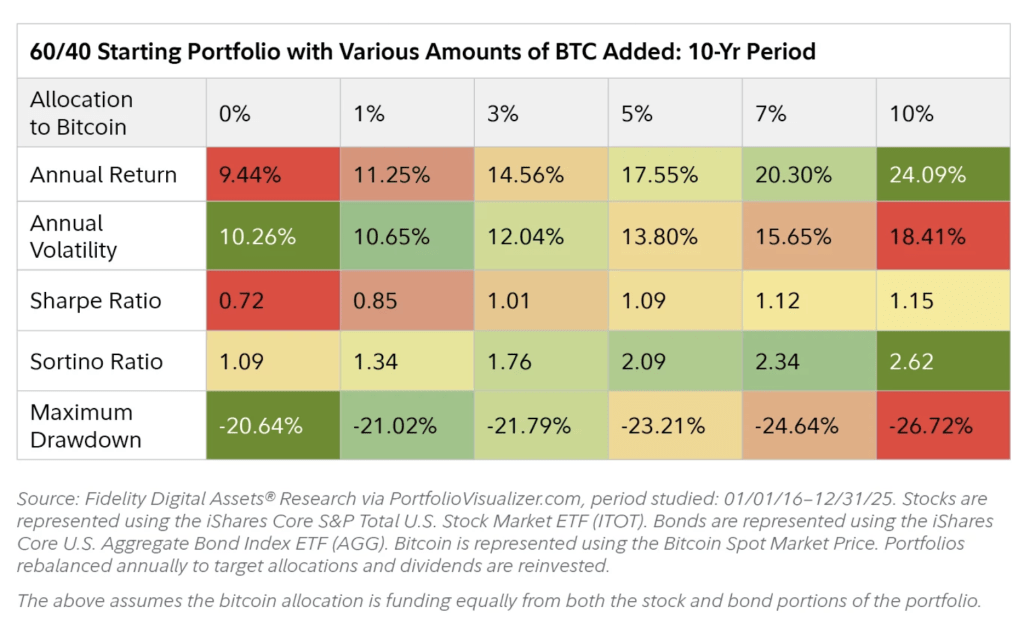
60/40 portfolio with various amounts of Bitcoin | Source: Fidelity

Perhaps more notable for conservative managers, Fidelity says maximum drawdowns did not increase as dramatically as many would assume, partly because of low correlation and partly because annual rebalancing kept the bitcoin sleeve from dominating the portfolio.

Fidelity’s modeling gets more aggressive deeper in the paper. In a mean-variance optimization exercise using what it calls conservative bitcoin assumptions, 25% expected annual return and 50% volatility, against 14.5% expected equity returns and 2% for bonds, the maximum-Sharpe portfolio included 9.4% bitcoin and no bonds at all.

A separate Kelly Criterion exercise produced a 65% position size using historical annual returns, though Fidelity immediately warns that this is not an investment recommendation and notes that more conservative assumptions bring that figure down to 10%. The point is less that institutions should adopt those weights than that BTC’s asymmetric payoff profile can justify larger allocations than intuition might suggest.

That is where the report’s challenge to 60/40 becomes explicit. Fidelity argues the last decade’s strength in traditional portfolios was helped by four decades of falling rates, richening equity valuations, and repeated policy support for credit markets.

It questions whether those tailwinds are durable. On bonds, the paper points to episodes of sharp losses, rising stock-bond correlations, and the risk of negative real returns in a world of persistent debt expansion; on equities, it argues that elevated valuations may leave markets “priced for perfection” even if AI and capital-light business models support margins.

The report stops short of prescribing a universal BTC weight, but its message is clear enough. Fidelity is not presenting bitcoin as a replacement for every traditional asset or as a one-way macro hedge. It is arguing that in a world where fixed income may no longer offer the same ballast and equity valuations already reflect high expectations, even a small bitcoin allocation can produce what it calls a “material outcome” from a non-material starting weight.

At press time; BTC traded at $69,935.
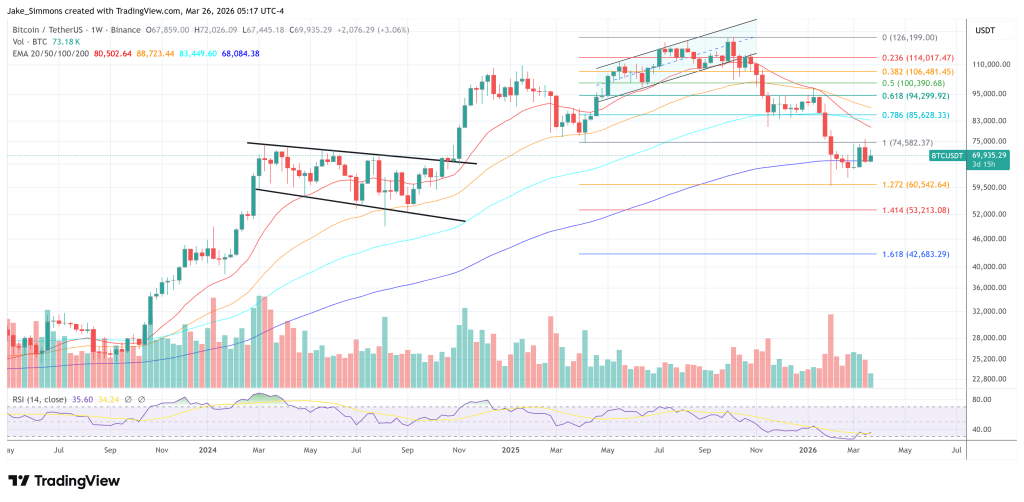
BTC must break above $74,500 1-week chart | Source: BTCUSDT on TradingView.com

Related Questions

QAccording to Fidelity's report, what is the new central question regarding Bitcoin allocation for institutional investors?

AThe central question is no longer whether Bitcoin merits consideration, but rather 'What is your current Bitcoin allocation, and why?'

QWhat key statistical relationship does Fidelity report between global M2 and Bitcoin's price?

AChanges in global M2 have explained 87% of BTC's price changes over the past 15 years on an r-squared basis, though Fidelity notes correlation does not prove causation.

QHow did adding Bitcoin to a traditional 60/40 portfolio affect risk-adjusted returns in Fidelity study?

AAdding Bitcoin historically lifted both annual and total returns, and the increase in volatility was compensated by stronger risk-adjusted returns, with the biggest improvement in Sharpe and Sortino ratios showing when allocations moved from 1% to 3%.

QWhat was the maximum-Sharpe portfolio allocation to Bitcoin in Fidelity's mean-variance optimization using conservative assumptions?

AThe maximum-Sharpe portfolio included 9.4% Bitcoin and no bonds at all, using conservative assumptions of 25% expected annual return and 50% volatility for Bitcoin.

QWhat three factors does Fidelity identify as having supported traditional portfolio strength in the last decade that may not be durable?

AFour decades of falling rates, richening equity valuations, and repeated policy support for credit markets.

Related Reads

Will the Next Crypto Bull Run Start with On-Chain Trading of SpaceX?

This article presents a scenario-based forecast for the crypto industry from 2026 to 2029, arguing that the next major cycle will be driven not by technological narratives but by legal access to real-world assets. The author predicts that by mid-2026, pre-IPO perpetual contracts for top private companies like SpaceX, OpenAI, and Anthropic on platforms like Hyperliquid will become the primary gateway for accessing quality assets, as most crypto-native tokens fail to capture real value. The much-hyped AI x Crypto intersection largely fails except for prediction markets, which thrive on betting on AI model supremacy. By 2027, public blockchain foundations are forced to choose between catering to retail speculation or building compliant infrastructure for institutions, with many opting for the latter. Growth in stablecoins and tokenized private credit/equity hits a "triple ceiling" due to regulatory and political uncertainty rather than market demand. The pivotal shift is forecast for 2028. A major liquidation event in pre-IPO perpetuals exposes the structural flaw of synthetic markets lacking a real underlying asset anchor. In response, regulatory changes finally allow the public solicitation of private securities resales to verified accredited investors. This creates a legitimate secondary market for real company equity, which then becomes the core asset class of the new bull market, relegating synthetic perps to a niche role. By 2029, the industry becomes "boring" but foundational. Tokens without claims on real cash flows or assets cease trading. Stablecoin growth is steady but politically capped. Crypto infrastructure fades from view as it gets absorbed into traditional finance backends. The article's central thesis is that the key bottleneck for crypto's next phase is legal and regulatory channels for real asset ownership, not technology.

marsbit1h ago

Will the Next Crypto Bull Run Start with On-Chain Trading of SpaceX?

marsbit1h ago

The Value Distribution of Stablecoins

**Summary: The Value Distribution of Stablecoins** The article argues that stablecoins are evolving from mere trading tools into broader channels for dollar access. It divides the stablecoin ecosystem into four layers to analyze how value is distributed: 1. **Issuance Layer:** Mints stablecoins, holds reserve assets, and captures the spread between reserve yield and user costs (e.g., Tether, Circle). This layer currently earns the largest profit margin. 2. **Infrastructure Layer:** Connects stablecoins to the traditional financial system, handling fiat on/off-ramps, banking integration, compliance (KYC/AML), and asset management (e.g., Bridge, BVNK). This is the "unglamorous" but critical work, building the essential bridges between crypto and real-world finance. 3. **Acquiring/Distribution Layer:** Integrates stablecoins into merchant systems, manages payment flows, and provides enterprise financial software (e.g., Stripe, Coinbase). They act as the access point for businesses. 4. **Application Layer:** The end-users and businesses that ultimately use stablecoins for payments, settlements, or as a store of value. They benefit from convenience but have little pricing power. The core thesis is that while the issuance layer currently dominates profits, the often-overlooked **infrastructure layer holds significant long-term potential**. The real challenge and barrier to mass adoption is not the on-chain transfer of stablecoins (which is simple), but the complex "last mile" integration into existing business workflows, banking systems, and regulatory frameworks across different countries. Companies in this layer are currently in a "land grab" phase, investing heavily to build networks, secure bank partnerships, and establish compliance pathways. While their position is currently pressured by the profitable issuers above and distribution platforms below, the article suggests that if stablecoins become a default financial rail for businesses, the infrastructure providers who have done the hard work of integration will ultimately gain strong pricing power and become entrenched, essential players.

marsbit7h ago

The Value Distribution of Stablecoins

marsbit7h ago

The Value Distribution of Stablecoins

The Value Distribution of Stablecoins The article argues that stablecoins are evolving from a mere trading tool into a broad "dollar channel." It analyzes the industry's value chain through four layers: 1. **Issuance Layer (e.g., Tether, Circle):** The top layer that mints stablecoins, holds reserve assets, and captures the thickest interest rate spread. 2. **Infrastructure Layer (e.g., Bridge, BVNK):** Connects stablecoins to the traditional financial system, handling critical but complex "dirty work" like fiat on/off-ramps, banking integration, compliance (KYC/AML), and cross-border settlement. 3. **Acquiring/Distribution Layer (e.g., Stripe, Coinbase):** Embeds stablecoins into merchant systems, manages payment flows, and integrates with enterprise software. 4. **Application Layer:** End-users and businesses that ultimately use stablecoins for payments, settlement, or storing value. The author posits that while the issuance layer currently captures the most profit, the most overlooked and potentially critical layer is infrastructure. The core challenge for stablecoin adoption isn't the on-chain transfer (which is simple), but bridging the gap between blockchain and the real-world financial system. This involves solving practical problems for businesses: fiat conversion, reconciliation, tax handling, and user onboarding. Infrastructure companies are currently in a difficult "land-grab" phase—building networks, securing banking relationships, and achieving compliance country-by-country. They face pressure from both the profitable issuance layer above and distribution platforms below. However, the author suggests this layer is building a crucial moat. Once stablecoins become a default business rail, the infrastructure players who have done the hard work of integration may gain significant, durable value and pricing power.

链捕手7h ago

The Value Distribution of Stablecoins

链捕手7h ago

Trading

Spot
Futures

Hot Articles

What is $BITCOIN

DIGITAL GOLD ($BITCOIN): A Comprehensive Analysis Introduction to DIGITAL GOLD ($BITCOIN) DIGITAL GOLD ($BITCOIN) is a blockchain-based project operating on the Solana network, which aims to combine the characteristics of traditional precious metals with the innovation of decentralized technologies. While it shares a name with Bitcoin, often referred to as “digital gold” due to its perception as a store of value, DIGITAL GOLD is a separate token designed to create a unique ecosystem within the Web3 landscape. Its goal is to position itself as a viable alternative digital asset, although specifics regarding its applications and functionalities are still developing. What is DIGITAL GOLD ($BITCOIN)? DIGITAL GOLD ($BITCOIN) is a cryptocurrency token explicitly designed for use on the Solana blockchain. In contrast to Bitcoin, which provides a widely recognized value storage role, this token appears to focus on broader applications and characteristics. Notable aspects include: Blockchain Infrastructure: The token is built on the Solana blockchain, known for its capacity to handle high-speed and low-cost transactions. Supply Dynamics: DIGITAL GOLD has a maximum supply capped at 100 quadrillion tokens (100P $BITCOIN), although details regarding its circulating supply are currently undisclosed. Utility: While precise functionalities are not explicitly outlined, there are indications that the token could be utilized for various applications, potentially involving decentralized applications (dApps) or asset tokenization strategies. Who is the Creator of DIGITAL GOLD ($BITCOIN)? At present, the identity of the creators and development team behind DIGITAL GOLD ($BITCOIN) remains unknown. This situation is typical among many innovative projects within the blockchain space, particularly those aligning with decentralized finance and meme coin phenomena. While such anonymity may foster a community-driven culture, it intensifies concerns about governance and accountability. Who are the Investors of DIGITAL GOLD ($BITCOIN)? The available information indicates that DIGITAL GOLD ($BITCOIN) does not have any known institutional backers or prominent venture capital investments. The project seems to operate on a peer-to-peer model focused on community support and adoption rather than traditional funding routes. Its activity and liquidity are primarily situated on decentralized exchanges (DEXs), such as PumpSwap, rather than established centralized trading platforms, further highlighting its grassroots approach. How DIGITAL GOLD ($BITCOIN) Works The operational mechanics of DIGITAL GOLD ($BITCOIN) can be elaborated on based on its blockchain design and network attributes: Consensus Mechanism: By leveraging Solana’s unique proof-of-history (PoH) combined with a proof-of-stake (PoS) model, the project ensures efficient transaction validation contributing to the network's high performance. Tokenomics: While specific deflationary mechanisms have not been extensively detailed, the vast maximum token supply implies that it may cater to microtransactions or niche use cases that are still to be defined. Interoperability: There exists the potential for integration with Solana’s broader ecosystem, including various decentralized finance (DeFi) platforms. However, the details regarding specific integrations remain unspecified. Timeline of Key Events Here is a timeline that highlights significant milestones concerning DIGITAL GOLD ($BITCOIN): 2023: The initial deployment of the token occurs on the Solana blockchain, marked by its contract address. 2024: DIGITAL GOLD gains visibility as it becomes available for trading on decentralized exchanges like PumpSwap, allowing users to trade it against SOL. 2025: The project witnesses sporadic trading activity and potential interest in community-led engagements, although no noteworthy partnerships or technical advancements have been documented as of yet. Critical Analysis Strengths Scalability: The underlying Solana infrastructure supports high transaction volumes, which could enhance the utility of $BITCOIN in various transaction scenarios. Accessibility: The potential low trading price per token could attract retail investors, facilitating wider participation due to fractional ownership opportunities. Risks Lack of Transparency: The absence of publicly known backers, developers, or an audit process may yield skepticism regarding the project's sustainability and trustworthiness. Market Volatility: The trading activity is heavily reliant on speculative behavior, which can result in significant price volatility and uncertainty for investors. Conclusion DIGITAL GOLD ($BITCOIN) emerges as an intriguing yet ambiguous project within the rapidly evolving Solana ecosystem. While it attempts to leverage the “digital gold” narrative, its departure from Bitcoin's established role as a store of value underscores the need for a clearer differentiation of its intended utility and governance structure. Future acceptance and adoption will likely depend on addressing the current opacity and defining its operational and economic strategies more explicitly. Note: This report encompasses synthesised information available as of October 2023, and developments may have transpired beyond the research period.

367 Total ViewsPublished 2025.05.13Updated 2025.05.13

What is $BITCOIN

Discussions

Welcome to the HTX Community. Here, you can stay informed about the latest platform developments and gain access to professional market insights. Users' opinions on the price of BTC (BTC) are presented below.

活动图片















