Fed Candidates Warsh and Hassett: Who Is More Beneficial for Us?

marsbitPublished on 2025-12-16Last updated on 2025-12-16

Abstract

Amidst inflation pressures and geopolitical uncertainty in 2025, the potential successors to the U.S. Federal Reserve Chair—Kevin Warsh and Kevin Hassett—present sharply contrasting policy approaches. Warsh, a former Fed governor with a hawkish stance, emphasizes financial stability, market discipline, and inflation control, advocating for cautious monetary tightening and reduced intervention risks. In contrast, Hassett, a former White House economic advisor and dovish figure, supports aggressive rate cuts, growth-oriented policies, and closer alignment with presidential agendas, potentially benefiting markets and cryptocurrencies. Market predictions show narrowing odds, with Warsh gaining traction post-Trump’s endorsement, though Hassett retains advantages due to his political ties. The selection will significantly influence long-term economic stability versus short-term growth, testing the Fed’s independence and global financial resilience.

Against the backdrop of inflation pressures, geopolitical uncertainties, and technological changes facing the U.S. economy in 2025, the successor to the Federal Reserve Chair position has drawn significant attention.‍‍‍‍‍‍‍‍‍‍‍‍‍‍‍‍‍‍‍‍‍‍‍‍‍‍‍‍‍‍‍

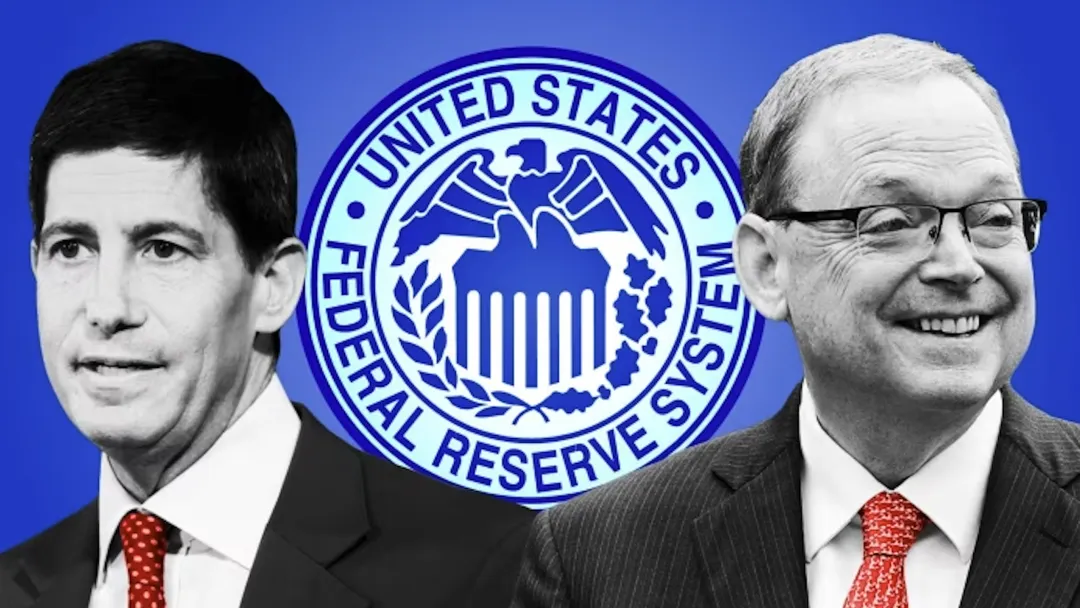
President Donald Trump recently stated that he is "leaning towards Warsh or Hassett," a remark that has triggered market volatility and widespread discussion.

Kevin Warsh, a former Federal Reserve Governor, is known for his hawkish stance and experience in responding to the financial crisis;


Kevin Hassett, a former White House economic advisor, is renowned for his dovish perspective and pro-growth policies.


Comparing their backgrounds, monetary policy thinking, potential impacts, and current online public sentiment, who has a greater chance of being elected?

Overview of the Two Candidates' Backgrounds


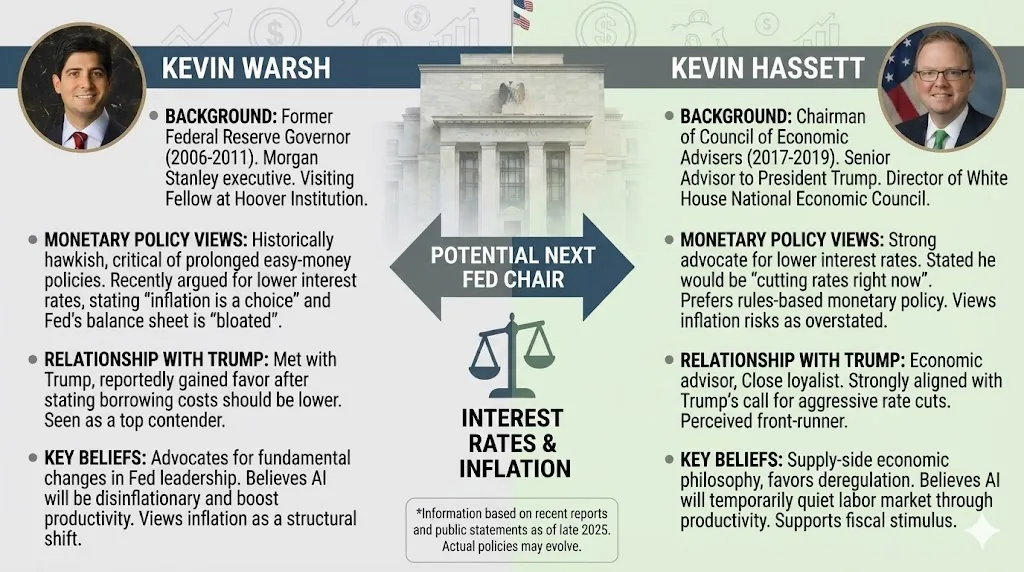
Kevin Warsh is an experienced financial policy expert, born in 1970, and a graduate of Stanford University and Harvard Law School. He worked as an investment banker at Morgan Stanley and served as Special Assistant to the President for Economic Policy during the George W. Bush administration. From 2006 to 2011, Warsh served as a Federal Reserve Governor, participating in the response to the global financial crisis, including the formulation of quantitative easing (QE) policies. Currently, he is a visiting scholar at the Hoover Institution and serves on the boards of several companies. Warsh's career emphasizes financial stability and market discipline, and he is seen as a representative of conservative economics.


Kevin Hassett is a seasoned economist with a Ph.D. in economics from the University of Pennsylvania. He has taught at Yale University and Columbia University and worked at the conservative think tank American Enterprise Institute. Hassett served as Chairman of the White House Council of Economic Advisers during Trump's first term and as Director of the National Economic Council in the second term. He led the design of the Trump tax reforms and is known for his expertise in macroeconomics and tax policy. Currently, Hassett also serves as an advisor to Coinbase, showing an affinity for cryptocurrencies.

Distinct Contrasts in Monetary Policy Thinking


The differences in monetary policy thinking between Warsh and Hassett are rooted in their philosophical foundations.


Warsh holds a hawkish view, believing that inflation is a result of policy choices rather than simply an outcome of economic growth. He criticizes the Fed for indirectly fueling fiscal deficits through low interest rates and QE, advocating for shrinking the central bank's balance sheet, restoring market discipline, and avoiding the moral hazard of "too big to fail."


Warsh views tariffs as a one-time price shock rather than a sustained driver of inflation, emphasizing that the central bank should intervene in crises but quickly normalize policies to maintain long-term economic stability.


Hassett, on the other hand, leans more dovish, emphasizing that monetary policy should coordinate with fiscal policy, supporting investment growth driven by tax incentives and regulatory certainty. He advocates for aggressive rate cuts, such as recently suggesting a 50-basis-point cut to address slowing growth and inflation below expectations, and criticizes the Fed for potential "anti-Trump partisan bias" if it does not cut rates.


Hassett believes the Fed should not be a "black box," advocating for "slow and steady" interest rate adjustments to boost the stock and cryptocurrency markets.


This difference reflects the classic hawk versus dove opposition:Warsh prioritizes controlling inflation and fiscal sustainability, guarding against the risks of excessive easing; Hassett focuses on stimulating economic growth and coordinating with White House policies, potentially being more market-friendly.


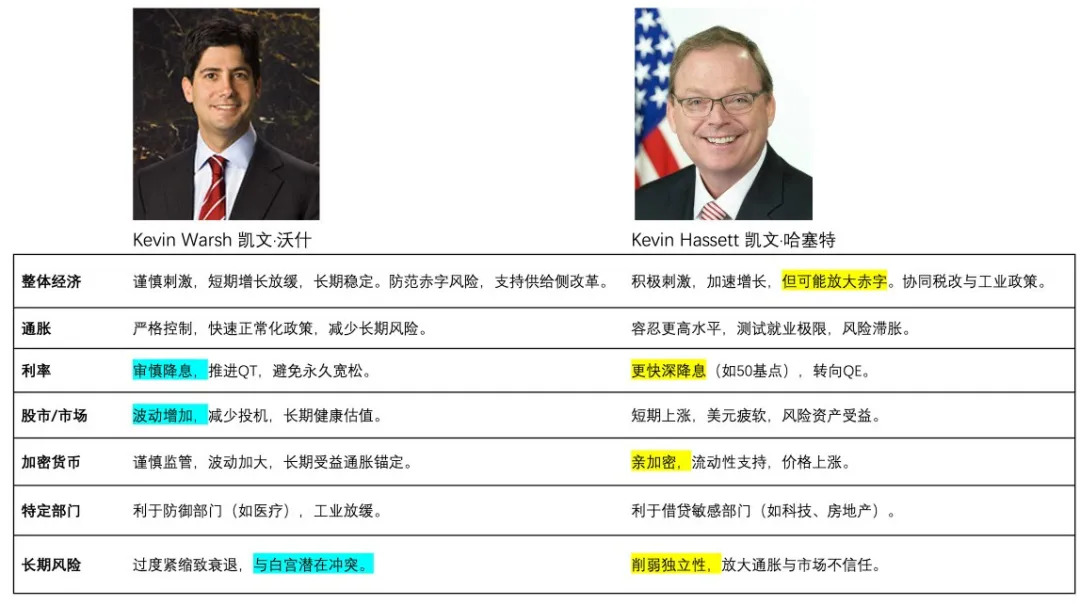
If Warsh is elected, the Fed may shift to a more cautious monetary policy framework.In the short term, this could lead to slower economic growth, prudent rate cuts, and the推进 of quantitative tightening (QT), thereby controlling inflation and reducing the risk of asset bubbles. However, it could also exacerbate an economic recession and create political friction with the White House. Stock market volatility may increase, but in the long run, it would promote healthy valuations, benefiting defensive sectors like healthcare and utilities.


Conversely, under Hassett's leadership, the Fed might focus more on short-term prosperity, stimulating consumption and investment through faster rate cuts and ending QT.This would benefit borrowing-sensitive sectors like technology and real estate, driving up stock and cryptocurrency markets, but could amplify deficits and inflation expectations, leading to stagflation risks and weakening the Fed's independence.


Overall, Warsh's policies focus more on long-term stability, while Hassett could amplify short-term market prosperity but increase the risk of political intervention.


Online Public Sentiment and Election Chance Analysis


As of December 13, 2025, opinion leaders and public sentiment on X platform (formerly Twitter) show that Hassett initially led, but after Trump's statement, Warsh's probability surged from 15% to 37-40%.


Prediction markets like Kalshi and Polymarket show Hassett's probability at around 49%, but the gap is narrowing.
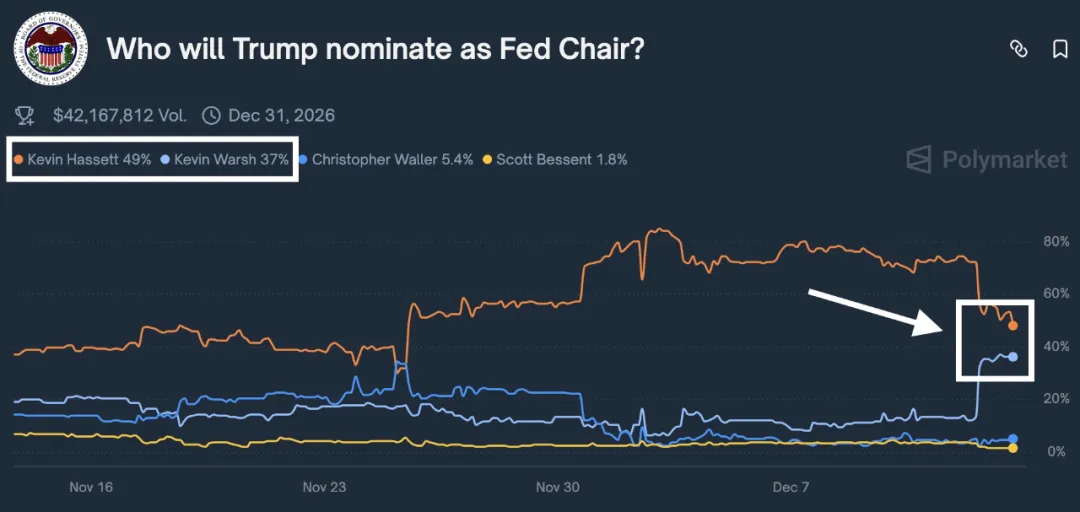

Wall Street Journal reporter Nick Timiraos pointed out that Hassett might "win the race," while financial commentator Steve Grasso emphasized that his pro-rate-cut stance is beneficial for the market.


Crypto analyst MartyParty sees Hassett as a pro-crypto candidate.


Mainstream media reports indicate that Trump views both as "top contenders" and expects an announcement before Christmas.


Warsh has received support from JPMorgan CEO Dimon, enhancing his prestige in financial circles. Currently, Warsh has stronger momentum and a slightly greater chance of being elected, but Hassett's pro-Trump background still gives him an advantage.


The appointment of the Fed Chair will profoundly affect the trajectory of the U.S. economy.


Warsh could bring an era of disciplined stability, while Hassett预示着 more aggressive growth-oriented policies.


Against the backdrop of the Trump administration's emphasis on "America First," who will prevail remains undecided, but regardless of the outcome, this choice will test the Fed's independence and the resilience of global financial markets.


Investors and policy observers should closely monitor subsequent developments to应对 potential market volatility.



Related Questions

QWhat are the key differences in monetary policy philosophy between Kevin Warsh and Kevin Hassett?

AKevin Warsh holds a hawkish view, prioritizing inflation control and fiscal sustainability, advocating for market discipline and cautious monetary policy normalization. Kevin Hassett is more dovish, emphasizing growth stimulation through aggressive rate cuts and coordination with fiscal policy, which may favor short-term market prosperity but risks higher deficits and inflation.

QHow did the market and prediction markets react to Trump's preference for Warsh or Hassett?

AFollowing Trump's statement, Kevin Warsh's probability surged from 15% to 37-40%, while prediction markets like Kalshi and Polymarket showed Hassett's probability around 49%, indicating a narrowing gap between the two candidates.

QWhat are the potential economic impacts if Kevin Warsh is appointed as Fed Chair?

AUnder Warsh's leadership, the Fed might adopt a more cautious monetary framework, leading to slower growth, prudent rate cuts, and quantitative tightening. This could control inflation and reduce asset bubbles but may increase recession risks and cause political friction with the White House.

QWhat are the potential economic impacts if Kevin Hassett is appointed as Fed Chair?

AHassett's Fed would likely focus on short-term prosperity through faster rate cuts and ending quantitative tightening, benefiting sectors like tech and real estate. However, this approach could amplify deficits, inflation expectations, and stagflation risks, potentially undermining Fed independence.

QWho are the key supporters of Warsh and Hassett, and how does this influence their chances?

AWarsh gained support from JPMorgan CEO Dimon, enhancing his credibility in financial circles. Hassett is favored for his pro-Trump background and endorsements from figures like crypto analyst MartyParty. Currently, Warsh has slightly stronger momentum, but Hassett's alignment with Trump keeps him competitive.

Related Reads

Has Hook Summer Truly Arrived? sato, Lo0p, FLOOD Ignite the New Uniswap v4 Narrative

With the broader market showing signs of recovery, a new wave of interest has emerged around Ethereum-based meme coins. Following ASTEROID, tokens like sato, sat1, Lo0p, and FLOOD, built upon the Uniswap v4 Hook protocol, are capturing market attention. Their market capitalizations range from millions to tens of millions of dollars, injecting much-needed focused liquidity into a market lacking narratives. This article explores whether this trend signifies an incoming "Hook Summer" and its potential impact on UNI's price. Hooks are essentially plug-in smart contracts for Uniswap v4 liquidity pools, allowing developers to inject custom logic at key points in a pool's lifecycle (like initialization, adding/removing liquidity, swaps). This transforms the AMM into programmable building blocks. Key highlighted projects include: * **sato**: Peaked over $38M market cap. It utilizes a v4 curve for minting/burning; buying locks ETH as reserve to mint new tokens, while selling redeems ETH from the reserve and burns tokens. * **sat1**: Market cap briefly exceeded $10M, promoted as an "optimized sato," but later declined significantly. * **Lo0p**: Reached nearly $6.6M. It's a lending AMM protocol where buying LO0P tokens locks them as collateral, allowing users to borrow ETH from the pool reserve at 40% LTV, aiming to improve capital efficiency for idle ETH in LPs. * **FLOOD**: Peaked near $6M. Its mechanism directs asset reserves from buys into Aave v3 to generate yield, with fees and interest retained in the pool to potentially influence the token's price long-term. In the long term, the development of the Hook ecosystem can attract users and liquidity to Uniswap v4, benefiting UNI's fundamentals—especially combined with the recent activation of the protocol fee switch, where a portion of fees is used to burn UNI. However, in the short term, these Hook-based tokens are unlikely to directly drive significant UNI price appreciation. Their impact is moderated by factors like token sustainability, price volatility, and broader market and regulatory conditions. Currently, Uniswap v4's TVL ($595M) still trails behind v2 and v3, indicating adoption and growth will take time. The article concludes that while the Hook ecosystem provides long-term "nourishment" for UNI, its short-term role is more of a "catalyst" than a "booster." Readers are cautioned that these are early-stage experimental tokens and may carry unknown risks.

Odaily星球日报2m ago

Has Hook Summer Truly Arrived? sato, Lo0p, FLOOD Ignite the New Uniswap v4 Narrative

Odaily星球日报2m ago

Interview with Michael Saylor: I Did Say I Would Sell Bitcoin, But Never a Net Sale

Interview with Michael Saylor: I Said We'd Sell Bitcoin, But Never Be a Net Seller In a recent podcast, MicroStrategy Executive Chairman Michael Saylor clarified the company's stance on potentially selling Bitcoin. Following MicroStrategy's earnings call statement about being prepared to sell BTC to fund dividends for its STRC (Strategic) credit product, Saylor emphasized the distinction between selling and being a "net seller." Saylor explained the core business model: MicroStrategy sells credit instruments like STRC and uses the proceeds to buy Bitcoin, which is viewed as "digital capital" expected to appreciate around 30-40% annually. A portion of these capital gains can then be used to pay the dividends on the credit products. He stressed that even if the company sells some Bitcoin for dividends, it simultaneously buys much more with new credit issuance. For example, after raising $3.2 billion from STRC sales in April, the dividend obligation was only $80-90 million, making the company a net buyer. The clarification aims to counter market narratives questioning the value of Bitcoin on MicroStrategy's balance sheet if it were never sold, and to dismiss claims of a "Ponzi scheme." Saylor reiterated his personal philosophy for investors: "Don't be a net seller of bitcoin" and ensure your Bitcoin holdings increase each year. Saylor also discussed Bitcoin's role as the foundation for "digital credit," noting that STRC has become the largest and most liquid preferred stock issue in the U.S., offering high risk-adjusted returns (Sharpe ratio). He highlighted Bitcoin's deep liquidity, stating that even large purchases by MicroStrategy do not move the market significantly, which is driven by macro factors, geopolitical tensions, and capital flows from ETFs and credit products. Finally, Saylor reflected on his early inspiration from sci-fi books, which motivated his path to MIT, and maintained his fundamental thesis on Bitcoin remains unchanged: it is superior digital capital enabling superior digital credit.

链捕手6m ago

Interview with Michael Saylor: I Did Say I Would Sell Bitcoin, But Never a Net Sale

链捕手6m ago

Beaten SK Hynix Employees in China: Year-end Bonus Less Than 5% of Korean Staff's

"SK Hynix Chinese Staff Hit Hard: Bonuses Less Than 5% of Korean Counterparts" Driven by the AI boom, South Korea's SK Hynix is experiencing record performance, with media reports predicting massive year-end bonuses for its employees, making them highly desirable in the matchmaking market. However, this prosperity starkly contrasts with the situation for the company's Chinese employees. According to reports, SK Hynix operates under a rule allocating 10% of operating profit for employee bonuses. While projections suggest Korean employees could receive bonuses reaching millions of RMB, a Chinese employee with over a decade of technical experience revealed the disparity: "If they get 3 million, Chinese staff get less than 5% of that." After adjustments based on KPI ratings, this employee's highest bonus was slightly over 100,000 RMB. Bonuses are paid annually in Korea but semi-annually in China. During the industry downturn in 2023-2024, Chinese employees received no bonus at all. The gap extends beyond bonuses. Recruitment posts for SK Hynix's Chinese factories (in Wuxi, Dalian, Chongqing) show engineer monthly salaries ranging from 10,000 to 35,000 RMB, with a 13th-month salary promised. Chinese employees also receive standard benefits like annual leave but lack stock incentives, which are reportedly unavailable to them. Furthermore, management positions in China are predominantly held by Korean personnel, though industry observers note a gradual increase in local middle managers over time. SK Hynix has confirmed the 10% bonus rule but cautioned that specific future bonus amounts remain unpredictable. The company forecasts strong demand for HBM and other high-value enterprise products for the next 2-3 years, driven by AI infrastructure investment. This focus on business-to-business markets may continue to constrain supply for consumer products, potentially prolonging price increases for components like memory.

链捕手19m ago

Beaten SK Hynix Employees in China: Year-end Bonus Less Than 5% of Korean Staff's

链捕手19m ago

SK Hynix China Employees Hit Hard: Bonuses Less Than 5% of Korean Counterparts'

"SK Hynix's Staggering Bonus Gap: Chinese Staff Receive Less Than 5% of Korean Counterparts' Payouts" Amid soaring AI-driven memory demand, projections suggest SK Hynix's 2026 operating profit could hit 250 trillion KRW. Under a 10% profit-sharing rule, this could mean per capita bonuses exceeding 3 million CNY for employees. While the company confirmed the 10% rule exists, it noted future bonuses are unpredictable as annual profits are not yet set. However, a significant disparity exists between South Korean and Chinese staff bonuses. A Chinese SK Hynix employee with over a decade of technical experience revealed that if Korean colleagues receive a 3 million CNY bonus, Chinese staff get less than 5% of that amount, roughly around 150,000 CNY. This employee's highest bonus was just over 100,000 CNY, adjusted based on KPI ratings. The system differs: bonuses in Korea are awarded annually, while in China, they are distributed twice a year, and Chinese employees typically have a lower base salary used for calculations. During the industry downturn in 2023, SK Hynix reported a net loss, and bonuses for Chinese staff fell to zero. Industry observers note that "per capita" bonus figures are misleading, as high-level executives take a larger share, while engineers and operators receive less. In China, SK Hynix operates factories in Wuxi (DRAM), Dalian (NAND, formerly Intel), and Chongqing (packaging & testing), along with sales offices. Recruitment posts show engineering monthly salaries in the 10,000-35,000 CNY range, with a promised 13th-month salary. Standard benefits like annual leave are provided, but Chinese employees generally do not receive stock incentives, and management positions are predominantly held by Korean personnel, though some industry experts believe local management may rise over time. Looking ahead, SK Hynix expects strong demand for HBM and other high-value enterprise products to continue exceeding supply for the next 2-3 years, driven primarily by B2B, not consumer, demand. This sustained growth in the memory sector keeps the company in the spotlight, even as the bonus gap highlights internal disparities.

marsbit40m ago

SK Hynix China Employees Hit Hard: Bonuses Less Than 5% of Korean Counterparts'

marsbit40m ago

Trading

Spot
Futures

Hot Articles

How to Buy US

Welcome to HTX.com! We've made purchasing Talus Network (US) simple and convenient. Follow our step-by-step guide to embark on your crypto journey.Step 1: Create Your HTX AccountUse your email or phone number to sign up for a free account on HTX. Experience a hassle-free registration journey and unlock all features.Get My AccountStep 2: Go to Buy Crypto and Choose Your Payment MethodCredit/Debit Card: Use your Visa or Mastercard to buy Talus Network (US) instantly.Balance: Use funds from your HTX account balance to trade seamlessly.Third Parties: We've added popular payment methods such as Google Pay and Apple Pay to enhance convenience.P2P: Trade directly with other users on HTX.Over-the-Counter (OTC): We offer tailor-made services and competitive exchange rates for traders.Step 3: Store Your Talus Network (US)After purchasing your Talus Network (US), store it in your HTX account. Alternatively, you can send it elsewhere via blockchain transfer or use it to trade other cryptocurrencies.Step 4: Trade Talus Network (US)Easily trade Talus Network (US) on HTX's spot market. Simply access your account, select your trading pair, execute your trades, and monitor in real-time. We offer a user-friendly experience for both beginners and seasoned traders.

4.5k Total ViewsPublished 2025.12.11Updated 2025.12.11

How to Buy US

Discussions

Welcome to the HTX Community. Here, you can stay informed about the latest platform developments and gain access to professional market insights. Users' opinions on the price of US (US) are presented below.

活动图片