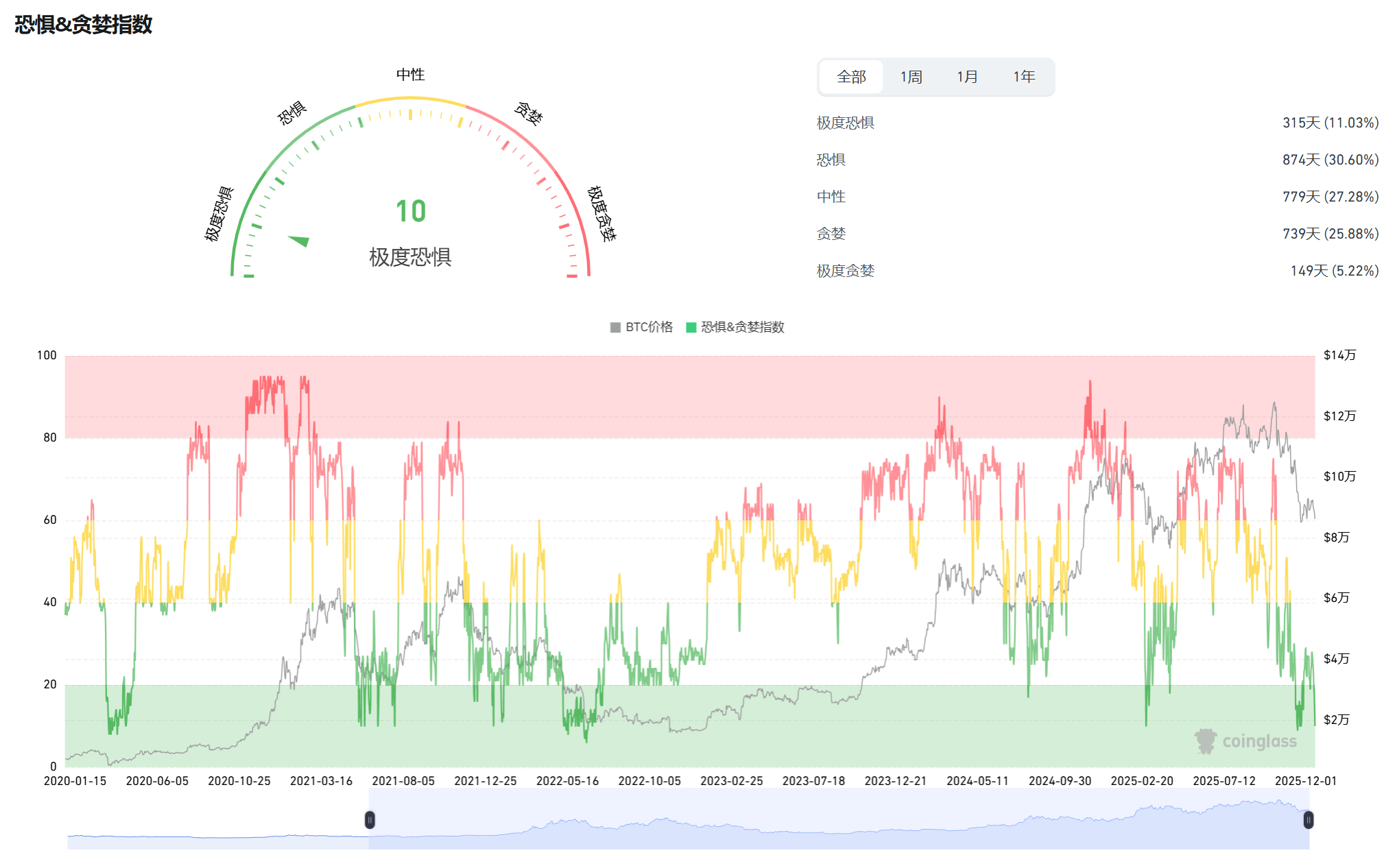
Fear & Greed Index Hits New Low of 10! Bitcoin Breaks Below $86K! Are All Blockchains Dead Except Tron, SOL, and BNB?

marsbitPublished on 2025-12-16Last updated on 2025-12-16

Abstract

The Crypto Fear & Greed Index has plummeted to a shocking 10, indicating "extreme fear" in the market—the lowest level since the COVID-19 crash of March 2020. Bitcoin fell to around $85,100, while Ethereum dropped to $2,880. On-chain data reveals a stark divergence among blockchains. Tron leads with $1.24 million in 24-hour fees, followed by Solana ($589,088) and BNB Chain ($435,075). Ethereum ranked fourth with just $418,425. Many once-popular chains like Celestia, Sui, and Algorand generated less than $50 in fees, raising serious concerns about their utility and sustainability. The panic stems from macro liquidity tightening—due to delayed Fed rate cuts and Bank of Japan hikes—and cracks in crypto’s core narratives. Bitcoin ETFs have seen net outflows of over $2.3 billion since November, and long-term holders are selling aggressively. Ethereum’s staking model faces scrutiny: with 27.89% of ETH staked, yields rely heavily on token inflation rather than organic fee revenue, creating economic vulnerability. Historically, such extreme fear has often marked market bottoms. While retail and mid-sized whales panic-sell, large entities continue accumulating Bitcoin. The current sell-off may present a long-term opportunity, echoing past cycles where despair preceded major rallies.

Today, the Crypto Fear & Greed Index has plummeted to a shocking value of 10, officially marking market sentiment as entering the "Extreme Fear" zone.

This is the lowest level since the global market crash triggered by the COVID-19 pandemic in March 2020, even surpassing the panic levels of the Terra/Luna collapse in 2022.

In this morning's sharp decline, Bitcoin briefly touched a low of $85,100, while Ethereum also fell to a low of $2,880.

Market participant sentiment has nearly frozen solid; this panic is not only reflected in prices but is deeply etched into every byte of on-chain data.

The Harsh Truth of On-Chain Fees: The "Survival Stress Test" for Blockchains

The ranking of fees generated across all blockchains in the past 24 hours presents an extremely polarized picture:
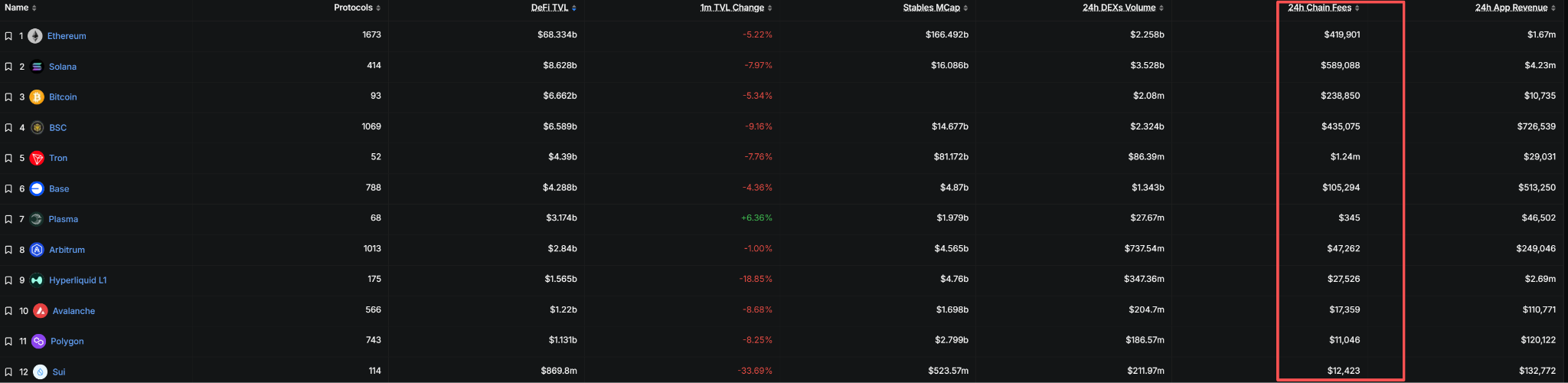
Tron leads with $1.24 million, SOL follows closely with $589,088, the BNB Chain ranks third with $435,075, while Ethereum trails in fourth place with only $418,425.

This data far exceeds general expectations, with several so-called star blockchains like SUI and Plasma generating less than 1/10th of Tron's fees.


However, the truly alarming situation is the survival state of the long-tail blockchains.
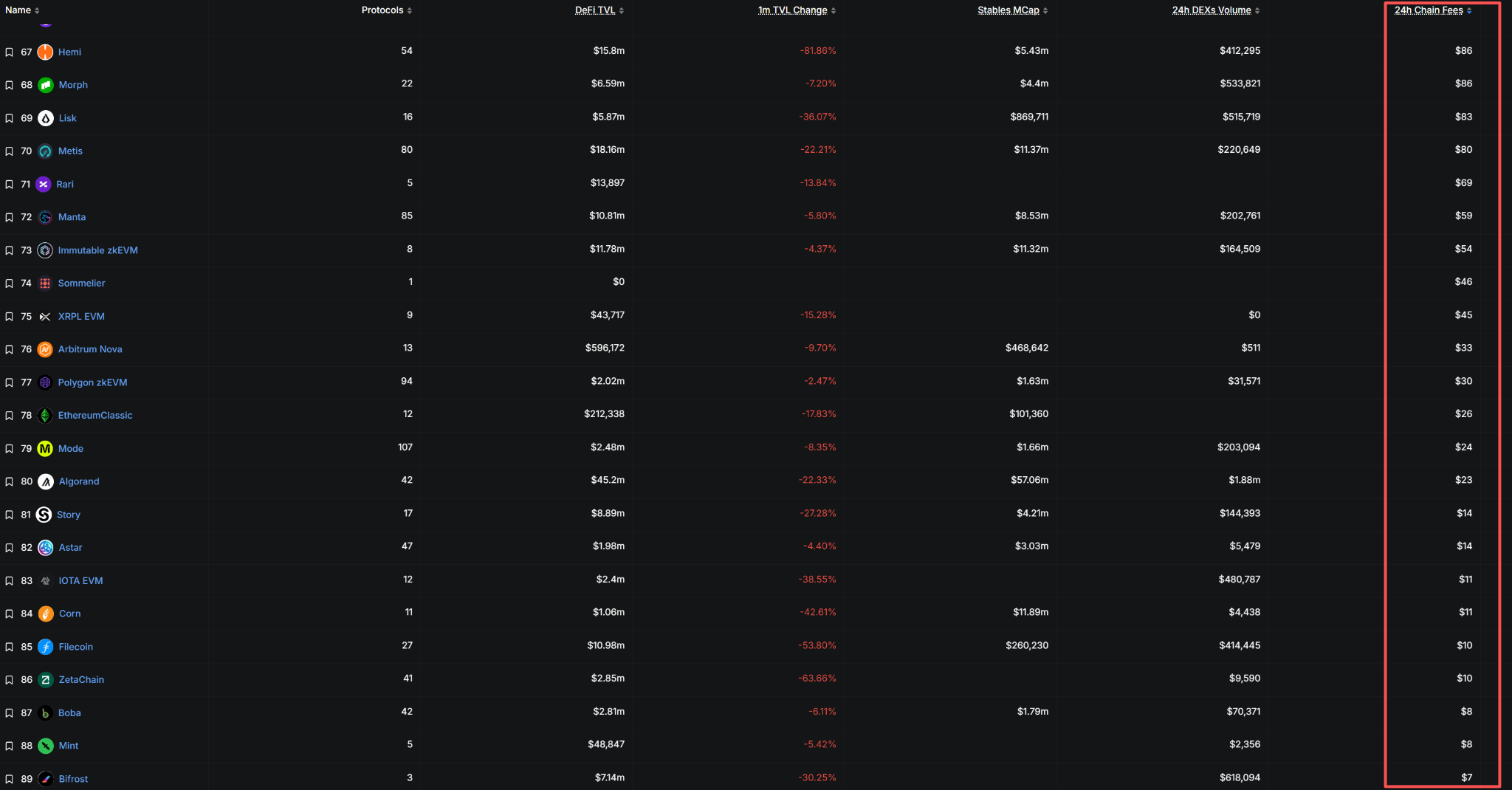
Blockchains that were once popular, such as Celestia, Hemi, Morph, Manta, Immutable zkEVM, EthereumClassic, Algorand, Story, and Filecoin, generated less than $50 in fees in the past 24 hours—less than a roadside stall.

This data undoubtedly indicates that the actual usage of these blockchains is nearing zero.

Fees are the direct "tax" of a blockchain's economy and a core metric for measuring network value.

When a blockchain's daily fees are less than $50, its network security, degree of decentralization, and long-term sustainability are all called into serious question.


The Macro Backdrop of Market Panic: Liquidity Crisis and Narrative Breakdown

This market panic is not due to a single factor but is the result of a combination of tightening global liquidity and the breakdown of internal crypto narratives.

On one hand, global USD liquidity is facing severe challenges. The Fed's maintained hawkish stance, delaying rate cut expectations, has led to a heavy blow to global risk assets.

The Bank of Japan's rate hike has further intensified global liquidity contraction. Historical data shows that BoJ hiking cycles often coincide with global liquidity tightening; the two rounds of hikes in March 2024 and January 2025 both caused Bitcoin to retreat by over 30%.

On the other hand, two core internal narratives of the crypto market are being severely tested.

Bitcoin spot ETFs have turned from an "engine" into a "pump," with net outflows exceeding $2.3 billion since November alone.
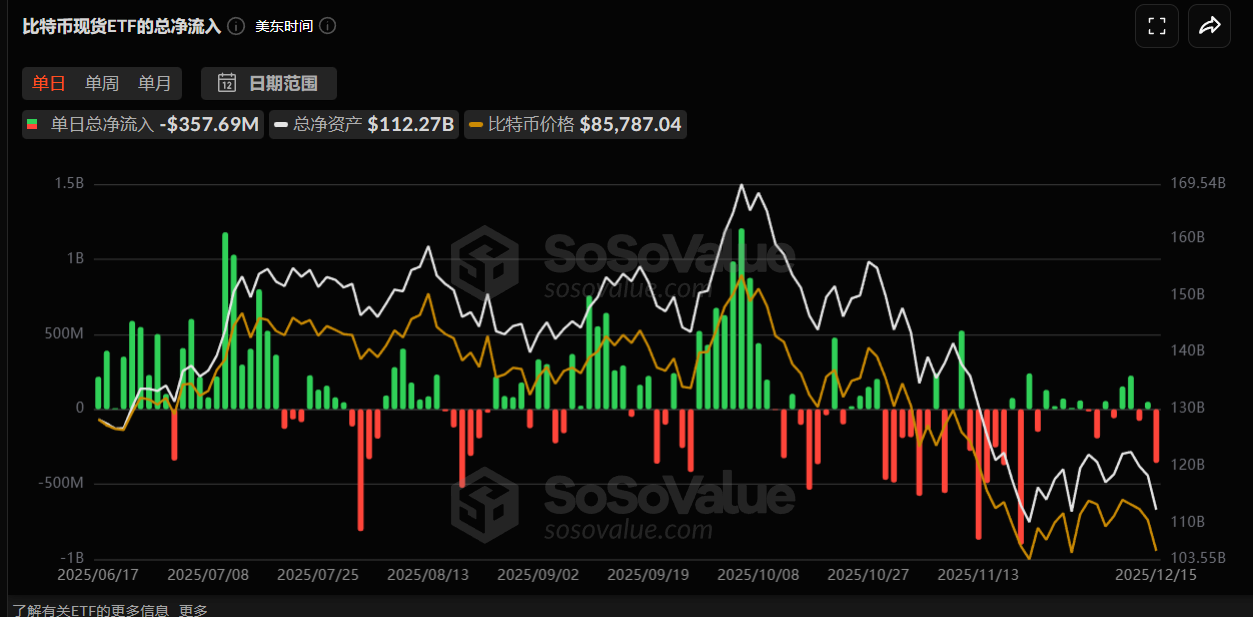
More worryingly, long-term holders have been selling Bitcoin on a large scale, a rare occurrence, selling approximately 815,000 BTC just in early November. When the two major narratives of "institutional adoption" and "long-term holding" show cracks simultaneously, market confidence collapses like an avalanche.

On-chain data shows the market just experienced "the largest realized loss day in the past six months," meaning a massive amount of assets were sold below their purchase price, and investors are纷纷 "cutting losses" and exiting.


The Economic Paradox of Ethereum Staking: Who is Paying for the Whales' Profits?

Against the bear market backdrop, Ethereum's economic model deserves particular scrutiny.

Ethereum's problem gets to the core: Big players staking Ethereum are taking so much money from the protocol every day; who is paying for that?

In reality, the Ethereum Beacon Chain staking annual yield is approximately 3.5%. These returns primarily come from two parts: block rewards (paid by the protocol issuing new tokens, effectively diluting the value for all token holders) and transaction fees (paid by users engaged in on-chain activity).

During a bull market, high Gas fees can be absorbed by active users through DeFi, NFT, and other applications;

but in a bear market, on-chain activity plummets, and staking rewards rely more on token issuance—this essentially means later participants are "transfusing" early stakers through inflation.
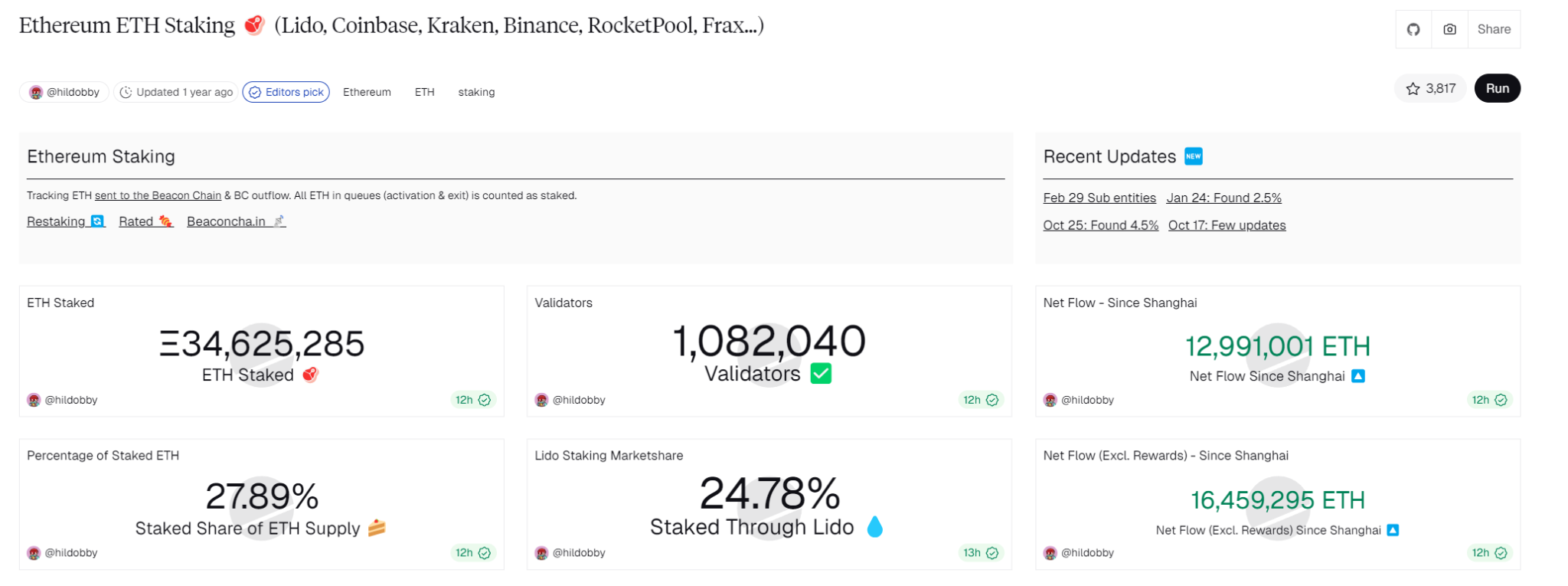

The current total amount staked on the Ethereum Beacon Chain accounts for 27.89% of the circulating supply. These stakers earn stable returns from the protocol daily. However, with fee revenue at only $418,000 (less than a third of Tron's), whether the Ethereum network can sustainably support such massive staking rewards is indeed worth pondering.

More seriously, when the Ethereum price falls, stakers may face a situation where "rewards are insufficient to cover the currency's depreciation," potentially triggering a negative feedback loop of unstaking and selling.

This does share similarities with Ponzi structures in traditional finance: any system reliant on new funds to maintain old returns exposes its fragility during liquidity contractions.


A Philosophical Question: After the Crypto "Red Pill" Takes Effect

"When people say Bitcoin is a Ponzi scheme, it's also the first time they realize the essence of any form of property rights in the real world is a Ponzi." This view touches the essence of the problem.

All value systems are built on consensus, whether fiat currency, gold, or cryptocurrency.

When people say the crypto space is a casino, it might be the first time they truly recognize the nature of the global financial system.

In traditional financial markets, central banks can print money indefinitely, governments can change rules arbitrarily, and insider trading and market manipulation are commonplace. Compared to these traditional financial markets hidden behind opaque rules, the crypto space at least presents the brutality of finance in an extremely transparent, real-time manner to all participants.

In today's market, the Bitcoin Fear & Greed Index is only 11, and on-chain data shows most blockchains are nearly "brain dead." Investors are not disappointed with crypto itself but are unable to accept the real world seen after swallowing the "red pill."

The cryptocurrency market is like a mirror, reflecting the nature of the global financial system: all asset prices are ultimately driven by liquidity, not intrinsic value. When the Fed "turns off the tap," everything from stocks and crypto to gold faces selling pressure.


Historical Perspective: Value Return After Extreme Fear

Looking back at cryptocurrency history, every period of extreme market fear has ultimately proven to be an excellent opportunity for long-term investment.

During the COVID-19 crash in March 2020, the Fear & Greed Index plummeted to 10-15, but Bitcoin subsequently embarked on a bull market that lasted over a year.

In June 2022, following the Terra/Luna collapse and macro-economic tightening, the index remained in "Extreme Fear" territory (8-15) for weeks. Although prices fell across the board, sustained panic actually marked the market bottom. Currently, although market sentiment is extremely pessimistic, on-chain data reveals another picture: behind the panic "surrender," a great "asset transfer" is quietly taking place. Medium-sized whales and panicked retail investors are selling, while large strategic entities and steadfast retail investors are actively accumulating.

Data shows that the largest strategic entities (holding >10,000 BTC) continued to accumulate throughout November, with a net increase of 10,700 BTC. Even Bitcoin's most famous evangelist, Michael Saylor's company, announced buying another $50 million worth of Bitcoin amidst the market panic.

Periods of extreme fear are the perfect time to "be greedy when others are fearful." Historically, choosing to sell when the Fear Index drops to single digits has often been the wrong move.


Trending Cryptos

Related Questions

QWhat does a Crypto Fear & Greed Index reading of 10 indicate about the current market sentiment?

AA reading of 10 indicates that the market sentiment has officially fallen into the 'Extreme Fear' zone, marking the lowest level of investor confidence since the global market crash triggered by the COVID-19 pandemic in March 2020.

QAccording to the article, which three blockchains lead in 24-hour fee generation, and what does this indicate?

ATron leads with $1.24 million, followed by Solana with $589,088, and BNB Chain with $435,075. This indicates a highly differentiated landscape where these few chains capture the vast majority of actual usage and economic activity, while many others are struggling.

QWhat two core internal narratives in the cryptocurrency market are being severely tested, according to the analysis?

AThe two core narratives being tested are: 1) Bitcoin spot ETFs, which have turned from an 'engine' of growth into a 'pump' draining liquidity, with a net outflow of over $2.3 billion since November. 2) The 'long-term holding' narrative, as long-term holders have been selling on a large scale, with approximately 815,000 BTC sold in early November.

QWhat economic paradox does the article highlight regarding Ethereum's staking model, especially in a bear market?

AThe paradox is that large stakeholders staking ETH earn yields (approx. 3.5% APY) that are paid through block rewards (new token issuance, diluting all holders) and transaction fees. In a bear market with reduced on-chain activity, the rewards rely more on inflation, meaning later participants are effectively 'transferring blood' to early stakers through dilution, creating a potentially unsustainable model.

QWhat historical pattern does the article suggest often follows periods when the Fear & Greed Index reaches extreme lows like 10?

AHistorically, periods of extreme fear, such as the index dropping to 10-15, have often proven to be excellent long-term investment opportunities. For example, the crash in March 2020 was followed by a bull market that lasted over a year, and the panic in June 2022 marked a market bottom.

Related Reads

As Consensus Accelerates, What Are Young Investors Betting On?

Title: As Consensus Forms Faster, What Are Young Investors Betting On? In the rapid evolution of tech investment, a new generation of young investors is navigating a landscape where AI, robotics, commercial aerospace, and quantum computing are advancing simultaneously. Traditional investment logic based on financial models is giving way to a need for deep technical understanding and the ability to act before industry consensus forms. An analysis of trends from the "WAIC FUTURE TECH" list of young investment leaders reveals key shifts in focus. The first major trend is the movement of AI from the digital screen into the physical world. Investment is shifting from large language models and chatbots towards embodied AI, robotics, AI hardware, and edge computing. While demonstrations generate excitement, the real challenge lies in achieving scalable, reliable, and cost-effective delivery in complex real-world environments like factories and logistics. Success depends not just on algorithms but on the integration of sensors, actuators, and control systems. Second, the competitive focus for large models is moving beyond raw capability toward building an "intelligence flywheel." The goal is to create self-reinforcing systems where user interaction generates data, improving the model, which in turn enhances the user experience and attracts more engagement. Companies that successfully embed AI into workflows to create these closed-loop systems can build lasting value that isn't easily erased by the next model upgrade. Third, facing a potential bottleneck in high-quality human-generated data, investors are looking at new underlying technologies. Reinforcement learning and self-play, as demonstrated by AlphaGo Zero, offer paths for AI to generate its own experience. Scientific foundation models, which aim to build general AI capabilities for fields like life sciences and materials discovery, represent a non-consensus direction that could unlock new frontiers of knowledge and data. Finally, in deep-tech areas like quantum computing, commercial aerospace, and space-based infrastructure, patient capital is essential. These fields have long, uncertain development and validation cycles involving complex engineering, supply chains, and regulations. Investment here requires a long-term view, focusing on foundational team capabilities and the eventual emergence of market demand, even if commercial returns are distant. Collectively, these trends illustrate how young investors are adapting to a new era. They are learning to make earlier, technically-informed judgments, balance hype with real-world viability, and provide the patient capital needed to build the deep-tech foundations of the future.

marsbit5m ago

As Consensus Accelerates, What Are Young Investors Betting On?

marsbit5m ago

Can Japan Buy Growth with AI? Will the Bond Market Believe It?

Japan's cabinet has introduced the 2026 Basic Policy on Economic and Fiscal Management and Reform, shifting its primary fiscal target. The new framework moves away from the traditional annual primary balance goal and instead prioritizes a stable reduction of the debt-to-GDP ratio. This change is tied to a strategy of increased "responsible proactive fiscal" spending, aiming to boost long-term growth through investments in strategic sectors like AI, semiconductors, energy, and robotics. The government estimates total public and private investment in 62 key technologies could exceed 370 trillion yen by 2040. The market reaction has been mixed and cautious. While equity markets may respond to policy signals, bond markets are focused on fiscal credibility. Concerns center on whether the weakening of the clear primary balance anchor could lead to looser fiscal discipline. If investors doubt that these strategic investments will generate sufficient productivity gains, tax revenue, and nominal growth to outpace rising interest costs, they may demand higher yields on Japanese Government Bonds (JGBs). Recent volatility in the yen and JGB yields, with the 10-year yield briefly reaching 2.9%, reflects this skepticism. The success of this new framework hinges on two factors: whether Japan can achieve a nominal growth rate consistently higher than its long-term interest rates, and whether future budgets demonstrate disciplined control over bond issuance. The government's narrative is that strategic investment is essential to break Japan's cycle of low growth, aging, and labor shortages. However, the bond market will continuously assess the credibility of this plan, pricing the risk that it may represent fiscal expansion rather than a viable growth strategy.

marsbit42m ago

Can Japan Buy Growth with AI? Will the Bond Market Believe It?

marsbit42m ago

Misjudged A-Shares: Resilience, Expectations, and Confidence

China's A-share market recently faced selling pressure, especially in tech sectors, initially triggered by a global tech sell-off that began in South Korea. However, the article argues this is a case of "mistaken injury" and highlights the market's underlying resilience. This resilience stems from three main pillars: **1) Tech Sector Fundamentals:** Unlike Korea's market dominated by a few memory chip stocks, China's tech sector is diversified across computing, communications, electronics, and semiconductors, supported by dual narratives of global AI supply chains and domestic substitution. Core areas like optical modules and fiber optics continue to show strong earnings growth. **2) "National Team" Support:** State-backed institutions and large corporations have made significant market purchases and announced buybacks, providing liquidity and signaling confidence. This is seen as a stabilizing policy signal, often associated with market bottoms. **3) Broader Market Pillars:** Other major sectors are showing endogenous recovery momentum. Consumer stocks benefit from stabilizing CPI and signs of sector recovery (e.g., liquor price hikes). Cyclical sectors like aluminum have high earnings, potential price increases due to tight supply, and low valuations. The financial sector offers stable dividends and low valuations. The conclusion is that the sell-off was driven by external contagion, not a collapse in fundamentals. With strong policy support and recovering momentum across key sectors, the A-share market possesses the toughness to regain stability.

marsbit1h ago

Misjudged A-Shares: Resilience, Expectations, and Confidence

marsbit1h ago

Trading

Spot

Hot Articles

What is $BITCOIN

DIGITAL GOLD ($BITCOIN): A Comprehensive Analysis Introduction to DIGITAL GOLD ($BITCOIN) DIGITAL GOLD ($BITCOIN) is a blockchain-based project operating on the Solana network, which aims to combine the characteristics of traditional precious metals with the innovation of decentralized technologies. While it shares a name with Bitcoin, often referred to as “digital gold” due to its perception as a store of value, DIGITAL GOLD is a separate token designed to create a unique ecosystem within the Web3 landscape. Its goal is to position itself as a viable alternative digital asset, although specifics regarding its applications and functionalities are still developing. What is DIGITAL GOLD ($BITCOIN)? DIGITAL GOLD ($BITCOIN) is a cryptocurrency token explicitly designed for use on the Solana blockchain. In contrast to Bitcoin, which provides a widely recognized value storage role, this token appears to focus on broader applications and characteristics. Notable aspects include: Blockchain Infrastructure: The token is built on the Solana blockchain, known for its capacity to handle high-speed and low-cost transactions. Supply Dynamics: DIGITAL GOLD has a maximum supply capped at 100 quadrillion tokens (100P $BITCOIN), although details regarding its circulating supply are currently undisclosed. Utility: While precise functionalities are not explicitly outlined, there are indications that the token could be utilized for various applications, potentially involving decentralized applications (dApps) or asset tokenization strategies. Who is the Creator of DIGITAL GOLD ($BITCOIN)? At present, the identity of the creators and development team behind DIGITAL GOLD ($BITCOIN) remains unknown. This situation is typical among many innovative projects within the blockchain space, particularly those aligning with decentralized finance and meme coin phenomena. While such anonymity may foster a community-driven culture, it intensifies concerns about governance and accountability. Who are the Investors of DIGITAL GOLD ($BITCOIN)? The available information indicates that DIGITAL GOLD ($BITCOIN) does not have any known institutional backers or prominent venture capital investments. The project seems to operate on a peer-to-peer model focused on community support and adoption rather than traditional funding routes. Its activity and liquidity are primarily situated on decentralized exchanges (DEXs), such as PumpSwap, rather than established centralized trading platforms, further highlighting its grassroots approach. How DIGITAL GOLD ($BITCOIN) Works The operational mechanics of DIGITAL GOLD ($BITCOIN) can be elaborated on based on its blockchain design and network attributes: Consensus Mechanism: By leveraging Solana’s unique proof-of-history (PoH) combined with a proof-of-stake (PoS) model, the project ensures efficient transaction validation contributing to the network's high performance. Tokenomics: While specific deflationary mechanisms have not been extensively detailed, the vast maximum token supply implies that it may cater to microtransactions or niche use cases that are still to be defined. Interoperability: There exists the potential for integration with Solana’s broader ecosystem, including various decentralized finance (DeFi) platforms. However, the details regarding specific integrations remain unspecified. Timeline of Key Events Here is a timeline that highlights significant milestones concerning DIGITAL GOLD ($BITCOIN): 2023: The initial deployment of the token occurs on the Solana blockchain, marked by its contract address. 2024: DIGITAL GOLD gains visibility as it becomes available for trading on decentralized exchanges like PumpSwap, allowing users to trade it against SOL. 2025: The project witnesses sporadic trading activity and potential interest in community-led engagements, although no noteworthy partnerships or technical advancements have been documented as of yet. Critical Analysis Strengths Scalability: The underlying Solana infrastructure supports high transaction volumes, which could enhance the utility of $BITCOIN in various transaction scenarios. Accessibility: The potential low trading price per token could attract retail investors, facilitating wider participation due to fractional ownership opportunities. Risks Lack of Transparency: The absence of publicly known backers, developers, or an audit process may yield skepticism regarding the project's sustainability and trustworthiness. Market Volatility: The trading activity is heavily reliant on speculative behavior, which can result in significant price volatility and uncertainty for investors. Conclusion DIGITAL GOLD ($BITCOIN) emerges as an intriguing yet ambiguous project within the rapidly evolving Solana ecosystem. While it attempts to leverage the “digital gold” narrative, its departure from Bitcoin's established role as a store of value underscores the need for a clearer differentiation of its intended utility and governance structure. Future acceptance and adoption will likely depend on addressing the current opacity and defining its operational and economic strategies more explicitly. Note: This report encompasses synthesised information available as of October 2023, and developments may have transpired beyond the research period.

972 Total ViewsPublished 2025.05.13Updated 2025.05.13

What is $BITCOIN

Discussions

Welcome to the HTX Community. Here, you can stay informed about the latest platform developments and gain access to professional market insights. Users' opinions on the price of BTC (BTC) are presented below.

活动图片














