Farewell to 24-Hour Delays: How to Predict ETF Fund Flows Through Premium Rates

marsbitPublished on 2026-02-01Last updated on 2026-02-01

Abstract

The article explains how ETF premium/discount rates can predict daily fund flows for Bitcoin and ETH ETFs, bypassing the 24-hour delay of official data. A persistent negative premium (ETF trading below its net asset value) typically signals net outflows, as Authorized Participants (APs) arbitrage by buying cheap ETF shares, redeeming them for the underlying asset, and selling it. Conversely, a positive premium (ETF trading above NAV) predicts inflows, as APs buy the underlying asset to create new ETF shares to sell at the higher price. Statistical analysis from a 146-day period showed this indicator was accurate approximately 81-84% of the time. For instance, a week of sustained premiums below -0.15% in January 2026 preceded a $1.3 billion outflow and a significant price drop. The article cautions that the premium rate is not a standalone tool. Its effectiveness depends on normal market function and should be combined with other indicators for confirmation, such as: - ETF holdings changes - Futures basis and funding rates - Options Put/Call ratios - On-chain large transfers and exchange net flows Key usage tips include focusing on the persistence of the extremity of the premium rate (±1% is significant) and considering the asset's price context (e.g., negative premium at a price high may signal a top). The goal is to use this real-time data to gain an informational edge and validate trends.

Since the approval of spot ETFs for BTC and ETH, daily ETF fund inflows and outflows have become a core metric for many traders to set their positions.

The logic is simple: net inflows indicate institutional buying and bullish sentiment; net outflows indicate institutional selling and bearish sentiment.

But the problem is, the ETF data we see every day is the result of the previous day.

By the time the data is released, the price has often already reflected it.

So, is there any way to predict in advance whether today's ETF will see net inflows or net outflows?

Yes, the answer is the ETF premium rate.

It's not hard to verify this pattern; reviewing the soon-to-end January 2026 is the best sample.

As of January 28th, there were 18 trading days in the U.S. stock market.

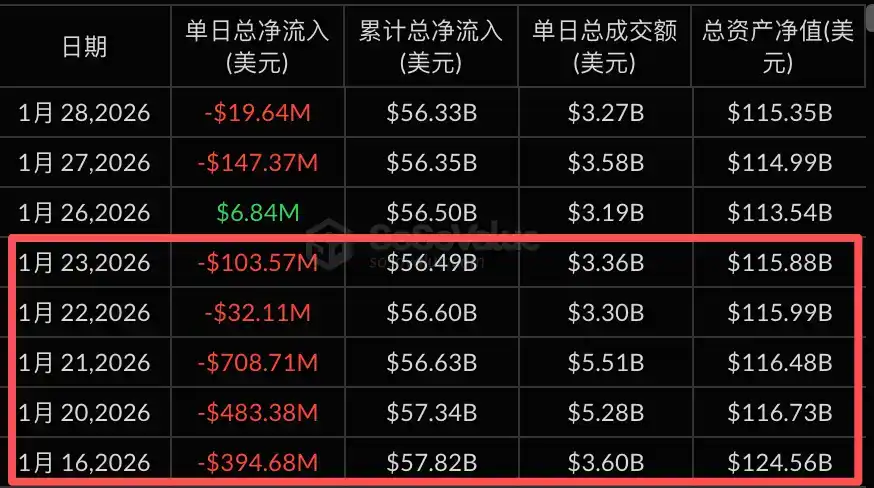
Statistics show that the premium index on Coinbase stayed in positive territory for only two days, while the other 16 days were all in negative premium territory.

Corresponding ETF fund flows show that 11 of these 16 days ultimately recorded net outflows.

Especially from January 16th to 23rd, the negative premium rate continuously fell below -0.15%, corresponding to a weekly net outflow of over $1.3 billion from the ETF market, with BTC's price dropping from a high of $97,000 to around $88,000.
Let's take a longer-term view.

From July 1, 2025, to January 28, 2026, a total of 146 trading days.

· Negative premium rate occurred for 48 days, corresponding to net outflows for 39 days, accuracy rate 81%.

· Positive premium rate occurred for 98 days, corresponding to net inflows for 82 days, accuracy rate 84%.

This is the value of the premium rate: it allows you to see where the money is flowing earlier than most.

What is the Premium Rate

We've been talking about the premium rate, but what exactly is it?

Here's an analogy.

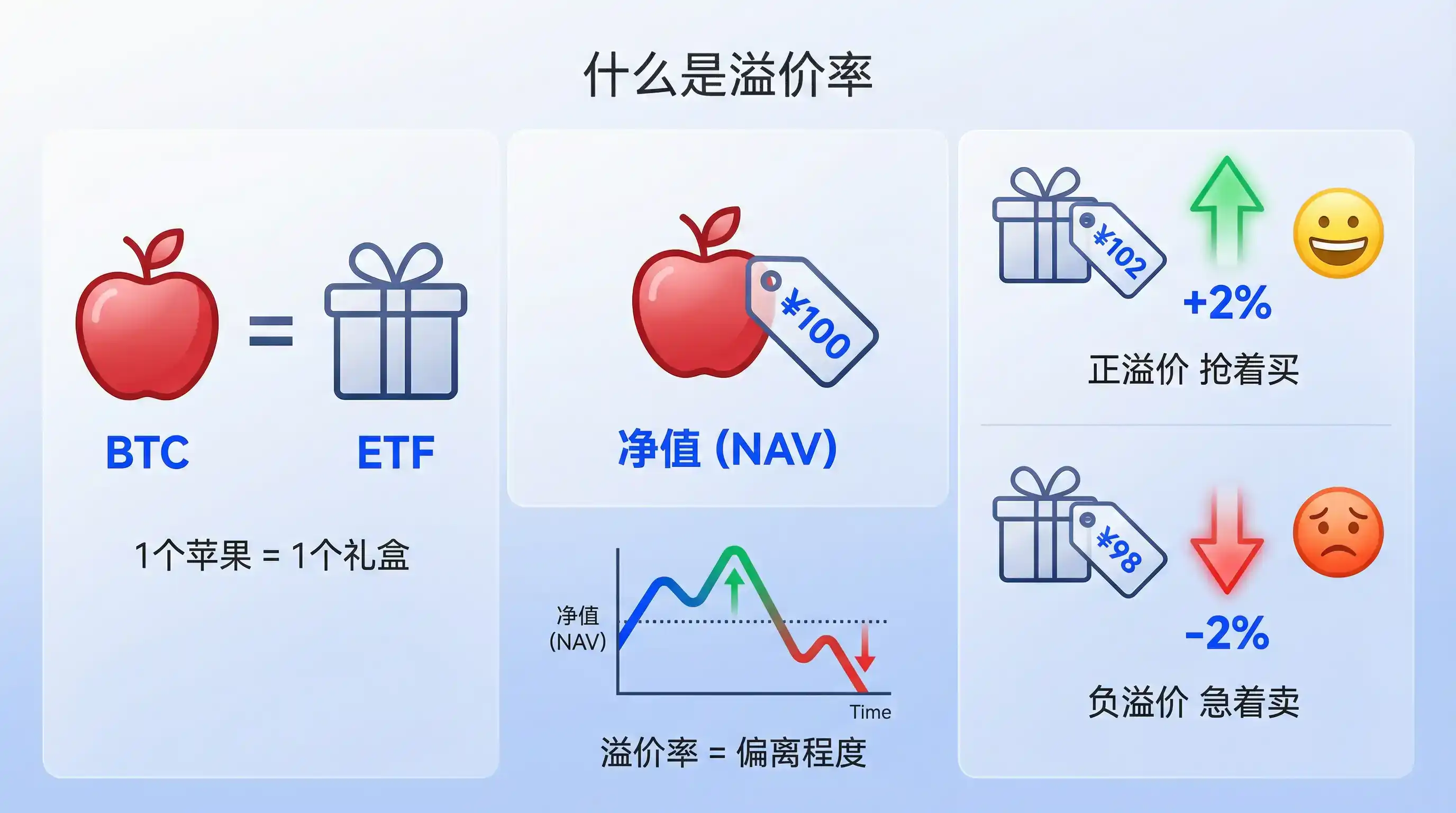
BTC is like loose apples in a grocery market, while a BTC spot ETF is like a packaged apple gift box in a supermarket, each containing one apple.

An apple sells for $100 in the grocery market; this is the Net Asset Value (NAV).

How much the apple gift box sells for in the supermarket depends on supply and demand.

If many people buy it, the box gets bid up to $102; this is a positive premium rate, a premium of +2%.

If many people sell it, the box drops to $98; this is a negative premium rate, a discount of -2%.

The premium rate reflects the degree to which the ETF market price deviates from the true price of BTC.

A positive premium indicates optimistic market sentiment; everyone is rushing to buy.

A negative premium indicates pessimistic market sentiment; everyone is eager to sell.
The Relationship Between Premium Rate Polarity and ETF Inflows/Outflows

The premium rate is not just a market sentiment indicator; it also becomes a key factor driving fund flows.

The key player in this is the AP, or Authorized Participant, which you can think of as a privileged arbitrageur.

The core logic for APs is risk-free arbitrage: they can create and redeem ETF shares in the primary market, and also buy and sell them in the secondary market.

As long as there is a price difference, they will arbitrage it.

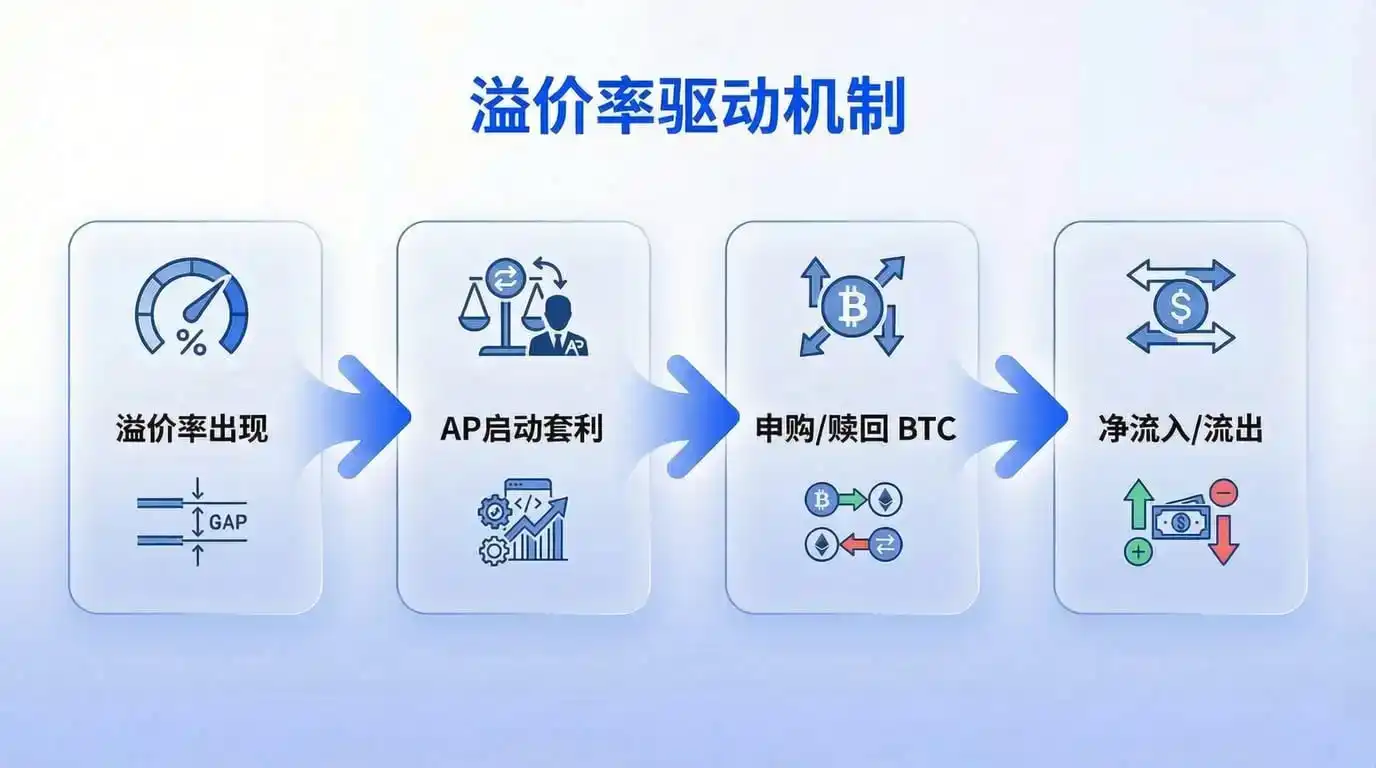
When a positive premium rate occurs, the gift box is more expensive than the apple. APs will go to the primary market to buy BTC, package it into ETF shares, and then sell them in the secondary market to profit from the difference. In this process, BTC is bought, resulting in a net inflow of funds.

Conversely, when a negative premium rate occurs, the gift box is cheaper than the apple. APs will buy ETFs in the secondary market, unbundle them to redeem the underlying BTC, and then sell the BTC to profit from the difference. In this process, BTC is sold, resulting in a net outflow of funds.

So the logical chain is this:

Premium rate appears → APs initiate arbitrage → Creation or redemption occurs → Net inflow or outflow is formed.
And the ETF fund data we see every day is published the next day after settlement.

The premium rate is real-time; the fund data is lagging.

This is why the premium rate can give you a step ahead of the market.

How to Apply the Premium Rate

Now that we understand the principle behind the premium rate and ETF net inflows/outflows, how should we apply it to our individual trading plans?

First, the premium rate is not an indicator to be used in isolation.

It can tell us the direction of funds but not the magnitude or persistence.

Here, I suggest considering it in conjunction with the following dimensions.

1. The Persistence of the Premium Rate is More Important Than a Single Day's Value

A single day of negative premium rate might just be short-term volatility.

But if negative premium rates appear for multiple consecutive days, it likely corresponds to continuous net outflows and is worth being alert about.

Look back at the five consecutive trading days of negative premium rates from January 16th to 23rd this year, which corresponded to five days of net outflows, with BTC falling nearly 10%.

2. Pay Attention to Extreme Values of the Premium Rate

Generally, fluctuations within ±0.5% are normal.

Once it breaks through ±1%, it indicates a clear deviation in market sentiment, AP arbitrage motivation strengthens, and fund flows will accelerate.

3. Judge in Conjunction with Price Levels

Sustained negative premium rates at high prices might be an early signal of capital flight.

Sustained positive premium rates at low prices might be a sign of bottom-fishing capital entering the market.

The premium rate itself does not constitute a buy or sell signal, but it can help you verify the current trend or detect turning points in the trend early.

Final Notes

Finally, a few points to note.

No indicator is a holy grail; the effectiveness of the premium rate is based on the premise of normal AP arbitrage mechanisms.

In extreme market conditions, such as the 10.11 crash, where market liquidity dries up, the arbitrage mechanism may fail, and the correlation between the premium rate and fund flows may decrease.

Furthermore, the premium rate is just one window into observing ETF fund movements.

For mature investors, the premium rate is just one piece of the puzzle.

It is recommended to conduct multi-dimensional cross-verification with the following indicators:

1. Changes in ETF Holdings: Rising holdings indicate institutions are accumulating; falling holdings indicate they are reducing positions. More direct than the premium rate, but data updates are delayed.

2. Futures Basis and Funding Rate: A positive basis and continuously high funding rates indicate overheated long sentiment and possible excessive optimism. Conversely, it indicates bearish dominance.

3. Put/Call Ratio in the Options Market: Puts are put options (bearish), Calls are call options (bullish). A rising ratio indicates rising market risk-off sentiment; a falling ratio indicates dominant optimism.

4. On-chain Large Transfers and Exchange Net Inflows: Large BTC transfers to exchanges often signal impending selling pressure. Large withdrawals from exchanges indicate accumulation.

For example:

When you observe: the premium rate is continuously negative, ETF holdings are decreasing, and exchange net inflows are rising.

Three signals point in the same direction: funds are withdrawing, selling pressure is accumulating.

At this time, you should at least increase vigilance and control your position size, rather than buying the dip.

A single indicator cannot show the full picture; multi-dimensional cross-verification is needed to improve the accuracy of judgment.

In this market, the more dimensions you observe, the smaller the information gap, but the time gap will always exist.

Whoever sees the direction of funds first gains an extra ounce of initiative.

Trending Cryptos

Related Questions

QWhat is the main indicator discussed in the article for predicting ETF fund flows in advance?

AThe ETF premium rate.

QAccording to the data from July 1, 2025, to January 28, 2026, what was the accuracy of positive premium rates in predicting net inflows?

A84%.

QWho are the key players that execute arbitrage based on the ETF premium rate?

AAuthorized Participants (APs).

QWhat does a sustained negative premium rate at a high price level potentially signal?

AIt may be an early signal of capital outflows.

QBesides the premium rate, what other indicators are suggested for multi-dimensional cross-verification?

AETF holdings changes, futures basis and funding rates, Put/Call ratio in the options market, and on-chain large transfers and exchange net inflows.

Related Reads

human.tech Launches Clean SDK for Privacy-First Web3 Apps

human.tech has launched the Clean SDK, a toolkit enabling developers to build privacy-first Web3 applications with transparent accountability. Released alongside Aztec's version 5, the SDK provides components for integrating zero-knowledge identity verification, sanctions screening, and private transactions, without developers handling sensitive user data or building compliance infrastructure from scratch. It uses zero-knowledge proofs and programmable verification to allow apps to confirm user legitimacy and sanctions compliance while keeping identities confidential. The first application built on the SDK, Shield, a privacy bridge to Aztec, also launched. It allows users to transfer assets privately while proving a unique human is behind each transfer and that funds have passed sanctions checks, as verified by a May 2026 audit. The SDK offers three core verification techniques: Proof of Innocence (sanctions screening against 23 sources), Proof of Personhood (simpler verification via Human Passport), and Proof of Clean Hands (higher-assurance zero-knowledge government ID checks). This allows apps to authenticate users and transactions without exposing personal data. Designed for Aztec builders, the SDK lets developers add programmable privacy to decentralized apps, eliminating the need to create their own verification and ZK infrastructure. Shield demonstrates its practical use for private bridges, but the SDK aims to enable a wider ecosystem of private, accountable financial apps and services. The launch addresses growing demand for infrastructure that balances privacy and accountability. The SDK avoids traditional identity databases, storing encrypted data off-chain, screening at both entry and exit points, and including a gated disclosure mechanism for legal requests. human.tech's products, including the Clean SDK, focus on using zero-knowledge technology to enable verifiable personhood and privacy in digital systems.

TheNewsCrypto4m ago

human.tech Launches Clean SDK for Privacy-First Web3 Apps

TheNewsCrypto4m ago

Unlocking $100 Million in Liquidity? Pump.fun's New Policy Tests the 5-Minute Pump Technique

Pump.fun, a popular meme coin launchpad, has introduced a new standard mechanism called BOOST. It aims to address a significant capital efficiency issue: when a newly launched token graduates from its initial bonding curve to a liquidity pool (LP), roughly 20% of its liquidity becomes permanently locked as "dead liquidity," estimated to waste over $100 million annually. Instead of locking these funds permanently, BOOST repurposes them. Upon a token's migration, approximately 20% of the settlement funds (e.g., 17.6 SOL or ~$2516 USDC) are used to buy back the token on the open market over a 5-minute period via a Time-Weighted Average Price (TWAP) mechanism. All purchased tokens are immediately burned. This creates a brief, systematic buy pressure immediately after migration, potentially generating a short-term price surge ("pump") while permanently reducing the token's circulating supply. The goal is to enhance the immediate post-launch trading experience, potentially increasing trader retention and sustainable protocol revenue, which funds ongoing token buybacks. However, concerns exist that this artificial 5-minute boost could lower the barrier for launching low-quality tokens and lead to steeper price crashes once the buy pressure stops, if followed by large sell-offs. The feature automatically applies to tokens migrating after July 21, 2024, but not to previously migrated tokens or those launched via the Mayhem AI Agent lab.

marsbit11m ago

Unlocking $100 Million in Liquidity? Pump.fun's New Policy Tests the 5-Minute Pump Technique

marsbit11m ago

Podcast Notes | Conversation with GSR Asset Management Head: To Determine if This Crypto Rally is Real, Just Watch the Lending Rates on Aave

Podcast Summary: Dialogue with GSR's Head of Asset Management: To Determine if This Crypto Rally is Real, Just Check Lending Rates on Aave Andy Baehr, Managing Director of Asset Management at GSR, discusses the current crypto market, characterizing it as stuck in a state of "ambivalence" with short-lived, unsustainable rallies. He outlines a simple framework: the market moves between "ambivalence" and "conviction" (sustained upward momentum). Currently, every rally resembles a single-stage rocket booster that quickly fizzles out. Baehr identifies three key signals to watch: 1) DeFi lending rates, 2) the potential passage of the CLARITY Act, and 3) the market forming a consensus on the "Fed hawkish peak." He emphasizes that the most immediate indicator for the sustainability of the recent CPI-triggered rally is the USDC borrowing rate on Aave, currently around 3.75%—close to U.S. Treasury yields. The absence of a credit spread indicates low leverage demand and a lack of market energy. He explains that a healthy, sustained rally requires layered buying pressure. Last year's rally progressed from an ETH short squeeze to crypto-native trader influx and finally to ETF inflows. Currently, this structure is missing. Other potential structural buyers like Digital Asset Treasury (DAT) companies are absent, and ETF flows have proven transient. Baehr notes that while small-cap crypto tokens outperformed large caps in Q2—a potential sign of capitation in major assets—capital is also flowing to more exciting opportunities like AI stocks and tech IPOs, leaving crypto sidelined. Regarding DeFi, he highlights that platforms like Aave provide a clear, real-time signal of leverage demand through their supply/demand-driven interest rates. A significant, sustained rate increase would signal genuine market conviction. He also observes the quiet emergence of fixed-income-like products and vaults in DeFi. On regulation, the probability of the CLARITY Act passing before the August 7th deadline has dropped linearly from 75% to below 40% on Polymarket. Baehr suggests its passage would be treated as a bullish surprise, a potent driver for price movement. However, political hurdles, including ethical clause debates and disclosures about the First Family's crypto profits, remain significant obstacles. Ultimately, the market awaits clarity on the Fed's terminal rate under Chair Warsh. Until the "Fed Solstice"—the point where the market collectively understands the peak of hawkish policy—sustained conviction will be difficult to achieve.

marsbit42m ago

Podcast Notes | Conversation with GSR Asset Management Head: To Determine if This Crypto Rally is Real, Just Watch the Lending Rates on Aave

marsbit42m ago

Trading

Spot

Hot Articles

What is $BITCOIN

DIGITAL GOLD ($BITCOIN): A Comprehensive Analysis Introduction to DIGITAL GOLD ($BITCOIN) DIGITAL GOLD ($BITCOIN) is a blockchain-based project operating on the Solana network, which aims to combine the characteristics of traditional precious metals with the innovation of decentralized technologies. While it shares a name with Bitcoin, often referred to as “digital gold” due to its perception as a store of value, DIGITAL GOLD is a separate token designed to create a unique ecosystem within the Web3 landscape. Its goal is to position itself as a viable alternative digital asset, although specifics regarding its applications and functionalities are still developing. What is DIGITAL GOLD ($BITCOIN)? DIGITAL GOLD ($BITCOIN) is a cryptocurrency token explicitly designed for use on the Solana blockchain. In contrast to Bitcoin, which provides a widely recognized value storage role, this token appears to focus on broader applications and characteristics. Notable aspects include: Blockchain Infrastructure: The token is built on the Solana blockchain, known for its capacity to handle high-speed and low-cost transactions. Supply Dynamics: DIGITAL GOLD has a maximum supply capped at 100 quadrillion tokens (100P $BITCOIN), although details regarding its circulating supply are currently undisclosed. Utility: While precise functionalities are not explicitly outlined, there are indications that the token could be utilized for various applications, potentially involving decentralized applications (dApps) or asset tokenization strategies. Who is the Creator of DIGITAL GOLD ($BITCOIN)? At present, the identity of the creators and development team behind DIGITAL GOLD ($BITCOIN) remains unknown. This situation is typical among many innovative projects within the blockchain space, particularly those aligning with decentralized finance and meme coin phenomena. While such anonymity may foster a community-driven culture, it intensifies concerns about governance and accountability. Who are the Investors of DIGITAL GOLD ($BITCOIN)? The available information indicates that DIGITAL GOLD ($BITCOIN) does not have any known institutional backers or prominent venture capital investments. The project seems to operate on a peer-to-peer model focused on community support and adoption rather than traditional funding routes. Its activity and liquidity are primarily situated on decentralized exchanges (DEXs), such as PumpSwap, rather than established centralized trading platforms, further highlighting its grassroots approach. How DIGITAL GOLD ($BITCOIN) Works The operational mechanics of DIGITAL GOLD ($BITCOIN) can be elaborated on based on its blockchain design and network attributes: Consensus Mechanism: By leveraging Solana’s unique proof-of-history (PoH) combined with a proof-of-stake (PoS) model, the project ensures efficient transaction validation contributing to the network's high performance. Tokenomics: While specific deflationary mechanisms have not been extensively detailed, the vast maximum token supply implies that it may cater to microtransactions or niche use cases that are still to be defined. Interoperability: There exists the potential for integration with Solana’s broader ecosystem, including various decentralized finance (DeFi) platforms. However, the details regarding specific integrations remain unspecified. Timeline of Key Events Here is a timeline that highlights significant milestones concerning DIGITAL GOLD ($BITCOIN): 2023: The initial deployment of the token occurs on the Solana blockchain, marked by its contract address. 2024: DIGITAL GOLD gains visibility as it becomes available for trading on decentralized exchanges like PumpSwap, allowing users to trade it against SOL. 2025: The project witnesses sporadic trading activity and potential interest in community-led engagements, although no noteworthy partnerships or technical advancements have been documented as of yet. Critical Analysis Strengths Scalability: The underlying Solana infrastructure supports high transaction volumes, which could enhance the utility of $BITCOIN in various transaction scenarios. Accessibility: The potential low trading price per token could attract retail investors, facilitating wider participation due to fractional ownership opportunities. Risks Lack of Transparency: The absence of publicly known backers, developers, or an audit process may yield skepticism regarding the project's sustainability and trustworthiness. Market Volatility: The trading activity is heavily reliant on speculative behavior, which can result in significant price volatility and uncertainty for investors. Conclusion DIGITAL GOLD ($BITCOIN) emerges as an intriguing yet ambiguous project within the rapidly evolving Solana ecosystem. While it attempts to leverage the “digital gold” narrative, its departure from Bitcoin's established role as a store of value underscores the need for a clearer differentiation of its intended utility and governance structure. Future acceptance and adoption will likely depend on addressing the current opacity and defining its operational and economic strategies more explicitly. Note: This report encompasses synthesised information available as of October 2023, and developments may have transpired beyond the research period.

973 Total ViewsPublished 2025.05.13Updated 2025.05.13

What is $BITCOIN

Discussions

Welcome to the HTX Community. Here, you can stay informed about the latest platform developments and gain access to professional market insights. Users' opinions on the price of BTC (BTC) are presented below.

活动图片