Fairlead Strategies: Bitcoin May Have Reached Its Major Low

cryptonews.ruPublished on 2026-08-15Last updated on 2026-08-15

Abstract

Fairlead Strategies founder Katie Stockton suggests Bitcoin may have reached its primary low, as long-term technical indicators show extreme oversold conditions that historically precede major trend reversals. She notes improving long-term momentum despite ongoing price pressure, using support levels, Fibonacci retracements, and Ichimoku Cloud analysis to identify potential demand zones. Stockton extends this view to Ethereum, arguing both assets could be simultaneously bottoming, which would signal a broader market cycle turn rather than a short-lived bounce. This comes amidst a challenging August for Bitcoin, trading below key moving averages amid regulatory uncertainty and persistent fear in market sentiment. While the long-term outlook appears constructive, Stockton cautions that converting these signals into a sustained uptrend may take weeks or months, with short-term volatility likely to continue.

Katie Stockton, founder of Fairlead Strategies, believes that the technical damage inflicted on Bitcoin over the past few months may finally be coming to an end. To support her point, Stockton pointed to a rare long-term signal: Bitcoin showed significant oversold readings on two of Fairlead's preferred long-term indicators—such a combination has historically preceded major turning points, not short-lived rebounds.
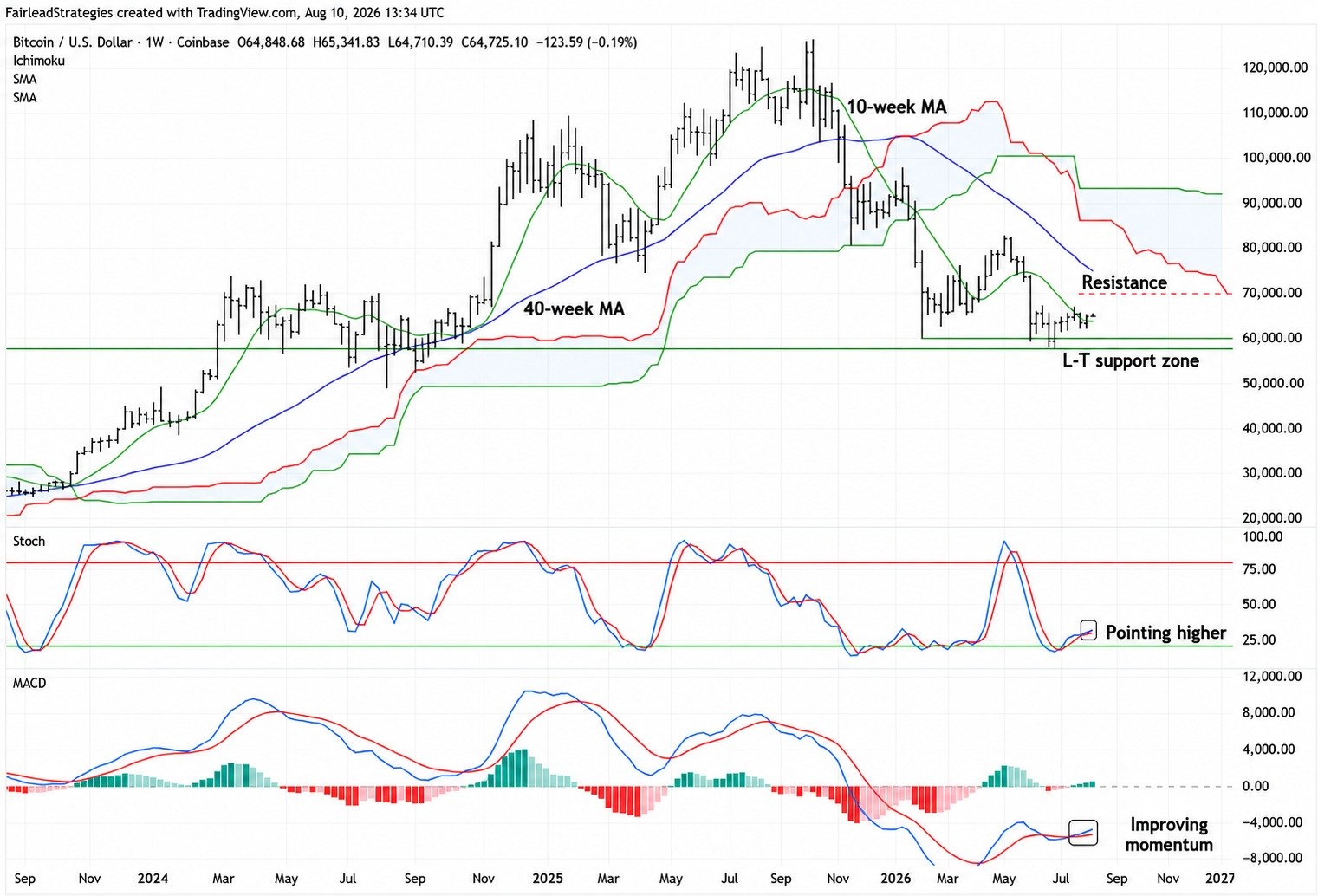
"We are already seeing these signs of long-term downtrend exhaustion," she said, adding that momentum is gradually beginning to improve on the long-term timeframe, even though the price remains under pressure.

Stockton's analysis relies on support levels, Fibonacci retracements (a charting tool that identifies potential reversal zones based on prior price swings) and the Ichimoku Cloud model to determine where new demand might emerge. She added:

"Not only is there a measurable state of long-term oversold conditions, but there is also an improvement in long-term momentum."

She also drew a comparison with gold, which recently reclaimed its 50-day moving average during a pullback. Despite this, Stockton argued that Bitcoin has "a better chance of forming a significant low" than gold at the moment, characterizing the current situation as exceptionally favorable, given how deep and prolonged the decline has already been.

A Difficult August for Bitcoin and Ether

This forecast comes at a genuinely uncomfortable time for holders, given that Bitcoin spent much of the week trading around $63,000, remaining below all major daily moving averages (including the 20-day, 50-day, and 200-day lines).

Furthermore, the Fear & Greed Index—a widely followed gauge of sentiment in the crypto market—continues to hover at 34, squarely in the "Fear" zone, as the protracted process of tokenization rule development by the Securities and Exchange Commission (SEC) has exacerbated bearish sentiment.

Stockton does not limit her theory to Bitcoin alone, extending the concept of a "major low" specifically to Ether. "The good news is we may have already seen that major low," Stockton said, commenting on the Ether chart as part of a broader technical discussion that also covered Solana, XRP, and Hyperliquid beyond Bitcoin.

This analysis is significant because Stockton has previously argued that smaller tokens tend to bottom and top in sync with Bitcoin, making these two largest assets useful indicators for assessing the overall market condition. If Bitcoin and Ether are indeed simultaneously concluding long-term downtrend exhaustion, it would represent one of the most significant confirmations that technical analysts look for ahead of a new cycle, not just another short-term bounce.

What Comes Next

From the outside, Stockton's concept seems built on long-term signals precisely because it may take weeks or months for them to translate into a sustained trend change, and short-term charts can still fluctuate sideways or retest lows even after the long-term signal has turned.

Bitcoin.com News previously reported that Bitcoin held above the $59,100 low as short-term charts signaled an oversold bounce was forming—this was an earlier version of the same conflict between weak short-term structure and improving long-term signals that Stockton is now describing on a much larger timeframe.

end-content

Trending Cryptos

Related Questions

QAccording to Katie Stockton of Fairlead Strategies, what rare long-term signal suggests Bitcoin's technical damage may be ending?

AAccording to Katie Stockton, Bitcoin has shown pronounced oversold readings on two of Fairlead's preferred long-term indicators. This combination has historically preceded major turning points rather than short-lived rallies.

QWhat does Katie Stockton use, besides oversold conditions, to identify where new demand for Bitcoin might emerge?

AIn addition to oversold conditions, Katie Stockton's analysis relies on support levels, Fibonacci retracements, and the Ichimoku Cloud model to determine where new demand might emerge for Bitcoin.

QCompared to gold, what does Katie Stockton believe is more likely for Bitcoin at this moment?

AKatie Stockton believes Bitcoin has 'a better chance of carving out a meaningful low' than gold at the moment, characterizing the situation as unusually favorable given the depth and length of the decline.

QBesides Bitcoin, which other major cryptocurrency does Stockton's 'primary low' concept specifically apply to?

AKatie Stockton extends the concept of a 'primary low' specifically to Ether (ETH), suggesting it may have already seen this low point as well.

QWhy might short-term price action continue to be weak or choppy even after a long-term bullish signal appears, according to the article's perspective on Stockton's analysis?

AAccording to the article, even after a long-term bullish signal appears, it can take weeks or months for it to translate into a sustained trend change. Short-term charts may still fluctuate sideways or retest lows during this period.

Related Reads

Altcoin Hacked, Leading to Sharp Price Drop! Also Listed on Major Exchanges!

The price of the NES token plummeted significantly following suspicious activity and large sell-offs detected on the network. Blockchain observers suggested that one wallet minted approximately $55 million worth of NES tokens and began selling them on decentralized exchanges. This selling pressure caused the price of NES to drop by up to 40%. According to the data, the address in question still holds around $18 million worth of NES, indicating that market sell-off pressure may continue. Prior to the incident, it was reported that about $12.35 million worth (62.9 million NES tokens) were transferred to the Ethereum mainnet in the morning (Turkish time), with claims that liquidity was withdrawn and tokens were sold on the market later that evening. However, data regarding the $55 million token mint and the transfer of 62.9 million NES tokens has not been independently confirmed. The NESA team confirmed in a statement that they detected malicious activity exploiting a vulnerability in their Layer 1 network originating from Cosmos EVM. They stated they are working to contain the impact, responded promptly, and will restore services after implementing a software patch and additional measures to ensure secure network operation. Nesa also notified all cryptocurrency exchanges and stated deposit operations will resume after necessary work is completed. The article includes a chart showing the NES price decline following the exploit and concludes with a standard disclaimer that this is not investment advice.

cryptonews.ru2h ago

Altcoin Hacked, Leading to Sharp Price Drop! Also Listed on Major Exchanges!

cryptonews.ru2h ago

PeaqOS and World ID Integrate ZK Proofs into Autonomous Robots

The integration of PeaqOS and World ID now allows autonomous machines to verify they are interacting with real, unique individuals without collecting names, photos, or other personal data. This update, available via robotic.sh, enables connected devices to directly request and verify World ID proofs. The system leverages zero-knowledge technology, letting a person prove they are human while maintaining the privacy of their identity. This addresses a key challenge for operators of delivery robots, shared machines, and autonomous systems: how to authenticate a user as genuine without relying on insecure PINs, pickup codes, or traditional identity checks that require personal data collection. Instead of obtaining identifying information, a device receives a cryptographic proof that the user is a real person. PeaqOS acts as a coordination layer, allowing devices to utilize World ID via decentralized identifiers and a device marketplace. A robot can request verification, receive a zero-knowledge proof, and register an auditable record of the interaction—all without exposing underlying personal data. The system also supports uniqueness verification, enabling machines to enforce rules like "one item per person" without maintaining user identity databases. A demonstrated use case involves autonomous medicine delivery: a patient verifies via the World App when placing an order, a pharmacist verifies before loading the medication, and the patient verifies again upon delivery so the robot can confirm the recipient is linked to the order before unlocking the compartment. Similarly, promotional robots could ensure one item per person, and shared vending machines could grant access to verified individuals without requiring accounts or personal data. This integration for PeaqOS-powered robots and devices minimizes the identity information collected or stored while allowing autonomous systems to confirm they are interacting with real humans.

cryptonews.ru3h ago

PeaqOS and World ID Integrate ZK Proofs into Autonomous Robots

cryptonews.ru3h ago

Trading

Spot

Hot Articles

What is $BITCOIN

DIGITAL GOLD ($BITCOIN): A Comprehensive Analysis Introduction to DIGITAL GOLD ($BITCOIN) DIGITAL GOLD ($BITCOIN) is a blockchain-based project operating on the Solana network, which aims to combine the characteristics of traditional precious metals with the innovation of decentralized technologies. While it shares a name with Bitcoin, often referred to as “digital gold” due to its perception as a store of value, DIGITAL GOLD is a separate token designed to create a unique ecosystem within the Web3 landscape. Its goal is to position itself as a viable alternative digital asset, although specifics regarding its applications and functionalities are still developing. What is DIGITAL GOLD ($BITCOIN)? DIGITAL GOLD ($BITCOIN) is a cryptocurrency token explicitly designed for use on the Solana blockchain. In contrast to Bitcoin, which provides a widely recognized value storage role, this token appears to focus on broader applications and characteristics. Notable aspects include: Blockchain Infrastructure: The token is built on the Solana blockchain, known for its capacity to handle high-speed and low-cost transactions. Supply Dynamics: DIGITAL GOLD has a maximum supply capped at 100 quadrillion tokens (100P $BITCOIN), although details regarding its circulating supply are currently undisclosed. Utility: While precise functionalities are not explicitly outlined, there are indications that the token could be utilized for various applications, potentially involving decentralized applications (dApps) or asset tokenization strategies. Who is the Creator of DIGITAL GOLD ($BITCOIN)? At present, the identity of the creators and development team behind DIGITAL GOLD ($BITCOIN) remains unknown. This situation is typical among many innovative projects within the blockchain space, particularly those aligning with decentralized finance and meme coin phenomena. While such anonymity may foster a community-driven culture, it intensifies concerns about governance and accountability. Who are the Investors of DIGITAL GOLD ($BITCOIN)? The available information indicates that DIGITAL GOLD ($BITCOIN) does not have any known institutional backers or prominent venture capital investments. The project seems to operate on a peer-to-peer model focused on community support and adoption rather than traditional funding routes. Its activity and liquidity are primarily situated on decentralized exchanges (DEXs), such as PumpSwap, rather than established centralized trading platforms, further highlighting its grassroots approach. How DIGITAL GOLD ($BITCOIN) Works The operational mechanics of DIGITAL GOLD ($BITCOIN) can be elaborated on based on its blockchain design and network attributes: Consensus Mechanism: By leveraging Solana’s unique proof-of-history (PoH) combined with a proof-of-stake (PoS) model, the project ensures efficient transaction validation contributing to the network's high performance. Tokenomics: While specific deflationary mechanisms have not been extensively detailed, the vast maximum token supply implies that it may cater to microtransactions or niche use cases that are still to be defined. Interoperability: There exists the potential for integration with Solana’s broader ecosystem, including various decentralized finance (DeFi) platforms. However, the details regarding specific integrations remain unspecified. Timeline of Key Events Here is a timeline that highlights significant milestones concerning DIGITAL GOLD ($BITCOIN): 2023: The initial deployment of the token occurs on the Solana blockchain, marked by its contract address. 2024: DIGITAL GOLD gains visibility as it becomes available for trading on decentralized exchanges like PumpSwap, allowing users to trade it against SOL. 2025: The project witnesses sporadic trading activity and potential interest in community-led engagements, although no noteworthy partnerships or technical advancements have been documented as of yet. Critical Analysis Strengths Scalability: The underlying Solana infrastructure supports high transaction volumes, which could enhance the utility of $BITCOIN in various transaction scenarios. Accessibility: The potential low trading price per token could attract retail investors, facilitating wider participation due to fractional ownership opportunities. Risks Lack of Transparency: The absence of publicly known backers, developers, or an audit process may yield skepticism regarding the project's sustainability and trustworthiness. Market Volatility: The trading activity is heavily reliant on speculative behavior, which can result in significant price volatility and uncertainty for investors. Conclusion DIGITAL GOLD ($BITCOIN) emerges as an intriguing yet ambiguous project within the rapidly evolving Solana ecosystem. While it attempts to leverage the “digital gold” narrative, its departure from Bitcoin's established role as a store of value underscores the need for a clearer differentiation of its intended utility and governance structure. Future acceptance and adoption will likely depend on addressing the current opacity and defining its operational and economic strategies more explicitly. Note: This report encompasses synthesised information available as of October 2023, and developments may have transpired beyond the research period.

2.1k Total ViewsPublished 2025.05.13Updated 2025.05.13

What is $BITCOIN

Discussions

Welcome to the HTX Community. Here, you can stay informed about the latest platform developments and gain access to professional market insights. Users' opinions on the price of BTC (BTC) are presented below.

活动图片