Ethlabs Founded, Treasury Companies to Fund Ethereum Post-EF

Foresight NewsPublished on 2026-06-23Last updated on 2026-06-23

Abstract

Former Ethereum Foundation (EF) core researchers Ansgar Dietrichs, Barnabé Monnot, Caspar Schwarz-Schilling, Josh Rudolf, and Julian Ma announced the launch of Ethlabs, an independent non-profit R&D lab focused on Ethereum core protocol research and institutional-grade infrastructure. The initiative, backed by over 50 community participants including ETH treasury companies BitMine and Sharplink, Joseph Lubin, Hayden Adams, and Jesse Pollak, aims to make Ethereum the global economic settlement layer. This move comes amidst significant pressure on the EF, which has seen key departures and a strategic narrowing of its focus. A critical funding gap of approximately $30 million annually for core client development, following the expiration of the client incentive program, poses a near-term risk to the network's development. The context includes the evolution of ETH's value narrative. While mechanisms like EIP-1559 and the Merge previously supported the "ultrasound money" thesis, the success of L2 scaling via EIP-4844 has drastically reduced L1 fee revenue, leading to net ETH issuance and challenging that narrative. Ethlabs has listed ETH monetary economics as a primary research focus. Backing from corporate ETH treasuries like BitMine and Sharplink represents a strategic alignment, as these entities' asset values are directly tied to Ethereum's health and adoption. Their support is an investment rather than a pure donation. Ethereum's governance is shifting from a centralized ...


Author: Sanqing, Foresight News


On June 22nd, five former core researchers from the Ethereum Foundation (EF) – Ansgar Dietrichs, Barnabé Monnot, Caspar Schwarz-Schilling, Josh Rudolf, and Julian Ma – officially announced the establishment of Ethlabs, an independent non-profit R&D (Research and Development) laboratory focused on Ethereum core protocol research and institutional-grade infrastructure. The initial supporters include Ethereum treasury companies BitMine (BMNR) and Sharplink (SBET), as well as over 50 community and ecosystem participants such as Ethereum co-founder Joseph Lubin, Uniswap founder Hayden Adams, and Base lead Jesse Pollak.
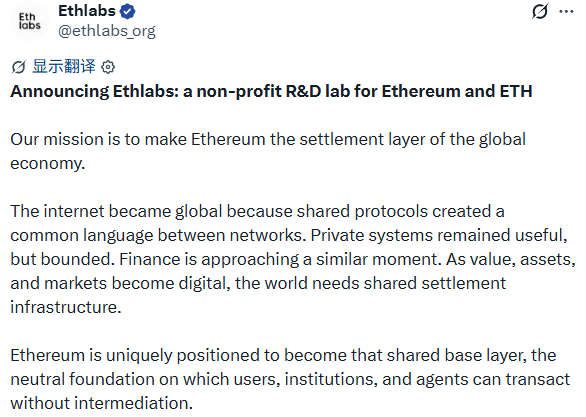


Ethlabs' mission directly targets the core: "Make Ethereum the settlement layer for the global economy." The official statement lists four core beliefs: credible neutrality, ETH as programmable value storage, the value of open markets in DeFi, and translating these principles into real-world adoption. All five founders served at EF for many years, deeply involved in crucial protocol work such as the Dencun upgrade (EIP-4844), Proposer-Builder Separation (PBS), the anti-censorship mechanism FOCIL, and the ETH monetary economics framework.


EF Faces Dual Pressures on Funding and Talent


From early 2026, the EF underwent a wave of intensive personnel changes. Co-Executive Director Tomasz Stańczak left at the end of February, moving into AI. Co-Executive Director Hsiao-Wei Wang stepped down in mid-June, citing a need to "re-evaluate priorities."


Key personnel including Josh Stark, Trent Van Epps, and Alex Stokes departed successively, with total attrition around 19 people. EF currently has only Bastian Aue performing executive functions, with no succession structure or public timeline.


The EF itself is acutely aware of this and proactively frames it as a "return to a leaner core mission." Its latest operational plan, the "EF Way," narrows the focus to core issues like MEV mitigation, privacy protection, and ETH payments, explicitly abandoning the all-encompassing, full-stack coordination role.
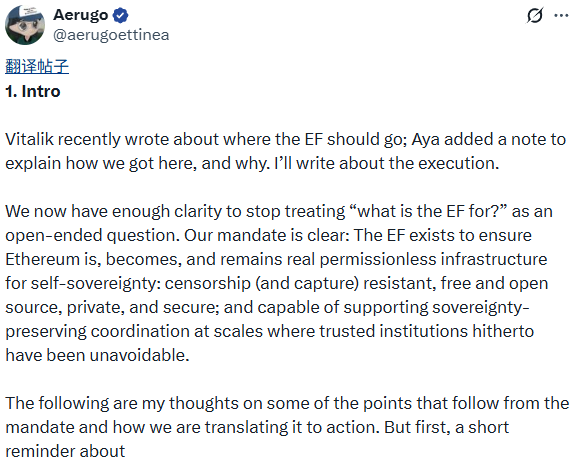


However, beyond this proactive adjustment, there are more urgent structural pressures.


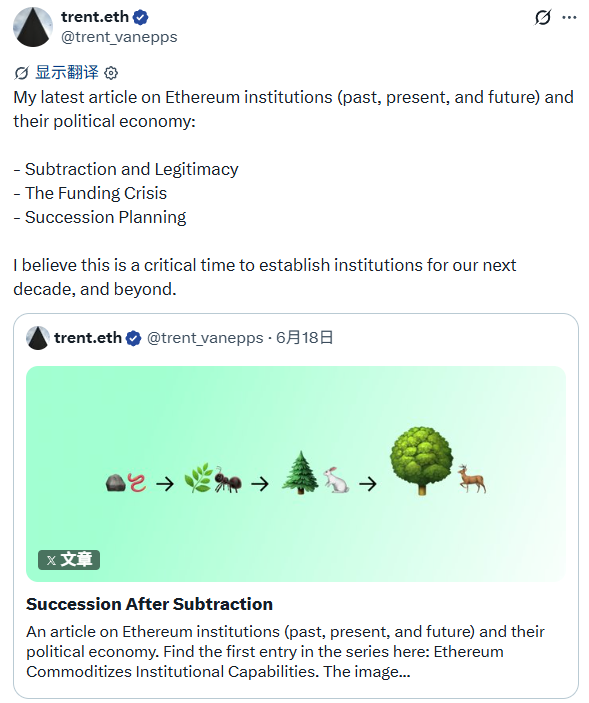
Former EF contributor Trent Van Epps warned in a post after his departure: The "Client Incentive Program" supporting over 10 core client teams like Geth, Erigon, and Lighthouse expired in April 2026, with no renewal arrangements yet. He estimates the annual operational cost for Ethereum's core development to be around $30 million. If this funding gap is not filled, it will gradually become apparent within 3 to 9 months.


The dilemma for the EF is that it has long shouldered a function not ideally suited for a single entity in a decentralized protocol. The EF has been simultaneously a protocol researcher, a funder, and an external spokesperson. As the network scales, pressure on any of these layers is amplified by the community into a broader governance issue.


The Evolution of ETH Value Capture Narratives


In 2021, EIP-1559 introduced a burn mechanism. In 2022, the Merge compressed ETH issuance to historical lows, making "ultrasound money" the most compelling narrative for ETH: a continuously deflationary, censorship-resistant, programmable store of value. This narrative self-reinforced during ETH's price ascent cycles, forming a closed loop.


In March 2024, the Dencun upgrade activated EIP-4844, introducing an independent blob fee market, which reduced L2 data availability costs by 10 to 100 times. A significant amount of activity migrated to L2s, causing the L1 base fee to plummet. Daily ETH burn volume dropped sharply post-Merge from thousands of ETH. According to The Block, it hit a historical low of 53 ETH on a single day in 2026.
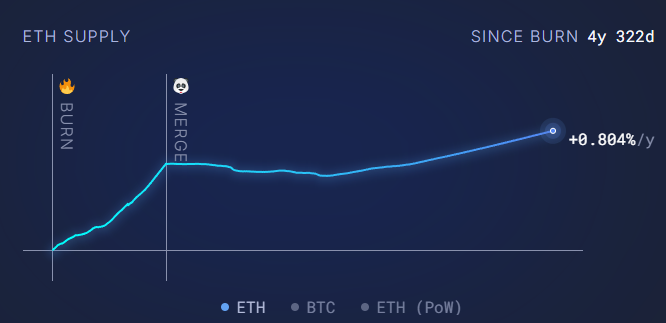


Meanwhile, staking issuance remains at approximately 1,700 ETH per day, keeping net issuance consistently positive. According to ultrasound.money data, Ethereum's annualized net inflation rate has risen to about 0.8%, with mainnet gas fees as low as 0.1 Gwei, and recent block burns near zero. The "ultrasound money" narrative has temporarily lost its effect.


The fundamental contradiction is perennial: the more successful Ethereum's L2 scaling strategy becomes, the less fee capture L1 sees, and the weaker the direct returns for ETH holders.


Controversy follows. Critics argue that L2s are "siphoning" value from L1, with value flowing to L2 operators, dApp protocols, and stablecoin issuers, not ETH holders. Supporters contend that ETH's structural position as the ultimate settlement layer, security provider, and liquidity hub is irreplaceable, and value will ultimately flow back. However, this requires time and new mechanism designs.


It is precisely in this context that Ethlabs lists the "ETH monetary economics framework" as one of its initial research priorities. The five founders were deeply involved in designing EIP-4844 and PBS; they understand the boundaries of these mechanisms better than anyone.


Entry of Treasury Companies


BitMine, led by Fundstrat Chairman Tom Lee, is the most aggressive corporate ETH treasury company, publicly stating its goal is to hold 5% of Ethereum's circulating supply. As of June 21, 2026, BitMine holds approximately 5.67 million ETH, valued at about $10.7 billion (estimated at $1,733 per ETH). Of this, 4.719 million ETH are staked, making it the second-largest cryptocurrency treasury globally and the largest Ethereum treasury.


Sharplink transformed into an ETH treasury company in 2025 after a $425 million private placement, with Joe Lubin appointed Chairman. As of May 2026, Sharplink holds approximately 869,000 ETH, valued at about $1.5 billion, making it the world's second-largest publicly-listed Ethereum treasury company, with almost its entire holdings staked.


The core logic both companies are betting on is that Ethereum will become the neutral foundational layer for global financial settlement, with ETH as the native reserve asset on this layer. Supporting Ethlabs is a natural extension of this logic.


The fundamental difference between these corporate treasury entities and traditional Ethereum funders (foundations, protocol treasuries) is their significant ETH holdings. The health of Ethereum's protocol layer and its institutional adoption can impact the ETH price, thereby affecting their asset value and stock performance.


Funding core R&D thus becomes strategic support highly aligned with their own asset value, rather than unconditional donation. Ethlabs' funding structure is designed for this isolation: an independent funding manager will be responsible for fund selection and allocation. Supporters receive transparent reports and audits but do not interfere with research directions or technical decisions.


At the Consensus 2026 conference, Joe Lubin publicly stated that the tokenization of the global economy is "inevitable" and strongly endorsed the corporate ETH treasury model as "permanent long-term capital for Ethereum." He simultaneously warned of systemic risks in imitative projects built on weak tokens.


Specialized Division of Labor with Associated Coordination Costs


Ethlabs writes in its official statement: "Ethlabs is independent, but Ethereum is a shared project. We are just one node in a larger network of stewards. This is the multi-node future."


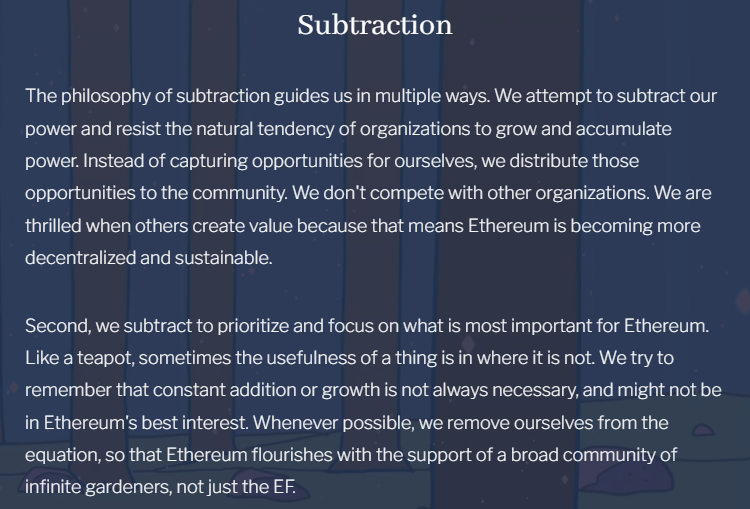
Ethereum's governance structure is shifting from a single centralized entity (EF) towards a distributed collaboration of multiple independent, focused "steward nodes" with distinct specialties. The EF itself is actively driving this transformation, repositioning itself as a high-level coordination and funding body, encouraging external, specialized entities to undertake specific research and development work.


Protocol research, client development, institutional adoption, and standard setting are inherently different types of work. Having them independently advanced by specialized bodies can improve efficiency and reduce systemic risk from a single point of failure.


Ethlabs' funding isolation design is timely: an independent funding manager handles fund selection and allocation, providing supporters with transparent reporting and annual audits, without interfering in any research direction or technical decisions.


However, distributed collaboration itself introduces new problems. Who coordinates priority conflicts among multiple nodes? If Ethlabs' research direction diverges from the EF roadmap, can Ethereum's community consensus mechanisms effectively converge? Who fills the $30 million client funding gap under a "multi-node" framework?


A distributed structure lacking sufficient coordination layers risks transforming the complexity of protocol governance from a "single entity's execution problem" into a "multi-entity coordination cost problem."


Ethereum's experiment continues.

Trending Cryptos

Related Questions

QWhat is Ethlabs, and what is its core mission according to the article?

AEthlabs is an independent non-profit R&D laboratory focused on Ethereum core protocol research and institutional-grade infrastructure, founded by five former Ethereum Foundation core researchers. Its core mission is 'to make Ethereum the settlement layer for the global economy.'

QWhat is the 'client incentive program' mentioned in the article, and what is its current status?

AThe 'client incentive program' was a funding mechanism that supported core client teams like Geth, Erigon, and Lighthouse. According to the article, the program expired in April 2026 and currently has no renewal arrangement, potentially creating a $30 million annual funding gap for Ethereum core development.

QHow has the 'ultrasound money' narrative for ETH been impacted according to the article, and what is the cited reason?

AThe 'ultrasound money' narrative has been temporarily invalidated. This is due to the success of Ethereum's L2 scaling strategy, specifically the Dencun upgrade (EIP-4844), which drastically reduced L1 transaction fees and daily ETH burn. With low L1 activity and ongoing staking issuance, Ethereum has experienced net positive issuance, with an annualized rate around 0.8%.

QWhat role do treasury companies like BitMine and Sharplink play in supporting Ethlabs, and what distinguishes them from traditional donors?

ABitMine and Sharplink are among the first supporters of Ethlabs. As corporate ETH treasury companies holding large amounts of ETH, their support is a strategic investment tied to the health of the Ethereum protocol and its adoption, which directly affects their asset value and stock performance. This differs from unconditional donations from foundations or protocol treasuries.

QWhat potential challenge does the article highlight regarding Ethereum's shift towards a more distributed governance structure with entities like Ethlabs and EF?

AThe article highlights the challenge of coordination costs. While a distributed structure with specialized entities like Ethlabs can increase efficiency, it may transform governance complexity from an 'execution problem of a single institution' into a 'coordination cost problem among multiple institutions.' Questions arise about who resolves priority conflicts and fills funding gaps, like the one for client teams, in this multi-node framework.

Related Reads

Bitcoin Community in Uproar: Deciphering the New Scaling War Sparked by BIP-110

On August 10, Luke Dashjr, a long-time Bitcoin Improvement Proposal (BIP) editor and co-founder of Ocean mining pool, was removed from the BIP editing team for bypassing discussion protocols and preemptively assigning a number to BIP-110, a controversial soft fork proposal he helped draft. The conflict stems from Bitcoin Core's version 30 release in October 2025, which removed the default 83-byte limit on OP_RETURN, a field used for embedding non-transaction data. In response, BIP-110 aimed to enforce this limit as a consensus rule. It controversially lowered the activation threshold for miners to 55% and included a mandatory activation clause, causing significant community backlash. Major mining pools like Foundry USA and AntPool did not support it, with public criticism from figures like F2Pool's Wang Chun and Michael Saylor, who argued it compromised Bitcoin's neutrality. On August 8, at block height 961,632, nodes running the BIP-110 patch rejected the main chain block, causing a chain split. The minority chain, supported by only about 2.53% of the network's hash rate, produced just one additional block before stalling. The main chain quickly outpaced it by over 240 blocks. No major exchanges have supported the minority chain. The event highlighted Bitcoin's governance reality: while rules can be proposed by a few, ultimate authority lies with the economic majority—miners willing to expend hash power and users/exchanges recognizing a chain's validity. Following the failed split, BIP-110 proponents, including Luke Dashjr, have begun discussing a change to the proof-of-work algorithm to create a separate coin, though this remains in early discussion stages.

marsbit2m ago

Bitcoin Community in Uproar: Deciphering the New Scaling War Sparked by BIP-110

marsbit2m ago

Stock Price Soars 655%, Sichuan Brothers Build a 50 Billion Semiconductor IPO

Chengdu Ultra-pure Applied Materials Co., Ltd. ("Ultra-pure Materials"), a Sichuan-based supplier of core semiconductor equipment components, officially listed on the Shenzhen Stock Exchange on August 11. Its share price surged 654.66% to 498 yuan on its debut, giving the company a market capitalization exceeding 50.7 billion yuan. Founded in 2005, the company is a national-level "little giant" specializing in special-coated components and precision optical devices for semiconductor equipment. It is one of the few domestic suppliers capable of providing core parts for 5nm and below process etching tools. According to a Frost & Sullivan report, it held the top market share (5.7%) among local Chinese suppliers of these coated components in 2024. Financially, Ultra-pure Materials has shown rapid growth. Its revenue soared from 169 million yuan in 2023 to 496 million yuan in 2025, with net profit increasing from 65 million to 185 million yuan in the same period. Over 95% of its 2025 revenue came from sales of semiconductor equipment special-coated components. The company has developed dozens of component products covering wafer fabrication, packaging, and silicon wafer manufacturing processes. Major customers include leading domestic semiconductor equipment manufacturers such as NAURA and AMEC, with its top five clients accounting for nearly 90% of revenue in 2025. Its shareholder structure features strategic investors including BYD, AMEC, and State Development & Investment Venture Capital. Post-IPO, Chairman and CEO Chai Jie holds 31.42% of shares, while his brother and Chief Engineer Chai Lin holds 15.46%. The company plans to use raised capital for capacity expansion, R&D center construction, and supplementary working capital. The global market for these high-precision components is dominated by US, European, and Japanese firms. However, driven by domestic equipment substitution policies and improving local technological capabilities, the localization rate in China is projected to rise significantly. Ultra-pure Materials' listing aims to strengthen its position in this expanding market.

marsbit41m ago

Stock Price Soars 655%, Sichuan Brothers Build a 50 Billion Semiconductor IPO

marsbit41m ago

Opinion: Altcoins Might Still Have a Chance, but VC-Backed Coins Are Truly Hopeless

Author: Haotian. Through deep discussions with experienced on-chain investors, a consensus has emerged on survival strategies for the current market cycle: the focus has decisively shifted from "narratives and speculation" to "cash flow and tangible validation." Several key principles are outlined: 1) Prioritize assets with genuine value capture. In a bear market, sustainable protocol fees and a proven record of using them for token buybacks, burns, or dividends are essential. Examples include launchpad tokens like $UNI, $PUMP, $PONS, and the notable buyback token $HYPE. 2) Choose only projects with proven Product-Market Fit (PMF) and a complete operational loop. The next cycle's narratives, likely around "real-world asset tokenization" and the "Agentic Economy," will favor practical validation over technical roadmaps. Projects must demonstrate real users, transaction volume, and revenue. Examples such as $ONDO, $VVV, and $VIRTUAL will be evaluated on metrics like Assets Under Management (AUM) and fee generation. 3) Opt for assets with strong, organically developed "consensus." True consensus is market-driven and survives multiple cycles, not manufactured through marketing. Examples include enduring meme coins like $DOGE, $PEPE, $PEOPLE, or established sector leaders like $ZEC and $TAO, which benefit from resilient communities and sustained liquidity. 4) Avoid purely venture-capital (VC)-backed tokens. Unlike general altcoins which may cycle back, VC coins are seen as particularly problematic. Their typical high Fully Diluted Valuation (FDV), low circulating supply, and continuous large unlock schedules often lead to post-unlock sell pressure, especially if the project lacks inherent value capture. This dynamic is a key factor in the current cycle's restrained rallies and deep corrections, discouraging retail participation. *Note: This is a summary of personal discussions. Mentioned tokens are examples only, not investment advice.*

marsbit1h ago

Opinion: Altcoins Might Still Have a Chance, but VC-Backed Coins Are Truly Hopeless

marsbit1h ago

Trading

Spot

Hot Articles

Discussions

Welcome to the HTX Community. Here, you can stay informed about the latest platform developments and gain access to professional market insights. Users' opinions on the price of ETH (ETH) are presented below.

活动图片