Ethereum’s Price Pulls Back Close To $1,900, But Large Holders Remain Unfazed

bitcoinistPublished on 2026-05-28Last updated on 2026-05-28

Abstract

Ethereum's price has declined toward $1,950, a level not seen since March, amid broader bearish pressure in the cryptocurrency market. Despite this downturn, large ETH holders, or "whales," are not selling off their positions. Key metrics indicate whales are accumulating more ETH, with the Whale vs Retail Delta metric turning positive, suggesting renewed institutional confidence. Furthermore, activity in the Ethereum futures market is increasing, with rising Open Interest and long positions, signaling investors are positioning for a potential future rally. Analysts also note that Ethereum's Market Value to Realized Value (MVRV) ratio has fallen below 0.8, a zone historically associated with accumulation and a potential foundation for the next bull market. While ETH price dropped nearly 5% in 24 hours, trading volume increased by over 17%.

With bearish pressure building across the cryptocurrency market, the Ethereum price is steadily dropping toward the $1,950 mark once again, a level last seen in March. Despite the altcoin’s declining price action and general unfavorable market conditions, large ETH holders seem to be holding onto their positions.

What Ethereum Whales Are Doing In This Pullback

Ethereum’s large investors have remained resilient in recent market sessions. While ETH’s price has struggled to sustain strong momentum, these key investors continue to hold on to their positions rather than aggressively reduce their exposure or sell off their coins.

In a waning market environment, the activity of large holders is closely monitored as it typically provides more insight into long-term market conviction and sentiment among institutional investors. This trend is seen in the Ethereum Whale Vs Retail Delta metric, which has flipped toward the upside once again.

As reported by CW, a verified data analyst at the CryptoQuant platform and crypto investor, the crucial metric has now surpassed the 0.5 level and continues to move in an upward direction. When this metric flips upward, it is a sign that whales are regaining influence over the market, reflecting renewed confidence in the asset’s long-term prospects.
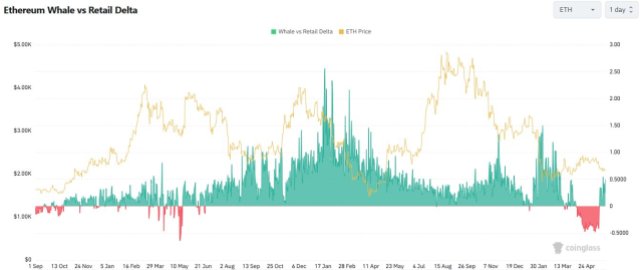
Source: Chart from CW on X

Amid ongoing volatility in ETH’s price action, the large investors have shifted into an accumulation phase as they quietly and rapidly increase their long positions in the altcoin. Should this trend continue over the following days and weeks, it could play a critical role in shaping the altcoin’s next trajectory.

Another aspect that is picking up again is the Ethereum Futures market. CW revealed that movement in the market is steadily increasing, as investors start to lean toward the upside for ETH. Open Interest (OI) has transitioned into an upward direction alongside a persistent rise in long positions.

Investors appear to be taking advantage of the current downside performance of ETH’s price rather than exiting the market in fear. Furthermore, this activity suggests that investors may be positioning for the altcoin’s next major rally.

This Metric Could Support ETH’s Next Move

Bullish momentum is starting to reflect on several key Ethereum metrics even as prices trend downward. Ali Charts, a seasoned crypto investor and data analyst, has outlined a renewed shift, emerging in the ETH market as the Market Value To Realized Value (MVRV) metric declines below the 0.8 level.

However, this bullish development may fade soon. According to Ali Charts, whenever ETH drops below the 0.8 MVRV band, the move is not sustained for very long. Data shows that in the past, this exact zone represented a high-probability macro accumulation window. At the same time, this window could build the ultimate foundation for the next major bull market.

At the time of writing, the ETH price was trading at $1,980, demonstrating a nearly 5% decline in the last 24 hours. However, its trading volume is moving in an opposite direction, rising by more than 17% over the past day.

ETH trading at $1,994 on the 1D chart | Source: ETHUSDT on Tradingview.com

Related Questions

QWhat is the current trend in the Ethereum price according to the article, and why is it significant?

AThe Ethereum price is steadily dropping toward the $1,950 mark, a level last seen in March, due to bearish pressure across the cryptocurrency market. This is significant as it represents a notable pullback.

QHow are large Ethereum investors, or 'whales', behaving during this price pullback?

ALarge Ethereum holders have remained resilient and are holding onto their positions rather than selling off their coins. They have shifted into an accumulation phase, quietly increasing their long positions.

QWhat does the upward movement of the 'Ethereum Whale Vs Retail Delta' metric indicate?

AThe upward movement of the 'Ethereum Whale Vs Retail Delta' metric, surpassing the 0.5 level, is a sign that whales are regaining influence over the market. It reflects renewed confidence in Ethereum's long-term prospects.

QWhat trend is observed in the Ethereum Futures market, as per the article?

AIn the Ethereum Futures market, movement is steadily increasing. Open Interest (OI) has transitioned into an upward direction alongside a persistent rise in long positions, indicating investors are leaning toward the upside for ETH.

QAccording to analyst Ali Charts, what is the potential significance of the ETH MVRV metric dropping below the 0.8 level?

AAccording to Ali Charts, when the ETH Market Value to Realized Value (MVRV) metric drops below the 0.8 level, it represents a high-probability macro accumulation window. Historically, this zone has built the foundation for the next major bull market.

Related Reads

CPU, Quietly Returning to the Center of the AI Computing Power Stage

Over the past three years, AI computing power narratives have been dominated by GPUs. However, starting in 2026, this story began to shift. While training large models remains GPU-intensive, the rapid growth of inference and AI agent workloads, which require high levels of task orchestration, concurrency, and data flow management, has highlighted a renewed critical role for CPUs. These are tasks GPUs are not designed to handle. Intel's recent launch of the Xeon 6+ processor, built on its Intel 18A process and featuring up to 288 efficiency cores (E-cores), exemplifies this strategic pivot. It is positioned not as a mere companion to GPUs but as the essential "control plane" for AI infrastructure, optimized for high-density, energy-efficient, and high-throughput workloads characteristic of AI agents and inference. This "CPU resurgence" is not about CPUs outperforming GPUs in raw computation. It reflects a systemic bottleneck: as AI scales from training single models to deploying countless intelligent agents, the demand for coordination and data handling surges. Major cloud providers are also developing their own high-density ARM-based server CPUs for similar workloads. However, Intel's success with this strategy faces significant challenges. Competition includes NVIDIA's integrated CPU-GPU solutions, the expanding adoption of cloud vendors' in-house ARM CPUs, and the crucial market test of Intel's 18A manufacturing process against rivals like TSMC's N2. In conclusion, CPUs are indeed reclaiming a central, though redefined, role in AI compute—managing the complex orchestration that enables massive-scale AI deployment. While the trend is clear, which company will ultimately lead this CPU resurgence remains an open question to be decided in the data centers of 2027 and beyond.

marsbit9m ago

CPU, Quietly Returning to the Center of the AI Computing Power Stage

marsbit9m ago

After Collaborating with 35+ DeFi Projects, Pink Brains Discovers the New 2026 KOL Marketing Rules

After collaborating with over 35 leading DeFi projects on marketing over three years, Pink Brains identifies a key shift for effective marketing in 2026: prioritizing the user journey over traditional campaign tactics. The most effective marketing mirrors how users actually behave—starting with discovery on social platforms like X (formerly Twitter), followed by data-driven verification on sites like DefiLlama, and finally, participation with small test funds. Success hinges on genuine, verifiable mechanisms, not just marketing hype. Current user interest centers on several key themes: new DeFi trends (RWA, perps, crypto x AI), meaningful airdrops requiring real contributions, real yield from protocol revenue, and tokens with value capture mechanisms directly tied to product usage. Case studies like Hyperliquid's HYPE (with its aggressive buyback program) and Venice's VVV (linking demand to AI compute) exemplify how strong tokenomics foster user retention. New trading venues like prediction markets, collectibles platforms, and GambleFi are also gaining traction, driven by verifiable activity. The article outlines common mistakes in DeFi KOL marketing, such as using creators unfamiliar with the product, generic messaging, or relying on a few top-tier KOLs. Instead, effective strategies align with different KOL types—educators, content creators, airdrop hunters, and niche experts—for various stages of the user journey. Ultimately, long-term user retention depends on a combination of a genuinely useful product, responsive support, community-aligned tokenomics, and strategic community building. The core takeaway is that sustainable growth stems from products whose value is validated by data and real-world utility, not just promotional efforts.

marsbit27m ago

After Collaborating with 35+ DeFi Projects, Pink Brains Discovers the New 2026 KOL Marketing Rules

marsbit27m ago

Trading

Spot
Futures

Hot Articles

Discussions

Welcome to the HTX Community. Here, you can stay informed about the latest platform developments and gain access to professional market insights. Users' opinions on the price of ETH (ETH) are presented below.

活动图片















