Ethereum's Narrative Is Being Rewritten: When L1 zkEVM Becomes the Endgame, When Will the Next Revolution Arrive?

marsbitPublished on 2026-03-07Last updated on 2026-03-07

Abstract

Ethereum's narrative is undergoing a significant rewrite, shifting from a programmable ledger (2015-2020) to an L2-centric settlement layer (2021-2023), and now toward becoming a verifiable computer with L1 zkEVM as its endgame (2024 onward). The newly proposed Strawmap roadmap outlines an ambitious technical direction, targeting faster L1 confirmation, "Gigagas"-level throughput (10,000 TPS), quantum resistance, and native privacy. This transformation is driven by eight core technical workstreams: formalizing EVM specifications, replacing Keccak with ZK-friendly hashes, transitioning to Verkle Trees, enabling stateless clients, standardizing ZK proof systems, decoupling execution and consensus layers, implementing recursive proof aggregation, and ensuring developer toolchain compatibility. L1 zkEVM aims to integrate zero-knowledge proofs directly into Ethereum’s consensus layer, fundamentally upgrading its trust model. While full implementation may take until 2028-2029, this shift repositions Ethereum as the verifiable trust root for the entire Web3 ecosystem—enhancing scalability without compromising decentralization. The move also redefines the role of L2s, evolving them from scaling solutions to specialized execution environments. Ethereum’s structured, multi-year effort reflects its unique capacity for coordinated innovation and may ultimately establish it as a global settlement layer—fast, secure, and private.

From a purely experiential perspective, since 2025, the update frequency of the Ethereum core developer community has been unusually intense.

From the Fusaka upgrade to Glamsterdam, and then to long-term planning around issues like kEVM, quantum-resistant cryptography systems, and Gas Limit over the next three years, Ethereum has densely released multiple roadmap documents covering three to five years within just a few months.

This pace itself is a signal.

If you carefully read the latest roadmap, you will find a clearer and more radical direction emerging: Ethereum is transforming itself into a verifiable computer, and the end point of this path is L1 zkEVM.

I. The Three Shifts in Ethereum's Narrative Focus

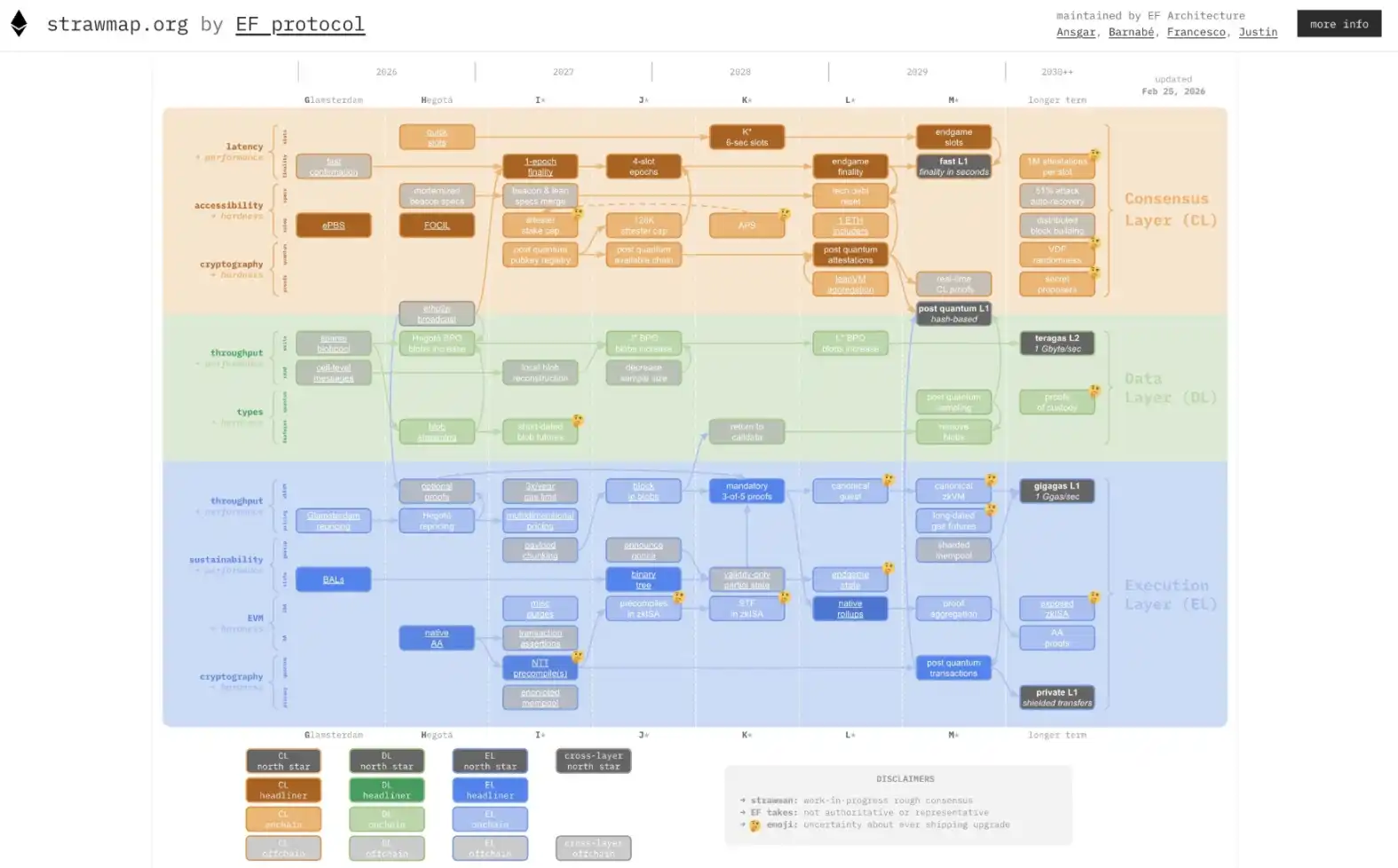
On February 26, Ethereum Foundation researcher Justin Drake posted on a social platform stating that the Ethereum Foundation had proposed a roadmap draft named Strawmap, outlining the upgrade direction for the Ethereum L1 protocol in the coming years.

This roadmap proposes five core goals: a faster L1 (second-level finality), a "Gigagas" L1 achieving 10,000 TPS through zkEVM, high-throughput L2 based on Data Availability Sampling (DAS), a quantum-resistant cryptography system, and native private transaction functionality; the roadmap also plans for seven protocol forks by 2029, averaging about one every six months.
It can be said that over the past decade, Ethereum's development has always been accompanied by the continuous evolution of its narrative and technical路线.

The first stage (2015–2020) was the programmable ledger.

This was the initial core narrative of Ethereum, namely "Turing-complete smart contracts." At that time, Ethereum's biggest advantage was that it could do more things compared to Bitcoin, such as DeFi, NFTs, and DAOs, all products of this narrative. A large number of decentralized financial protocols began operating on-chain, from lending and DEXs to stablecoins. Ethereum gradually became the main settlement network for the crypto economy.

The second stage (2021–2023) saw the narrative taken over by L2.

As Gas fees on the Ethereum mainnet soared, making transaction costs unaffordable for ordinary users, Rollups began to take the lead in scaling. Ethereum also gradually repositioned itself as a settlement layer, aiming to be the foundational base providing security for L2s.

Simply put, this involved migrating most of the execution layer's computation to L2, scaling through Rollups, while L1 was only responsible for data availability and final settlement. During this period, The Merge and EIP-4844 served this narrative, aiming to make L2s cheaper and safer to use Ethereum's trust.

The third stage (2024–2025) focused on narrative introspection and reflection.

As is well known, the prosperity of L2 brought an unexpected problem: Ethereum L1 itself became less important. Users began operating more on Arbitrum, Base, Optimism, etc., rarely interacting directly with L1. The price performance of ETH also reflected this anxiety.

This led the community to debate: if L2s capture all the users and activity, where is the value capture for L1? It wasn't until the internal turbulence within Ethereum in 2025 and the series of roadmaps laid out in 2026 that this logic began to evolve profoundly.

In fact,梳理 (sorting out) the core technical directions since 2025, Verkle Trees, Stateless Clients, EVM Formal Verification, native ZK support, etc., have repeatedly appeared. These technical directions all point to the same thing: making Ethereum L1 itself verifiable. It is important to note that this is not just about allowing L2 proofs to be verified on L1, but about enabling every step of L1's state transition to be compressed and verified via zero-knowledge proofs.

This is the ambition of L1 zkEVM. Different from L2 zkEVM, L1 zkEVM (in-protocol zkEVM) means integrating zero-knowledge proof technology directly into the Ethereum consensus layer.

It is not a replica of L2 zkEVMs (like zkSync, Starknet, Scroll), but rather transforming Ethereum's execution layer itself into a ZK-friendly system. So, if L2 zkEVM is about building a ZK world on top of Ethereum, then L1 zkEVM is about turning Ethereum itself into that ZK world.

Once this goal is achieved, Ethereum's narrative will upgrade from being L2's settlement layer to the "root trust for verifiable computation."

This will be a qualitative change, not the quantitative change of the past few years.

II. What is the True L1 zkEVM?

It's worth reiterating a common point: in the traditional model, validators need to "re-execute" every transaction to verify a block, whereas in the zkEVM model, validators only need to verify a ZK Proof. This allows Ethereum to increase the Gas Limit to 100 million or even higher without increasing the burden on nodes (Further reading: 'The Dawn of the ZK Route: Is the Roadmap for Ethereum's Endgame Accelerating?').

However, transforming Ethereum L1 into a zkEVM is by no means a matter of a single breakthrough; it requires simultaneous progress in eight directions, each being a multi-year engineering effort.

Workstream 1: EVM Formalization

The prerequisite for any ZK proof is that the object being proven has a precise mathematical definition. However, today's EVM behavior is defined by client implementations (Geth, Nethermind, etc.), not by a strict formal specification. The behavior of different clients might be inconsistent in edge cases, making it extremely difficult to write ZK circuits for the EVM—after all, you can't write proofs for an ambiguously defined system.

Therefore, the goal of this workstream is to write every EVM instruction, every state transition rule, into a machine-verifiable formal specification. This is the foundation of the entire L1 zkEVM project. Without it, everything that follows is building on sand.

Workstream 2: ZK-Friendly Hash Function Replacement

Ethereum currently uses Keccak-256 extensively as its hash function. Keccak is extremely unfriendly to ZK circuits, with huge computational overhead, significantly increasing proof generation time and cost.

The core task of this workstream is to gradually replace the use of Keccak inside Ethereum with ZK-friendly hash functions (like Poseidon, Blake series), especially on the state tree and Merkle proof paths. This is a change that affects everything, as the hash function permeates every corner of the Ethereum protocol.

Workstream 3: Verkle Tree Replacing Merkle Patricia Tree

This is one of the most anticipated changes in the 2025–2027 roadmap. Ethereum currently uses the Merkle Patricia Tree (MPT) to store the global state. Verkle Trees replace hash linkages with vector commitments, which can compress witness size by tens of times.

For L1 zkEVM, this means the amount of data needed to prove each block is drastically reduced, and proof generation speed is significantly improved. It also means the introduction of Verkle Trees is a key infrastructure prerequisite for the feasibility of L1 zkEVM.

Workstream 4: Stateless Clients

Stateless clients refer to nodes that, when verifying blocks, do not need to locally store the complete Ethereum state database; they only need the witness data附带 (attached) with the block itself to complete verification.

This workstream is deeply bound with Verkle Trees because stateless clients are only practically feasible if the witness is small enough. Thus, the significance of stateless clients for L1 zkEVM is twofold: on one hand, it greatly reduces the hardware threshold for running nodes, aiding decentralization; on the other hand, it provides a clear input boundary for ZK proofs, allowing the prover to only need to process the data contained in the witness, not the entire world state.

Workstream 5: ZK Proof System Standardization and Integration

L1 zkEVM needs a mature ZK proof system to generate proofs for block execution. However, the current technical landscape in the ZK field is highly fragmented, with no公认 (consensus) optimal solution. The goal of this workstream is to define a standardized proof interface at the Ethereum protocol layer, allowing different proof systems to接入 (access/be integrated) through competition, rather than designating a specific one.

This maintains technological openness while also leaving room for the continuous evolution of proof systems. The Ethereum Foundation's PSE (Privacy and Scaling Explorations) team has substantial preliminary积累 (accumulation) in this direction.

Workstream 6: Decoupling Execution Layer and Consensus Layer (Engine API Evolution)

Currently, Ethereum's Execution Layer (EL) and Consensus Layer (CL) communicate via the Engine API. Under the L1 zkEVM architecture, every state transition of the execution layer requires generating a ZK proof, and the generation time for this proof may far exceed a block's出块间隔 (block time).

The core problem this workstream needs to solve is how to decouple execution and proof generation without breaking the consensus mechanism—execution can be completed quickly first, proof generation can be滞后异步 (generated asynchronously later), and then validators can complete final confirmation at an appropriate time. This involves a deep改造 (overhaul) of the block finality model.

Workstream 7: Recursive Proofs and Proof Aggregation

The cost of generating a ZK proof for a single block is high, but if proofs for multiple blocks can be recursively aggregated into one proof, the verification cost can be significantly reduced. Progress in this workstream will directly determine how低成本 (low-cost) L1 zkEVM can operate.

Workstream 8: Developer Toolchain and EVM Compatibility Guarantee

All underlying technical transformations must ultimately be transparent to smart contract developers on Ethereum. The existing hundreds of thousands of contracts cannot fail due to the introduction of zkEVM. Developers' toolchains cannot be forced to rewrite.

This workstream is the most easily underestimated but often the most time-consuming. Historically, every EVM upgrade required extensive backward compatibility testing and toolchain adaptation work. The scale of changes for L1 zkEVM is far greater than previous upgrades, so the workload for toolchains and compatibility will be an order of magnitude higher.

III. Why is Now the Right Time to Understand This?

The release of Strawmap coincides with a time when the market has doubts about ETH's price performance. From this perspective, the most important value of this roadmap lies in redefining Ethereum as "infrastructure."

For builders, represented by developers, Strawmap provides directional certainty. For users, these technical upgrades will ultimately translate into perceptible experiences: transactions finalized within seconds, assets seamlessly flowing between L1 and L2, privacy protection becoming a built-in feature rather than a plugin.

Objectively speaking, L1 zkEVM is not a product that will be launched in the near future; its complete implementation may take until 2028-2029 or even later.

But at least it redefines Ethereum's value proposition. If L1 zkEVM succeeds, Ethereum will no longer be just the settlement layer for L2, but the verifiable trust root for the entire Web3 world, allowing any on-chain state to ultimately be traced back mathematically to Ethereum's ZK proof chain. This is decisive (决定性) for Ethereum's long-term value capture.

Secondly, it also affects the long-term positioning of L2. After all, when L1 itself possesses ZK capabilities, the role of L2 will change—evolving from "secure scaling solutions" to "specialized execution environments." Which L2s can find their place in this new landscape will be the most值得观察 (worth observing) ecological evolution in the coming years.

Most importantly, the author feels it is also an excellent window to observe Ethereum's developer culture—the ability to simultaneously advance eight interdependent technical workstreams, each being a multi-year engineering effort, while maintaining a decentralized coordination method, is itself Ethereum's unique capability as a protocol.

Understanding this helps to more accurately assess Ethereum's true position in various competitive narratives.

Overall, from the "Rollup-centric" approach of 2020 to the Strawmap of 2026, the evolution of Ethereum's narrative reflects a clear trajectory: scaling cannot rely solely on L2; L1 and L2 must co-evolve.

Therefore, the eight workstreams of L1 zkEVM are the technical mapping of this cognitive shift. They collectively point to one goal: enabling the Ethereum mainnet to achieve an order-of-magnitude performance improvement without sacrificing decentralization. This is not a negation of the L2 route, but its perfection and supplement.

In the next three years, this "Ship of Theseus" will undergo seven forks and replace countless "planks." When it arrives at the next stop in 2029, we may see a truly "global settlement layer"—fast, secure, private, and as open as ever.

Let's wait and see together.

Related Questions

QWhat is the ultimate goal of Ethereum's latest roadmap, Strawmap, as described in the article?

AThe ultimate goal is to transform Ethereum into a verifiable computer, with L1 zkEVM as the endgame. This involves making Ethereum L1 itself a ZK-friendly system, turning it into the root of verifiable trust for the entire Web3 world, rather than just a settlement layer for L2s.

QWhat are the three major shifts in Ethereum's narrative focus from 2015 to the present?

A1. 2015-2020: Programmable Ledbger - Focus on Turing-complete smart contracts enabling DeFi, NFTs, and DAOs. 2. 2021-2023: L2 Narrative - Ethereum repositioned as a settlement layer for L2 Rollups to scale. 3. 2024-2025: Introspection and Inward Focus - A shift towards making L1 itself verifiable with zkEVM to address value capture concerns.

QWhat is the key difference between an L2 zkEVM and the proposed L1 zkEVM?

AAn L2 zkEVM (like zkSync or Starknet) builds a ZK world on top of Ethereum. In contrast, L1 zkEVM (in-protocol zkEVM) integrates zero-knowledge proof technology directly into Ethereum's consensus layer, transforming Ethereum itself into that ZK world.

QName at least three of the eight key workstreams required to implement L1 zkEVM.

AThree of the eight workstreams are: 1. EVM Formalization: Creating a precise mathematical definition of the EVM. 2. ZK-Friendly Hash Function Replacement: Substituting Keccak-256 with ZK-friendly alternatives like Poseidon. 3. Verkle Tree Replacement: Replacing the Merkle Patricia Tree with Verkle Trees to compress witness data.

QHow does the article suggest the role of L2s will change if L1 zkEVM is successfully implemented?

AThe role of L2s will evolve from being security and scaling solutions to becoming specialized execution environments. Their long-term positioning will shift as L1 itself takes on the core role of providing verifiable trust.

Related Reads

Google and Amazon Simultaneously Invest Heavily in a Competitor: The Most Absurd Business Logic of the AI Era Is Becoming Reality

In a span of four days, Amazon announced an additional $25 billion investment, and Google pledged up to $40 billion—both direct competitors pouring over $65 billion into the same AI startup, Anthropic. Rather than a typical venture capital move, this signals the latest escalation in the cloud wars. The core of the deal is not equity but compute pre-orders: Anthropic must spend the majority of these funds on AWS and Google Cloud services and chips, effectively locking in massive future compute consumption. This reflects a shift in cloud market dynamics—enterprises now choose cloud providers based on which hosts the best AI models, not just price or stability. With OpenAI deeply tied to Microsoft, Anthropic’s Claude has become the only viable strategic asset for Google and Amazon to remain competitive. Anthropic’s annualized revenue has surged to $30 billion, and it is expanding into verticals like biotech, positioning itself as a cross-industry AI infrastructure layer. However, this funding comes with constraints: Anthropic’s independence is challenged as it balances two rival investors, its safety-first narrative faces pressure from regulatory scrutiny, and its path to IPO introduces new financial pressures. Globally, this accelerates a "tri-polar" closed-loop structure in AI infrastructure, with Microsoft-OpenAI, Google-Anthropic, and Amazon-Anthropic forming exclusive model-cloud alliances. In contrast, China’s landscape differs—investments like Alibaba and Tencent backing open-source model firm DeepSeek reflect a more decoupled approach, though closed-source models from major cloud providers still dominate. The $65 billion bet is ultimately about securing a seat at the table in an AI-defined future—where missing the model layer means losing the cloud war.

marsbit1h ago

Google and Amazon Simultaneously Invest Heavily in a Competitor: The Most Absurd Business Logic of the AI Era Is Becoming Reality

marsbit1h ago

Computing Power Constrained, Why Did DeepSeek-V4 Open Source?

DeepSeek-V4 has been released as a preview open-source model, featuring 1 million tokens of context length as a baseline capability—previously a premium feature locked behind enterprise paywalls by major overseas AI firms. The official announcement, however, openly acknowledges computational constraints, particularly limited service throughput for the high-end DeepSeek-V4-Pro version due to restricted high-end computing power. Rather than competing on pure scale, DeepSeek adopts a pragmatic approach that balances algorithmic innovation with hardware realities in China’s AI ecosystem. The V4-Pro model uses a highly sparse architecture with 1.6T total parameters but only activates 49B during inference. It performs strongly in agentic coding, knowledge-intensive tasks, and STEM reasoning, competing closely with top-tier closed models like Gemini Pro 3.1 and Claude Opus 4.6 in certain scenarios. A key strategic product is the Flash edition, with 284B total parameters but only 13B activated—making it cost-effective and accessible for mid- and low-tier hardware, including domestic AI chips from Huawei (Ascend), Cambricon, and Hygon. This design supports broader adoption across developers and SMEs while stimulating China's domestic semiconductor ecosystem. Despite facing talent outflow and intense competition in user traffic—with rivals like Doubao and Qianwen leading in monthly active users—DeepSeek has maintained technical momentum. The release also comes amid reports of a new funding round targeting a valuation exceeding $10 billion, potentially setting a new record in China’s LLM sector. Ultimately, DeepSeek-V4 represents a shift toward open yet realistic infrastructure development in the constrained compute landscape of Chinese AI, emphasizing engineering efficiency and domestic hardware compatibility over pure model scale.

marsbit1h ago

Computing Power Constrained, Why Did DeepSeek-V4 Open Source?

marsbit1h ago

Trading

Spot
Futures

Hot Articles

What is SONIC

Sonic: Pioneering the Future of Gaming in Web3 Introduction to Sonic In the ever-evolving landscape of Web3, the gaming industry stands out as one of the most dynamic and promising sectors. At the forefront of this revolution is Sonic, a project designed to amplify the gaming ecosystem on the Solana blockchain. Leveraging cutting-edge technology, Sonic aims to deliver an unparalleled gaming experience by efficiently processing millions of requests per second, ensuring that players enjoy seamless gameplay while maintaining low transaction costs. This article delves into the intricate details of Sonic, exploring its creators, funding sources, operational mechanics, and the timeline of significant events that have shaped its journey. What is Sonic? Sonic is an innovative layer-2 network that operates atop the Solana blockchain, specifically tailored to enhance the existing Solana gaming ecosystem. It accomplishes this through a customised, VM-agnostic game engine paired with a HyperGrid interpreter, facilitating sovereign game economies that roll up back to the Solana platform. The primary goals of Sonic include: Enhanced Gaming Experiences: Sonic is committed to offering lightning-fast on-chain gameplay, allowing players and developers to engage with games at previously unattainable speeds. Atomic Interoperability: This feature enables transactions to be executed within Sonic without the need to redeploy Solana programmes and accounts. This makes the process more efficient and directly benefits from Solana Layer1 services and liquidity. Seamless Deployment: Sonic allows developers to write for Ethereum Virtual Machine (EVM) based systems and execute them on Solana’s SVM infrastructure. This interoperability is crucial for attracting a broader range of dApps and decentralised applications to the platform. Support for Developers: By offering native composable gaming primitives and extensible data types - dining within the Entity-Component-System (ECS) framework - game creators can craft intricate business logic with ease. Overall, Sonic's unique approach not only caters to players but also provides an accessible and low-cost environment for developers to innovate and thrive. Creator of Sonic The information regarding the creator of Sonic is somewhat ambiguous. However, it is known that Sonic's SVM is owned by the company Mirror World. The absence of detailed information about the individuals behind Sonic reflects a common trend in several Web3 projects, where collective efforts and partnerships often overshadow individual contributions. Investors of Sonic Sonic has garnered considerable attention and support from various investors within the crypto and gaming sectors. Notably, the project raised an impressive $12 million during its Series A funding round. The round was led by BITKRAFT Ventures, with other notable investors including Galaxy, Okx Ventures, Interactive, Big Brain Holdings, and Mirana. This financial backing signifies the confidence that investment foundations have in Sonic’s potential to revolutionise the Web3 gaming landscape, further validating its innovative approaches and technologies. How Does Sonic Work? Sonic utilises the HyperGrid framework, a sophisticated parallel processing mechanism that enhances its scalability and customisability. Here are the core features that set Sonic apart: Lightning Speed at Low Costs: Sonic offers one of the fastest on-chain gaming experiences compared to other Layer-1 solutions, powered by the scalability of Solana’s virtual machine (SVM). Atomic Interoperability: Sonic enables transaction execution without redeployment of Solana programmes and accounts, effectively streamlining the interaction between users and the blockchain. EVM Compatibility: Developers can effortlessly migrate decentralised applications from EVM chains to the Solana environment using Sonic’s HyperGrid interpreter, increasing the accessibility and integration of various dApps. Ecosystem Support for Developers: By exposing native composable gaming primitives, Sonic facilitates a sandbox-like environment where developers can experiment and implement business logic, greatly enhancing the overall development experience. Monetisation Infrastructure: Sonic natively supports growth and monetisation efforts, providing frameworks for traffic generation, payments, and settlements, thereby ensuring that gaming projects are not only viable but also sustainable financially. Timeline of Sonic The evolution of Sonic has been marked by several key milestones. Below is a brief timeline highlighting critical events in the project's history: 2022: The Sonic cryptocurrency was officially launched, marking the beginning of its journey in the Web3 gaming arena. 2024: June: Sonic SVM successfully raised $12 million in a Series A funding round. This investment allowed Sonic to further develop its platform and expand its offerings. August: The launch of the Sonic Odyssey testnet provided users with the first opportunity to engage with the platform, offering interactive activities such as collecting rings—a nod to gaming nostalgia. October: SonicX, an innovative crypto game integrated with Solana, made its debut on TikTok, capturing the attention of over 120,000 users within a short span. This integration illustrated Sonic’s commitment to reaching a broader, global audience and showcased the potential of blockchain gaming. Key Points Sonic SVM is a revolutionary layer-2 network on Solana explicitly designed to enhance the GameFi landscape, demonstrating great potential for future development. HyperGrid Framework empowers Sonic by introducing horizontal scaling capabilities, ensuring that the network can handle the demands of Web3 gaming. Integration with Social Platforms: The successful launch of SonicX on TikTok displays Sonic’s strategy to leverage social media platforms to engage users, exponentially increasing the exposure and reach of its projects. Investment Confidence: The substantial funding from BITKRAFT Ventures, among others, emphasizes the robust backing Sonic has, paving the way for its ambitious future. In conclusion, Sonic encapsulates the essence of Web3 gaming innovation, striking a balance between cutting-edge technology, developer-centric tools, and community engagement. As the project continues to evolve, it is poised to redefine the gaming landscape, making it a notable entity for gamers and developers alike. As Sonic moves forward, it will undoubtedly attract greater interest and participation, solidifying its place within the broader narrative of blockchain gaming.

1.1k Total ViewsPublished 2024.04.04Updated 2024.12.03

What is SONIC

What is $S$

Understanding SPERO: A Comprehensive Overview Introduction to SPERO As the landscape of innovation continues to evolve, the emergence of web3 technologies and cryptocurrency projects plays a pivotal role in shaping the digital future. One project that has garnered attention in this dynamic field is SPERO, denoted as SPERO,$$s$. This article aims to gather and present detailed information about SPERO, to help enthusiasts and investors understand its foundations, objectives, and innovations within the web3 and crypto domains. What is SPERO,$$s$? SPERO,$$s$ is a unique project within the crypto space that seeks to leverage the principles of decentralisation and blockchain technology to create an ecosystem that promotes engagement, utility, and financial inclusion. The project is tailored to facilitate peer-to-peer interactions in new ways, providing users with innovative financial solutions and services. At its core, SPERO,$$s$ aims to empower individuals by providing tools and platforms that enhance user experience in the cryptocurrency space. This includes enabling more flexible transaction methods, fostering community-driven initiatives, and creating pathways for financial opportunities through decentralised applications (dApps). The underlying vision of SPERO,$$s$ revolves around inclusiveness, aiming to bridge gaps within traditional finance while harnessing the benefits of blockchain technology. Who is the Creator of SPERO,$$s$? The identity of the creator of SPERO,$$s$ remains somewhat obscure, as there are limited publicly available resources providing detailed background information on its founder(s). This lack of transparency can stem from the project's commitment to decentralisation—an ethos that many web3 projects share, prioritising collective contributions over individual recognition. By centring discussions around the community and its collective goals, SPERO,$$s$ embodies the essence of empowerment without singling out specific individuals. As such, understanding the ethos and mission of SPERO remains more important than identifying a singular creator. Who are the Investors of SPERO,$$s$? SPERO,$$s$ is supported by a diverse array of investors ranging from venture capitalists to angel investors dedicated to fostering innovation in the crypto sector. The focus of these investors generally aligns with SPERO's mission—prioritising projects that promise societal technological advancement, financial inclusivity, and decentralised governance. These investor foundations are typically interested in projects that not only offer innovative products but also contribute positively to the blockchain community and its ecosystems. The backing from these investors reinforces SPERO,$$s$ as a noteworthy contender in the rapidly evolving domain of crypto projects. How Does SPERO,$$s$ Work? SPERO,$$s$ employs a multi-faceted framework that distinguishes it from conventional cryptocurrency projects. Here are some of the key features that underline its uniqueness and innovation: Decentralised Governance: SPERO,$$s$ integrates decentralised governance models, empowering users to participate actively in decision-making processes regarding the project’s future. This approach fosters a sense of ownership and accountability among community members. Token Utility: SPERO,$$s$ utilises its own cryptocurrency token, designed to serve various functions within the ecosystem. These tokens enable transactions, rewards, and the facilitation of services offered on the platform, enhancing overall engagement and utility. Layered Architecture: The technical architecture of SPERO,$$s$ supports modularity and scalability, allowing for seamless integration of additional features and applications as the project evolves. This adaptability is paramount for sustaining relevance in the ever-changing crypto landscape. Community Engagement: The project emphasises community-driven initiatives, employing mechanisms that incentivise collaboration and feedback. By nurturing a strong community, SPERO,$$s$ can better address user needs and adapt to market trends. Focus on Inclusion: By offering low transaction fees and user-friendly interfaces, SPERO,$$s$ aims to attract a diverse user base, including individuals who may not previously have engaged in the crypto space. This commitment to inclusion aligns with its overarching mission of empowerment through accessibility. Timeline of SPERO,$$s$ Understanding a project's history provides crucial insights into its development trajectory and milestones. Below is a suggested timeline mapping significant events in the evolution of SPERO,$$s$: Conceptualisation and Ideation Phase: The initial ideas forming the basis of SPERO,$$s$ were conceived, aligning closely with the principles of decentralisation and community focus within the blockchain industry. Launch of Project Whitepaper: Following the conceptual phase, a comprehensive whitepaper detailing the vision, goals, and technological infrastructure of SPERO,$$s$ was released to garner community interest and feedback. Community Building and Early Engagements: Active outreach efforts were made to build a community of early adopters and potential investors, facilitating discussions around the project’s goals and garnering support. Token Generation Event: SPERO,$$s$ conducted a token generation event (TGE) to distribute its native tokens to early supporters and establish initial liquidity within the ecosystem. Launch of Initial dApp: The first decentralised application (dApp) associated with SPERO,$$s$ went live, allowing users to engage with the platform's core functionalities. Ongoing Development and Partnerships: Continuous updates and enhancements to the project's offerings, including strategic partnerships with other players in the blockchain space, have shaped SPERO,$$s$ into a competitive and evolving player in the crypto market. Conclusion SPERO,$$s$ stands as a testament to the potential of web3 and cryptocurrency to revolutionise financial systems and empower individuals. With a commitment to decentralised governance, community engagement, and innovatively designed functionalities, it paves the way toward a more inclusive financial landscape. As with any investment in the rapidly evolving crypto space, potential investors and users are encouraged to research thoroughly and engage thoughtfully with the ongoing developments within SPERO,$$s$. The project showcases the innovative spirit of the crypto industry, inviting further exploration into its myriad possibilities. While the journey of SPERO,$$s$ is still unfolding, its foundational principles may indeed influence the future of how we interact with technology, finance, and each other in interconnected digital ecosystems.

54 Total ViewsPublished 2024.12.17Updated 2024.12.17

What is $S$

What is AGENT S

Agent S: The Future of Autonomous Interaction in Web3 Introduction In the ever-evolving landscape of Web3 and cryptocurrency, innovations are constantly redefining how individuals interact with digital platforms. One such pioneering project, Agent S, promises to revolutionise human-computer interaction through its open agentic framework. By paving the way for autonomous interactions, Agent S aims to simplify complex tasks, offering transformative applications in artificial intelligence (AI). This detailed exploration will delve into the project's intricacies, its unique features, and the implications for the cryptocurrency domain. What is Agent S? Agent S stands as a groundbreaking open agentic framework, specifically designed to tackle three fundamental challenges in the automation of computer tasks: Acquiring Domain-Specific Knowledge: The framework intelligently learns from various external knowledge sources and internal experiences. This dual approach empowers it to build a rich repository of domain-specific knowledge, enhancing its performance in task execution. Planning Over Long Task Horizons: Agent S employs experience-augmented hierarchical planning, a strategic approach that facilitates efficient breakdown and execution of intricate tasks. This feature significantly enhances its ability to manage multiple subtasks efficiently and effectively. Handling Dynamic, Non-Uniform Interfaces: The project introduces the Agent-Computer Interface (ACI), an innovative solution that enhances the interaction between agents and users. Utilizing Multimodal Large Language Models (MLLMs), Agent S can navigate and manipulate diverse graphical user interfaces seamlessly. Through these pioneering features, Agent S provides a robust framework that addresses the complexities involved in automating human interaction with machines, setting the stage for myriad applications in AI and beyond. Who is the Creator of Agent S? While the concept of Agent S is fundamentally innovative, specific information about its creator remains elusive. The creator is currently unknown, which highlights either the nascent stage of the project or the strategic choice to keep founding members under wraps. Regardless of anonymity, the focus remains on the framework's capabilities and potential. Who are the Investors of Agent S? As Agent S is relatively new in the cryptographic ecosystem, detailed information regarding its investors and financial backers is not explicitly documented. The lack of publicly available insights into the investment foundations or organisations supporting the project raises questions about its funding structure and development roadmap. Understanding the backing is crucial for gauging the project's sustainability and potential market impact. How Does Agent S Work? At the core of Agent S lies cutting-edge technology that enables it to function effectively in diverse settings. Its operational model is built around several key features: Human-like Computer Interaction: The framework offers advanced AI planning, striving to make interactions with computers more intuitive. By mimicking human behaviour in tasks execution, it promises to elevate user experiences. Narrative Memory: Employed to leverage high-level experiences, Agent S utilises narrative memory to keep track of task histories, thereby enhancing its decision-making processes. Episodic Memory: This feature provides users with step-by-step guidance, allowing the framework to offer contextual support as tasks unfold. Support for OpenACI: With the ability to run locally, Agent S allows users to maintain control over their interactions and workflows, aligning with the decentralised ethos of Web3. Easy Integration with External APIs: Its versatility and compatibility with various AI platforms ensure that Agent S can fit seamlessly into existing technological ecosystems, making it an appealing choice for developers and organisations. These functionalities collectively contribute to Agent S's unique position within the crypto space, as it automates complex, multi-step tasks with minimal human intervention. As the project evolves, its potential applications in Web3 could redefine how digital interactions unfold. Timeline of Agent S The development and milestones of Agent S can be encapsulated in a timeline that highlights its significant events: September 27, 2024: The concept of Agent S was launched in a comprehensive research paper titled “An Open Agentic Framework that Uses Computers Like a Human,” showcasing the groundwork for the project. October 10, 2024: The research paper was made publicly available on arXiv, offering an in-depth exploration of the framework and its performance evaluation based on the OSWorld benchmark. October 12, 2024: A video presentation was released, providing a visual insight into the capabilities and features of Agent S, further engaging potential users and investors. These markers in the timeline not only illustrate the progress of Agent S but also indicate its commitment to transparency and community engagement. Key Points About Agent S As the Agent S framework continues to evolve, several key attributes stand out, underscoring its innovative nature and potential: Innovative Framework: Designed to provide an intuitive use of computers akin to human interaction, Agent S brings a novel approach to task automation. Autonomous Interaction: The ability to interact autonomously with computers through GUI signifies a leap towards more intelligent and efficient computing solutions. Complex Task Automation: With its robust methodology, it can automate complex, multi-step tasks, making processes faster and less error-prone. Continuous Improvement: The learning mechanisms enable Agent S to improve from past experiences, continually enhancing its performance and efficacy. Versatility: Its adaptability across different operating environments like OSWorld and WindowsAgentArena ensures that it can serve a broad range of applications. As Agent S positions itself in the Web3 and crypto landscape, its potential to enhance interaction capabilities and automate processes signifies a significant advancement in AI technologies. Through its innovative framework, Agent S exemplifies the future of digital interactions, promising a more seamless and efficient experience for users across various industries. Conclusion Agent S represents a bold leap forward in the marriage of AI and Web3, with the capacity to redefine how we interact with technology. While still in its early stages, the possibilities for its application are vast and compelling. Through its comprehensive framework addressing critical challenges, Agent S aims to bring autonomous interactions to the forefront of the digital experience. As we move deeper into the realms of cryptocurrency and decentralisation, projects like Agent S will undoubtedly play a crucial role in shaping the future of technology and human-computer collaboration.

555 Total ViewsPublished 2025.01.14Updated 2025.01.14

What is AGENT S

Discussions

Welcome to the HTX Community. Here, you can stay informed about the latest platform developments and gain access to professional market insights. Users' opinions on the price of S (S) are presented below.

活动图片













