Ethereum Whales Loses Nearly 25% Of Their Holdings Amid Market Shift

bitcoinistPublished on 2026-05-09Last updated on 2026-05-09

Abstract

Ethereum whales, defined as addresses holding between 1,000 and 10,000 ETH, have sharply reduced their holdings by approximately 21.5% (from 15.95 million to 12.52 million ETH) between October 2025 and May 2026. This sell-off, flagged as a supply overhang by analyst Ali Charts, indicates fading bullish sentiment among major investors and raises questions about short-term market stability. It contrasts with a previous accumulation phase and recent buying sprees, suggesting Ethereum's price may struggle to reach $3,000 without new institutional or retail demand. Concurrently, Ethereum's utility is growing, with tokenized U.S. treasuries on its network surpassing $8 billion, highlighting its role in traditional finance despite current price struggles below $2,300.

With the crypto market turning slightly bearish, the Ethereum price has lost the $2,300 mark, raising questions about the stability of its recent upswing. Amid this sideways price action, a report shows that a fading bullish sentiment among Ethereum whales is evidenced by a significant decline in their holdings.

Large ETH Players’ Portfolio Shrinks Sharply

After examining Ethereum whales‘ holdings, Ali Charts, a seasoned market expert and trader, revealed that these key investors are exhibiting a trend not seen in over a year. While ETH’s price is slowly losing its upside momentum, a major wave of selling has rattled the ETH market.

This heightened selling activity was observed among large investors or whales holding between 1,000 ETH and 10,000 ETH as they dump nearly a quarter of their holdings in the face of uncertainty. Such a trend underscores a major decrease in exposure, which raises questions about confidence and short-term market stability.

Since October 6, 2025, Ethereum holders between 1,000 and 10,000 ETH have undergone a notable regime shift in their market activity. Prior to the shift, the cohort was spotted in a steady accumulation phase. During the period, these investors’ ETH portfolio saw a rise from 12.95 million ETH in April 2025 to a peak of 15.95 million ETH by October 6, 2025. Fast forward to May 2026, and this behavior has flipped again.
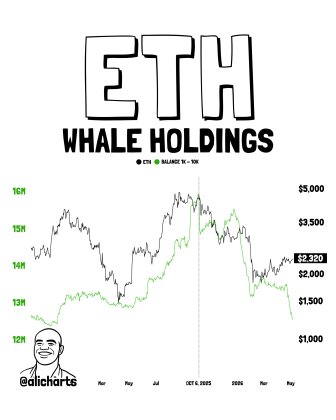
Source: Chart from Ali Charts on X

As seen in the chart shared by Ali Charts, the amount of ETH held by these mid-tier whales has dropped from 15.95 million to about 12.52 million, which represents an approximately 21.5% decrease in their total position. This simply implies a dramatic change in positioning from some of the network’s largest investors.

Ali Charts have flagged this development as a supply overhang. According to the expert, this suggests that the road to the $3,000 may require a fresh wave of demand from institutional or retail investors to offset whale distribution.

It is worth noting that a few days ago, ETH whales went on a buying spree. During the period, over 140,000 ETH, valued at around $322 million, were scooped up by these key players. When high-net-worth holders are buying more, it is a sign that smart money is positioning for a breakout.

Tokenized Treasuries Surges On The ETH Network

Even with the Ethereum price still significantly down from its all-time high, this drop has not hindered institutional adoption, which is currently accelerating. Coin Bureau has reported a surge in tokenized treasuries across the leading network.

The chart shows that the ETH network just surpassed $8 billion in tokenized US treasuries for the first time in its history. The rise in blockchain-based sovereign debt instruments underscores Ethereum’s growing relevance as a foundation for actual financial assets.

In addition, the week experienced the expansion of Stripe’s BRIDGE stablecoins to Celo and plans for Canada’s first regulated stablecoin on Ethereum. Despite the growth, ETH’s price continues to struggle to break key short-term resistance.

ETH trading at $2,279 on the 1D chart | Source: ETHUSDT on Tradingview.com

Related Questions

QAccording to the article, what has happened to the holdings of Ethereum whales in the range of 1,000 to 10,000 ETH?

ATheir holdings have dropped sharply, decreasing by approximately 21.5% from 15.95 million ETH in October 2025 to about 12.52 million ETH by May 2026.

QWhat does market expert Ali Charts suggest is needed for Ethereum's price to reach $3,000?

AAli Charts suggests that reaching $3,000 may require a fresh wave of demand from institutional or retail investors to offset the distribution pressure from whale selling.

QWhat positive development regarding institutional adoption is reported on the Ethereum network despite the price drop?

ATokenized US treasuries on the Ethereum network have surged, surpassing $8 billion for the first time in its history, indicating growing institutional adoption for real financial assets.

QHow did the behavior of the 1,000-10,000 ETH whale cohort change in early October 2025?

ATheir behavior shifted from a steady accumulation phase, where holdings grew from 12.95 million ETH in April to a peak of 15.95 million ETH, to a significant selling phase starting around October 6, 2025.

QWhat was the approximate value and amount of ETH that whales reportedly bought in a recent buying spree mentioned in the article?

ADuring the recent buying spree, whales scooped up over 140,000 ETH, which was valued at around $322 million at the time.

Related Reads

Fei-Fei Li's Team Clarifies the Concept of 'World Models', Sora Merely a Renderer

"World Models" has become a widely used yet confusing term in AI. To address this, a team led by Fei-Fei Li and World Labs proposed a functional taxonomy based on the Partially Observable Markov Decision Process framework. This taxonomy categorizes systems called "world models" into three distinct projections: Renderers, Simulators, and Planners. Renderers, like OpenAI's Sora and other video generation models, focus on producing photorealistic visual outputs for human perception. They prioritize visual fidelity over physical accuracy. Simulators, such as NVIDIA Omniverse, aim to compute precise future environmental states for computational tasks like engineering analysis or digital twins. Planners, like Vision-Language-Action models, take in observations and goals to output executable actions for robots or agents. The article clarifies that most current "world models," including Sora, are primarily Renderers. They generate convincing visuals but lack the core ability to simulate state transitions based on actions, a key requirement for a true world model in classic reinforcement learning definitions. This conceptual confusion has practical implications, leading to potential misalignment in technology selection, investment, and public understanding of AI capabilities. Clear categorization is crucial. It helps enterprises avoid costly mistakes (e.g., using a renderer for robot training), allows investors to accurately assess markets, and enables researchers to build comparable benchmarks. While future systems may integrate these functions, recognizing current boundaries is essential for honest assessment and progress.

marsbit6m ago

Fei-Fei Li's Team Clarifies the Concept of 'World Models', Sora Merely a Renderer

marsbit6m ago

Bloomberg Uncovered: How Do China's Wealthy Circumvent the Annual $50,000 Limit to Transfer Assets?

**Summary: How Wealthy Chinese Circumvent $50,000 Annual Foreign Exchange Limits** Despite China's strict capital controls, including an annual $50,000 per person foreign exchange quota, an estimated $150 billion in funds still leaves the country annually via various gray and underground channels. This report outlines the evolution of China's "capital wall" and the methods used to bypass it. **The Evolving Capital Controls:** * **Foundation (1994):** The system of "current account convertibility with strict capital account controls" was established. * **Quota Set (2007):** The $50,000 individual annual forex purchase limit was formalized. * **Crackdown Begins (2015-2017):** Following market volatility, enforcement tightened. Banks were required to scrutinize transactions, and channels like using UnionPay cards for Hong Kong insurance premiums or buying overseas property were blocked. * **Digital & Legal Upgrades (2024-2026):** Enhanced algorithms now flag suspicious patterns (e.g., "smurfing"). The Common Reporting Standard (CRS) provides Chinese tax authorities with data on citizens' offshore accounts. Unlicensed cross-border brokers have been targeted. **Five Primary Methods for Moving Capital:** 1. **Underground Banking / "Hawala" (Duiqiao):** The largest-scale method. No money crosses borders. Clients pay RMB to a domestic account; an overseas associate deposits equivalent foreign currency into the client's offshore account. Risks include high fees, account freezes, and legal penalties. 2. **"Smurfing" or "Ant Moving":** Using multiple individuals' $50,000 quotas to pool funds for one offshore recipient. Increasingly detected by anti-money laundering algorithms. 3. **Trade Invoice Manipulation:** Businesses over-invoice imports or under-invoice exports via offshore shell companies, creating a pretext to transfer excess funds abroad under the guise of trade. 4. **Channel Migration:** After a crackdown on internet brokers, funds flow toward more compliant but costly channels like major banks' cross-border wealth management services or Qualified Domestic Institutional Investor (QDII) quotas. 5. **Structural Arrangements:** High-net-worth individuals use complex, high-cost legal structures involving offshore trusts, insurance, and investment migration programs to transfer asset ownership. **Regulatory Response: Focusing on People, Not Just Money** The current strategy extends oversight from enterprises to **individual residents**. Tools like CRS allow retroactive visibility into offshore assets. Cryptocurrencies, once seen as a potential loophole, are now actively monitored and prosecuted as an illegal channel. The underlying driver remains: with significant wealth concentrated among millions of affluent households seeking diversification amid domestic economic shifts, the incentive to move assets offshore persists despite regulatory barriers.

marsbit25m ago

Bloomberg Uncovered: How Do China's Wealthy Circumvent the Annual $50,000 Limit to Transfer Assets?

marsbit25m ago

Ethereum's Ballmer Moment: As Everyone Is Bearish, the Circulating Supply Is Disappearing

"Ethereum's Ballmer Moment: Circulation Shrinks Amid Bearish Sentiment" Amid widespread bearish sentiment, with prominent figures like Bankless founder David Hoffman selling ETH and young developers flocking to Solana, some argue Ethereum is entering its "Ballmer era"—akin to Microsoft's perceived stagnation under Steve Ballmer. While surface-level criticisms about slow protocol development, cautious leadership, and competitive pressure are valid, underlying fundamentals tell a different story. Approximately 30% of ETH is staked, major holders like BitMine are accumulating, and spot ETFs continue to absorb supply. Regulatory clarity, including the SEC/CFTC's March ruling on staking rewards and the potential passage of the CLARITY Act, is transforming crypto from a regulatory threat into a legitimized framework. This institutionalization, alongside a shrinking circulating supply (with net issuance around 0.23% annually), creates significant buy-side pressure independent of fee-based value capture. The broader crypto total addressable market is expanding through regulated stablecoins, tokenized assets, and institutional adoption. While public chains face competition from permissioned alternatives, the winning model appears to be permissioned assets settling on public chains like Ethereum and Solana. The author advocates a non-maximalist, barbell strategy: holding ETH for its institutional role and supply squeeze, SOL for consumer/throughput trends, BTC as a macro hedge, and a basket of next-gen L1s. Key bullish drivers for ETH include rapid circulation shrinkage, potential Q2 staked ETF approvals, regulatory tailwinds solidifying its role as a default settlement layer, and the optionality of an eventual "Satya moment" leadership shift. Despite bearish consensus, the current setup—where crypto is "not hot" and regulatory groundwork is being laid—presents a compelling investment opportunity. The crypto cycle's focus may have shifted to AI, but blockchain infrastructure is gaining a legal and institutional foothold precisely while attention is elsewhere.

marsbit25m ago

Ethereum's Ballmer Moment: As Everyone Is Bearish, the Circulating Supply Is Disappearing

marsbit25m ago

Trading

Spot
Futures

Hot Articles

Discussions

Welcome to the HTX Community. Here, you can stay informed about the latest platform developments and gain access to professional market insights. Users' opinions on the price of ETH (ETH) are presented below.

活动图片