Ethereum Vs. Solana: Why BlackRock’s Former Crypto Head Is Betting On ETH

bitcoinistPublished on 2026-01-27Last updated on 2026-01-27

Abstract

In a comparison between Ethereum and Solana, Joseph Chalom, former BlackRock digital assets head and current SharpLink CEO, argues that Ethereum is the clear choice for high-value institutional use cases. He emphasizes that while Solana offers speed and low fees, Ethereum’s superior trust, security, and liquidity make it the preferred platform for serious financial applications like asset tokenization and large-scale settlements. Chalom points to market data showing that over 65% of stablecoin and tokenized asset activity occurs on Ethereum—roughly ten times more than on Solana—and notes this gap is widening. He acknowledges Solana’s strengths in areas like memecoins and gaming, where lower security and higher speed are acceptable. However, for institutional-grade applications requiring reliability, he states that "people are voting with their feet" by building on Ethereum. Notably, SharpLink itself holds significant Ethereum reserves, with public records showing around 864,840 ETH (approx. $2.5B).

SharpLink CEO Joseph Chalom, who previously led BlackRock’s digital assets strategy, framed the Ethereum-versus-Solana debate as a mismatch between narrative and actual institutional behavior: TradFi firms may praise speed and low fees, but the highest-value financial use cases are gravitating to networks optimized for trust, security, and liquidity.

Why Ethereum Beats Solana

Speaking with CoinDesk’s Jennifer Sanasie on Jan. 26, Chalom said he would avoid positioning his view as opinion and instead point to what he called observable market signals. “Maybe I’ll just share facts,” he said. “The fact is that Ethereum has been around for 10 years. It’s the secure, trusted, and liquid ecosystem. And I talk about both the layer 1 mainnet as well as the long set of layer 2s who help do that rollup strategy.”

That longevity, in his telling, matters because institutions aren’t selecting chains the way consumers pick apps. They’re selecting settlement rails for moving money, tokenizing assets, and representing ownership, workflows where operational failure and security assumptions are existential. Solana, Chalom acknowledged, has carved out a reputation for performance. But he drew a hard line on reliability. “Solana has been fast and cheap but it has not been secure. It has had downtime,” he said, arguing that downtime risk is disqualifying for “high value projects.”

Chalom’s thesis is that when the use case is “tokenizing assets” and “moving money,” the decision criteria compress into three buckets. “The real institutions who care only about three things,” he said, are “trust, security, and liquidity.” On that basis, he argued, “they’re building on Ethereum for high value projects,” adding: “It’s happening on Ethereum.”

He also anchored the comparison in stablecoin and tokenized-asset activity, citing a sharp share gap as evidence of where the market is allocating serious volume. “More than 65% of stablecoins and tokenized assets are happening there,” Chalom said, describing that as “10x what you see on Salana.” He reinforced the directional claim immediately after: “Ethereum leads in high quality assets in DeFi, tokenization, and stable coins by a factor of 10 to one over Salana. And that gap is only getting larger.”

Still, Chalom did not argue for a single-chain world. Instead, he mapped Ethereum and Solana to different product surfaces based on security tolerance. “I do think there’s a role for cheap, fast, less secure chains,” he said, and suggested Solana’s comparative advantage shows up where finality speed and cost trump institutional-grade assurances. “I think Solana will win in the memecoin, maybe the gaming space where actually security matters a lot less and speed matters more.”

The subtext is a segmentation story: Ethereum as the default rail for high-value, regulated, reputation-sensitive flows; Solana as the venue for high-throughput consumer and speculative activity where users accept different risk tradeoffs. Chalom insisted this is not about persuasion so much as migration patterns. “It’s not my perspective,” he said. “People are voting with their feet.”

Notably, SharpLink Gaming (Nasdaq: SBET) has emerged as one of the largest corporate ETH holders, with public trackers putting its holdings at roughly 864,840 ETH (about $2.5B at recent marks).

At press time, ETH traded at $2,921.
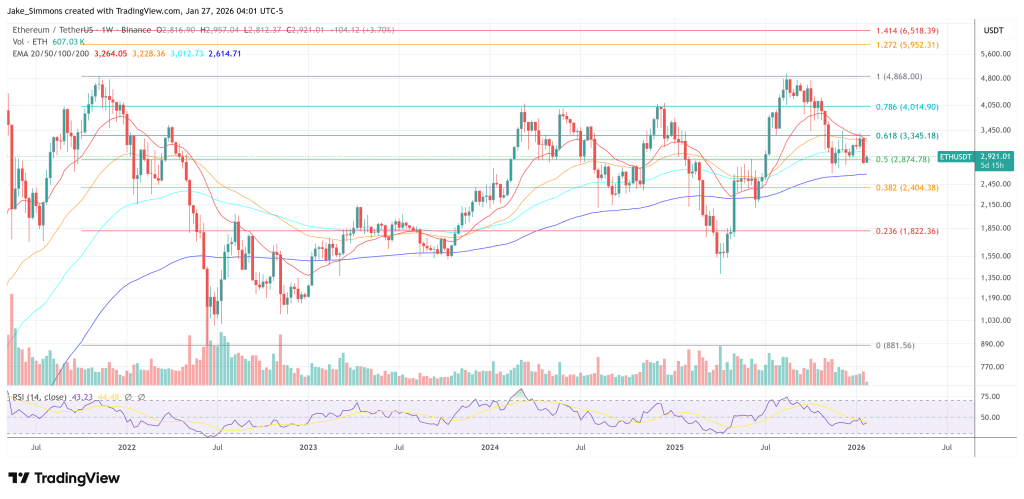
ETH recover back above the 0.5 Fib, 1-week chart | Source: ETHUSDT on TradingView.com

Trending Cryptos

Related Questions

QAccording to Joseph Chalom, what are the three key criteria that institutions prioritize when selecting a blockchain for high-value projects?

ATrust, security, and liquidity.

QWhat percentage of stablecoins and tokenized assets does Chalom claim are happening on Ethereum, and how does this compare to Solana?

AMore than 65% are on Ethereum, which he describes as 10 times the volume seen on Solana.

QWhat specific use cases does Chalom believe Solana is better suited for, despite its perceived shortcomings in security?

AMemecoin and gaming, where speed and low cost are more important than institutional-grade security.

QHow does Chalom frame the fundamental difference in how institutions choose a blockchain versus how consumers choose applications?

AInstitutions are selecting settlement rails for moving money and tokenizing assets, where operational failure is an existential risk, not just picking apps based on features.

QWhat is the evidence provided in the article that SharpLink Gaming is putting its money behind its thesis on Ethereum?

ASharpLink Gaming is one of the largest corporate ETH holders, with public trackers showing holdings of roughly 864,840 ETH (worth about $2.5 billion).

Related Reads

Bitcoin Withdrawals Continue: 8 Years of Storage in a Coldcard Cold Wallet Ended in Zero

Coldcard Hardware Wallet Hacked: Losses Mount Due to Vulnerable Seed Generation A critical vulnerability in Coldcard hardware wallets has led to a continued wave of fund thefts. According to Galaxy Research, the total stolen has reached 1,367.05 BTC (approx. $88.6 million) from 4,585 addresses, a significant increase from the initial 594.5 BTC reported on July 30, 2026. Most of the stolen funds remain on the attackers' addresses. The issue is not with the current firmware, which Coinkite has updated, but with seed phrases generated on vulnerable devices between March 2021 and the release of fixed firmware versions. Due to a programmer error, devices switched from using a hardware random number generator to the software-based Yasmarang generator, which was initialized with publicly accessible data like the chip's serial number. This made the seed phrases predictable through offline brute-force attacks, meaning wallets remain at risk until funds are moved to a new wallet generated with the patched firmware. Affected devices include Mk2/Mk3 with firmware 4.0.1–4.1.9 (and up to 5.0.3), Mk4/Mk5 up to version 5.6.0, and Q models up to 1.5.0Q. The only exceptions are seeds created with a high-entropy method like at least 50 independent dice rolls or a strong unique BIP-39 passphrase. All other owners must generate a new seed on the fixed firmware and transfer their assets. A case highlighting the human impact involves a 39-year-old long-term investor who lost 2 BTC (approx. $130,000) in minutes. He had accumulated the Bitcoin over eight years through physical labor, viewing it as a financial lifeline and a retirement plan in a country suffering from hyperinflation. His story underscores that even conservative "buy and hold in cold storage" strategies can be compromised by such underlying technical flaws. From a technical perspective, this incident echoes historical failures where weak random number generators undermined cryptographic security, challenging the assumption that offline storage is automatically foolproof.

cryptonews.ru3h ago

Bitcoin Withdrawals Continue: 8 Years of Storage in a Coldcard Cold Wallet Ended in Zero

cryptonews.ru3h ago

Trading

Spot

Hot Articles

Discussions

Welcome to the HTX Community. Here, you can stay informed about the latest platform developments and gain access to professional market insights. Users' opinions on the price of ETH (ETH) are presented below.

活动图片















