Ethereum vs Solana – No chain has defensible ‘moat’ yet, warns Wintermute CEO

ambcryptoPublished on 2026-03-21Last updated on 2026-03-21

Abstract

Wintermute CEO Evgeny Gaevoy argues that neither Ethereum nor Solana has established a defensible market position, despite Ethereum's dominance in DeFi TVL ($56 billion vs. Solana's $6.8 billion). He claims Ethereum's value is largely "stuck money" and corporate experiments with limited real-world impact, while Solana, though technologically capable, remains overly reliant on memecoin activity without major new dApps. Gaevoy believes the space remains open for new blockchains to emerge and attract users. Hyperliquid's success supports this view, as it now generates 45% of blockchain fee revenue—surpassing Ethereum (7%) and Solana (13%)—by expanding into commodity trading. Additionally, new corporate chains like Tempo and Circle’s Arc threaten public chains' stablecoin and tokenization advantages by offering lower fees and enhanced security. The competition remains fluid, with no clear winner yet.

From the outside, one might think public blockchains are a two-horse race, pitting DeFi pioneer Ethereum against its closest and fastest challenger, Solana. In fact, DeFi activity and liquidity (total locked value) may somewhat reinforce the above picture.

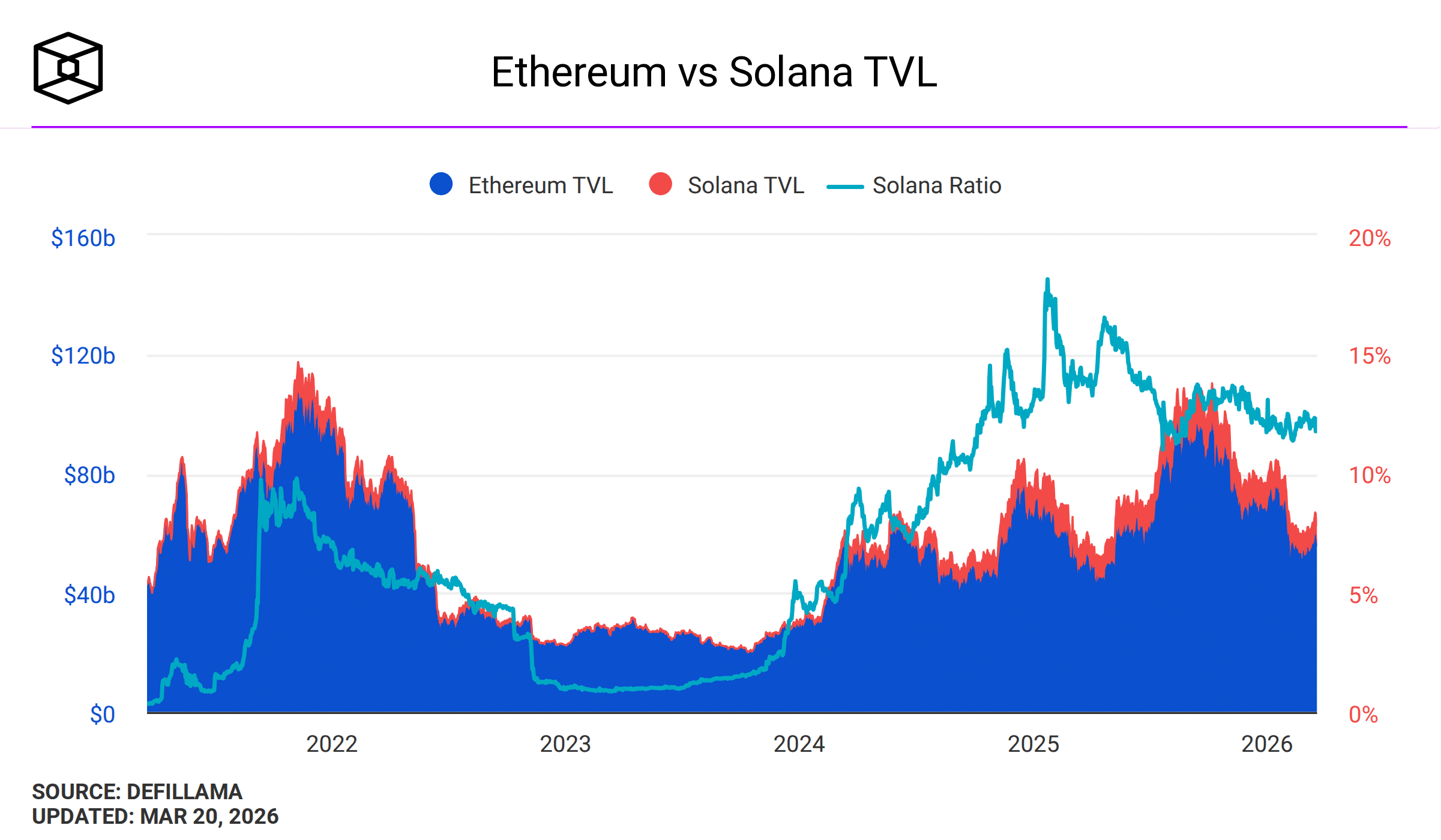
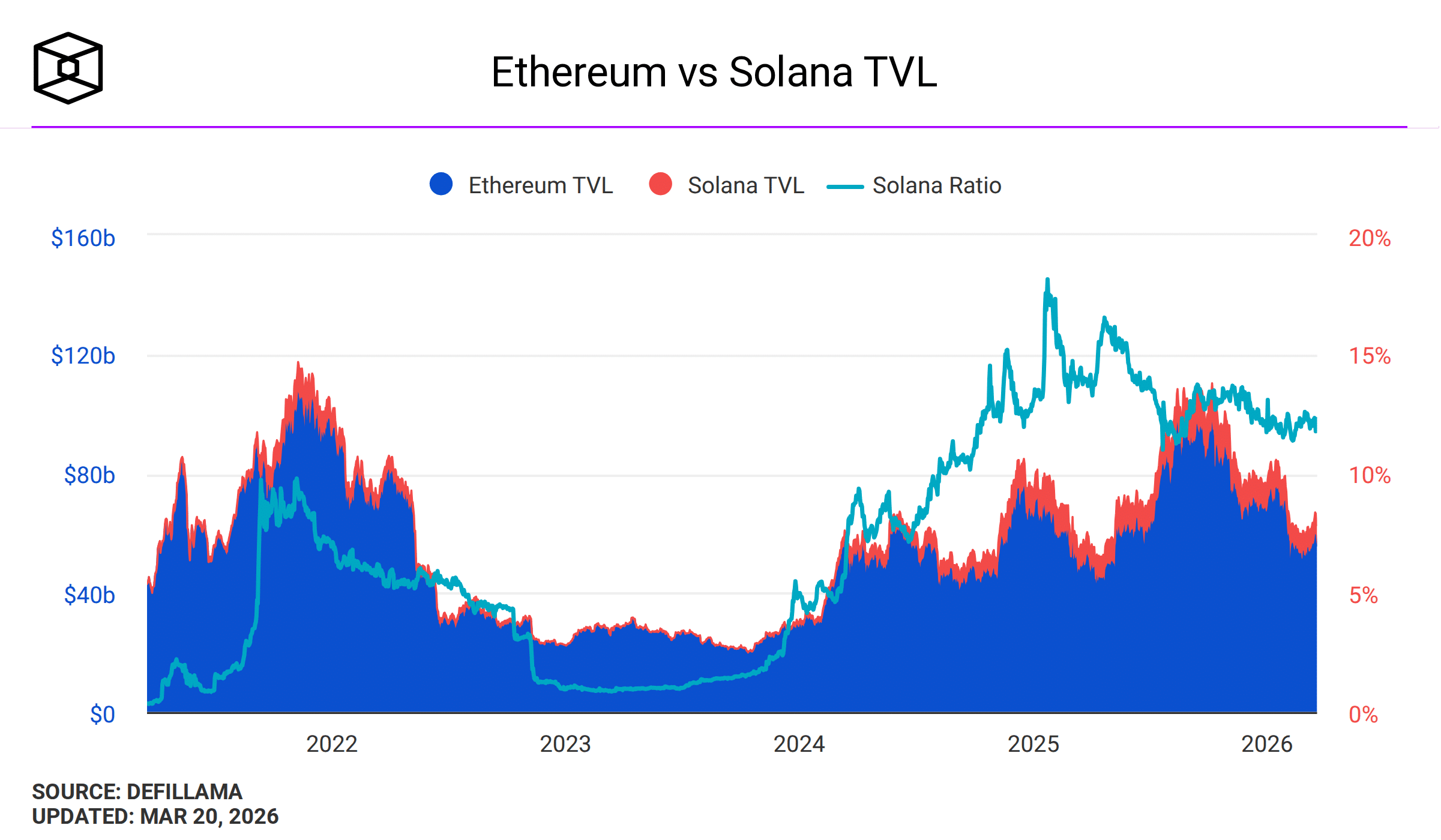
Check this out – Out of the total DeFi TVL of $95.3 billion, Ethereum dominates with $56 billion, while Solana comes in second at $6.8 billion – About 10% of Ethereum’s size.
Source: The Block/DeFiLlama

However, Evgeny Gaevoy, CEO of crypto market maker Wintermute, believes neither of the two leading chains has a sticky moat.

ETH vs SOL – No clear winner just yet

For Ethereum’s massive TVL, Gaevoy claimed that most of the capital on the chain is “stuck money” and “corporate experiments” on blockchain rails.

People quite overestimate those corporate pilots to put some cash markets and bonds on the block. It’s a tiny TradFi economic activity.

On the contrary, for Solana, the memecoin mania has revealed that its technology works and it can handle massive transaction volumes with faster transfers.

According to the exec though, Solana is still stuck with memecoins. Additionally, there are no major new dApps or exchanges to catalyze it.

He concluded,

I don’t feel anyone has won yet. It’s feasible that a new blockchain could attract a new cohort of believers and take the world by storm. It’s possible because nobody has this moat yet.

In the stablecoin and tokenization boom, Ethereum and Solana are still ranked first and second, respectively.

Hyperliquid validates his theory

Gaevoy’s arguments are plausible too, especially after Hyperliquid’s success despite being operational for about three years.

The chain and DEX were purpose-built for high-frequency crypto trading and DeFi activity. However, now it has become the best place to trade oil and other commodities amid geopolitical tensions.

Interestingly, the massive trading activity across crypto and non-crypto assets has driven Hyperliquid to generate more fees and revenue.

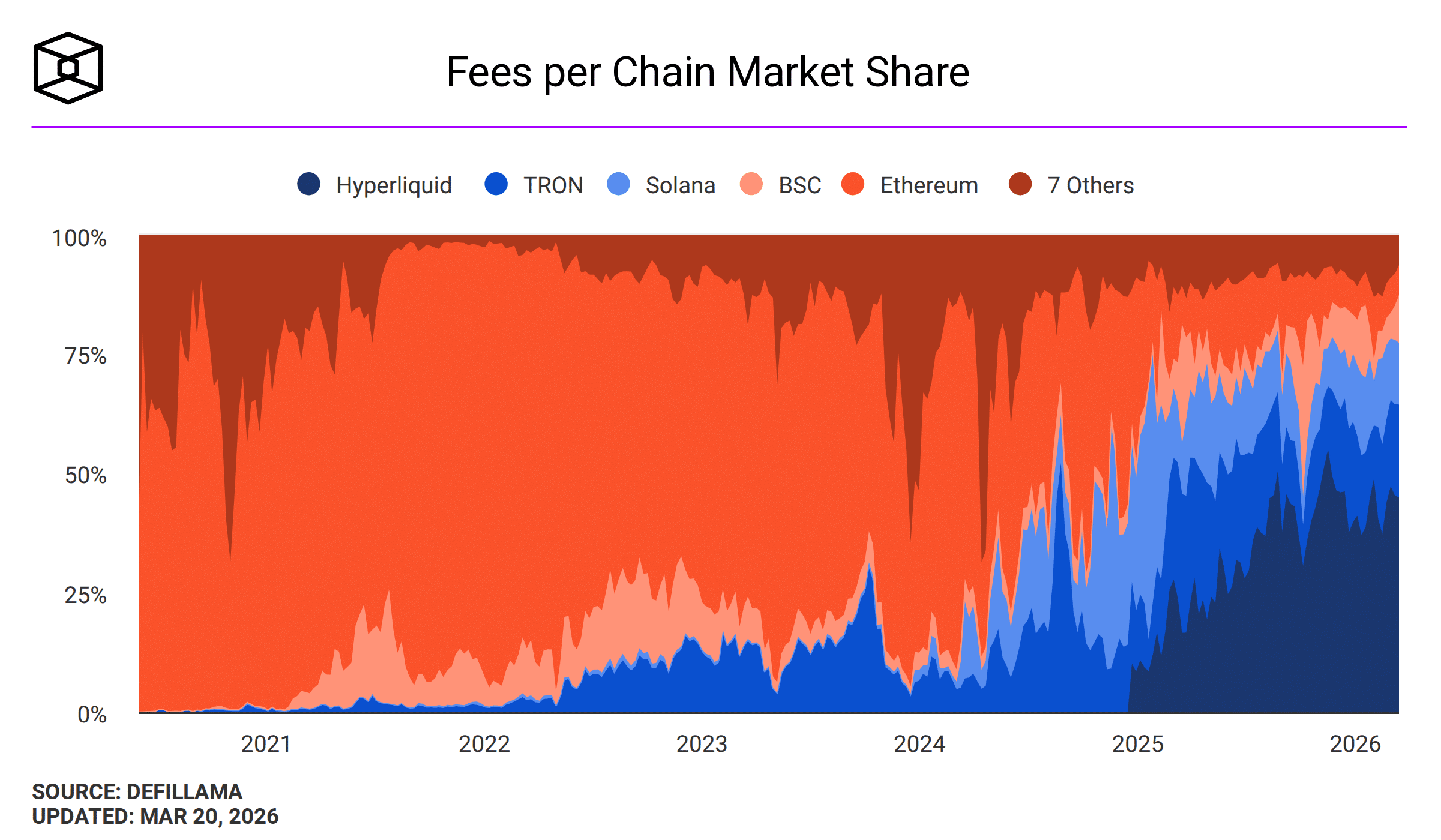
The results? Hyperliquid now dominates 45% of the generated fee revenue market. TRON controls 20% of the revenue, while Solana ranks third with a 13% market share. Finally, Ethereum comes fifth at 7% after BNB Chain’s 10%.
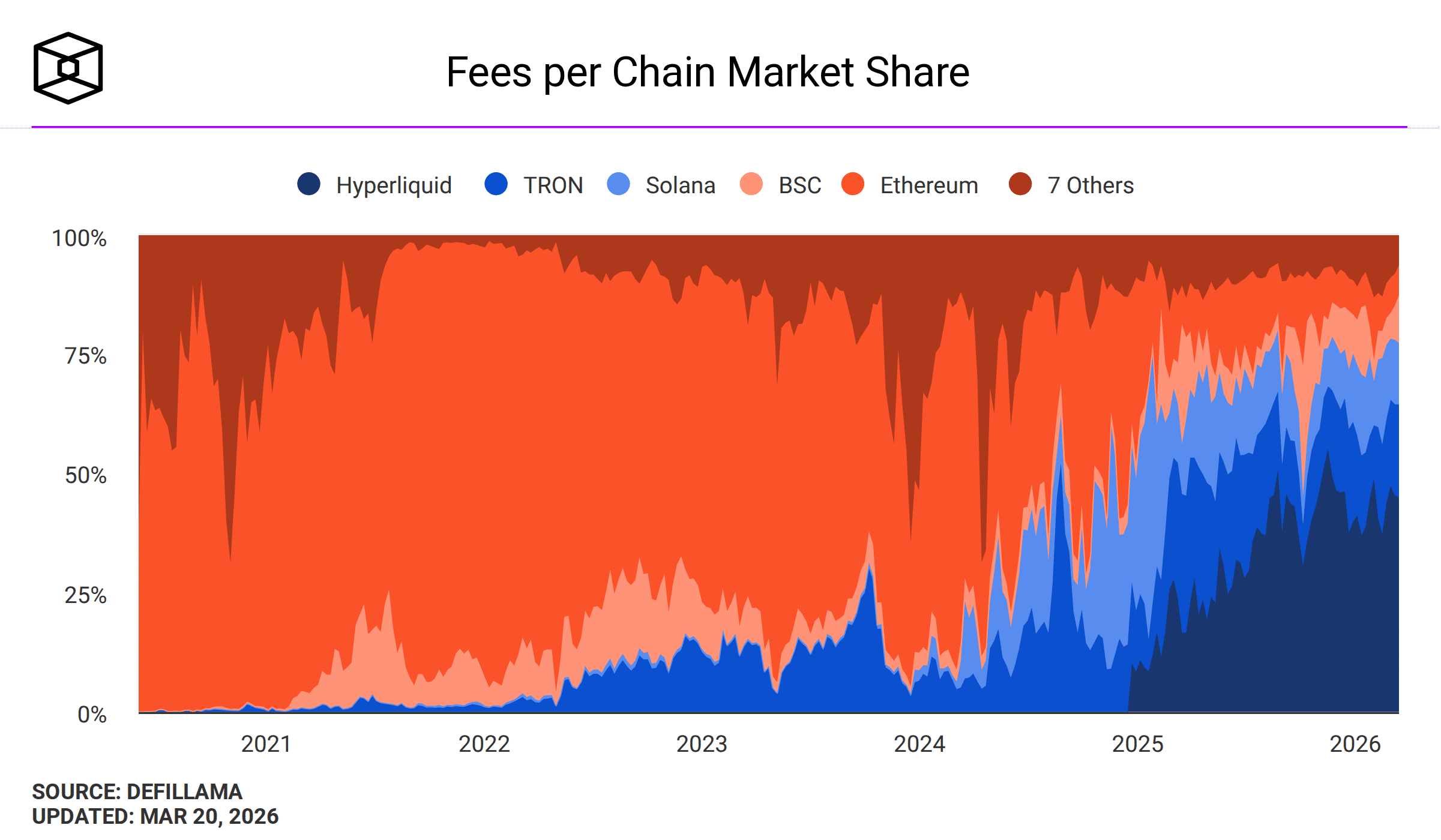
Source: The Block/DeFiLlama

And yet, the current perceived ‘moats’ for Ethereum and Solana, such as stablecoins and tokenized markets, are under threat from rival private corporate chains.

Stripe-backed stablecoin payment-focused Tempo chain went live recently. A similar chain, Circle’s Arc, debuted too. The full roll-out of Google Cloud Universal Ledger (GCUL) is expected this year, with all of them eyeing payments and tokenized capital markets.

All these new chains seek to scrap the volatile, unpredictable transfer fees charged by current public chains and minimize scams. So, it’s feasible they could eat into public chains’ market share and their perceived moat.


Final Summary

  • Wintermute CEO has downplayed the perceived moats of Ethereum and Solana, warning that they could still be easily disrupted.
  • Hyperliquid’s 45% market dominance in total blockchain revenue validated exec’s argument

Trending Cryptos

Related Questions

QAccording to Wintermute CEO Evgeny Gaevoy, why does Ethereum's massive TVL not necessarily represent a strong moat?

AGaevoy claims that most of the capital on Ethereum is 'stuck money' and 'corporate experiments' on blockchain rails, referring to small-scale TradFi economic activity like putting cash markets and bonds on-chain.

QWhat technological advantage of Solana was revealed during the memecoin mania, according to the article?

AThe memecoin mania revealed that Solana's technology works and it can handle massive transaction volumes with faster transfers.

QWhich blockchain currently dominates the market in generated fee revenue, and what is its market share?

AHyperliquid currently dominates the generated fee revenue market with a 45% share.

QWhat are some of the new rival chains mentioned that threaten the stablecoin and tokenization moat of public chains like Ethereum and Solana?

AThe article mentions the Stripe-backed Tempo chain, Circle's Arc chain, and the upcoming Google Cloud Universal Ledger (GCUL), all of which are focused on payments and tokenized capital markets.

QWhat is the core argument made by Wintermute's CEO about the current state of competition between blockchain networks?

AThe core argument is that no chain has a defensible moat yet, and it's still feasible for a new blockchain to attract believers and take the world by storm, as the current leaders are vulnerable to disruption.

Related Reads

Annual Salary of Millions Competing for Electricians, Meta Rushes to Open Its Own Technical School

The AI boom is facing an unexpected bottleneck: a severe shortage of skilled construction workers and electricians. As tech giants like Meta, OpenAI, and Alphabet race to build massive data centers—such as OpenAI's $16 billion "Stargate" project—they are hitting a critical labor wall. The U.S. needs an estimated 130,000 more electricians, 240,000 construction workers, and 150,000 supervisors by 2030 for AI infrastructure alone, but tens of thousands of electrician jobs go unfilled each year. While AI companies offer high premiums, with electricians earning up to $280,000 annually, worker scarcity still causes massive losses—delays on a single project can cost $14.2 million per month. The complexity of building AI data centers, which require immense power (equivalent to powering hundreds of thousands of homes), sophisticated electrical systems, and advanced liquid cooling solutions, demands highly skilled technicians who are in short supply. To combat this, companies are investing heavily in training. Meta has committed $115 million to a free training school offering tuition, housing, and stipends, targeting 5,000 new workers. OpenAI is partnering with unions to secure skilled labor. These efforts are paying off, with a significant rise in Gen Z interest in trade schools over college. However, the power demands are staggering. AI data centers are driving a rapid surge in electricity consumption, projected to account for up to 12% of U.S. power use by 2028 and raising costs for consumers. Furthermore, the construction boom is project-based, leading to a potential future glut of trained workers once building peaks, which could depress wages industry-wide. The race for AI supremacy now depends as much on skilled hands as on advanced chips.

marsbit59m ago

Annual Salary of Millions Competing for Electricians, Meta Rushes to Open Its Own Technical School

marsbit59m ago

OpenAI No Longer Sells Its Most Expensive Model for Profit

OpenAI is shifting its business strategy away from promoting its most expensive, flagship models for every task. Recent price cuts—80% for GPT-5.6 Luna and 20% for Terra—signal a deeper change: the company now actively advises users that many tasks don't require the most powerful model. Instead, OpenAI recommends a tiered approach: use the high-end GPT-5.6 Sol for complex planning and analysis, then delegate execution to cheaper models like Luna. This mirrors moves by Anthropic, which recently launched Claude Opus 5 at half the price of its top model, Fable 5. Both companies are de-emphasizing flagship models as primary revenue drivers, using them instead for brand prestige and technological showcases. The industry is entering a "mass-market" phase, similar to automotive, where high-volume, cost-effective models handle daily operations and drive scale. OpenAI's price reductions are partly enabled by AI models themselves optimizing underlying code and infrastructure, creating a self-reinforcing cycle of efficiency gains and cost reduction. Competition is shifting from "who is smartest" to "who offers the best value." The goal is no longer selling individual models but fostering widespread API adoption and ecosystem lock-in. By making AI calls cheap and ubiquitous, companies like OpenAI aim to become the indispensable, utility-like infrastructure powering automated workflows—the "water and electricity" of software, quietly embedded everywhere.

marsbit59m ago

OpenAI No Longer Sells Its Most Expensive Model for Profit

marsbit59m ago

Trading

Spot

Hot Articles

Discussions

Welcome to the HTX Community. Here, you can stay informed about the latest platform developments and gain access to professional market insights. Users' opinions on the price of ETH (ETH) are presented below.

活动图片