Ethereum vs Solana – No chain has defensible ‘moat’ yet, warns Wintermute CEO

ambcryptoPublished on 2026-03-21Last updated on 2026-03-21

Abstract

Wintermute CEO Evgeny Gaevoy argues that neither Ethereum nor Solana has established a defensible market position, despite Ethereum's dominance in DeFi TVL ($56 billion vs. Solana's $6.8 billion). He claims Ethereum's value is largely "stuck money" and corporate experiments with limited real-world impact, while Solana, though technologically capable, remains overly reliant on memecoin activity without major new dApps. Gaevoy believes the space remains open for new blockchains to emerge and attract users. Hyperliquid's success supports this view, as it now generates 45% of blockchain fee revenue—surpassing Ethereum (7%) and Solana (13%)—by expanding into commodity trading. Additionally, new corporate chains like Tempo and Circle’s Arc threaten public chains' stablecoin and tokenization advantages by offering lower fees and enhanced security. The competition remains fluid, with no clear winner yet.

From the outside, one might think public blockchains are a two-horse race, pitting DeFi pioneer Ethereum against its closest and fastest challenger, Solana. In fact, DeFi activity and liquidity (total locked value) may somewhat reinforce the above picture.

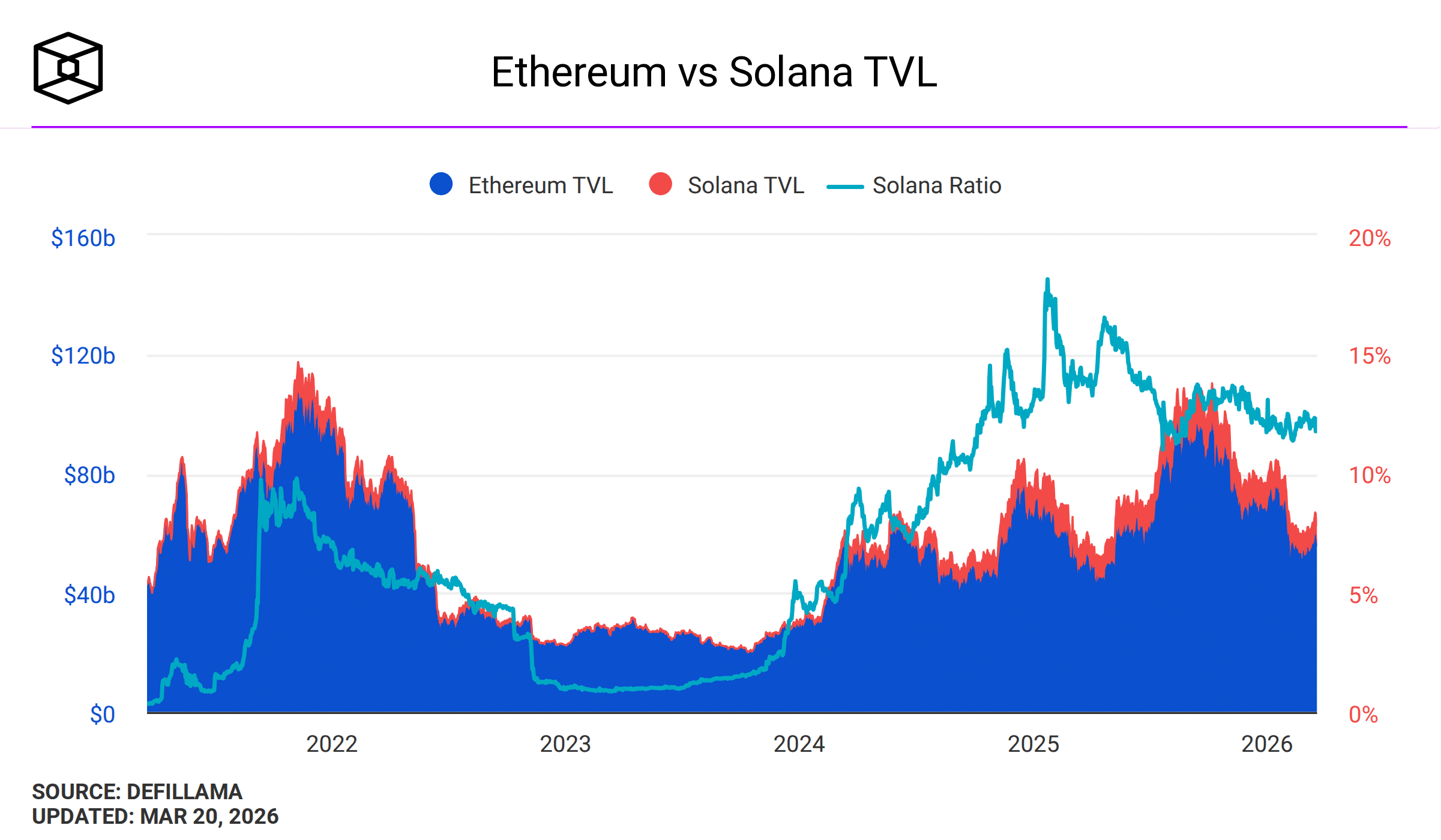
Check this out – Out of the total DeFi TVL of $95.3 billion, Ethereum dominates with $56 billion, while Solana comes in second at $6.8 billion – About 10% of Ethereum’s size.
Source: The Block/DeFiLlama

However, Evgeny Gaevoy, CEO of crypto market maker Wintermute, believes neither of the two leading chains has a sticky moat.

ETH vs SOL – No clear winner just yet

For Ethereum’s massive TVL, Gaevoy claimed that most of the capital on the chain is “stuck money” and “corporate experiments” on blockchain rails.

People quite overestimate those corporate pilots to put some cash markets and bonds on the block. It’s a tiny TradFi economic activity.

On the contrary, for Solana, the memecoin mania has revealed that its technology works and it can handle massive transaction volumes with faster transfers.

According to the exec though, Solana is still stuck with memecoins. Additionally, there are no major new dApps or exchanges to catalyze it.

He concluded,

I don’t feel anyone has won yet. It’s feasible that a new blockchain could attract a new cohort of believers and take the world by storm. It’s possible because nobody has this moat yet.

In the stablecoin and tokenization boom, Ethereum and Solana are still ranked first and second, respectively.

Hyperliquid validates his theory

Gaevoy’s arguments are plausible too, especially after Hyperliquid’s success despite being operational for about three years.

The chain and DEX were purpose-built for high-frequency crypto trading and DeFi activity. However, now it has become the best place to trade oil and other commodities amid geopolitical tensions.

Interestingly, the massive trading activity across crypto and non-crypto assets has driven Hyperliquid to generate more fees and revenue.

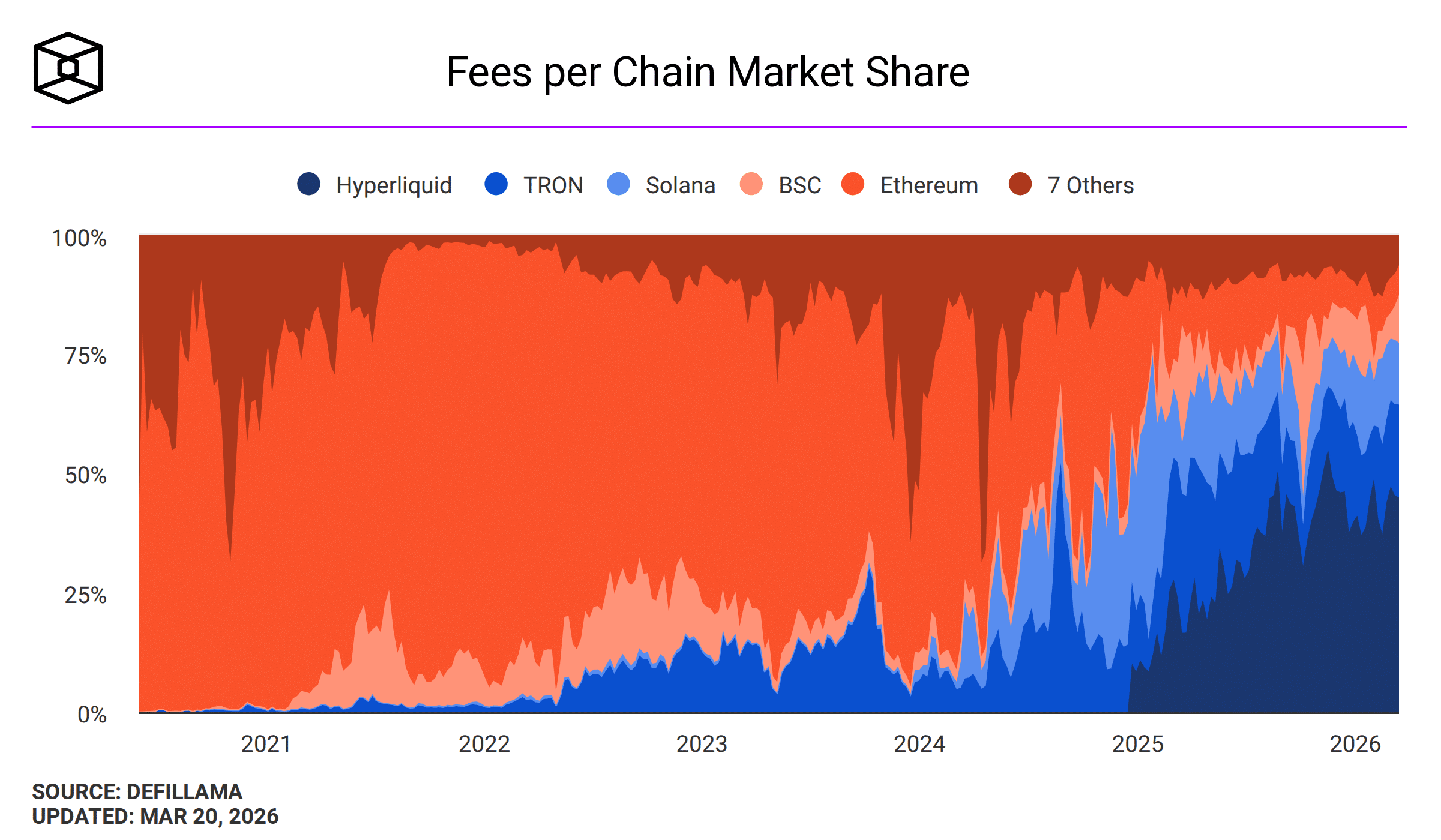
The results? Hyperliquid now dominates 45% of the generated fee revenue market. TRON controls 20% of the revenue, while Solana ranks third with a 13% market share. Finally, Ethereum comes fifth at 7% after BNB Chain’s 10%.
Source: The Block/DeFiLlama

And yet, the current perceived ‘moats’ for Ethereum and Solana, such as stablecoins and tokenized markets, are under threat from rival private corporate chains.

Stripe-backed stablecoin payment-focused Tempo chain went live recently. A similar chain, Circle’s Arc, debuted too. The full roll-out of Google Cloud Universal Ledger (GCUL) is expected this year, with all of them eyeing payments and tokenized capital markets.

All these new chains seek to scrap the volatile, unpredictable transfer fees charged by current public chains and minimize scams. So, it’s feasible they could eat into public chains’ market share and their perceived moat.


Final Summary

  • Wintermute CEO has downplayed the perceived moats of Ethereum and Solana, warning that they could still be easily disrupted.
  • Hyperliquid’s 45% market dominance in total blockchain revenue validated exec’s argument

Trending Cryptos

Related Questions

QAccording to Wintermute CEO Evgeny Gaevoy, why does Ethereum's massive TVL not necessarily represent a strong moat?

AGaevoy claims that most of the capital on Ethereum is 'stuck money' and 'corporate experiments' on blockchain rails, referring to small-scale TradFi economic activity like putting cash markets and bonds on-chain.

QWhat technological advantage of Solana was revealed during the memecoin mania, according to the article?

AThe memecoin mania revealed that Solana's technology works and it can handle massive transaction volumes with faster transfers.

QWhich blockchain currently dominates the market in generated fee revenue, and what is its market share?

AHyperliquid currently dominates the generated fee revenue market with a 45% share.

QWhat are some of the new rival chains mentioned that threaten the stablecoin and tokenization moat of public chains like Ethereum and Solana?

AThe article mentions the Stripe-backed Tempo chain, Circle's Arc chain, and the upcoming Google Cloud Universal Ledger (GCUL), all of which are focused on payments and tokenized capital markets.

QWhat is the core argument made by Wintermute's CEO about the current state of competition between blockchain networks?

AThe core argument is that no chain has a defensible moat yet, and it's still feasible for a new blockchain to attract believers and take the world by storm, as the current leaders are vulnerable to disruption.

Related Reads

Bitcoin Boom in Full Swing: Saylor's Latest Statement Fuels Buying Speculation

MicroStrategy's Executive Chairman Michael Saylor has fueled speculation about a new Bitcoin purchase by posting "Bitcoin Drive engaged" on August 2, accompanied by the company's customary purchase tracker. This aligns with his pattern of hinting at treasury changes ahead of weekly reports. The accompanying report showed MicroStrategy's Bitcoin holdings at 843,775 BTC, with an average cost of $75,653 per coin and an unrealized loss of -$10.58B. A similar signal preceded the company's July 27 announcement, strengthening expectations for a treasury update on Monday. However, MicroStrategy's real-time ledger reflects two recent Bitcoin sales totaling 3,588 BTC, reducing holdings from 847,363 BTC to the current 843,775 BTC. The company stated these sales funded preferred stock dividends and replenished its U.S. dollar reserve. Recent reports indicate the company made no Bitcoin purchases the week ending July 26 while increasing its dollar reserve to approximately $3.75B. The company faces financial headwinds after reporting an $8.33B operating loss for Q2 2026, including an $8.32B unrealized loss on its digital assets. Management may sell up to $1.25B more in Bitcoin to meet cash obligations. The expected Monday update will reveal if the "Bitcoin Drive" signal marks a return to accumulation as MicroStrategy balances its massive Bitcoin stash against growing cash commitments.

cryptonews.ru21m ago

Bitcoin Boom in Full Swing: Saylor's Latest Statement Fuels Buying Speculation

cryptonews.ru21m ago

Trading

Spot

Hot Articles

Discussions

Welcome to the HTX Community. Here, you can stay informed about the latest platform developments and gain access to professional market insights. Users' opinions on the price of ETH (ETH) are presented below.

活动图片















