Ethereum vs Solana – No chain has defensible ‘moat’ yet, warns Wintermute CEO

ambcryptoPublished on 2026-03-21Last updated on 2026-03-21

Abstract

Wintermute CEO Evgeny Gaevoy argues that neither Ethereum nor Solana has established a defensible market position, despite Ethereum's dominance in DeFi TVL ($56 billion vs. Solana's $6.8 billion). He claims Ethereum's value is largely "stuck money" and corporate experiments with limited real-world impact, while Solana, though technologically capable, remains overly reliant on memecoin activity without major new dApps. Gaevoy believes the space remains open for new blockchains to emerge and attract users. Hyperliquid's success supports this view, as it now generates 45% of blockchain fee revenue—surpassing Ethereum (7%) and Solana (13%)—by expanding into commodity trading. Additionally, new corporate chains like Tempo and Circle’s Arc threaten public chains' stablecoin and tokenization advantages by offering lower fees and enhanced security. The competition remains fluid, with no clear winner yet.

From the outside, one might think public blockchains are a two-horse race, pitting DeFi pioneer Ethereum against its closest and fastest challenger, Solana. In fact, DeFi activity and liquidity (total locked value) may somewhat reinforce the above picture.

Check this out – Out of the total DeFi TVL of $95.3 billion, Ethereum dominates with $56 billion, while Solana comes in second at $6.8 billion – About 10% of Ethereum’s size.
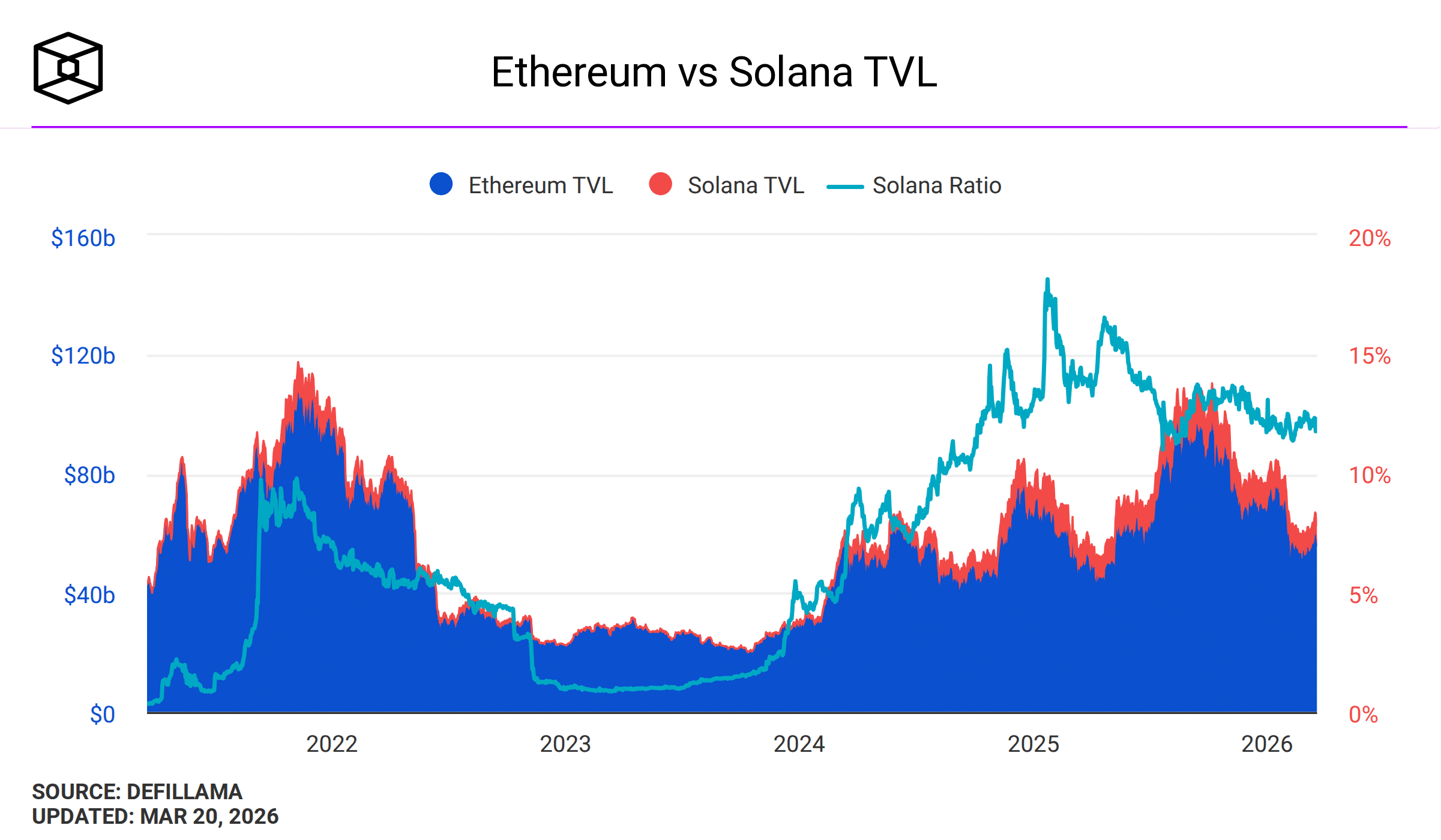
Source: The Block/DeFiLlama

However, Evgeny Gaevoy, CEO of crypto market maker Wintermute, believes neither of the two leading chains has a sticky moat.

ETH vs SOL – No clear winner just yet

For Ethereum’s massive TVL, Gaevoy claimed that most of the capital on the chain is “stuck money” and “corporate experiments” on blockchain rails.

People quite overestimate those corporate pilots to put some cash markets and bonds on the block. It’s a tiny TradFi economic activity.

On the contrary, for Solana, the memecoin mania has revealed that its technology works and it can handle massive transaction volumes with faster transfers.

According to the exec though, Solana is still stuck with memecoins. Additionally, there are no major new dApps or exchanges to catalyze it.

He concluded,

I don’t feel anyone has won yet. It’s feasible that a new blockchain could attract a new cohort of believers and take the world by storm. It’s possible because nobody has this moat yet.

In the stablecoin and tokenization boom, Ethereum and Solana are still ranked first and second, respectively.

Hyperliquid validates his theory

Gaevoy’s arguments are plausible too, especially after Hyperliquid’s success despite being operational for about three years.

The chain and DEX were purpose-built for high-frequency crypto trading and DeFi activity. However, now it has become the best place to trade oil and other commodities amid geopolitical tensions.

Interestingly, the massive trading activity across crypto and non-crypto assets has driven Hyperliquid to generate more fees and revenue.

The results? Hyperliquid now dominates 45% of the generated fee revenue market. TRON controls 20% of the revenue, while Solana ranks third with a 13% market share. Finally, Ethereum comes fifth at 7% after BNB Chain’s 10%.
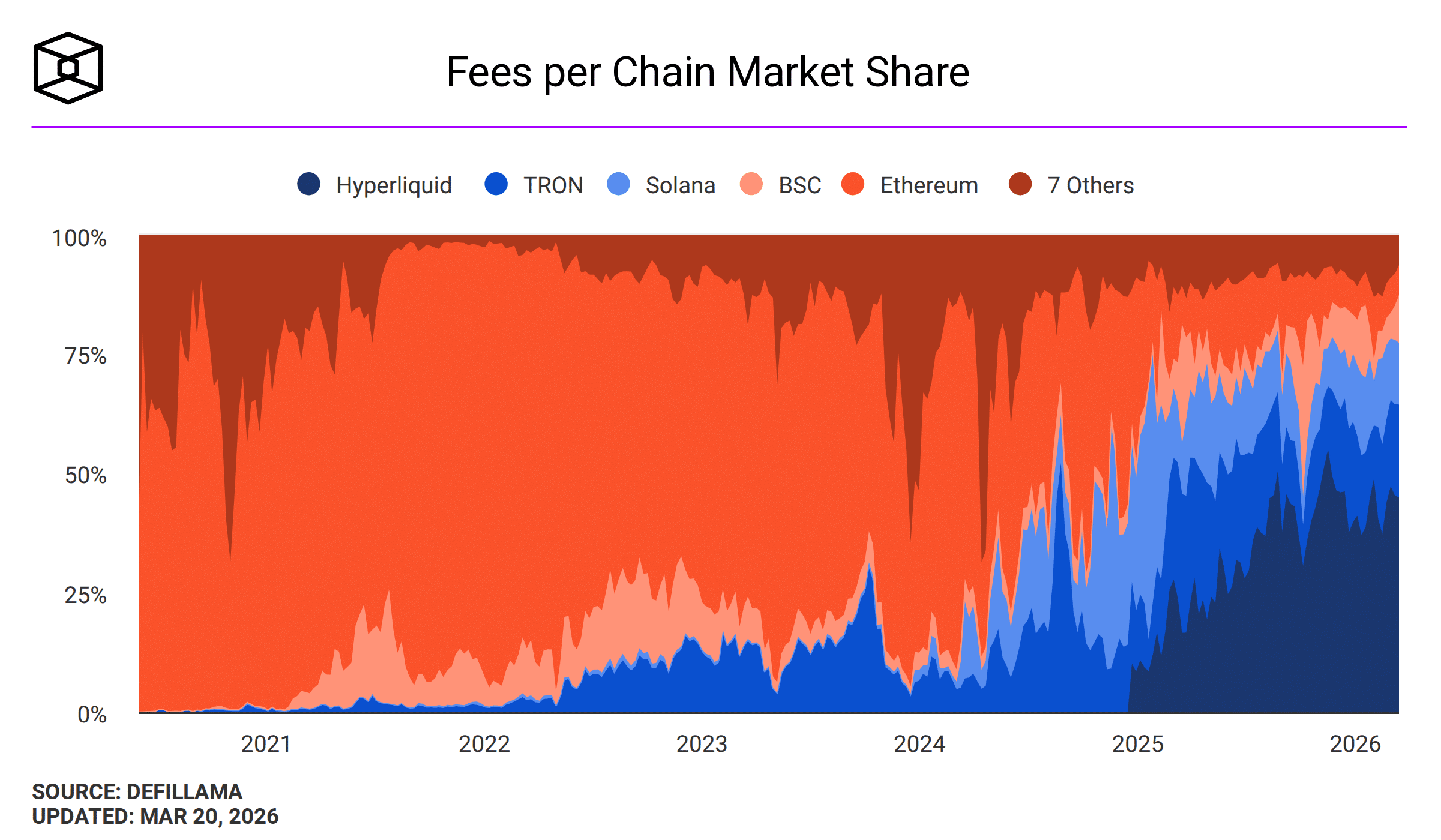
Source: The Block/DeFiLlama

And yet, the current perceived ‘moats’ for Ethereum and Solana, such as stablecoins and tokenized markets, are under threat from rival private corporate chains.

Stripe-backed stablecoin payment-focused Tempo chain went live recently. A similar chain, Circle’s Arc, debuted too. The full roll-out of Google Cloud Universal Ledger (GCUL) is expected this year, with all of them eyeing payments and tokenized capital markets.

All these new chains seek to scrap the volatile, unpredictable transfer fees charged by current public chains and minimize scams. So, it’s feasible they could eat into public chains’ market share and their perceived moat.


Final Summary

  • Wintermute CEO has downplayed the perceived moats of Ethereum and Solana, warning that they could still be easily disrupted.
  • Hyperliquid’s 45% market dominance in total blockchain revenue validated exec’s argument

Trending Cryptos

Related Questions

QAccording to Wintermute CEO Evgeny Gaevoy, why does Ethereum's massive TVL not necessarily represent a strong moat?

AGaevoy claims that most of the capital on Ethereum is 'stuck money' and 'corporate experiments' on blockchain rails, referring to small-scale TradFi economic activity like putting cash markets and bonds on-chain.

QWhat technological advantage of Solana was revealed during the memecoin mania, according to the article?

AThe memecoin mania revealed that Solana's technology works and it can handle massive transaction volumes with faster transfers.

QWhich blockchain currently dominates the market in generated fee revenue, and what is its market share?

AHyperliquid currently dominates the generated fee revenue market with a 45% share.

QWhat are some of the new rival chains mentioned that threaten the stablecoin and tokenization moat of public chains like Ethereum and Solana?

AThe article mentions the Stripe-backed Tempo chain, Circle's Arc chain, and the upcoming Google Cloud Universal Ledger (GCUL), all of which are focused on payments and tokenized capital markets.

QWhat is the core argument made by Wintermute's CEO about the current state of competition between blockchain networks?

AThe core argument is that no chain has a defensible moat yet, and it's still feasible for a new blockchain to attract believers and take the world by storm, as the current leaders are vulnerable to disruption.

Related Reads

From South Korea to the United States: Blue-Collar Jobs Are Becoming Increasingly Popular, Thanks to AI

AI is reshaping the labor market's value proposition. The traditional four-year college degree is losing its appeal as a guaranteed career path, while skilled blue-collar trades like electricians, welders, and plumbers are experiencing historic demand and wage premiums. This shift is driven by dual pressures: AI's displacement of certain white-collar roles and a booming need for physical infrastructure and data center construction. Data confirms the trend. In the U.S., vocational school revenue surged, and a significant portion of recent layoffs are AI-related. Surveys show a majority of Gen Z adults plan to pursue blue-collar work, citing better job security against AI automation. Vocational education interest has exploded recently. Experts cite a psychological shift as younger generations seek tangible, AI-resistant careers and avoid high student debt. In many cases, salaries for skilled trades now match or exceed those requiring a bachelor's degree. In South Korea, semiconductor vocational high schools boast near-total employment, with graduates securing high-paying roles at companies like Samsung. The shortage is structural, exacerbated by a retiring baby boomer workforce and massive infrastructure projects. Companies like JPMorgan Chase, Meta, and Lowe's are investing heavily in training programs. However, overcoming historical stigma and a "perception gap" around trade careers remains a key challenge to closing the talent gap.

marsbit19m ago

From South Korea to the United States: Blue-Collar Jobs Are Becoming Increasingly Popular, Thanks to AI

marsbit19m ago

Qualcomm: AI Hype Subsides, When Will Smartphones Emerge from the Gloom?

Qualcomm reported its Q3 FY2026 results (ending June 2026), with revenue of $9.95B, down 4% YoY but above expectations. Gross margin declined to 53.1%, pressured by rising costs across manufacturing and memory. Key business segments showed mixed performance: Handset revenue fell 19.6% YoY to $5.09B, dragged by an 11% decline in non-Apple Android shipments and weaker high-end mix. Conversely, Automotive revenue surged 61% to $1.59B, and IoT grew 9% to $1.83B. Core operating profit dropped 41% YoY due to margin compression and higher expenses. Management's Q4 FY2026 guidance projects revenue of $9.7B-$10.5B, in line with consensus, but Non-GAAP EPS guidance of $2.05-$2.25 fell short of expectations. Amidst persistent weakness in its core handset market, Qualcomm is pursuing growth in AI, focusing on Edge AI (smartphones, PCs, automotive) and Data Center AI. Its data center strategy includes four pillars: AI accelerators (e.g., AI200), commercial CPUs (Dragonfly C1000), custom silicon, and connectivity solutions. While these initiatives initially boosted its stock, concerns over AI capital expenditure sustainability have since erased those gains. The company targets $5B in data center revenue for FY2027 and $15B for FY2029. The report concludes that with the traditional handset business still under pressure, the data center opportunity is currently viewed as a longer-term option, and a more conservative valuation based on core operations may be warranted until AI contributions materialize.

marsbit23m ago

Qualcomm: AI Hype Subsides, When Will Smartphones Emerge from the Gloom?

marsbit23m ago

From TPU to Self-Evolving Agents: How Jeff Dean Predicts the Next Step in AI

At the 2026 YC Startup School, Jeff Dean outlined his vision for AI's next phase, shifting focus from simply scaling models to building intelligent, autonomous systems. He believes AI's progress is no longer just about creating smarter models, but about integrating them into systems capable of long-term, iterative work, automated experimentation, and continuous learning. This evolution moves the competition from "who has the bigger model" to "who can best organize intelligence." Dean suggests AI capabilities are now comparable to a junior engineer, enabling the automation of complex workflows. However, the true challenge and opportunity lie in managing these AI "workers" at scale. He emphasizes the importance of **context engineering**—structuring tools, memory, and feedback loops—over raw model power. For startups, this means building deep expertise in niche domains where general models currently fail (near 0-1% success rates), leveraging proprietary data, specialized tools, and domain-specific evaluators. A recurring theme is re-examining fundamental constraints. Dean's past work, like moving Google's search index to memory or creating the TPU, stemmed from questioning outdated assumptions about hardware and cost. He sees similar inflection points today, particularly in **specialized inference hardware** to drastically reduce latency and energy consumption for real-time Agent operation. Notably, he points out that in modern AI systems, the dominant cost is often not computation but **data movement**. Reliable, long-running Agents require robust system design, borrowing concepts from distributed computing like checkpointing, state management, and parallel exploration to handle failures and maintain progress over days or weeks. As AI automates execution, the scarcest human skills will shift to **defining clear specifications**, **judging what problems are worth solving** (taste), and designing effective feedback loops. Ultimately, Dean's framework prioritizes understanding the problem deeply, identifying the true bottlenecks, and systematically building closed-loop systems where AI can not only perform tasks but also improve AI itself.

marsbit24m ago

From TPU to Self-Evolving Agents: How Jeff Dean Predicts the Next Step in AI

marsbit24m ago

Trading

Spot

Hot Articles

Discussions

Welcome to the HTX Community. Here, you can stay informed about the latest platform developments and gain access to professional market insights. Users' opinions on the price of ETH (ETH) are presented below.

活动图片















