Ethereum uses less power than British Museum – Here’s what changed

ambcryptoPublished on 2026-07-11Last updated on 2026-07-11

Abstract

Ethereum's transition from Proof-of-Work (PoW) to Proof-of-Stake (PoS) in "The Merge" has drastically reduced its energy consumption. The network now uses approximately 7.87 GWh of electricity annually, less than half the British Museum's usage, marking a reduction of over 99.9% from pre-Merge levels. This has also cut its carbon footprint by 99.98% to an estimated 2.37 kilotonnes of CO2 equivalent per year, comparable to the emissions of about 900 UK households. The Cambridge Centre for Alternative Finance (CCAF) reports that Ethereum's infrastructure remains decentralized, though geographically concentrated, with 62% of nodes hosted in the US, Germany, Finland, and France. About 56.4% of its electricity comes from sustainable sources, primarily nuclear and renewables, exceeding the global average. Future developments like stateless verification may further reduce energy needs. Meanwhile, Ethereum's development enters a new phase with "Lean Ethereum," a multi-year overhaul plan for the network's evolution. At the time of reporting, ETH's price saw a slight increase, trading near $1,800.

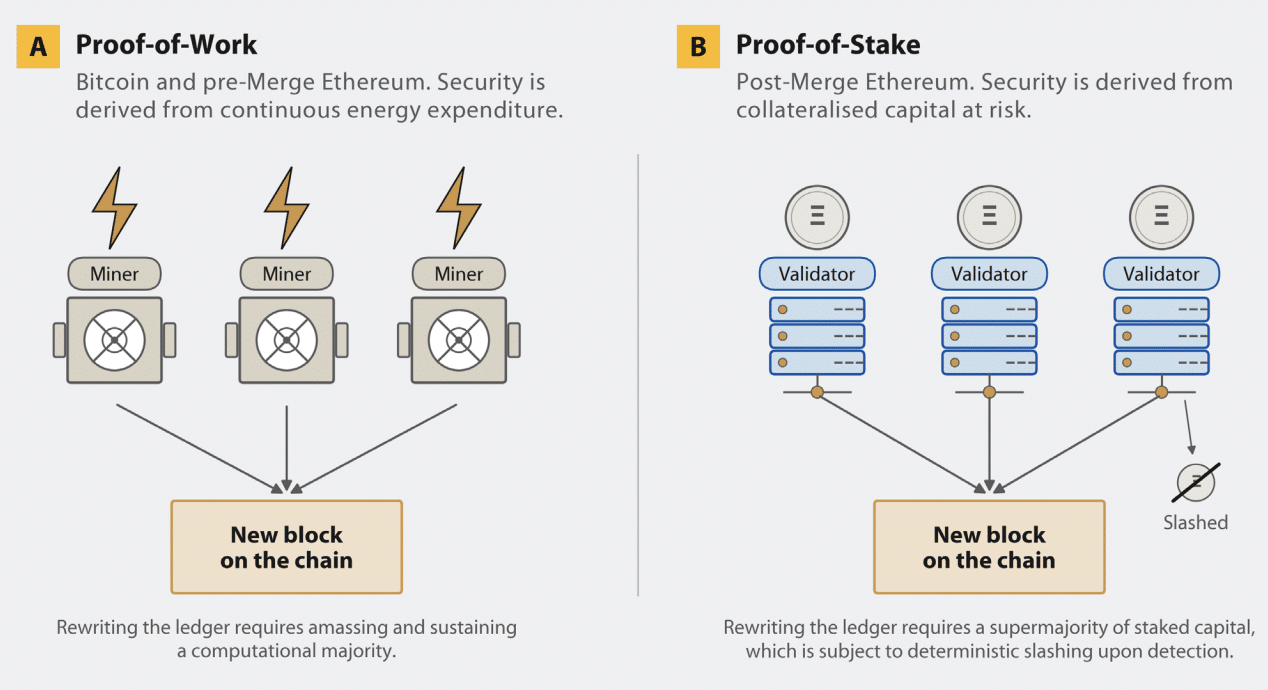
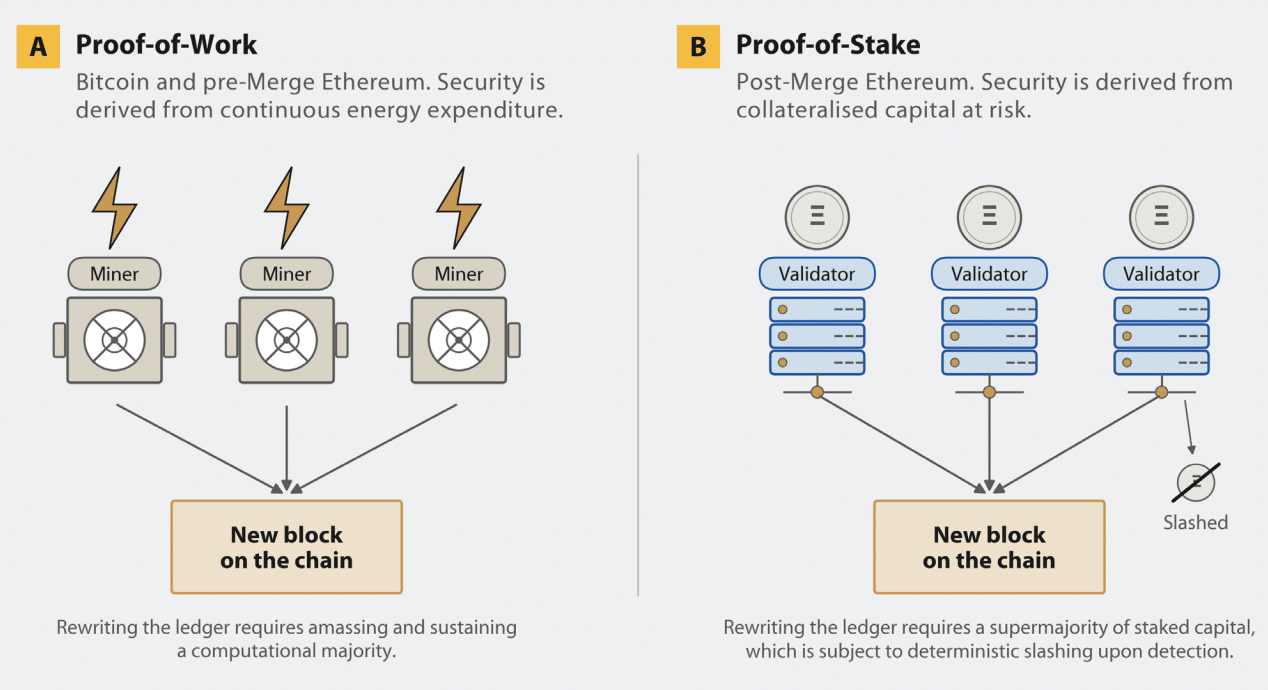
Ethereum has undergone significant change over time, particularly since The Merge.The upgrade replaced the energy-intensive Proof-of-Work (PoW) system with Proof-of-Stake (PoS).

With this change, Ethereum currently uses about 8,522 physical nodes, many of which house multiple validators, and nearly 894,000 validators.
Source: CCAF Report

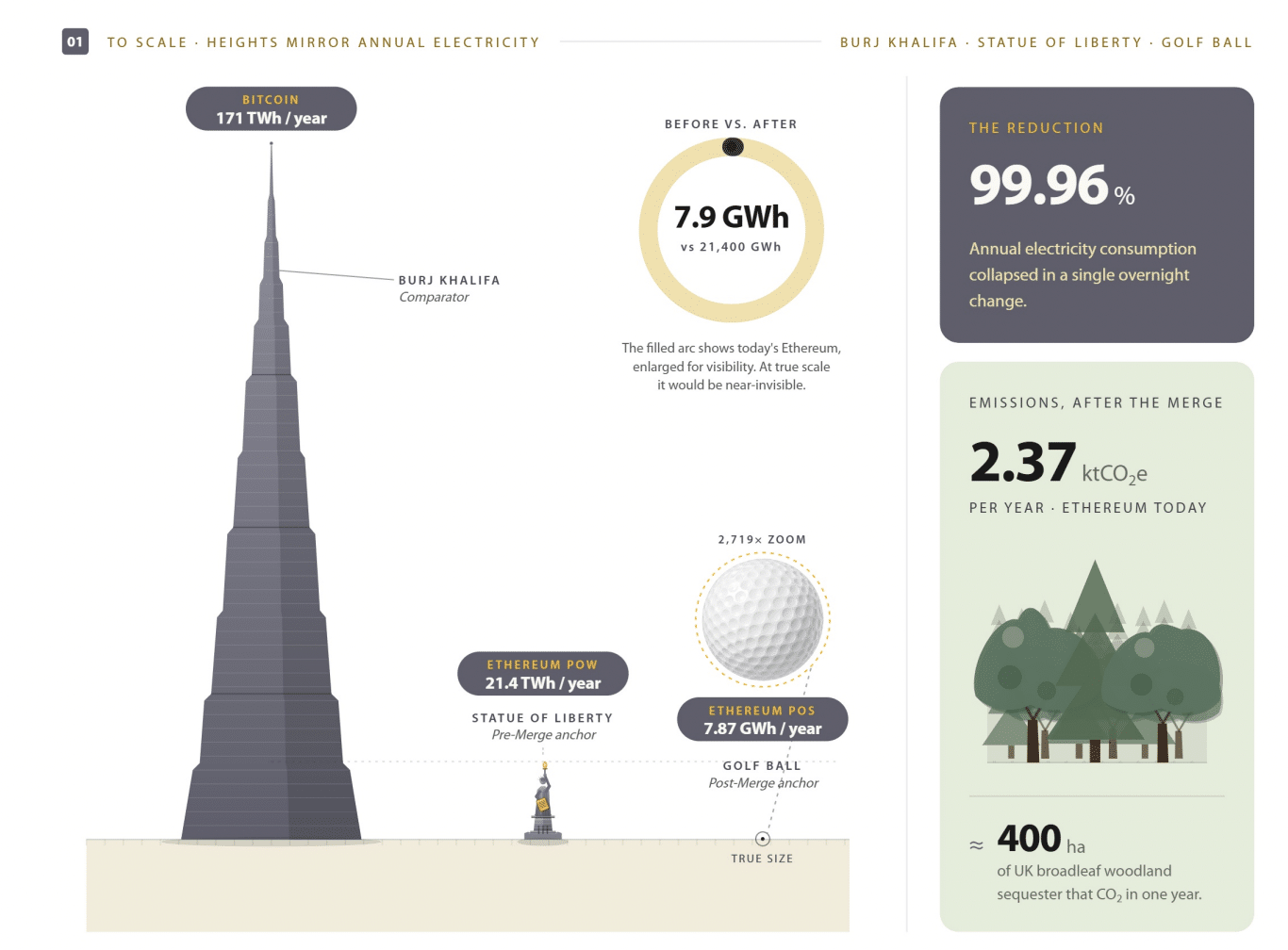
As a result, Ethereum now consumes only 7.87 GWh of electricity annually, or about 0.90 MW of continuous power. That is less than half the British Museum’s annual electricity consumption.

Before The Merge, the network required roughly 2.4 GW of continuous power.

Since then, Ethereum’s electricity consumption has fallen by more than 99.9%, marking one of the largest energy reductions by a major blockchain.

Is Ethereum truly decentralized?

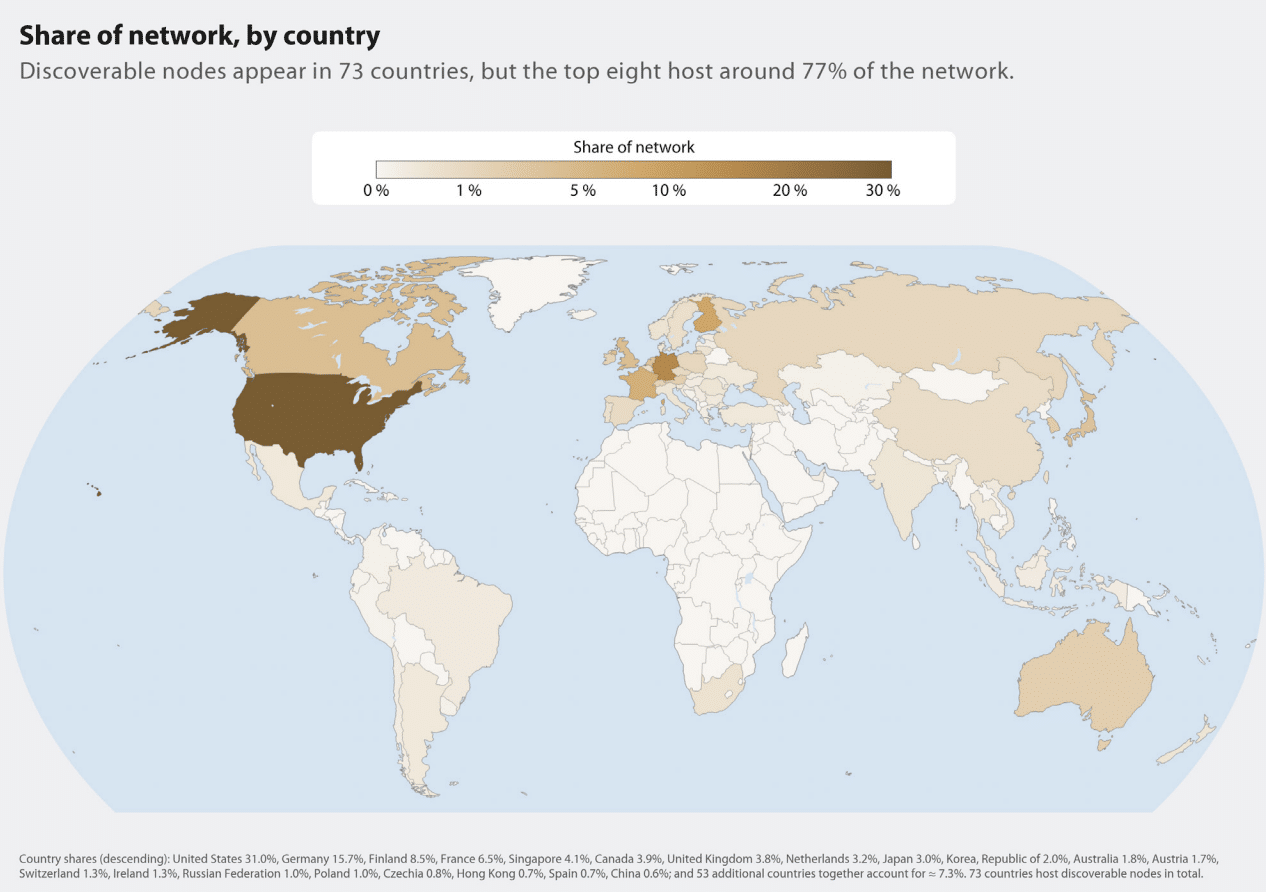
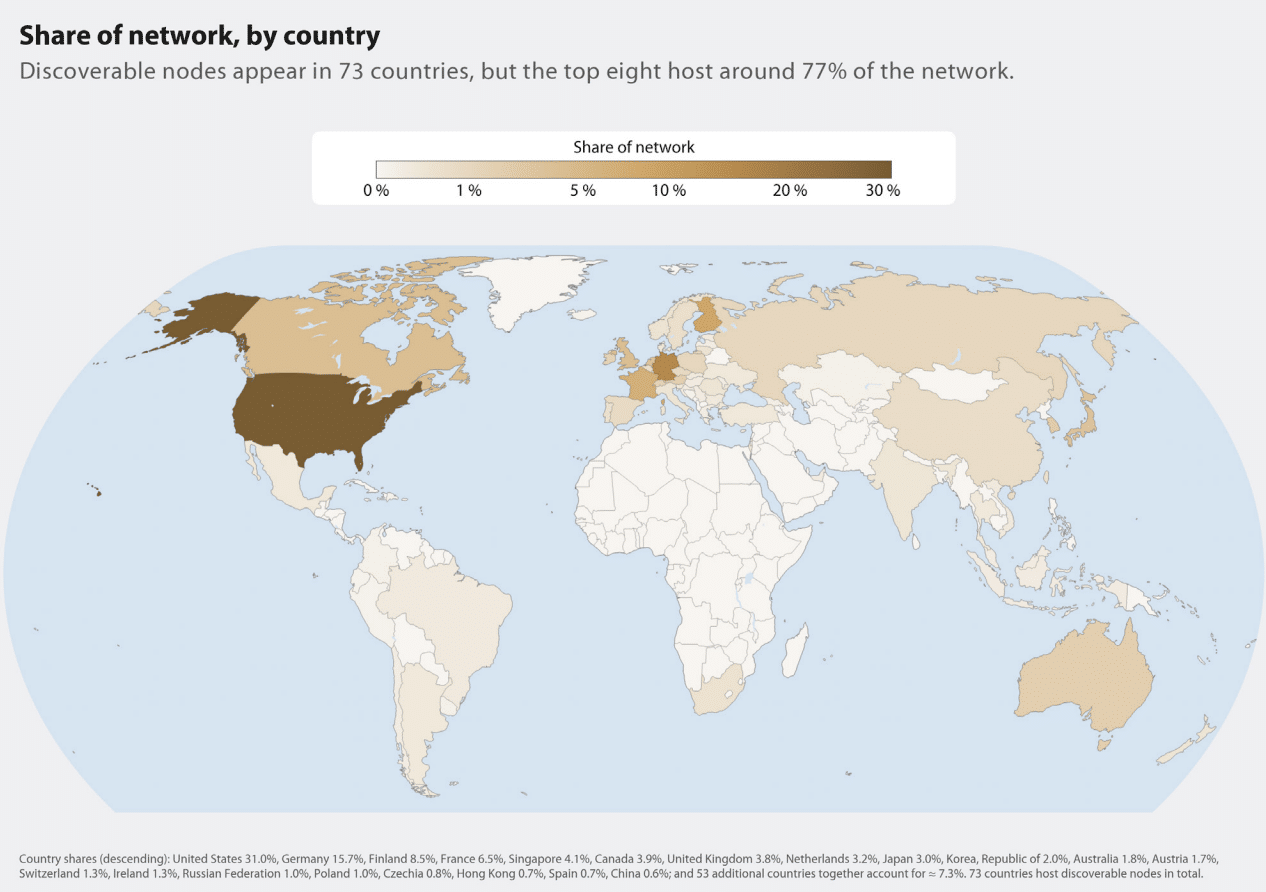
Additionally, the Cambridge Centre for Alternative Finance (CCAF) report highlighted that Ethereum’s infrastructure is decentralized despite being geographically concentrated. Of all nodes, roughly 62% are hosted by the United States (31%), Germany (16%), Finland (8%), and France (6%).
Source: CCAF Report

Another significant discovery is that 56.4% of the electricity used to power Ethereum originates from sustainable sources, such as 17% nuclear energy and 39.4% renewable energy.

Given the electricity mix of the main host nations, natural gas continues to be the largest fossil fuel source at 27.7%. The fact that Ethereum’s sustainable energy share is higher overall than the global average of about 43% shows how much the network depends on cleaner electrical grids.

What does Ethereum’s carbon footprint mean for the network?

At the same time, Ethereum’s carbon footprint has dramatically decreased in tandem with its dramatic decrease in electricity consumption. As per the report, the network has reduced its emissions by 99.98% from its final Proof-of-Work era to an estimated 2.37 kilotonnes of CO2 equivalent (ktCO2e) per year.
Source: CCAF Report

To put this into perspective, Ethereum’s yearly emissions are equivalent to the carbon footprint of roughly 900 households in the UK.

Interestingly, future developments, like stateless verification, may further minimize the need for energy and hardware, reducing Ethereum’s carbon footprint while maintaining its decentralization and security.

What’s ahead?

This further coincided with Ethereum’s development that has entered a new phase as researchers unveiled “Lean Ethereum,” a multi-year overhaul aimed at the network’s long-term evolution. The plan intends to replace the Ethereum protocol’s cores over a period of roughly three to four years, as opposed to a single upgrade.

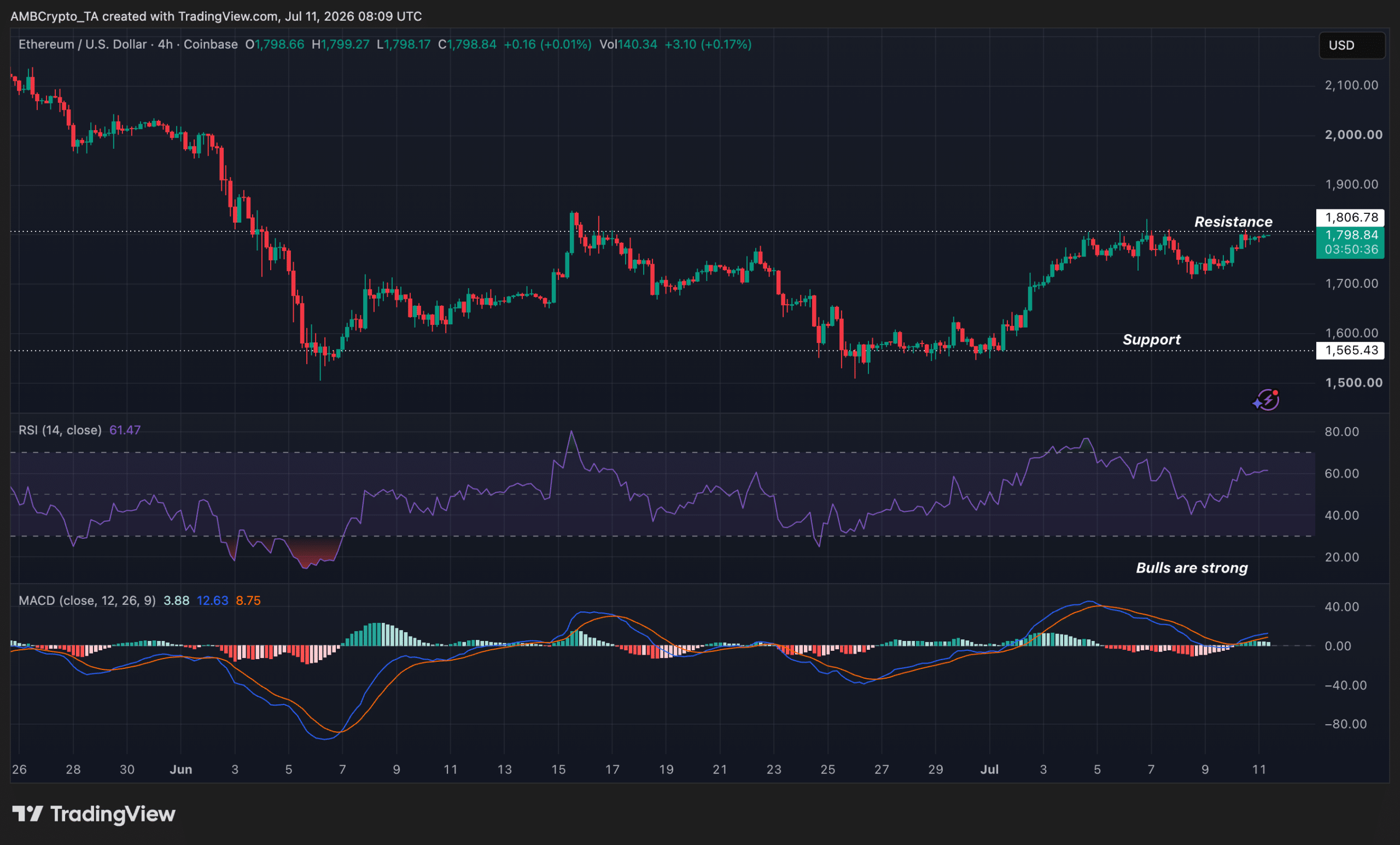
While these developments were happening, Ethereum’s price surged by 1.42% in the previous day and was now trading at $1,798.71 at press time. The MACD and RSI indicators also showed that bulls are more aggressive than they were previously. However, ETH needs to surpass the $1.8k mark in order for the bulls to continue.
Source: Trading View

Final Summary

  • Ethereum roughly has 62% of all nodes hosted by the United States, followed by Germany, Finland, and France.
  • The network has reduced its emissions to an estimated 2.37 kilotonnes of CO2 equivalent (ktCO2e) per year.


Trending Cryptos

Related Questions

QWhat major change significantly reduced Ethereum's energy consumption?

AThe Merge, which replaced the energy-intensive Proof-of-Work (PoW) system with the Proof-of-Stake (PoS) system.

QBy what percentage has Ethereum's electricity consumption decreased since The Merge?

ABy more than 99.9%.

QHow much electricity does Ethereum consume annually after The Merge, and how does it compare to the British Museum?

AEthereum now consumes 7.87 GWh of electricity annually, which is less than half of the British Museum's annual electricity consumption.

QAccording to the CCAF report, what percentage of Ethereum's electricity comes from sustainable sources?

A56.4%, with 17% from nuclear energy and 39.4% from renewable energy.

QWhat is Ethereum's estimated annual carbon footprint in CO2 equivalent after The Merge?

AAn estimated 2.37 kilotonnes of CO2 equivalent (ktCO2e) per year, a reduction of 99.98% from its final Proof-of-Work era.

Related Reads

In Jinjiang, Fujian, a Storage Super Unicorn Lies Quiet

In Fujian's Jinjiang, a city known for sportswear, lies a quiet semiconductor giant: Fujian Jinhua Integrated Circuit Co. (JHICC). Once a promising domestic DRAM manufacturer alongside Yangtze Memory and ChangXin Memory Technologies (CXMT), its journey was derailed in 2018 when the U.S. placed it on an Entity List and filed criminal charges for alleged trade secret theft. This halted production for years. A turning point came in February 2024 when a U.S. federal court found JHICC not guilty. However, it had lost crucial time. While CXMT soared to become a top-valued A-share company in 2024, JHICC, with an estimated valuation of 80 billion RMB, was just restarting. Its current output is primarily customized DDR4 chips, not the advanced DDR5/HBM demanded for AI, but it still benefits from the broader memory chip upcycle. JHICC's story is tied to Chen Zhengkun, a veteran engineer who left Micron to lead the venture. Founded in 2016 with state-backed funding, JHICC partnered with Taiwan's UMC to develop DRAM technology. Rapid progress was cut short by the U.S. actions, which Micron initiated, partly due to its heavy reliance on the Chinese market. Post-sanctions, Chen's team worked to rebuild the production line with reduced reliance on U.S. technology. According to its records, JHICC achieved small-scale production and revenue growth under immense pressure. It now focuses on the stable "niche" DRAM market (e.g., TVs, routers) with a monthly capacity of ~40,000 wafers, aiming for 60,000 by 2026. It holds over 1,000 patents but remains on the Entity List. For Jinjiang, investing in JHICC was a bold industrial leap. The local government provided unwavering financial and logistical support during the crisis, helping the company survive. JHICC has become the anchor for a growing local semiconductor cluster. Though its scale lags behind domestic peers, JHICC's persistence symbolizes a hard-won foothold in a global market long dominated by Samsung, SK Hynix, and Micron. Having missed one boom, it seeks a place in the new AI-driven memory supercycle.

marsbit2h ago

In Jinjiang, Fujian, a Storage Super Unicorn Lies Quiet

marsbit2h ago

Trading

Spot

Hot Articles

Discussions

Welcome to the HTX Community. Here, you can stay informed about the latest platform developments and gain access to professional market insights. Users' opinions on the price of ETH (ETH) are presented below.

活动图片














