Ethereum Unveils Post-Quantum Security Roadmap For Institutions

bitcoinistPublished on 2026-03-24Last updated on 2026-03-24

Abstract

Ethereum has publicly formalized its post-quantum security roadmap, targeting a critical threat to its cryptographic foundations. Presented at the Institutional Ethereum Forum, researcher Will Corcoran outlined the risks quantum computers pose to elliptic-curve cryptography, which secures validator attestations, transactions, and wallet signatures. The core challenge is not just replacing signatures but managing the trade-offs: the proposed hash-based scheme, LeanSig, is significantly larger than current BLS signatures, threatening bandwidth and decentralization if naively implemented. Ethereum's solution pairs LeanSig with a STARK-based aggregation engine called Lean Multisig to compress signature data, making it viable. With a cryptographically relevant quantum computer estimated by 2032, Ethereum is targeting key upgrades for its 2029 hard fork. The effort, involving extensive research and testing, is positioned to set a new industry standard for all proof-of-stake blockchains facing this unavoidable scaling problem.

Ethereum is beginning to formalize its post-quantum security push in public. ETH Foundation researcher Will Corcoran used a presentation at the Institutional Ethereum Forum in New York to lay out both the threat model and the protocol work already underway. The effort matters well beyond ETH, he argued, because the core bottleneck is not unique to one chain: every proof-of-stake network built on today’s cryptographic assumptions will eventually face the same scaling problem.

Alongside the talk, the Ethereum Foundation launched pq.ethereum.org, a new portal that packages the project’s roadmap, technical resources, FAQs for institutions, and a registration form for a post-quantum retreat in Cambridge in October 2026. Corcoran framed the site as a way to consolidate years of research and answer what he described as growing inbound interest from institutions asking how Ethereum plans to prepare for a future in which quantum computers can break elliptic-curve cryptography.

Ethereum Eyes Post-Quantum Industry Standard

That future is still projected to be years away, but Corcoran said Ethereum is already working against a tight window. He pointed to current estimates for “Q-Day”: the arrival of a cryptographically relevant quantum computer, clustering around 2032, while the current roadmap targets key post-quantum components for the protocol’s “L” or “M” fork, roughly around 2029.

The presentation’s core argument was that post-quantum security cannot be reduced to a simple signature swap. Ethereum today relies on elliptic-curve cryptography across the stack: validator attestations at the consensus layer, blob proof data at the data layer, and transaction and wallet signatures at the execution layer. If that cryptography is broken, large parts of the network’s security model break with it.

But replacing it introduces a second-order problem. Ethereum’s current BLS signatures are compact and aggregate extremely efficiently: 10,000 signatures still compress to 96 bytes. The proposed post-quantum replacement, a hash-based scheme Corcoran called Lean Sig, is around 3,000 bytes per signature, and naively aggregating them would produce roughly 30 megabytes of data per slot.

That tradeoff is not merely an engineering inconvenience. Corcoran repeatedly tied it back to Ethereum’s decentralization constraint, arguing that bigger signatures would raise bandwidth requirements, reduce the number of viable home validators, and weaken the chain’s security properties. In his telling, the entire design challenge is downstream from that point.

“So making Ethereum post quantum secure isn’t just as simple as swapping out the signature schemes because that one change cascades through everything else,” he said. “Bigger signatures would result in more bandwidth that would result in fewer home validators, less decentralization, and weaker security guarantees. So that one change cascades through everything.”

Ethereum’s proposed answer is a pairing of LeanSig with a proving system called Lean Multisig, which Corcoran described as a STARK-based aggregation engine. Instead of forwarding all of the signatures directly, the system aims to prove that they were verified correctly and compress the output to around 125 kilobytes. He called that roughly 250x compression “the moon math” that makes post-quantum consensus viable on Ethereum.

Corcoran also used the talk to stress that this is no longer a purely theoretical research thread. He said Ethereum is already running devnets with 10 client teams, has shipped four devnets so far, and is building around three-slot finality and four-second slots as a design basis. The broader effort, he added, spans more than eight years of research, about $25 million in funding, and roughly 1,500 contributors across more than 250 organizations and teams.

For Ethereum, the immediate message is that post-quantum readiness is becoming a visible part of its long-range protocol agenda. For the rest of crypto, Corcoran’s claim was broader.

“Really, every proof of stake blockchain faces the same challenge, and that challenge is the ability to aggregate at scale hash based signatures. It’s nonnegotiable,” he said. “When we succeed in shipping LeanSig and LeanMultisig and Lean consensus, we think that this could really become the de facto industry standard.”

At press time, ETH traded at $2,154.
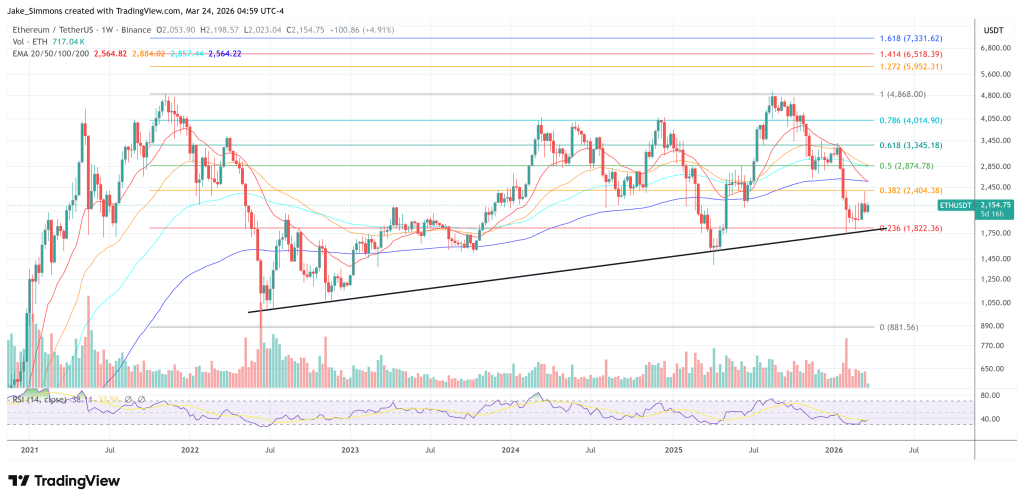
ETH must break above the 0.382 Fib, 1-week chart | Source: ETHUSDT on TradingView.com

Trending Cryptos

Related Questions

QWhat is the main purpose of Ethereum's new portal pq.ethereum.org?

AThe portal pq.ethereum.org packages the project's post-quantum roadmap, technical resources, FAQs for institutions, and a registration form for a post-quantum retreat in Cambridge in October 2026. It serves to consolidate years of research and address growing institutional interest in Ethereum's quantum preparedness.

QWhy can't Ethereum simply swap its current BLS signatures with a post-quantum alternative?

AA simple signature swap is insufficient because the proposed post-quantum replacement, LeanSig, is significantly larger (around 3,000 bytes per signature vs. BLS's 96 bytes for 10,000 signatures). This size increase would drastically raise bandwidth requirements, reduce the number of viable home validators, and weaken the network's decentralization and security.

QWhat is the estimated timeline for 'Q-Day' and how does it relate to Ethereum's development schedule?

ACurrent estimates for 'Q-Day' (the arrival of a cryptographically relevant quantum computer) cluster around 2032. Ethereum's roadmap targets key post-quantum components for its 'L' or 'M' fork, which is roughly scheduled for around 2029.

QWhat two technologies form the core of Ethereum's proposed post-quantum solution?

AThe core technologies are LeanSig, a hash-based signature scheme, and Lean Multisig, a STARK-based aggregation engine that compresses the verification of multiple signatures to around 125 kilobytes, achieving roughly 250x compression.

QAccording to the researcher, why is Ethereum's post-quantum challenge relevant to the broader crypto industry?

AThe researcher argues that every proof-of-stake blockchain faces the same fundamental challenge: the need to aggregate hash-based signatures at scale. He believes that if Ethereum succeeds with its LeanSig and LeanMultisig solution, it could become the de facto industry standard for post-quantum security.

Related Reads

The Verdict in Choi Tae-won's Divorce Case: Revealing the Inheritance Undercurrent Behind SK Hynix's Trillion-Won Empire

SK Group Chairman Chey Tae-won's high-profile divorce case, involving a record 1.38 trillion won settlement, has drawn attention to the succession plans for Korea's second-largest conglomerate, especially its crown jewel, SK hynix. Unlike traditional chaebol scripts centered on the eldest son, Chey's three children from his marriage to former President Roh Tae-woo's daughter, Roh Soh-yeong, are carving distinct, non-traditional paths. Eldest daughter Chey Yun-jung (b. 1989) is seen as the most evident successor. With a scientific and consulting background, she holds executive roles at SK bioscience and SK Inc.'s growth support department, focusing on future strategy and biopharma. Her marriage is to an AI infrastructure entrepreneur, not a traditional business alliance. Second daughter Chey Min-jung (b. 1991) took a unique route, voluntarily serving as a South Korean naval officer, including an anti-piracy deployment. She later worked on policy and strategy for SK hynix in Washington D.C. before co-founding an AI-driven healthcare startup. She married a former U.S. Marine Corps officer, connecting her to U.S. defense and policy circles—networks crucial for a global semiconductor giant. The only son, Chey In-geun (b. 1995), who studied physics like his father, worked briefly at SK E&S before joining McKinsey. Despite fitting the traditional "heir" profile as the eldest son, he remains silent and holds no public position or shares in SK, suggesting the old succession playbook is obsolete. As SK hynix's valuation soars, becoming a geopolitical asset in the AI era, the heirs' legitimacy is no longer automatic. They must prove themselves in fields like AI biotech, global policy, and strategic consulting. Their marriages also reflect new elite networks in tech and defense, not old political alliances. Their inheritance is the complex challenge of navigating a globalized, tech-driven world, not just a corporate throne.

marsbit16h ago

The Verdict in Choi Tae-won's Divorce Case: Revealing the Inheritance Undercurrent Behind SK Hynix's Trillion-Won Empire

marsbit16h ago

From OpenSea to OpenRouter: Is Alex Atallah Repeating His 'Exit at the Peak' Playbook?

From OpenSea to OpenRouter: Is Alex Atallah Repeating His "Exit at the Peak" Playbook? According to the Wall Street Journal, payments giant Stripe is in talks to acquire the AI model aggregation platform OpenRouter in a potential deal valuing the company near $100 billion. This would mark founder Alex Atallah's second creation of a company reaching a $100 billion valuation, following his co-founding of NFT marketplace OpenSea. OpenRouter, founded just over three years ago, has grown rapidly by acting as a unified gateway for developers to access over 400 AI models. It currently has about 10 million users and processes over 200 trillion tokens monthly. While the platform's annualized revenue is around $50 million, its valuation has skyrocketed from $1.3 billion in March 2026. The potential acquisition by Stripe, a company OpenRouter's founder once likened it to, represents a major expansion into AI infrastructure for the payments leader. This move echoes Atallah's previous timing with OpenSea, where he departed before the NFT market's significant downturn. For OpenRouter, selling now may be strategic. Despite its scale, its business model—charging a 5-5.5% fee on AI inference calls—faces pressure from competition, open-source models, and potential price wars among model providers, limiting its profitability narrative for an IPO. A key asset for potential acquirers like Stripe is OpenRouter's vast repository of real-world AI usage data, which offers unique insights into model performance and developer preferences that are difficult to replicate. Whether this potential deal signifies a new valuation benchmark for AI infrastructure or another market peak signal remains to be seen.

链捕手16h ago

From OpenSea to OpenRouter: Is Alex Atallah Repeating His 'Exit at the Peak' Playbook?

链捕手16h ago

Trading

Spot

Hot Articles

Discussions

Welcome to the HTX Community. Here, you can stay informed about the latest platform developments and gain access to professional market insights. Users' opinions on the price of ETH (ETH) are presented below.

活动图片
















