Ethereum Topples Bitcoin By 3x In Major Metric, But Can Price Still Reclaim $5,000?

bitcoinistPublished on 2026-03-14Last updated on 2026-03-14

Abstract

Ethereum has surpassed Bitcoin by more than three times in a key adoption metric, with over 182.7 million non-empty wallets compared to Bitcoin's 58.5 million. This significant growth in ETH's user base, which has been expanding steadily since overtaking Bitcoin in 2019, suggests the market may be undervaluing the cryptocurrency. Despite this strong on-chain activity, ETH's price remains around $2,100, facing resistance near the $2,000-$2,100 range. Analysts point to Ethereum's Rainbow Chart, which indicates ETH is in a cheap zone similar to the period before its 2021 rally from $700 to $4,800. Key levels to watch are a break above $2,500, which could signal a move toward new highs, or a drop below $1,900, which would place it in a "steal" zone. At the time of writing, ETH is trading at $2,103.

Ethereum is holding a commanding lead over Bitcoin in an interesting adoption indicator, even as its price action continues to face pressure around $2,000 to $2,100. New on-chain data shows that ETH’s network user base has expanded massively over the past decade.

As it stands, Ethereum now has more than three times as many wallets with balances as Bitcoin, showing that the market might actually be underpricing the world’s second-largest cryptocurrency.

Ethereum’s Holder Base Goes Parabolic

On-chain analytics platform Santiment recently highlighted an interesting trend across the crypto market: Ethereum’s holder base has increased far more than that of any other major digital asset.

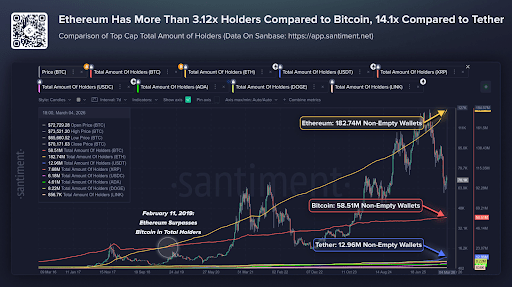
The data shows that ETH now has about 182.7 million non-empty wallets, compared with roughly 58.5 million for Bitcoin. That places ETH at more than 3.1 times the number of holders held by Bitcoin, and this gap has been widening steadily for years.

The turning point came in February 2019, when Ethereum first surpassed Bitcoin in the total number of addresses holding a balance. Since then, the divergence has increased, with ETH’s wallet growth curving upward while Bitcoin’s line has climbed at a much slower pace.
Source: Chart from Santiment on X

Tether, despite its ubiquity as the dominant stablecoin, holds just 12.96 million wallets, making Ethereum’s base more than 14 times larger. Interestingly, other notable altcoins also cannot keep up with ETH, where users are actively adding to positions. The number of non-empty wallets on the XRP Ledger sits at 7.68 million, Dogecoin at 8.22 million, and Cardano at 4.61 million. None comes close to Ethereum.

Price Lags Adoption, But The Rally To $5,000 Is Intact

The bullish case for ETH is easy to understand. A network with 182.74 million non-empty wallets has a much deeper base of users, and that kind of adoption can eventually feed into price. However, the disconnect between Ethereum’s on-chain strength and its current price around $2,000 is not lost on market participants.

For instance, crypto analyst Merlijn The Trader used the Ethereum Rainbow Chart to predict a notable rally for the leading altcoin. According to the analyst, the Rainbow Chart has entered its cheap zone for the first time since 2020, the same reading that preceded ETH’s run from $700 to $4,800 in 2021.

Right now, there are two important levels to watch for Ethereum. A move above $2,500 would unlock the next band on the chart, and this would open up the door to a slow distribution phase to new highs. On the other hand, a drop below $1,900 would push ETH into a steal zone based on the Rainbow model. At the time of writing, ETH is trading at $2,103, up by 2.9% in the past 24 hours.

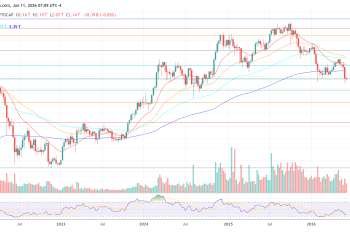
ETH trading at $2,102 on the 1D chart | Source: ETHUSDT on Tradingview.com

Trending Cryptos

Related Questions

QAccording to the on-chain data, how many times larger is Ethereum's number of non-empty wallets compared to Bitcoin's?

AEthereum's number of non-empty wallets is more than 3.1 times larger than Bitcoin's, with 182.7 million compared to roughly 58.5 million.

QWhat was the significant turning point in the comparison of wallet numbers between Ethereum and Bitcoin?

AThe turning point came in February 2019, when Ethereum first surpassed Bitcoin in the total number of addresses holding a balance.

QBased on the analyst's interpretation of the Ethereum Rainbow Chart, what was the price movement that followed the last time the chart entered its 'cheap zone'?

AThe last time the chart entered its 'cheap zone' was in 2020, which preceded ETH's run from $700 to $4,800 in 2021.

QWhat are the two critical price levels for Ethereum mentioned in the article that traders should watch?

AThe two critical levels are a move above $2,500, which would unlock the next band on the chart, and a drop below $1,900, which would push ETH into a 'steal zone'.

QHow does the number of Tether (USDT) wallets compare to the number of Ethereum wallets?

AEthereum's base of non-empty wallets is more than 14 times larger than Tether's, which has just 12.96 million wallets.

Related Reads

Can Generative Models Finally Be Trained End-to-End? The Core Is a For Loop

This article introduces a novel training paradigm for generative models called Explorative Modeling (XM), which enables true end-to-end training. Traditionally, powerful generative models like autoregressive and diffusion models are not trained end-to-end. They are trained to predict a single small step but require iterative multi-step sampling for inference. This "exposure bias" leads to error accumulation and limits performance. The core challenge XM addresses is "mode blurring." In generative tasks, a single input (e.g., "generate a dog") corresponds to many valid outputs (multiple modes). Standard training objectives like reconstruction loss force the model to average these modes, producing unrealistic, blurry outputs. To avoid this, existing models break generation into many small, almost deterministic steps, sacrificing end-to-end training. XM tackles this by restructuring the training loop itself. Its key insight is to amplify "generative expressivity." For each training input, instead of generating one sample, the model generates K candidate outputs. Only the candidate closest to the real data is used for computing the loss and updating the model via backpropagation. This simple "best-of-K" mechanism is implemented as a short for-loop. By exploring multiple possibilities, the model learns to distribute its guesses across different modes rather than collapsing to their uninformative average. The paper demonstrates that "exploration" acts as a new, powerful scaling axis. Gains from XM increase with model size, data scale, and compute. Experiments show improvements in FID scores for image generation and significant efficiency gains, sometimes outperforming larger models without exploration. When pushed to the limit, XM enables fully single-step, end-to-end generative models. In robotics tasks, an "Explorative Policy" matched the performance of a 100-step Diffusion Policy with a single forward pass, drastically improving inference speed. While the best-of-K concept is not entirely new, the authors' contribution lies in formally understanding it as a direct method to boost generative expressivity without fragmenting the generation process. This work suggests that as models scale, enhancing exploration during training may become crucial for overcoming fundamental performance bottlenecks.

marsbit29m ago

Can Generative Models Finally Be Trained End-to-End? The Core Is a For Loop

marsbit29m ago

Annual Salary of Millions Competing for Electricians, Meta Rushes to Open Its Own Technical School

The AI boom is facing an unexpected bottleneck: a severe shortage of skilled construction workers and electricians. As tech giants like Meta, OpenAI, and Alphabet race to build massive data centers—such as OpenAI's $16 billion "Stargate" project—they are hitting a critical labor wall. The U.S. needs an estimated 130,000 more electricians, 240,000 construction workers, and 150,000 supervisors by 2030 for AI infrastructure alone, but tens of thousands of electrician jobs go unfilled each year. While AI companies offer high premiums, with electricians earning up to $280,000 annually, worker scarcity still causes massive losses—delays on a single project can cost $14.2 million per month. The complexity of building AI data centers, which require immense power (equivalent to powering hundreds of thousands of homes), sophisticated electrical systems, and advanced liquid cooling solutions, demands highly skilled technicians who are in short supply. To combat this, companies are investing heavily in training. Meta has committed $115 million to a free training school offering tuition, housing, and stipends, targeting 5,000 new workers. OpenAI is partnering with unions to secure skilled labor. These efforts are paying off, with a significant rise in Gen Z interest in trade schools over college. However, the power demands are staggering. AI data centers are driving a rapid surge in electricity consumption, projected to account for up to 12% of U.S. power use by 2028 and raising costs for consumers. Furthermore, the construction boom is project-based, leading to a potential future glut of trained workers once building peaks, which could depress wages industry-wide. The race for AI supremacy now depends as much on skilled hands as on advanced chips.

marsbit2h ago

Annual Salary of Millions Competing for Electricians, Meta Rushes to Open Its Own Technical School

marsbit2h ago

Trading

Spot

Hot Articles

Discussions

Welcome to the HTX Community. Here, you can stay informed about the latest platform developments and gain access to professional market insights. Users' opinions on the price of ETH (ETH) are presented below.

活动图片