Ethereum Topples Bitcoin By 3x In Major Metric, But Can Price Still Reclaim $5,000?

bitcoinistPublished on 2026-03-14Last updated on 2026-03-14

Abstract

Ethereum has surpassed Bitcoin by more than three times in a key adoption metric, with over 182.7 million non-empty wallets compared to Bitcoin's 58.5 million. This significant growth in ETH's user base, which has been expanding steadily since overtaking Bitcoin in 2019, suggests the market may be undervaluing the cryptocurrency. Despite this strong on-chain activity, ETH's price remains around $2,100, facing resistance near the $2,000-$2,100 range. Analysts point to Ethereum's Rainbow Chart, which indicates ETH is in a cheap zone similar to the period before its 2021 rally from $700 to $4,800. Key levels to watch are a break above $2,500, which could signal a move toward new highs, or a drop below $1,900, which would place it in a "steal" zone. At the time of writing, ETH is trading at $2,103.

Ethereum is holding a commanding lead over Bitcoin in an interesting adoption indicator, even as its price action continues to face pressure around $2,000 to $2,100. New on-chain data shows that ETH’s network user base has expanded massively over the past decade.

As it stands, Ethereum now has more than three times as many wallets with balances as Bitcoin, showing that the market might actually be underpricing the world’s second-largest cryptocurrency.

Ethereum’s Holder Base Goes Parabolic

On-chain analytics platform Santiment recently highlighted an interesting trend across the crypto market: Ethereum’s holder base has increased far more than that of any other major digital asset.

The data shows that ETH now has about 182.7 million non-empty wallets, compared with roughly 58.5 million for Bitcoin. That places ETH at more than 3.1 times the number of holders held by Bitcoin, and this gap has been widening steadily for years.

The turning point came in February 2019, when Ethereum first surpassed Bitcoin in the total number of addresses holding a balance. Since then, the divergence has increased, with ETH’s wallet growth curving upward while Bitcoin’s line has climbed at a much slower pace.
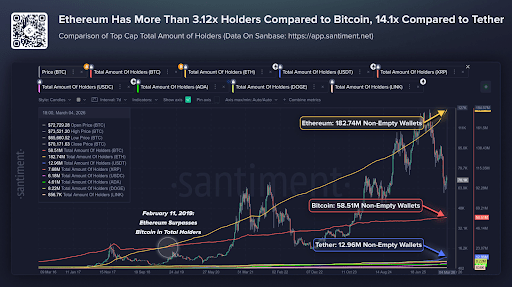
Source: Chart from Santiment on X

Tether, despite its ubiquity as the dominant stablecoin, holds just 12.96 million wallets, making Ethereum’s base more than 14 times larger. Interestingly, other notable altcoins also cannot keep up with ETH, where users are actively adding to positions. The number of non-empty wallets on the XRP Ledger sits at 7.68 million, Dogecoin at 8.22 million, and Cardano at 4.61 million. None comes close to Ethereum.

Price Lags Adoption, But The Rally To $5,000 Is Intact

The bullish case for ETH is easy to understand. A network with 182.74 million non-empty wallets has a much deeper base of users, and that kind of adoption can eventually feed into price. However, the disconnect between Ethereum’s on-chain strength and its current price around $2,000 is not lost on market participants.

For instance, crypto analyst Merlijn The Trader used the Ethereum Rainbow Chart to predict a notable rally for the leading altcoin. According to the analyst, the Rainbow Chart has entered its cheap zone for the first time since 2020, the same reading that preceded ETH’s run from $700 to $4,800 in 2021.

Right now, there are two important levels to watch for Ethereum. A move above $2,500 would unlock the next band on the chart, and this would open up the door to a slow distribution phase to new highs. On the other hand, a drop below $1,900 would push ETH into a steal zone based on the Rainbow model. At the time of writing, ETH is trading at $2,103, up by 2.9% in the past 24 hours.

ETH trading at $2,102 on the 1D chart | Source: ETHUSDT on Tradingview.com

Trending Cryptos

Related Questions

QAccording to the on-chain data, how many times larger is Ethereum's number of non-empty wallets compared to Bitcoin's?

AEthereum's number of non-empty wallets is more than 3.1 times larger than Bitcoin's, with 182.7 million compared to roughly 58.5 million.

QWhat was the significant turning point in the comparison of wallet numbers between Ethereum and Bitcoin?

AThe turning point came in February 2019, when Ethereum first surpassed Bitcoin in the total number of addresses holding a balance.

QBased on the analyst's interpretation of the Ethereum Rainbow Chart, what was the price movement that followed the last time the chart entered its 'cheap zone'?

AThe last time the chart entered its 'cheap zone' was in 2020, which preceded ETH's run from $700 to $4,800 in 2021.

QWhat are the two critical price levels for Ethereum mentioned in the article that traders should watch?

AThe two critical levels are a move above $2,500, which would unlock the next band on the chart, and a drop below $1,900, which would push ETH into a 'steal zone'.

QHow does the number of Tether (USDT) wallets compare to the number of Ethereum wallets?

AEthereum's base of non-empty wallets is more than 14 times larger than Tether's, which has just 12.96 million wallets.

Related Reads

Bitcoin Withdrawals Continue: 8 Years of Storage in a Coldcard Cold Wallet Ended in Zero

Coldcard Hardware Wallet Hacked: Losses Mount Due to Vulnerable Seed Generation A critical vulnerability in Coldcard hardware wallets has led to a continued wave of fund thefts. According to Galaxy Research, the total stolen has reached 1,367.05 BTC (approx. $88.6 million) from 4,585 addresses, a significant increase from the initial 594.5 BTC reported on July 30, 2026. Most of the stolen funds remain on the attackers' addresses. The issue is not with the current firmware, which Coinkite has updated, but with seed phrases generated on vulnerable devices between March 2021 and the release of fixed firmware versions. Due to a programmer error, devices switched from using a hardware random number generator to the software-based Yasmarang generator, which was initialized with publicly accessible data like the chip's serial number. This made the seed phrases predictable through offline brute-force attacks, meaning wallets remain at risk until funds are moved to a new wallet generated with the patched firmware. Affected devices include Mk2/Mk3 with firmware 4.0.1–4.1.9 (and up to 5.0.3), Mk4/Mk5 up to version 5.6.0, and Q models up to 1.5.0Q. The only exceptions are seeds created with a high-entropy method like at least 50 independent dice rolls or a strong unique BIP-39 passphrase. All other owners must generate a new seed on the fixed firmware and transfer their assets. A case highlighting the human impact involves a 39-year-old long-term investor who lost 2 BTC (approx. $130,000) in minutes. He had accumulated the Bitcoin over eight years through physical labor, viewing it as a financial lifeline and a retirement plan in a country suffering from hyperinflation. His story underscores that even conservative "buy and hold in cold storage" strategies can be compromised by such underlying technical flaws. From a technical perspective, this incident echoes historical failures where weak random number generators undermined cryptographic security, challenging the assumption that offline storage is automatically foolproof.

cryptonews.ru1h ago

Bitcoin Withdrawals Continue: 8 Years of Storage in a Coldcard Cold Wallet Ended in Zero

cryptonews.ru1h ago

Trading

Spot

Hot Articles

Discussions

Welcome to the HTX Community. Here, you can stay informed about the latest platform developments and gain access to professional market insights. Users' opinions on the price of ETH (ETH) are presented below.

活动图片















